Words for a hundred and related things in Celtic languages:
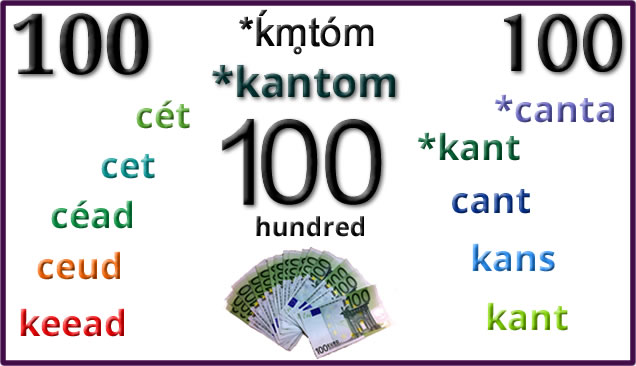
| Proto-Celtic | *kantom = hundred *kantometos = hundredth |
|---|---|
| Gaulish | *canta = hundred |
| Old Irish (Goídelc) | cét [kʲeːd] = hundred, a hundred people/warriors, troops, battalions cétmad [ˈkʲeːdṽað] = hundredth |
| Middle Irish (Gaoidhealg) | ced, céit, cét = hundred, a hundred people/warriors, troops, battalions cétach, cetach = hundredfold, possossing a hundred cétmad = hundredth |
| Irish (Gaeilge) | céad [ciːa̯d̪ˠ/ceːd̪ˠ] = hundred, century, hundredweight, great, long céadach = hundredfold, great, immense céadú = hundredth céadchosach = centipede céad míle fáilte = a hundred thousand welcomes |
| Scottish Gaelic (Gàidhlig) | ceud [kʲiəd] = hundred ceudamh [kʲiadəv] (100ᵐʰ) = hundredth 100ᵗʰ) ceudad [kʲiədəd] = percent, percentage ceud mìle fàilte = a hundred thousand welcomes ceudameatair = centimetre ceudamhail [kʲiədəval] = percentile ceud-chasach = centipede ceudach [kʲiədəx] = hundredfold |
| Manx (Gaelg) | keead [kiːəd] = hundred, century keeadoo = hundredth keead blein = centenary keead filley = hundredfold keead liauyr/mooar = long hundred keead-choshagh = centipede |
| Proto-Brythonic | *kant [kant] = hundred |
| Old Welsh | cant = hundred |
| Middle Welsh (Kymraec) | cant, can = hundred canvet, canuet, kannvet, canved = hundredth cantref, cantrew, cantreuyt = hundred, cantred, province, district |
| Welsh (Cymraeg) | cant, can [kant/kan] = hundred, a host, hundredweight, percentage; century canfed (100fed) = hundredth (100th), centesimal, century canrif = century cantref = hundred, cantred, province, district cantro = a hundred times, many times, twisted many times cantroed = centipede, a hundred feet cantwll = a hundred holes, riddled with holes hanner cant = fifty cant a mil = a hundred and one, a large number can diolch = many thanks |
| Middle Cornish (Cernewec) | cans = hundred canquyth, canswyth = a hundred times |
| Cornish (Kernewek) | kans = hundred kansves = hundredth kansbledhen = century kanskradh = centigrade kanskweyth = a hundred times kansplek = hundredfold kansran = percent(age) |
| Old Breton | cant = hundred |
| Middle Breton (Brezonec) | cant, cantt, can, chant = hundred, 100 pounds (lb) canuet, cantvet, cantved = hundredth cantved = century candad, cantad = around hundred cant(-)doubl = centuple cantenier, candener, candenyer = centurion |
| Breton (Brezhoneg) | kant [kãn(t)] = hundred kantvet [ˈkãn.vet] = hundredth kantved [ˈkãn.vet] = century kantad [ˈkãn.tat] = around hundred |
Etymology: from Proto-Indo-European *ḱm̥tóm (hundred) [source].
Words from the same roots include hundred, century, centigrade, hecatontome (a very large number of books) and hecatologue (a code of 100 rules) in English, and words related to hundred in other Indo-European languages [source].
Sources: Wiktionary, Am Faclair Beag, Online Manx Dictionary, Teanglann.ie, eDIL – Electronic Dictionary of the Irish Language, In Dúil Bélrai English – Old Irish glossary, Geiriadur Prifysgol Cymru, Gerlyver Kernewek, Gerlyvyr Cernewec, Dictionaire Favereau, TermOfis, Le dictionnaire diachronique du breton, Geriafurch, English – ProtoCeltic WordList (PDF), Etymological Dictionary Of Proto Celtic