Fresh & New

Words for fresh and new in Celtic languages.
Words for new in Celtic languages

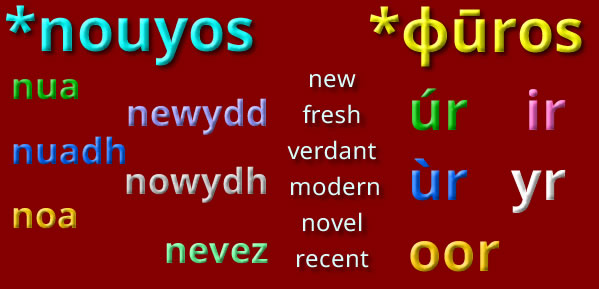
Proto-Celtic *ɸūros = new
Old Irish (Goídelc) úr = fresh, new
Middle Irish (Gaoidhealg) úr = fresh, new, bright, noble, generous, fair, active, recent
Irish (Gaeilge) úr [uːɾˠ] = fresh; free, liberal, moist
úrach = green timber
úraigh = to freshen, scour, cleanse, become moist, damp
úras = new milk
úrchneasach = fresh-complexioned
Scottish Gaelic (Gàidhlig) ùr [uːr] = new, fresh
ùrachadh = refreshing, renewing, renovating, renewal
ùr-ghnàthaich = innovative, innovatory
ùr-ghnàthaichear = innovator
ùrad = degree of newness, novelty
Manx (Gaelg) oor = new, sweet, novel, sappy, crisp, span, fresh, hour, raw
ooragh = hourly, refreshing
ooraghey = to freshen, purify, refresh, relieve, sweeten
ooraghtoil, oorey = refreshing
Welsh (Cymraeg) ir [iːr] = verdant, green, juicy, sappy, moist, succulent, not withered, not dried up or coagulated, fresh, undried; mild; alive, thriving, lively, vigorous; new, fresh, young, unripe
iraidd = fresh, verdant, green, juicy, sappy, moist, liquid
Cornish (Kernewek) yr [ɪ:r/iːr] = fresh

Etymology: from the Proto-Indo-European *puHrós (wheat), possibly from *pewH- (to be clean, pure) [Source].

Words from the same PIE roots include pure in English, პური (ṗuri – bread, wheat) in Georgian, and պուրի (puri – a type of bread) in Armenian [Source].

Proto-Celtic *nouyos = new
Gaulish *novios = (used in place names)
Celtiberian nouiza = new
Old Irish (Goídelc) núa [n͈uːa̯] = new
Middle Irish (Gaoidhealg) núa(e) = new, recent, fresh, lusty, vigorous, fair, clear, bright, lately, anew, again, recently
Irish (Gaeilge) nua [n̪ˠuə / n̪ˠuː] = new, fresh, recent, novel; newness, new thing
nua-aimseartha = modern
nuachan = novation
nuacht = news, novelty
nuachtóir = reporter, journalist
Scottish Gaelic (Gàidhlig) nuadh [nuəɣ] = new, fresh, recent, novel, modern, unfamiliar
a-nuadh = anew
nua-aimsireach = modern, up to date
nua-fhasanta = newfangled
nuadhachadh = renewing, renovating
nuadhachas = novelty, innovation
Manx (Gaelg) noa = fresh, modern, new, novel, original, recent, unused
noa-emshiragh = modern
noaght = freshness, modernity, newness, novelty
noaid = freshness, innovation, newness, novelty, originality
aanoaghey = to rejuvenate, renew, renovate
Proto-Brythonic *newɨð = new
Old Welsh neguid = new
Middle Welsh (Kymraec) newyt, newyd = new, recent, modern, late, novel
newydhau, newyddhau = to renew, renovate, restore
Welsh (Cymraeg) newydd [ˈnɛu̯.ɨ̞ð/ˈnɛu̯.ɪð] = new, recent, newly-grown, modern, late, novel, changed, different; new (moon), unused, fresh
newyddaf, newyddu = to renew, renovate, restore, be renewed or restored, replace, change, reform, modernize, innovate
newyddaidd = newish, new, modern, newfangled, fresh, renewed
newyddair = neologism, new word or spelling
newyddeb = novelty, innovation
newyddiadur = newspaper
newyddiadura = to be a journalist
newyddiadureg = jouralese, journalism
Middle Cornish (Cernewec) newydh, nowydh, nowedh = new, fresh, late, recent
Cornish nowydh = fresh, new, novel, newly, just
nowydh flamm = brand new
nowydh genys = newborn
Old Breton nouuid = new
Breton (Brezhoneg) nevez [ˈne.ve] = new
nevezadeg restoration campaign
nevezadenn = innovation
nevezadenniñ = to innovate
nevezadur = innovation, updating, actualisation
nevezer = innovator

Etymology: from the Proto-Indo-European *néw(y)os (new) [Source]. The town of Noia in A Coruña in Galicia in the northwest of Spain probably gets its new from the same Proto-Celtic root possibly via Celtiberian [Source].

Words marked with a * are reconstructions.

Sources: Wiktionary, Am Faclair Beag, Online Manx Dictionary, Teanglann.ie, eDIL – Electronic Dictionary of the Irish Language, In Dúil Bélrai English – Old Irish glossary, Geiriadur Prifysgol Cymru, Gerlyver Kernewek, Dictionaire Favereau, TermOfis, English – ProtoCeltic WordList (PDF), Etymological Dictionary Of Proto Celtic

The Fastest Way to Learn Japanese Guaranteed with JapanesePod101.com

Free

Words for free and related things in Celtic languages.

Freedom

Words marked with a * are reconstructions.

Proto-Celtic *su-wiros = free (“good man”)
Old Irish (Goídelc) saer [soːi̯r] = free, freeman, noble, craftsman
saeraid [ˈsoːi̯rɨðʲ] = to free, liberate, deliver, save, exempt
saire [ˈsai̯.rʲe] = freedom, liberty
Middle Irish saer, soer, sóer = free, freeman, noble, ready, skilled,
sáeraid = to free, liberate, save, rescue, deliver
saíre, sóire = freedom, liberty, nobility,
Irish (Gaeilge) saor [sˠeːɾˠ/sˠiːɾˠ] = free, enfranchised; noble; independent
saoradh = liberation, deliverance, release, acquittal, assurance, confirmation
saoráid = ease, facility, ease, freedom from constraint
saoráideach = easy, facile
saoráidí = easiness, facileness
saoráil = freedom, bargin
saorálach = voluntary, free, unconstrained
saorálaí = volunteer
saoirse = freedom, immunity, exemption
Scottish Gaelic (Gàidhlig) saor [sɯːr] = free (not captive); cheap; frank
saora [sɯːr̪ˠsə] = freedom, liberty, redemption
saorachd [sɯːrəxg] = freedom, cheapness
saoradair [sɯːrədɪrʲ] = liberator
saoradh [sɯːrəɣ] = freeing, libterating, liberation
saorsach = [sɯːr̪ˠsəx] = free, unrestrained
saorsachd = [sɯːr̪ˠsəxg] = freedom, exemption
saorsainn [sɯːr̪ˠsɪn̪ʲ] = liberty
Manx (Gaelg) seyr [seːr] = free, gratuitous, gratis, complimentary, immune, floating, independent, unforced
seyrsnys = autonomy, exemption, freedom, immunity, independence
seyrey = absolution, exemption, liberation; to absolve, acquite, exempt, free, libterate

Etymology: from Proto-Celtic *su- (good, well), from PIE *h₁su- (good, well), and Proto-Celtic *wiros (man, husband), from PIE *wiHrós (man, husband) [source]

The Irish name Fearghal (Fergal, Feargal), and the English name Farrell come from the Proto-Celtic name *Wirogalos, from *wiros (man) and‎ *galā (valour, ability) [source], and the Irish name Fearghas and the English version, Fergus, come from the Proto-Celtic name *Wirogustus, from *wiros (man) and‎ *gustus (excellence, force) [source]

Proto-Celtic *ɸriyos = free
Proto-Brythonic *rɨð [ˈrɨːð] = free
Middle Welsh (Cymraeg) ryd, rit = free, nonconformist; unrestricted, unrestrained; open; liberal
ryddd-dab, rydd-deb = freedom, liberation, deliverance, immunity
ryddhâd, rhyddhaad = release, libteration, freedom
rydhaw, rydhaa, rytha = to free, release, liberate
Welsh (Cymraeg) rhydd [r̥ɨːð / r̥iːð] = free, nonconformist; unrestricted, unrestrained; open; liberal
rhyddd-deb = freedom, liberation, deliverance, immunity
rhyddhad = release, libteration, freedom
rhyddhaf, rhyddhau = to free, release, liberate
Old Cornish rid = free
Middle Cornish (Cernewec) rid, ruid = free, unconstrained
Cornish (Kernewek) rydh [rɪ:ð / ri:ð] = free
rydhses = freedom, liberty
Old Breton (Brethonoc rid = free

Etymology: possibly from Proto-Indo-European *priHós (dear, beloved, happy, free), from *preyH- (like, love) [source]. English words from the same PIE roots include free(dom), friend and proper [source].

The Fastest Way to Learn Japanese Guaranteed with JapanesePod101.com

Sources: Wiktionary, Am Faclair Beag, Online Manx Dictionary, Teanglann.ie, eDIL – Electronic Dictionary of the Irish Language, In Dúil Bélrai English – Old Irish glossary, Geiriadur Prifysgol Cymru, Gerlyver Kernewek, Lexicon Cornu-britannicum: A Dictionary of the Ancient Celtic Language of Cornwall, Dictionaire Favereau, TermOfis, Le dictionnaire diachronique du breton, Etymological Dictionary Of Proto Celtic

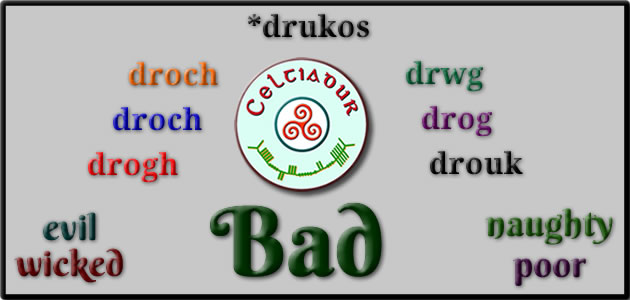
Bad

Words for bad and related things in Celtic languages.

Good

Words marked with a * are reconstructions.

Proto-Celtic *drukos = bad
Gaulish druco- = bad
Old Irish (Goídelc) droch [drox] = bad, ill
Middle Irish (Gaoidhealg) droch = bad
Irish (Gaeilge) droch [drɔx] = bad, poor, evil, ill, un-
drochbhéas = vice, bad habit
drochmheas = contempt
drochobair = bad work, mischief
drochrath = ill luck, misfortune
drochrud = bad thing, inferior thing, bad/evil person, devil
drochrún = evil intention
drochuair = evil hour, unfortunate occasion
Scottish Gaelic (Gàidhlig) droch [drɔx] = bad, evil, wicked, mischievous, sad, calamitous, dark, obscure, secretive
droch-aigne = ill-will
droch-allaidh = libel
droch-chòrdadh = disagreement
droch-fhàistinneach = ominous
droch-mhèin = malice
droch-thuarach = sinister
Manx (Gaelg) drogh [drɔx] = evil, wicked, bad, abusive, unenviable, misfortune, badness, ill, sinister, vile
drogh aghtalys = misbehaviour, misconduct
drogh chaaynt = bad language, smut, swearing
drogh chonagh = misfortune
drogh hraghtey = to smuggle, smuggling
drogh oor = bad luck, ill-times, misfortune
Proto-Brythonic *drug = bad
Middle Welsh (Kymraec) druc, dryg, drỽc, drwc = bad
drycaruer , drygarver, drycarver = bad habit, abuse, misuse
drygdafod = scurrilous language, evil tongue
Welsh (Cymraeg) drwg [druːɡ] = bad, rotten, putrid; poor, piteous, wretched; sorry, grievous, sad; unfavourable, causing disquiet; injurious, harmful; unpleasant (taste); indecent, obscene (words); counterfeit, false; bad; harsh, cruel, severe, ruthless; corrupt, depraved, sinful, wicked, mischievous, naughty
strong>drwgabsen = malicious defamation, slander
drwgafer = bad habit, abuse, misuse
drwgdafod = scurrilous language, evil tongue
drwgenwog = infamous, notorious, disreputable
Middle Cornish (Cernewec) droc, drôg, drog = evil, wickedness, harm, injury, wrong, bad, wicked, hurtful, mischievous
droca, droga = worst
drocoleth = an evil deed, ill doing, injury, damage
droga, droaga = to do harm, hurt, injure
drogbrederys = evil-minded, malicious, envious
drogbres = ill will, spite, grudge
drogdavasec = ill-tongued, foul-mouthed, back-biting, reviling
drogger = ill report, infamy, reproach
droggeriit = infamous, reproachful
droggras = revenge, requital
drogober, drôk-ober = an evil deed, a crime
Cornish (Kernewek) drog [drɔ:g / dro:g] = bad, harm, hurt, ill, wrong, evil, invalid, nasty, naughty, wicked, wrong
drogdybi = to suspect
drogedh = vice
drogfara = to behave badly
drogga = wrong
droghandla = to abuse, mishandle
droglam = accident, crash, mishap
drogober = crime
drogboeror, drogoberores criminal, culprit
drogura = to smear
drokoleth = widkedness
drokter = wickedness
Middle Breton (Brezoneg) drouc = bad, illness, anger
drouc Ælez = the devil, bad angel
drouc auantur = misfortune, bad luck
droucyez, drouguyez = wickedness, malice, animosity
drouc =
drouc =
Breton (Brezhoneg) drouk [druːk] = bad, evil, naughty
droug [druːk] = bad, wickedness
drougiezh [druˈɡiːɛs] = wickedness, malice, animosity
droukrañsus [druˈɡrãsːys] = angry, resentful
droukaat = to become bad, make bad
drouziwezh [dru.ˈziː.wɛs] = defeat, disaster
dizrouk [ˈdi.zruk] = inoffensive, without anger

Etymology: possibly from the Proto-Indo-European *dʰrewgʰ- (to deceive) [source]. Word from the same roots include dream in English, droom (dream) and driegen (to deceive) in Dutch, Traum (dream) and trügen (to deceive, be deceptive) in German [source].

Proto-Celtic *dognawos = badly grown (?)
Old Irish (Goídelc) dona [ˈdona] = unlucky, unfortunate
Middle Irish (Gaoidhealg) dona = unfortunate, unlucky, wretched
donaide = ill-disposed, wretched
donán = miserable creature, wretch
donas = ill-luck, misfortune, calamity
donogad = act of making wretched
Irish (Gaeilge) dona [ˈd̪ˠɔn̪ˠə/ˈd̪ˠʌnˠə] = unfortunate, unlucky, bad, poor, wretched, ill
donacht = badness, wretchedmess, misfortune, illness
donagar = bad condition, misfortune
donaigh = to make worse, aggravate, become word, deteriorate, injure, maim
donaire = wretch
donaireacht = wretchedness
donaisín = little wretch, weakling
donas = ill-luck, misfortune, affliction, misery, mischief
Scottish Gaelic (Gàidhlig) dona [dɔnə] = bad, not well
donachas [dɔnəxəs] = mischief, harm, bad luck, mishap, devil
donachd [dɔnəxg] = mischief, harm, bad luck, mishap
donad [dɔnəd] = degree of badness, severity
donadas [dɔnədəs] = badness, evil
donas [dɔnəs] = mischief, harm, bad luck, devil
donasag [dɔnəsag] = imp
Manx (Gaelg) donney [ɔlk] = calamitous, ill-advised, inauspicious, unfortunate, unlucky, very ill, woeful, unhappy
donnan = dolt, dunce, stupid person, worse
donnys = affliction, bad luck, mischief, woe

Etymology: possibly from the Proto-Indo-European *ǵneh₃- (to recognise, know) [source]. Words from the same root include can, canny, gnome, ignore, know and quaint in English [source].

Proto-Celtic *ulkos = evil, bad
Old Irish (Goídelc) olc [olk] = bad, evil
olcas = badness
Middle Irish (Gaoidhealg) olc, olcc = evil, bad, wrong, misfortune
olcach = hurtful, injurious, harm, injury
olcas = badness
Irish (Gaeilge) olc [ɔl̪ˠk] = evil, harm, bad, harmful, poor, wretched, ill-disposed, hardly, scarcely
olcach = causing evil, harmful, injurious.
olcas = badness, evil, bad state, bad nature, spite
Scottish Gaelic (Gàidhlig) olc [ɔl̪ˠxg] = evil, wicked, bad, infamous, ill, iniquity
olcag [ɔl̪ˠxgag] = little brat (female)
olcair [ɔl̪ˠxgɛrʲ] = evildoer
olcas [ɔl̪ˠxgəs] = wickedness, badness
Manx (Gaelg) olk [ɔlk] = bad, evil, ill, injury, lousy, truculence, unfavourable, vicious, wicked, mischief, naughty, sinful
olkeyr = criminal, culprit, evil-doer, offender, mischief-maker
olkid = badness, evilness
olkys = badness, evilness, iniquity, mischief
olkyssagh = baleful, elfish, diabolical, iniquitous, malicious, malignant, mischievous, naughty, vicious, wicked

Etymology: from the Proto-Indo-European *h₁elḱ- (bad [?]) [source]. Words from the same root include ill and possibly ulcer in English, illa (badly, poorly, not well) in Swedish, and ilkeä (bad, mean, wicked, evil) in Finnish [source].

Sources: Wiktionary, Am Faclair Beag, Online Manx Dictionary, Teanglann.ie, eDIL – Electronic Dictionary of the Irish Language, In Dúil Bélrai English – Old Irish glossary, Geiriadur Prifysgol Cymru, Gerlyver Kernewek, Lexicon Cornu-britannicum: A Dictionary of the Ancient Celtic Language of Cornwall, Dictionaire Favereau, TermOfis, Le dictionnaire diachronique du breton, Etymological Dictionary Of Proto Celtic

Good

Words for good and related things in Celtic languages.

Good

Proto-Celtic *matis = good
Old Irish (Goídelc) maith [maθʲ] = good
maithe = goodness
Middle Irish (Gaoidhealg) maith, maid = good, profiable, excellent, fitness, proficiency, wealth
Irish (Gaeilge) maith [mˠa(h) / mˠaɪ(h)] = good; goodness, kindness; good things; fertility
maithe = goodness, good
maitheamh = forgiveness, pardon, abatement, remission
maitheas = goodness, good, good thing, kindness, gift
maitheasach = good, useful, kind, obliging
maitheasaí = good worker
maithiúnas = forgiveness, pardon
Scottish Gaelic (Gàidhlig) math [mah] = good, well
maitheadh = forgiving, pardoning
maitheas = goodness
maitheanas = forgiveness, pardon
maitheamhnas = forgiveness
Manx (Gaelg) mie [maɪ] = good, nice, moral, fair, pious, ready, goodness, favourable, virtuous, virtue, goodly
mienys = favourableness, good, goodness
Proto-Brythonic *mad = good
Middle Welsh (Kymraec) mad, mat [maːd] = fortunate, lucky, good, etc
matweith, madwaith = good work, goodness
Welsh (Cymraeg) mad [maːd] = fortunate, lucky, auspicious, happy, suitable, proper, good, beneficial, holy, fair, pleasant, beautiful, goodness, fairness, benefit, good deed, kindness
madedd = goodness, generosity, bounteousness
madog = good man, good, just, righteous
madol = fair, good, beneficial
madwaith = good work, goodness
madwr = benefactor, patron
Old Cornish mad = good
Middle Cornish (Cernewec) mas, mat, mâs, mâd = good, beneficial
Cornish (Kernewek) mas [ma:z / mæ:z] = good, respectable, moral, virtuous
maseth = morality
Old Breton mat = good
Middle Breton (Brezonec) mat, mad = good
Breton (Brezhoneg) mat, mad [mɑːt/maːd] = good, good product, moral, well (done), sweet
madek = wealthy, gentle, soft
madelezh = kindness, benevolence
madelezhus = beneficent, generous
madig = sweet, bonbon
madoberer = benefactor, patron
mataat = to improve, moralize
demat [deˈmɑːt] = hello, good day
demata = to greet, say hello
peurvat [ˈpør.vat] = perfect

Etymology: from Proto-Indo-European *meh₂tis (ripe, good), from *meh₂- (to ripen, to mature) [source].

Words from the same roots include demure and mature in English, matin (morning) and mûr (mature, ripe) in French, and , mañana (tomorrow, soon, morning) and maduro (mature, ripe) in Spanish [source].

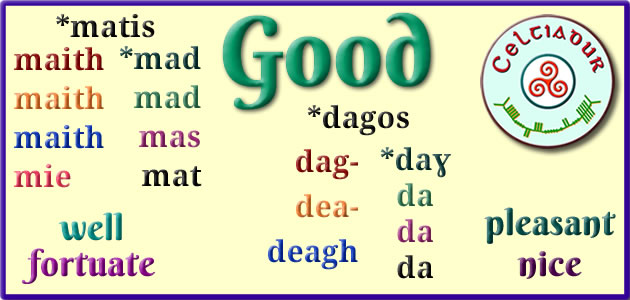
Proto-Celtic *dagos = good
Gaulish dagos = good
Old Irish (Goídelc) dag- = good
Middle Irish (Gaoidhealg) dag = good, well
Irish (Gaeilge) dea- [dʲa/ dʲeː] = good, well
dea-bhéasach = well-mannered, well-behaved
dea-chruthach = well-shaped, shapely, handsome
dea-dhéanta = well-made, of good figure, physique
Scottish Gaelic (Gàidhlig) deagh [dʲoː] = good, fine, nice, pretty, rather well
deagh-rùn = good intention
deagh-aithnichte = well-known
deagh-chliù = good reputation, fame
deagh-spiorad = good spirit
deagh-ghean = goodwill, benevolence
Proto-Brythonic *daɣ = good
Middle Welsh (Kymraec) dá, da = good, beneficial, acceptable, suitable, useful
daeoni, dayoni, daioni = goodness, uprightness, graciousness, kindness, bravery
daionvs, daionus, dayonus = good, beneficial, bountiful, kind, loving, gracious
Welsh (Cymraeg) da [daː] = good, beneficial, acceptable, suitable, useful
daeder = goodness, quality, of goodness
daionedd = goodness, benefit
daioni = goodness, uprightness, graciousness, kindness, bravery
daionus = good, beneficial, bountiful, kind, loving, gracious
daionusrwydd = goodness
daionuster = goodness, beneficence, benefit
Middle Cornish (Cernewec) da = good
dader = goodness, excellence
Cornish (Kernewek) da [da:] = good
da lowr = alright, mediocre, OK, passable
da-ober = good deed
dader = goodness
mellyer/melyores dader = do-gooder
Old Breton da = good
Middle Breton (Brezonec) da = good
Breton (Brezhoneg) da [da] = pleasant, agreeable, satifactory; good (archaic)

Etymology: related to the Proto-Indo-European *déḱos (that which is proper), from *deḱ- (to take, perceive) [source].

Words from the same roots include dech (best) in Old Irish and dainty, decent, decor, dignity, docile doctor and dogma in English [source].

Words marked with a * are reconstructions.

Blubrry podcast hosting

Sources: Wiktionary, Am Faclair Beag, Online Manx Dictionary, Teanglann.ie, eDIL – Electronic Dictionary of the Irish Language, In Dúil Bélrai English – Old Irish glossary, Geiriadur Prifysgol Cymru, Gerlyver Kernewek, Gerlyvyr Cernewec, Lexicon Cornu-britannicum: A Dictionary of the Ancient Celtic Language of Cornwall, Dictionaire Favereau, TermOfis, Le dictionnaire diachronique du breton, Geriafurch, English – ProtoCeltic WordList (PDF), Etymological Dictionary Of Proto Celtic

Left & North

Words for left, north and related words in Celtic languages.

Left & North

Words marked * are reconstructions.

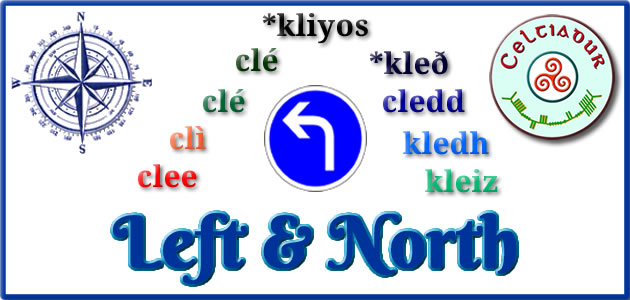
Proto-Celtic *kliyos = left (hand)
*uɸokliyom = north
Old Irish (Goídelc) clé = left
fochlae = the north, seat of honor
Middle Irish (Gaoidhealg) clé = left
fochla = the north, seat of honour
Irish (Gaeilge) clé [clʲeː / clʲiː] = left, left hand, left-hand side
clébhord = port, larbord
Scottish Gaelic (Gàidhlig) clì [kliə] = left
clì-làmhach = left-handed
làmh chlì = left hand, left wing (in politics)
clè [kleː] = left, left-handed, mistaken, wrong, lar-board, sinister (in heraldry)
Manx (Gaelg) clee = left. leftist
skian clee = left wing
cleeid = left handedness
Proto-Brythonic *kleð = left, northern
*gwogleð [ɡwoˈɡlɛːð] = north
Old Welsh cled = left hand, left side
gogled = north
Middle Welsh (Kymraec) cled, kled = left, left hand, left side
argled = left, unlucky, unfortunate
guocled, goglet, gogled, gogledd = north
Welsh (Cymraeg) cledd [kleːð] = left, left hand/side
argledd = left, unlucky, unfortunate
gogledd = north, northern, northerly, North Wales, north wind
Middle Cornish (Cernewec) cledh, clêdh = left, north
cledhec = left-handed
dorn-kledh = left-handed
Cornish (Kernewek) kledh [klɛ:ð / kle:ð] = left, left-handed, northern
kledhbarth = north
Kledhbarthyas, Kledhbarthyades = Northerner
kledhek = awkward, clumsy, left-handed
kledhek hy thowlow / y dowlow = impractical
gogledh = north
a-gledh = on the left
a-gledh dhe = to the left of
a-gledhbarth = on the north side
Middle Breton (Brezonec) cleiz = left
Breton (Brezhoneg) kleiz [klɛj(s)] = left, north, northern, irrascible
kleizell = left
kleizenn = north wind
kleiziad – left-handed, left-hander
kleizour = left winger
a-gleiz [aˈɡlɛj(s)] = to the left
gougleiz, gouglez [ˈɡuɡlɛj(s)] = north (archaic)

Etymology: from the Proto-Indo-European *ḱléyteh₂ (leaning, sloped, inclined) from *ḱley- (to lean, incline) [source].

Words from the same PIE roots include clement, client, climate, climax, clinic, ladder and to lean in English [source].

Proto-Celtic *(s)kīttos = left, left-handed, clumsy, awkward, wrong, sinister, sad
Middle Irish (Gaoidhealg) cittach = left-handed, awkward
Irish (Gaeilge) ciotach [ˈcɪt̪ˠəx / ˈcɪt̪ˠa(h)] = left-handed, awkward, clumsy, difficult, troublesome, inconvenient
ciotachán = left-handed person, awkward, clumsy person
ciotóg = left hand, left fist, lefthanded person
ciotógach = left-handed, left-fisted, awkward
Scottish Gaelic (Gàidhlig) ciotach [kʲihdəx] = left-handed, awkward, sinister
ciotachan = left-handed person
Manx (Gaelg) kiuttag = left hand
kyttagh = left-handed
kiuttaght = left-handedness
Middle Welsh (Kymraec) chwith, hwidd = left, left-handed
Welsh (Cymraeg) chwith [χwiːθ] = left; left-handed, awkward, bungling, uncouth, unfortunate, sinister, sad, strange, unaccustomed, unusual, wrong, amiss; the left (hand); the Left
chwithig = left, left-handed; strange, awkward, clumsy, bungling, wrong, inauspicious, unpleasant, suspicious
chwithlyd = sinister, chilly
gochwith, go chwith = contrary, opposite, inside out, clumsy, awkward, left-handed; evil, mishap, misfortune

Etymology: from the Proto-Indo-European *skh₂ey- (left) [source].

Proto-Celtic *towto = left, north
Old Irish (Goídelc) túaid, thúaid = north, in the north
túaidemain = in the north, northwards
fa thuaith, fo thuaidh = northwards, to the north
Middle Irish (Gaoidhealg) túaid, thúaid = north, in the north, northern, northwards
túaidebar = the north
túaidemain = in the north
túaiscert = the north, the left, northerly
túaiscertach = northern, left hand, a northerner
atúaid = from the north, to the north of
Irish (Gaeilge) thuaidh [huəɟ / huə / huəj] = (in the) north, northern
ó thuaidh = to the north, northwards
aduaidh = from the north
tuaisceart = north, northern part
Tuaisceart Éireann = Northern Ireland
tuaisceartach = Northerner, northern, awkward to deal with, surly, rude
tuaisceartacht = awkwardness, surliness, rudeness
Scottish Gaelic (Gàidhlig) tuath [tuə] = north
gu tuath = northward(s)
tuathach [tuəhəx] = northerner, person from North Uist; northerly, northern, boreal
tuathal = anti-clockwise, unlucky, ill-omended, confused, agitated, disorientated
tuathar = place with a northerly aspect, land facing north
tuathlach = unlucky, awkward, left-handed
Manx (Gaelg) twoaie = north, northerly, northern, boreal, northward
twoaieagh = northerner, northsider, northern (Manx) person
goal twoaie = rainbow (“going north”)
my hwoaie = north, northerly, northward
Nerin Hwoaie = Northern Ireland
Old Breton tut = good, favorable
tuthe = a kind of demon

Etymology: possibly from the Proto-Indo-European *tewto- or *tewH- (to look favorably, protect, observe). Cognate with the Latin tūtus (safe, prudent, secure, protected), which is the root of English words like tutor and intuition [source].
Blubrry podcast hosting

Blubrry podcast hosting

Sources: Wiktionary, Am Faclair Beag, Online Manx Dictionary, Teanglann.ie, eDIL – Electronic Dictionary of the Irish Language, In Dúil Bélrai English – Old Irish glossary, Geiriadur Prifysgol Cymru, Gerlyver Kernewek, Gerlyvyr Cernewec, Lexicon Cornu-britannicum: A Dictionary of the Ancient Celtic Language of Cornwall, Dictionaire Favereau, TermOfis, Le dictionnaire diachronique du breton, Geriafurch, English – ProtoCeltic WordList (PDF), Etymological Dictionary Of Proto Celtic

Narrow

Words for narrow and related things in Celtic languages.

NORE LINEAR PARK IN KILKENNY CITY TUESDAY 10 MAY 2016 [THE WEATHER WAS VERY WET AND HAZY]-115697

Words marked with a * are reconstructions.

Proto-Celtic *koilos = thin
Old Irish (Goídelc) cáel, cóel = thin, slender, narrow, fine, delicate, strait
cáelán = intestine
Middle Irish (Gaoidhealg) cáel, cóel, cóil = thin slender, narrow, fine, nice, delicate, subtle, exact
cáelán, caolan = intestine, gut
cáelas = narrows, strait
Irish (Gaeilge) caol [keːl̪ˠ / kiːlˠ] = thin, slender; fine; narrow; shrill; slender; palatalized; weak, dilute; slight; subtle
caolach =osiers, twigs, wicker-/wattle-work
caoladán = thin person, thing
caoladóir = wicker-worker, basker-maker
caolaigh = to become thin, narrow, reduce, dilute
caolán = creek, small intestine, catgut
caolas = strait, narrows, narrow place, bottleneck
Scottish Gaelic (Gàidhlig) caol [kɯːl̪ˠ] = narrow, slender; slim, thin, lean, skinny; lanky
caolan = colon, intestine, entrail(s), gut(s)
caolanach = colonic, intestinal
caolraid = alley, vennel, wynd
caolaich = make slender, slenderise
caolachadh = (act of) narrowing, slenderisation
caolas = narrow(s), strait
caoladair = wickerworker
Manx (Gaelg) keyl [keːl] = thin, fine, attenuated, lanky, lean, slim, slight, willowy, gracile, tapered, slender, hairline, narrow, spare, small, drawn out, watery (soup), weak (solution)
keyllaghey = narrow (down), narrowing
keyley = narrowing, slenderize, thin
keylagh = to attenuate, attenuation, slenderize, thin, thinning
Proto-Brythonic *kʉl = narrow
Middle Welsh (Kymraec) cul, kul = narrow, lean
culaidd, culedd = narrowish, restricted
culhau, kulhau = to become narrow, shrink
Welsh (Cymraeg) cul [kɨːl / ˈkiːl] = narrow, lean, illibera,; bigoted, narrow-minded
culaidd = narrowish, restricted
culder, culdra = narrowness, leanness
culdir = isthmus, narrow strip of land
culfa = strait, narrow place, narrow passage
culhaf, culhau = to become narrow, shrink, lose fat
Middle Cornish (Cernewec) cul = narrow, strait
culurionein, kylyrion = the bowel
Cornish (Kernewek) kul [ky:l / ki:l] = narrow
kuldremenva = corridor
Breton (Brezhoneg) kul = narrow

Etymology: from Proto-Indo-European *koyHlo- or *skey- (to dissect, split) [source].

The word kyle, which appears in placenames such as Kyle of Lochalsh (Caol Loch Aillse) is an English version of the Scottish Gaelic caol [source].

Another word for narrow in Breton is strizh [ˈstriːs], which comes from the Latin strictus (tightened, compressed). The English words strict and strait come from the same root [source].

Words marked with a * are reconstructions.

Sources: Wiktionary, Am Faclair Beag, Online Manx Dictionary, Teanglann.ie, eDIL – Electronic Dictionary of the Irish Language, In Dúil Bélrai English – Old Irish glossary, Geiriadur Prifysgol Cymru, Gerlyver Kernewek, Gerlyvyr Cernewec, Lexicon Cornu-britannicum: A Dictionary of the Ancient Celtic Language of Cornwall, Dictionaire Favereau, TermOfis, Le dictionnaire diachronique du breton, Geriafurch, English – ProtoCeltic WordList (PDF), Etymological Dictionary Of Proto Celtic

Blubrry podcast hosting

High, Elevated, Noble

Words for high and related things in Celtic languages.

Inis Mór / Inishmore

Proto-Celtic *ardwos = high
Gaulish *arduenna = high
Old Irish (Goídelc) ard [ar͈d] = high, height
Middle Irish (Gaoidhealg) ard = high, elevated, lofty, noble, distinguished, great, proud, difficult, laborious, arduous, height
ardach = hilly
ardae, airde = height, high place, greatness, nobility, loudness
ardaid = rises (against), to rebel
ardán = pride, arrogance
ardrí = high king
Irish (Gaeilge) ard [ɑːɾˠd̪ˠ / æːɾˠd̪ˠ] = height, hillock, top, high part; high, tall; loud; ambitious; chief, excellent, noble, advanced
ardaigh = to raise, elevate, ascend, carry
ardán = small height, platform, stage, stand, terrace, uplift
ardrí = high king
ardscoil = high school
ardú = elevation, increase, exaltation, excitement
Scottish Gaelic (Gàidhlig) àrd [aːr̪ˠd] = high, lofty, tall; great; loud; chief, eminent, superior, supreme
àrd-cheann = superior, chief
àrd-chùirt = high court
àrd-chiallach = intellectual
àrd-ollamh = professor
àrd-sgoil = secondary school, high school
àrdchadh = raising, elevating, promoting, advancing, raise, elevation, promotion, advancement
àrdaichte = raised, upgraded
àrdan = arrogance, haughtiness, pride, elevation, eminence, height
Manx (Gaelg) ard = high, towering, tall, big, loud, height, high place, fell, incline, district, region, direction, compass point, pole
ardan = platform, stage, stand
ard-chione = head, principal, superior, supremo
ardys = exaltation, greatness, height
Proto-Brythonic *arð = high
Middle Welsh (Kymraec) ard, art = hill, highland, top; high, upland
Welsh (Cymraeg) ardd [arð] = hill, highland, top; high, upland
ardd-tir = high ground
Middle Cornish (Cernewec) ard, arth = height, high place
arthelath = lordship
Cornish (Kernewek) ardh = height, high place
Breton (Brezhoneg) arz = high, elevated

Etymology: from Proto-Indo-European *h₃r̥dʰwós, from *h₃erdʰ- (to increase, grow; upright, high) and *-wós (creates adjectives from verbs) [source].

The Ardennes, a region of forests and hills in mainly in Belgium, Luxembourg, and also in France and Germany, was known as Arduenna Silva in Latin. The first part of the Latin name probably comes from the Gaulish *arduenna, or from the Latin arduus (lofty, high, steep, tall), which comes from the same PIE root [source].

Other words from the same PIE roots include arbor, arduous, orthodox and orthography in English, arbre (tree) in French, árbol (tree, mast) in Spanish, and рост [rost] (growth, increase, rise, height, stature) in Russian [source].

Proto-Celtic *ouxselos = high, elevated
Gaulish *uxelos = high
Old Irish (Goídelc) úasal = high
Middle Irish (Gaoidhealg) úasal = high, lofty, noble, honourable, noble
Irish (Gaeilge) uasal [ˈuəsˠəlˠ] = noble, high-born; gentle, gentlemanly; precious, fine; (of place) sacred to the dead; hallowed; enchanted, inhabited by fairies
Scottish Gaelic (Gàidhlig) uasal [uəsəl̻ˠ] = noble, highminded, genteel
Manx (Gaelg) ooasle = aristocratic, lofty, illustrious, esteemed, gentlemanly, patrician, honourable, dignified, lordly, magnificent, classy, respected
Proto-Brythonic *ʉxel [ʉˈxɛːl] = high, elevated
Middle Welsh (Kymraec) vchel, uchel = high, tall
Welsh (Cymraeg) uchel [ˈɨ̞χɛl / ˈiːχɛl /ˈɪχɛl] = hill, tall; high(-ranking), exalted, important, solemn, sublime, splendid, excellent, noble, stately, respectable, commendable; proud, haughty, arrogant, presumptuous, snobbish
uchelaf, uchelu = to raise, heighten, exalt, increase
uchelaidd = exalted
ucheldeb = highness
uchelder = high place, height, tallness, altitude, climax
ucheldir = highland, upland, high place, the Highlands
ucheldra = highness, height, glory, majesty, authority
ucheledig = elevated, sublime, noble
Middle Cornish (Cernewec) uchel = high, lofty, towering
uchelder = height, highness, loftiness
uchelle = to make high, exalt, hallow, sanctify
Cornish (Kernewek) ughel [‘ʏhɛl / ‘ɪʍɐl] = high, grand, loud, tall
ugheldas = patriarch
ughelder = height, loudness, tallness, volume
ughella = higher, superlative
ughelor = noble
ughelvam = matriarch
Old Breton uchel, uhel = high
Middle Breton vhel, uhel, uc’hel = high
uhelaat = to raise, elevate
uheladur = raising, heightening
uhelañ = highest, summit
uheldad = patriarch
uhelded = height, greatness, loftiness
uhelegezh = ambition, pride
Breton (Brezhoneg) uhel = high, upstream, uphill
uhelaat = raising
uhelder = altitude
uhelded = height, greatness
uheldiad = dignitary
uhelvrud = prestige

Etymology: from Proto-Indo-European *h₃ewps- (height) [source].

Words from the same PIE root include subtle and supine (lying on its back) in English, sotto (down, underneath, below) in Italian, arduous, orthodox and orthography in English, arbre (tree) in French, árbol in Spanish, and рост [rost] (growth, increase, rise, height, stature) [source].

Words marked with a * are reconstructions.

Sources: Wiktionary, Am Faclair Beag, Online Manx Dictionary, Teanglann.ie, eDIL – Electronic Dictionary of the Irish Language, In Dúil Bélrai English – Old Irish glossary, Geiriadur Prifysgol Cymru, Gerlyver Kernewek, Gerlyvyr Cernewec, Dictionaire Favereau, TermOfis, Le dictionnaire diachronique du breton, Geriafurch, English – ProtoCeltic WordList (PDF), Etymological Dictionary Of Proto Celtic

The Fastest Way to Learn Japanese Guaranteed with JapanesePod101.com

Broad & Wide

Words for broad, wide and related things in Celtic languages.

An trá mór

Proto-Celtic *ɸlitanos = broad, wide
Gaulish litana = broad, wide
Old Irish (Goídelc) lethan [l͈ʲeθan] = broad, wide
Middle Irish (Gaoidhealg) lethan, = broad, wide, wide-spread
leithet, leithne = breadth, width
lethaid, lethad = speads out, extends
Irish (Gaeilge) leathan [ˈl̠ʲahənˠ] = broad, wide, extensive
leathanaigeanta = broad-minded
leathanduilleach = broad-leaved, broad-brimmed
leathanghiallach = square-jawed
leathanghuailleach = broad- / square-shouldered
leathanas = wide extent, wideness
leathnú = widening, expension, extension
Scottish Gaelic (Gàidhlig) leathann [l̪ʲɛhən̪ˠ] = broad, wide, extensive
bann-leathann = broadband
aimhleathan [ãĩl̪ʲan] = narrow
cas-leathann = broad-footed, webbed, web-footed
Manx (Gaelg) lhean = wide, sheet, sweeping, flat of nose, extensive, broad, full (of chin)
lheanagh = broad, flattening
bann lhean = broadband
beeal lhean = wide-mouthed, yawning (chasm)
lhean cheeillagh = square-jawed
Proto-Brythonic *lɨdan [lɨˈdan] = broad, wide
Middle Welsh (Kymraec) litan, lledan, llydan = broad, wide
llydany = to widen
llydander, lledander = breadth, width
Welsh (Cymraeg) llydan [ˈɬədan] = broad, wide, long or wide (stride); sturdy, stout; extensive, spacious, plentiful, numerous
llydanaf, llydanu = to widen, make/become wide(r), enlarge, dilate
llydander, lledander = breadth, width, broadness, latitude, amplitude, extent, latitude
llydanedd, lledanedd = breadth, broadness, extent
llydan
llydan
Middle Cornish (Cernewec) ledan [‘lɛdan] = broad, wide, ample, spacious, extensive
ledanles = plantain
Cornish (Kernewek) ledan [‘lɛdan] = broad, wide, widely
ledandewlel = broadcast
ledanhe = to widen
bond ledan = broadband
Old Breton letan, litan = broad, wide
Middle Breton (Brezonec) ledan = broad, wide
ledañ, lediñ, ledek = to extend, spread, expand
ledanaat = to enlarge
ledanded = width, scope, calibre
Breton (Brezhoneg) ledan [ˈleː.dãn] = wide, broad
ledanded = width, scope, calibre
ledander = width, breadth, wideness

Etymology
From Proto-Indo-European *pl̥th₂-enos (wide, broad), from *pleth₂- (flat) [source].

The Welsh name for Brittany, Llydaw, comes from the same roots, via the Old Welsh Litau, the Proto-Brythonic *Llɨdaw (continent, mainland [Europe], Brittany), the Proto-Celtic *ɸlitawī (country, earth) and the PIE *pl̥th₂éwih₂ (country). The Old English word Lid-wiccas (Breton people, Brittany), as does the old French name for Brittany, Létavie [source].

Some English words from the same roots include field, flan, flat, plaza, plantain, plate, plateau [source].

Words marked with a * are reconstructions.

Sources: Wiktionary, Am Faclair Beag, Online Manx Dictionary, Teanglann.ie, eDIL – Electronic Dictionary of the Irish Language, In Dúil Bélrai English – Old Irish glossary, Geiriadur Prifysgol Cymru, Gerlyver Kernewek, Dictionaire Favereau, TermOfis, English – ProtoCeltic WordList (PDF), Etymological Dictionary Of Proto Celtic
Blubrry podcast hosting

Gods and Goddesses

Words for gods, deities & days in Celtic languages.

celts - the horse goddess epona
The Gallo-Roman Horse Goddess Epona

Proto-Celtic *dēwos = god, deity, day
*dēwā = goddess
Gaulish deuognata, teuoxtonio-, dēuos, dēwos, dēvona = god
Celtiberian teiuoreikis, deobriga = god
Old Irish (Goídelc) día [dʲiːa̯] = god
bandía = goddess
díadae, deoda = godly, divine, holy
deacht = godhead
Middle Irish (Gaoidhealg) día, dea, déa, de, dee = god, goddess, supernatural being, object of worship
deacht, déacht = godhead, divity
díadae, díade, diadu = divine, godly, holy
Irish (Gaeilge) dia [dʲiə] = god, deity
bandia = goddess
diaga = divine, godly, godlike, sacred, holy
diagacht = divinity, godhood, godliness, piety, theology
diagaigh = to deify, apotheosize
diagaire = divine, theologian
diaganta = godly, pious
dia-aithis = blasphemy
Scottish Gaelic (Gàidhlig) dia [dʲiə] = god, God
ban-dia = goddess
diadhachd [dʲiə.əxg] = deity, divinity, godhead
diadhaidh [dʲiə.ɪ] = divine, godly, pious
diadhaireachd [dʲiə.ɪjəxg] = godliness
diadhaidheachd [dʲiə.ɛrʲ] = theologian
diadhair [dʲiə.ɛrʲ] = theologian
Manx (Gaelg) jee = god, deity, godhead
ben jee = deity, goddess
jeeoil = divine, godlike, godly
jeeoilys = divinity, theology
jeeoilagh = divine, theologian
jeeaght = deity, divinity
jeeaghteyr = theologian
Proto-Brythonic *duɨw [ˈduɨ̯w] = god
Old Welsh duiu = god
Middle Welsh (Kymreac) duiu, duu, dyu, diu, duw = god
dwyes, dwywes = goddess, noble lady, queen
dywdap, dywdot, duwdab = the divine nature, divinity, theology
dywol, duwiol = godly, devout, religious, pious, good, holy, sanctimonious
Welsh (Cymraeg) duw / Duw [dɨu̯ / dɪu̯] = god, the Supreme Being, the Almighty, the Christian Trinity; O God!
duwies, dwywes, dwyes = goddess, noble lady, queen
duwdeb = the divine nature, divinity, theology
duweiddiad = deification, apotheosis
duweiddiaf, duweiddio = to deify, make a god of, turn into an object of worship
duwgar = loving God, pious, devout
duwiol, duwol = godly, devout, religious, pious, good, holy, sanctimonious
Old Cornish duy = god
Middle Cornish (Cernewec) dew, du, duy = god, God, a divinity
dues = goddess
Cornish (Kernewek) duw [dyˑʊ / diˑʊ] = god
duwes = goddess
duwonieth = theology
duwonydh, duwonydhes = theologian
Duw genes = goodbye (“god with you”)
Old Breton doi = god
Middle Breton doe, doué, dou = god
doueadur = apotheosis, deification
doueañ = to deify
doueadur = apotheosis, deification
doueañ = to deify
doueegezh = divinity, deity
doueek, doeel, doueel = divine
Breton (Brezhoneg) doue [du] = god
doueez =goddess
douead = theist
doueadegezh = deism
doueegezh = divinity
doueel = divine

Etymology: from Proto-Indo-European *deywós (god), from *dyew- (sky, heaven) [source]. The Deva rivers in Galicia get their name from the same Proto-Celtic root, and the Latin name for the city of Chester, Deva, possibly comes from the same Celtic root [source].

Words marked with a * are reconstructions.

Sources: Wiktionary, Etymological Dictionary Of Proto Celtic, In Dúil Bélrai English – Old Irish glossary, eDIL – Electronic Dictionary of the Irish Language, Teanglann.ie, Am Faclair Beag, Fockleyreen: Manx – English Dictionary, Online Manx Dictionary, Geiriadur Prifysgol Cymru, Lexicon cornu-britannicum : a dictionary of the ancient Celtic language of Cornwall, Gerlyver Kernewek, Devri : Le dictionnaire diachronique du breton, Dictionaire Favereau, TermOfis

Blubrry podcast hosting

Small

Words for small, little and related words in Celtic languages.

Kittens

Words marked with a * are reconstructions.

Proto-Celtic *bikkos, *biggos, *bekkos, *beggos = small, little
Old Irish (Goídelc) bec(c) [ˈbʲeɡ] = small, little
becán = little
MIidle Irish (Gaoidhealg) bec, beg = small, little, a small amount
becaid = to make small, deplete
becaigid, begaigh = to lessen, diminish, reduce
becán, begán, beccan = a little, small quantity, a few, a small number, little one, child, humble, lowly one
becda = lowly, humble
Irish (Gaeilge) beag [bʲɔɡ / bʲɞɡ / bʲɛɡ] = little, small, small amount; few
beagadán = diminutive person, little one
beagaigh = to lesson, diminish
beagán = little, a few, a little, somewhat
beagchainteach = silent, taciturn
beagchéillí = senseless, foolish
Scottish Gaelic (Gàidhlig) beag [beg] = small, little, wee; minor; petty, puny, trifling; slight
beagadh [begəg] = to diminish, lessen, reduce
beagachadh [begəxəɣ] = diminishing, lessening, reducing
beagag [begag] = small thing, trifle
beagan [began] = a little, a few
beaganas [beganəs] = slight, snub
beagnachd [begnəxg] = parvity, smallness
Manx (Gaelg) beg = small, short, slight, few, poky, model, narrow, quiet, dwarf
beggan = somewhat, slightly, partly, faintly, a few, little, small piece
begganid = littleness, smallness, slightness
beggid = diminutive, diminutiveness, littleness, paltriness
Proto-Brythonic *bɨx = small
Middle Welsh (Kymraec) hach, bych, bâch, = small, little
baches, baçes = darling, little, little woman
bachken, bachcen = boy, lad, youngster, servant, son, child
bachcennes = young girl, maiden, damsel, lass, wench
Welsh (Cymraeg) bach [baːχ] = small, little, short; not fully grown or developed, young; insignificant, unimportant, humble; small (business); lower-case (letter); dear, beloved; poor
baches = darling, little, little woman
bachgen = boy, lad, youngster, servant, son, child
bachgennes = young girl, maiden, damsel, lass, wench
bachigol = diminutive, small, little
bychan [ˈbəχan] = little, small, minute, diminutive; inconspicuous, obscure, unimportant, petty; young inexperienced; little one, young child
bychanaf, bychanu = to abase, disparage, disregard, slight, minimize
bychander, bychandod = littleness, smallness, scarcity, contempt, pettiness
bychanig = very little/small, minute, diminutive, bit, piece
bychan bach very little
Middle Cornish (Cernewec) bechan, bian, bichan, bihan, bochan, byan, byhan = little, small
Cornish (Kernewek) byghan [‘bɪhan] = little, small
byghanhe = to reduce, make smaller
byghanna = smaller
Middle Breton (Brezonec) bihan, byhan = small
bihanaat, bihanhat, bihanat = to shrink, diminish
bihanaet, bihannaet = decrease
bihanded, bihandet, bihandætt = smallness
Breton (Brezhoneg) bihan = small, insufficient, modest, little
bihanaat = diminutive, pet name
bihanadur = miniature
bihanniver = minority

Etmology: possibly from the Proto-Indo-European *bʰég-ko-s, from *bʰeg- (to break) +‎ the suffix *-kos [source]. Words for small and little in Romance languages, such as petit in French, pequeno in Portuguese and pequeño in Spanish, possibly come from the same Proto-Celtic root, via the Latin word *pittus (small, little) [source].

Proto-Celtic *legus = small
Gaulish lau = small
Old Irish (Goídelc) lagu, lugu, laigiu = smaller
Middle Irish (Gaoidhealg) lagu = smaller
Irish (Gaeilge) laghad = smallness, fewness
laghadaigh = to lessen, decrease, diminish, reduce
laghadaitheach = lessening, decreasing
laghadú = decrease, diminuition, reduction
laghadúchán = (act of) diminution
níos lú = smaller
is lú = smallest, least
Scottish Gaelic (Gàidhlig) lugha = less, least, more or most disagreeable
nas lugha = smaller, less, shorter, minimum
as lugha = smallest, tiniest, shortest
laghad [̪l̪ˠɤɣəd] = smallness, littleness, minority
luighead = degree of smallness, littleness
laghdaich, lùghdaich = (to) decrease, diminsh, lessen, reduce, decline
Manx (Gaelg) loo = fewer, least, little(r), minimim
(ny) sloo = less, lesser, smaller, shorter
by loo = smallest, fewest, less
leodagh = decreasing, degrading, dreogatory
leodaghey = to decrease, minimize, reduce, diminish
Proto-Brythonic *llaɣw = small, bad
*llaɣü = smaller
Middle Welsh (Kymraec) llaw = small, little, low, mean, weak
llei, lley = smaller, less, fewer
leyhaf, lleyaf, lleiaf = least, smallest, lowest, fewest
leihaa, leihaei, lleihav, leihau = to become smaller or less
Welsh (Cymraeg) llaw = small, little, low, mean, weak
llai [ɬai̯] = smaller, less, fewer
lleia(f) = least, smallest, lowest, fewest
lleiafrif = minority
lleihad = a lessening, decrease, easing
lleihadog = belittling, diminutive, derogative
lleihau = to become smaller or less, to diminish, to shink, to decrease, to less, to shorten
Middle Cornish (Cernewec) le = less, smaller
leia = least, smallest
leyhy, lyha = to make smaller, diminish, lessen
Cornish (Kernewek) le = smaller, less, lesser, fewer, minor
lehe = to lessen, extenuate, mitigate, reduce, shrink, zoom out
leheans = reduction
Old Breton (Brethonoc) lau = less, fewer
Middle Breton (Brezonec) lau = less, fewer
Breton (Brezhoneg) lei = less, fewer
leiaat = to decrease, lower, attenuate

Etymology: from *h₁léngʰus (lightweight, easy, nimble), from *h₁lengʷʰ- (to move lightly or effortlessly; lightweight) [source]. Words from the same PIE roots include gelingen (to turn out well, go smoothly) in German, light and lever in English, licht (light, easy, mild) in Dutch, and léim (to jump, leap) in Irish [source].

The Fastest Way to Learn Japanese Guaranteed with JapanesePod101.com

Sources: Wiktionary, Etymological Dictionary Of Proto Celtic, In Dúil Bélrai English – Old Irish glossary, eDIL – Electronic Dictionary of the Irish Language, Teanglann.ie, Am Faclair Beag, An etymological dictionary of the Gaelic language, Fockleyreen: Manx – English Dictionary, Online Manx Dictionary, Gaelg Corpus, Geiriadur Prifysgol Cymru, Lexicon cornu-britannicum : a dictionary of the ancient Celtic language of Cornwall, Gerlyver Kernewek, Devri : Le dictionaire diachronique du breton, Geriafurch, TermOfis