To search

Words for to search, track and related things in Celtic languages.

Searching

Words marked with a * are reconstructions.

Proto-Celtic *lorgom, *lergo- = track, trace
Old Irish (Goídelc) lorg = path, track, trace
Middle Irish (Gaoidhealg) lorg = trace, vestige, mark, impression, track, trail, path, course
Irish (Gaeilge) lorg [ˈl̪ˠɔɾˠəɡ / ˈl̪ˠʌɾˠəɡ] = to track, trace; seek, search for; trace, vestige, mark, impresssion, track, trail, path, course
lorgaire = tracker, pursuer, detective, seeker, searcher, follower, adherent
lorgaireacht = (act of) tracking, tracing, pursuing, seeking, searching, detection
Scottish Gaelic (Gàidhlig) lorg [ˈl̪ˠɔrɔg] = to trace, track, search, pursue, follow by scent or footprints
air lorg = on the track of, in search of, found, located
lorgadh [l̪ˠɔrɔgɪç] = (act of) discovering, finding
lorgaich = track! trace! pry! ferret out!
lorgadh [l̪ˠɔrɔgɛrʲə] = detective, detector, finder, tracker
lorganach [l̪ˠɔrɔganəx] = sluggard, slowcoach, trail, track
meur-lorg = fingerprint
Manx (Gaelg) lorg = trace, track, trail, vestige, spoor
lorgey = to trace, to track, to pursue, pursuit, tracing, trailing, urging
lorgaghey = to drive (on/along), to urge on, urging
Proto-Brythonic *llurɣ, ˈɬuːru = track, trail (?)
Middle Welsh (Kymraec) llwrw, llwry = track, trail, path, way, direction
Welsh (Cymraeg) llwrw, llwry [ˈɬʊru / ˈɬuːru] = track, trail, path, way, direction, course, career, manner, mode, form, semblance; tax, fee, fine, penalty; opportunity, convenince
Middle Cornish (Cernewec) lerch, lyrch, ler = trace, vestige, footstep
war lerch = after
Cornish (Kernewek) lergh = track, trail, trace
a-lergh = lately, recently
war-lergh = according to, after, behind
Old Breton (Brethonoc) lerg = trace, sequel
Middle Breton (Brezonec) lerch = trace, sequel
Breton (Brezhoneg) lerc’h [ˈlɛrx] = trace, sequel, continued
lerc’h-ouzh-lerc’h = next, right away, successively
lerc’henn = postposition
dilercʼh = remainder, consequence, delay
war-lercʼh = after, behind, because of

Etymology: uncertain [source] or from Proto-Indo-European *lerg- (slippery, even) [source]

Proto-Celtic *swelos = to turn
Old Irish (Goídelc) sel = a turn, a while, a spell
dessel = sunwise, clockwise
túaithbel = anticlockwise, widdershins, lefthandwise
Middle Irish (Gaoidhealg) sel, seal = a turn, a time, a while
dessel, deisell, dessiul = direction of the sun, right-hand course, sunwise, clockwise
túaithbel, tuaithbil, tuaithbiul = against the sun, withershins, lefthandwise
Irish (Gaeilge) seal [ˈʃal̪ˠ] = turn, while, spell, span
sealad = turn, while, space of time
sealadach = temporary, provisional
sealaíocht = (act of) alternating, taking turns, alternation
deiseal [ˈdʲeʃəlˠ] = righthand direction, direction of the sun, clockwise, sunwise
tuathal [ˈt̪ˠuəhəl̪ˠ] = anticlockwise, counterclockwise
Scottish Gaelic (Gàidhlig) seal [ʃal̪ˠ] = while, space of time
sealach [ʃal̪ˠəx] = temporary, transient, transitory
sealad [ʃal̪ˠəd] = while, period of time
sealadach [ʃal̪ˠədəx] = transitional, transitory, caretaker, provisional
sealaidheachd [ʃal̪ʲɪjəxg] = course of time, transitoriness, relay
sealan [ʃal̪ˠan] = a little/short while
deiseal [dʲeʃal] = clockwise, facing south, finished, ready, poised, prepared, handy, dexterous
tuathal [tuəhəl̪ˠ] = anticlockwise, counterclockwise, unlucky, ill-omened, confused, agitated, disorien(ta)ted
Manx (Gaelg) shalee = design, intention, project, purpose, pursuit, quest
shayll = piece of work, spell, turn
shallidagh = provisional, provisory, temporary, transient, interim
jeshal = clockwise
Proto-Brythonic *hwel = (?)
Old Welsh (Kembraec) chwel, cheil = turn, course, period
Middle Welsh (Kymraec) chwyl = turn of events, course, destiny
whel = turn, course, period
chwilyaw, chwiliaw, chwilio = to search, seek, trace, investigate, examine, rummage, ransack, try
Welsh (Cymraeg) chwŷl [χwɨːl / χwiːl] = turn of events, course, destiny
chwyl(i)ad = a turning round, roation, revolution
chwyl(i)o = to revolve, rotate, turn around
chwêl = turn, course, period, while, commotion, disturbance
chwilio [ˈχwɪljɔ / ˈχwɪljɔ] = to search, seek, trace, investigate, examine, rummage, ransack, try
chwiliadur = search engine
chwiliedydd = searcher, examiner, investigator
chwiliwr = searcher, investigator, examiner, trier, inquirer, spy, inquisitor
chwilys = inquisition
chwilyswr = inquisitor
chwiliota(f) = to rummage, pry, grope for, grabble, pilfer
Middle Cornish (Cernewec) chwila, whela(s), hwila(s), hwillaz = to seek, to seach for
hwiliog a searcher, seeker, conjuror
Cornish (Kernewek) hwilas [‘ʍilas / ‘ʍilɐz] = to seek, look for, attempt, try, search
hwilerbownder, hwiler hyns = pathfinder
hwilreseger = orienteer
hwilresek = orienteering
hwilva = laboratory
Middle Breton (Brezonec) chouilia = to search, look for
Breton (Brezhoneg) hoal = age, ascendancy, attractiveness
hoal-vat = happiness, prosperity
hoalad = career, era, epoc, period
hoaladur = delectation
hoalat = to seduce, to delight
holc’hiñ = to search

Etymology: possibly from Proto-Indo-European *welH- (to turn, revolve). Words from the same roots in English include helicopter, helix, valve, wallow, whelk, and deiseal (clockwise, sunwise – borrowed from Irish) [source]

Sources: Wiktionary, Etymological Dictionary Of Proto Celtic, In Dúil Bélrai English – Old Irish glossary, eDIL – Electronic Dictionary of the Irish Language, Teanglann.ie, Am Faclair Beag, An etymological dictionary of the Gaelic language, Fockleyreen: Manx – English Dictionary, Online Manx Dictionary, Gaelg Corpus, Geiriadur Prifysgol Cymru, Lexicon cornu-britannicum : a dictionary of the ancient Celtic language of Cornwall, Gerlyver Kernewek, Devri : Le dictionaire diachronique du breton, Geriafurch, TermOfis


Left & North

Words for left, north and related words in Celtic languages.

Left & North

Words marked * are reconstructions.

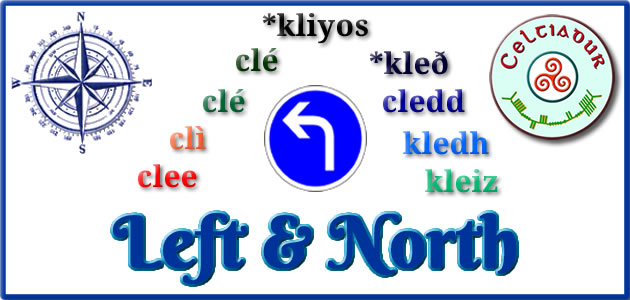
Proto-Celtic *kliyos = left (hand)
*uɸokliyom = north
Old Irish (Goídelc) clé = left
fochlae = the north, seat of honor
Middle Irish (Gaoidhealg) clé = left
fochla = the north, seat of honour
Irish (Gaeilge) clé [clʲeː / clʲiː] = left, left hand, left-hand side
clébhord = port, larbord
Scottish Gaelic (Gàidhlig) clì [kliə] = left
clì-làmhach = left-handed
làmh chlì = left hand, left wing (in politics)
clè [kleː] = left, left-handed, mistaken, wrong, lar-board, sinister (in heraldry)
Manx (Gaelg) clee = left. leftist
skian clee = left wing
cleeid = left handedness
Proto-Brythonic *kleð = left, northern
*gwogleð [ɡwoˈɡlɛːð] = north
Old Welsh cled = left hand, left side
gogled = north
Middle Welsh (Kymraec) cled, kled = left, left hand, left side
argled = left, unlucky, unfortunate
guocled, goglet, gogled, gogledd = north
Welsh (Cymraeg) cledd [kleːð] = left, left hand/side
argledd = left, unlucky, unfortunate
gogledd = north, northern, northerly, North Wales, north wind
Middle Cornish (Cernewec) cledh, clêdh = left, north
cledhec = left-handed
dorn-kledh = left-handed
Cornish (Kernewek) kledh [klɛ:ð / kle:ð] = left, left-handed, northern
kledhbarth = north
Kledhbarthyas, Kledhbarthyades = Northerner
kledhek = awkward, clumsy, left-handed
kledhek hy thowlow / y dowlow = impractical
gogledh = north
a-gledh = on the left
a-gledh dhe = to the left of
a-gledhbarth = on the north side
Middle Breton (Brezonec) cleiz = left
Breton (Brezhoneg) kleiz [klɛj(s)] = left, north, northern, irrascible
kleizell = left
kleizenn = north wind
kleiziad – left-handed, left-hander
kleizour = left winger
a-gleiz [aˈɡlɛj(s)] = to the left
gougleiz, gouglez [ˈɡuɡlɛj(s)] = north (archaic)

Etymology: from the Proto-Indo-European *ḱléyteh₂ (leaning, sloped, inclined) from *ḱley- (to lean, incline) [source].

Words from the same PIE roots include clement, client, climate, climax, clinic, ladder and to lean in English [source].

Proto-Celtic *(s)kīttos = left, left-handed, clumsy, awkward, wrong, sinister, sad
Middle Irish (Gaoidhealg) cittach = left-handed, awkward
Irish (Gaeilge) ciotach [ˈcɪt̪ˠəx / ˈcɪt̪ˠa(h)] = left-handed, awkward, clumsy, difficult, troublesome, inconvenient
ciotachán = left-handed person, awkward, clumsy person
ciotóg = left hand, left fist, lefthanded person
ciotógach = left-handed, left-fisted, awkward
Scottish Gaelic (Gàidhlig) ciotach [kʲihdəx] = left-handed, awkward, sinister
ciotachan = left-handed person
Manx (Gaelg) kiuttag = left hand
kyttagh = left-handed
kiuttaght = left-handedness
Middle Welsh (Kymraec) chwith, hwidd = left, left-handed
Welsh (Cymraeg) chwith [χwiːθ] = left; left-handed, awkward, bungling, uncouth, unfortunate, sinister, sad, strange, unaccustomed, unusual, wrong, amiss; the left (hand); the Left
chwithig = left, left-handed; strange, awkward, clumsy, bungling, wrong, inauspicious, unpleasant, suspicious
chwithlyd = sinister, chilly
gochwith, go chwith = contrary, opposite, inside out, clumsy, awkward, left-handed; evil, mishap, misfortune

Etymology: from the Proto-Indo-European *skh₂ey- (left) [source].

Proto-Celtic *towto = left, north
Old Irish (Goídelc) túaid, thúaid = north, in the north
túaidemain = in the north, northwards
fa thuaith, fo thuaidh = northwards, to the north
Middle Irish (Gaoidhealg) túaid, thúaid = north, in the north, northern, northwards
túaidebar = the north
túaidemain = in the north
túaiscert = the north, the left, northerly
túaiscertach = northern, left hand, a northerner
atúaid = from the north, to the north of
Irish (Gaeilge) thuaidh [huəɟ / huə / huəj] = (in the) north, northern
ó thuaidh = to the north, northwards
aduaidh = from the north
tuaisceart = north, northern part
Tuaisceart Éireann = Northern Ireland
tuaisceartach = Northerner, northern, awkward to deal with, surly, rude
tuaisceartacht = awkwardness, surliness, rudeness
Scottish Gaelic (Gàidhlig) tuath [tuə] = north
gu tuath = northward(s)
tuathach [tuəhəx] = northerner, person from North Uist; northerly, northern, boreal
tuathal = anti-clockwise, unlucky, ill-omended, confused, agitated, disorientated
tuathar = place with a northerly aspect, land facing north
tuathlach = unlucky, awkward, left-handed
Manx (Gaelg) twoaie = north, northerly, northern, boreal, northward
twoaieagh = northerner, northsider, northern (Manx) person
goal twoaie = rainbow (“going north”)
my hwoaie = north, northerly, northward
Nerin Hwoaie = Northern Ireland
Old Breton tut = good, favorable
tuthe = a kind of demon

Etymology: possibly from the Proto-Indo-European *tewto- or *tewH- (to look favorably, protect, observe). Cognate with the Latin tūtus (safe, prudent, secure, protected), which is the root of English words like tutor and intuition [source].
Blubrry podcast hosting

Blubrry podcast hosting

Sources: Wiktionary, Am Faclair Beag, Online Manx Dictionary, Teanglann.ie, eDIL – Electronic Dictionary of the Irish Language, In Dúil Bélrai English – Old Irish glossary, Geiriadur Prifysgol Cymru, Gerlyver Kernewek, Gerlyvyr Cernewec, Lexicon Cornu-britannicum: A Dictionary of the Ancient Celtic Language of Cornwall, Dictionaire Favereau, TermOfis, Le dictionnaire diachronique du breton, Geriafurch, English – ProtoCeltic WordList (PDF), Etymological Dictionary Of Proto Celtic

Right & South

Words for right & south in Celtic languages.

Right & South

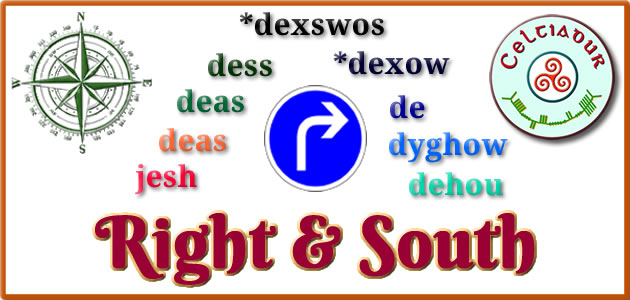
Proto-Celtic *dexswos = right (side), south
Old Irish (Goídelc) dess = right (side), right-hand; south; right, just; convenient, agreeable
desse = right side, rightness
andess = (from the) south
Middle Irish (Gaoidhleag) dess = right, right hand (side), south, just, meet, well-arranged, neat, pretty, fine
desse = the right side, right hand, rightness, fairness
dessebar = the south, southern aspect
dessel = direction of the sun, right-hand course, sunwise
andess = from the right, from the south
Irish (Gaeilge) deas [dʲasˠ / dʲæsˠ] = south, southerly, to the south; right, right-hand
deasach = right-handed, suitable for use with right hand
deaslámh = right hand
deaslámhach = right-handed, dexterous, handy
deaslámhaí = handiness, dexterity
deasóg = right hand, right fist, right-handed punch
Scottish Gaelic (Gàidhlig) deas [dʲes] = south; southern; right (side); ready, finished; accomplished, expert, skilful; active, alert, quick, snappy; to hand, handy; clever, sharp; deft, dexterous
deasach [dʲesəx] = southerly, southern, southerner
deasag [dʲesag] = right hand
deasail [dʲesal] = clockwise
deasad [dʲesad]= neatness, readiness
deasalt [dʲesəl̪ˠd] = clockwise/sunwise turn
deasalachd [dʲesəl̪ˠəxg] = readiness, convenience, dexterity
Manx (Gaelg) jesh = rightwing, righthand, starboard, nice, smart, felicitous, elegant, ready, tidy, groomed, adept, neat, seemly, becoming, suitable, fancy, trim
jiass [d͡ʒas] = south, southern, southerly, southward
jeshag = righthander, right-handed blow
jeshagh = illumination, right-handed blow
jeshid = applicability, elegance, neatness, propriety, right-handedness, seemliness, smartness, suitability, tidiness
neearass = southwest
niar ass = southeast
niass = southerly
cheu-jiass = southward
Proto-Brythonic *dexow = right, southern
Middle Welsh (Kymraec) dehev, deheu, deau = right, south, southern, right (hand, side)
dehau ddwyrain = southeast
deau-’orllewyn, deheûorllewin = southwest
Dehaubarth = the medieval kingdom of South Wales
dehevbôl = south pole
deheuec = dexterous, skilful, adroit, right
dehevawl = south, southern, of the south, austral, facing southwards
Welsh (Cymraeg) deau = right, south, southern
de [deː] = south; dexterous, skilful, clever; ready; useful, handy; suitable, appropriate, proper, right, just; favourable, auspicious
de(au)-ddwyrain = southeast
de(au)-orllewin- = southwest
Dehaubarth = South Wales, the medieval kingdom of South Wales, southern part
Dehaubarth Cymru (Newydd) = (New) South Wales
deheubol = south pole
deheuder, deheudra = dexterity, adroitness, cleverness
deheueg = dexterous, skilful, adroit, right; South Welsh dialect
deheuol = south, southern, of the south, austral, facing southwards
Middle Cornish (Cernewec) dehou, dyhow, dyow = right, south
dehoules = southernwood
Cornish (Kernewek) dyghow [dɪ’hɔʊ / də’hɔʊ] = south, right-handed, southern, right
dyghow dhuryen = southeast
dyghow orlewin = southwest
dyghowbarth = south
Old Breton dehou, deou = right, south
Middle Breton (Brezonec) dehou, deho, dehaou = right, south
dehouyat, deouiad = right-handed
Breton (Brezhoneg) dehou [ˈde(h).u] = right, south
dehouiad = right-handed
dehoubarzh = southern zone
a-zehou = to the right

Etymology
From Proto-Indo-European *deḱswo-, from *deḱs- (right-hand side) [source].

Words from the same PIE root include dexterity, dextrose and (ambi)dextrous in English, diestro (right, right-handed, skillful, dextrous) in Spanish, and destro (clever, able, right, right-hand) in Italian [source].

Words marked with a * are reconstructions.
Blubrry podcast hosting

Sources: Wiktionary, Am Faclair Beag, Online Manx Dictionary, Teanglann.ie, eDIL – Electronic Dictionary of the Irish Language, In Dúil Bélrai English – Old Irish glossary, Geiriadur Prifysgol Cymru, Gerlyver Kernewek, Gerlyvyr Cernewec, Lexicon Cornu-britannicum: A Dictionary of the Ancient Celtic Language of Cornwall, Dictionaire Favereau, TermOfis, Le dictionnaire diachronique du breton, Geriafurch, English – ProtoCeltic WordList (PDF), Etymological Dictionary Of Proto Celtic