Seaweed

In this post we’re looking into words meaning dulse, seaweed and related things in Celtic languages.

Dulse (Palmaria palmata) is a reddish-brown type of seaweed which is sometimes eaten in Ireland, Scotland, Wales and other places. The English word dulse was borrowed from Irish and/or Scottish Gaelic. It is also written dilisk, dillisk, dilsk or dulce.
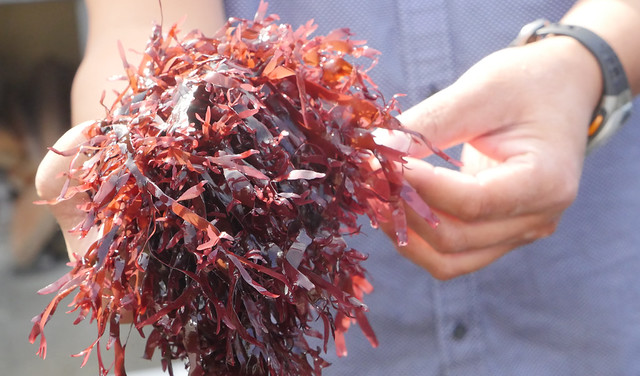
dulse003TW

Words marked with a * are reconstructions.

Proto-Celtic *doliskos = dulse, dilisk (edible seaweed of the species Palmaria palmata
Old Irish (Goídelc) duilesc = dulse
Middle Irish (Gaoidhealg) duilesc, duilleasg, duileasg [ˈd̪ulʲəsk] = dulse, seaweed with skinny horns, sea-grass
Irish (Gaeilge) duileasc = dulse
duileascar = rock moss
Scottish Gaelic (Gàidhlig) duileasg [duləsg] = (red) dulse, sea lettuce flakes
duileasg na h-aibhne = pondweed
Manx (Gaelg) dullish = dulse
dullish awin = pondweed
Proto-Brythonic *dölɨsk = dulse
Middle Welsh (Kymraec) dilysc, delysc, dylysc = dulse, edible seaweed
Welsh (Cymraeg) delysg, dylysg, dylusg [ˈdɛlˠɨ̞sk / ˈdeːlɪsk] = dulse, edible seaweed, palmated seaweed; stuff which is cast up by the sea, offscouring, filth, sweepings
delysg y môr = edible seaweed
Breton (Brezhoneg) tellesk = dulse
telleskek = where dulse is abundant

Etymology: from Proto-Celtic *dol- (leaves), from Proto-Indo-European *dʰelh₁- (to well forth, to spring forth, to flourish, to green) [source]. Words from the same roots include dal (to exist, go out, leave) in Albanian, դեղ (deġ – drug, medicine, poison) in Armenian, მდელო (mdelo – meadow) in Georgian, foglio (sheet) in Italian, full (sheet of paper) in Catalan, dail (leaves, sheets [of paper]) in Welsh, and dulse, foil, folio, and possibly dill in English [source].

Proto-Celtic *wimmonā = seaweed
Old Irish (Goídelc) femmuin = seaweed
Middle Irish (Gaoidhealg) fem(m)ain, femman, femmuin = seaweed
femnach = seaweed, edible water-weed
femnachda = resembling seaweed
Irish (Gaeilge) feamainn [ˈfʲamˠən̠ʲ] = seaweed, wrack, eelgrass, seawrack (Zostera marina)
feamainneach = clustered (as seaweed), tressed, ringleted (of hair)
feamnaigh = to cover with seaweed
talamh a fheamnú = to spread seaweed onland, to fertilize land with seaweed
Scottish Gaelic (Gàidhlig) feamainn [fɛmɪn̪ʲ] = seaweed, sea algae, seaweed used as fertiliser, marsh plant(s); fertilse with seaweed, harvest seaweed
feamainneach [fɛmɪn̪ʲəx] = like or pertaining to seaweed, fucoid, alginic
Manx (Gaelg) famlagh = seaweed, kelp, wrack
fammyragh = seaweed, wrack
Proto-Brythonic *gwɨmon = seaweed
Middle Welsh (Kymraec) guimon, gwimon, gwymon, gwmon = seaweed, laver, dulse
Welsh (Cymraeg) gwymon, gw(i)mon [ˈɡwɨ̞mɔn / ˈɡʊi̯mɔn] = seaweed, laver, dulse, freshwater alga, mean worthless thing
gwymona = to gather seaweed (for use as manure)
gw(y)monog, gwmanog = abounding in seaweed, covered with seaweed, seaweedy
Middle Cornish (Cernewec / Kernuak) gumman = seaweed
Cornish (Kernewek) gomonen = seaweed, kelp
gomonna, gomodna = to gather seaweed
Old Breton (Brethonoc) goumon, gueimmonou = seaweed
Middle Breton (Brezonec) goaymon, goumon = seaweed
Breton (Brezhoneg) gouemon, go(u)mon [ˈɡumːɔ̃n] = seaweed, kelp
gouemona = to search for / gather seaweed
gouemonaer = seaweed harvester

Etymology: uncertain, possibly from PIE *weyb- (to wind around). The words gamó (asphodel, mullein) in Catalan, gamón (asphodel) in Galician gamão (backgammon) in Portuguese might also come from the same Proto-Celtic roots [source]. The French word goémon (wrack [seaweed], kelp) was borrowed from Middle Breton gwemon [source].

Old Irish (Goídelc) fithrech = dulse, edible seaweed
Middle Irish (Gaoidhealg) fithrech, fithreoch = dulse, edible seaweed
Scottish Gaelic (Gàidhlig) fithreach = dulse, edible seaweed

Etymology: ?

The Fastest Way to Learn Japanese Guaranteed with JapanesePod101.com

Sources: Wiktionary, Am Faclair Beag, Online Manx Dictionary, Teanglann.ie, eDIL – Electronic Dictionary of the Irish Language, In Dúil Bélrai English – Old Irish glossary, Geiriadur Prifysgol Cymru, Gerlyver Kernehe, itk, Dictionaire Favereau, TermOfis, English – ProtoCeltic WordList (PDF), Etymological Dictionary Of Proto Celtic

Unlimited he, itb Hosting - Kualo

Larches

Words for larch (tree) and related things in Celtic languages.

The larch is a coniferous tree of the genus Larix with deciduous leaves in fascicles (bundles, clusters) [source]. There are various species of larches found in Europe, Siberia, Canada, the USA, China and Japan [source].

Conifer Colour

Words marked with a * are reconstructions.

Irish (Gaeilge) learóg = larch
crann learóige = larch tree
Scottish Gaelic (Gàidhlig) learag [l̪ʲɛrag] = larch
craobh-learaig = larch tree
learach [l̪ʲɛrəx] = larch wood
learagach [l̪ʲɛragəx] = abounding in larch trees
Manx (Gaelg) lhiarrag = larch
larsh = larch
Welsh (Cymraeg) lar(t)s = larch (tree), made of larch-wood, larchen, consisting of larches
llarsbren = larch tree
llar(s)wydd = larches, larch trees
Cornish (Kernewek) lar(ch)wedhen = larch

Etymology: from Ancient Greek λάριξ (lárix – larch, Venice turpentine*), possibly from Gaulish *devro (oak?), from Proto-Celtic *daru (oak), from Proto-Indo-European *dóru (tree). The Welsh and Cornish words, and larsh in Manx, come from the same roots via English [source].

*Venice turpentine = A thick substance made from the tree resin of the European larch (Larix decidua), formerly used as a component in the oil paintings to create glossy, translucent glazes [source].

Alternatively, according to Vitruvius (a Roman architect and engineer), larix in Latin was named after Larignum, a town in the Alps surrounded by larch trees which the Romans, lead by Julius Ceasar, beseiged in the 1st century AD when they refused to provide supplies [source].

The English word larch comes from the same roots, via early modern German Larche/Lärche (larch), from Middle High German larche, from Old High German larihha, from Latin larix (larch), from Ancient Greek λάριξ [source].

Words from Latin larix (larch) in other languages include: làrix in Catalan, lariks in Dutch, Lärche in German, ლარიქსი (lariksi) in Georgrian, mélèze in French and lærk in Danish, all of which mean larch (tree) [source].

Larch in Breton is melez, which comes from French mélèze (larch), which comes from Gaulish *mel- (larch) and Latin larix (larch) [source].

The Fastest Way to Learn Japanese Guaranteed with JapanesePod101.com

Sources: Wiktionary, Etymological Dictionary Of Proto Celtic, In Dúil Bélrai English – Old Irish glossary, eDIL – Electronic Dictionary of the Irish Language, Teanglann.ie, Am Faclair Beag, An etymological dictionary of the Gaelic language, Fockleyreen: Manx – English Dictionary, Online Manx Dictionary, Gaelg Corpus, Geiriadur Prifysgol Cymru, Lexicon cornu-britannicum : a dictionary of the ancient Celtic language of Cornwall, Gerlyver Kernewek, Devri : Le dictionaire diachronique du breton, Dictionnaires bilingues de Francis Favereau / Edition Skol Vreizh, TermOfis

Unlimited Web Hosting - Kualo

Fresh & New

Words for fresh and new in Celtic languages.

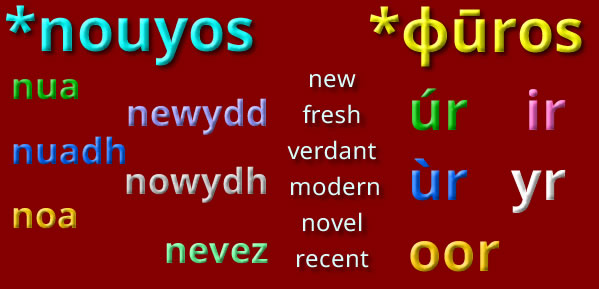
Words for new in Celtic languages

Proto-Celtic *ɸūros = new
Old Irish (Goídelc) úr = fresh, new
Middle Irish (Gaoidhealg) úr = fresh, new, bright, noble, generous, fair, active, recent
Irish (Gaeilge) úr [uːɾˠ] = fresh; free, liberal, moist
úrach = green timber
úraigh = to freshen, scour, cleanse, become moist, damp
úras = new milk
úrchneasach = fresh-complexioned
Scottish Gaelic (Gàidhlig) ùr [uːr] = new, fresh
ùrachadh = refreshing, renewing, renovating, renewal
ùr-ghnàthaich = innovative, innovatory
ùr-ghnàthaichear = innovator
ùrad = degree of newness, novelty
Manx (Gaelg) oor = new, sweet, novel, sappy, crisp, span, fresh, hour, raw
ooragh = hourly, refreshing
ooraghey = to freshen, purify, refresh, relieve, sweeten
ooraghtoil, oorey = refreshing
Welsh (Cymraeg) ir [iːr] = verdant, green, juicy, sappy, moist, succulent, not withered, not dried up or coagulated, fresh, undried; mild; alive, thriving, lively, vigorous; new, fresh, young, unripe
iraidd = fresh, verdant, green, juicy, sappy, moist, liquid
Cornish (Kernewek) yr [ɪ:r/iːr] = fresh

Etymology: from the Proto-Indo-European *puHrós (wheat), possibly from *pewH- (to be clean, pure) [Source].

Words from the same PIE roots include pure in English, პური (ṗuri – bread, wheat) in Georgian, and պուրի (puri – a type of bread) in Armenian [Source].

Proto-Celtic *nouyos = new
Gaulish *novios = (used in place names)
Celtiberian nouiza = new
Old Irish (Goídelc) núa [n͈uːa̯] = new
Middle Irish (Gaoidhealg) núa(e) = new, recent, fresh, lusty, vigorous, fair, clear, bright, lately, anew, again, recently
Irish (Gaeilge) nua [n̪ˠuə / n̪ˠuː] = new, fresh, recent, novel; newness, new thing
nua-aimseartha = modern
nuachan = novation
nuacht = news, novelty
nuachtóir = reporter, journalist
Scottish Gaelic (Gàidhlig) nuadh [nuəɣ] = new, fresh, recent, novel, modern, unfamiliar
a-nuadh = anew
nua-aimsireach = modern, up to date
nua-fhasanta = newfangled
nuadhachadh = renewing, renovating
nuadhachas = novelty, innovation
Manx (Gaelg) noa = fresh, modern, new, novel, original, recent, unused
noa-emshiragh = modern
noaght = freshness, modernity, newness, novelty
noaid = freshness, innovation, newness, novelty, originality
aanoaghey = to rejuvenate, renew, renovate
Proto-Brythonic *newɨð = new
Old Welsh neguid = new
Middle Welsh (Kymraec) newyt, newyd = new, recent, modern, late, novel
newydhau, newyddhau = to renew, renovate, restore
Welsh (Cymraeg) newydd [ˈnɛu̯.ɨ̞ð/ˈnɛu̯.ɪð] = new, recent, newly-grown, modern, late, novel, changed, different; new (moon), unused, fresh
newyddaf, newyddu = to renew, renovate, restore, be renewed or restored, replace, change, reform, modernize, innovate
newyddaidd = newish, new, modern, newfangled, fresh, renewed
newyddair = neologism, new word or spelling
newyddeb = novelty, innovation
newyddiadur = newspaper
newyddiadura = to be a journalist
newyddiadureg = jouralese, journalism
Middle Cornish (Cernewec) newydh, nowydh, nowedh = new, fresh, late, recent
Cornish nowydh = fresh, new, novel, newly, just
nowydh flamm = brand new
nowydh genys = newborn
Old Breton nouuid = new
Breton (Brezhoneg) nevez [ˈne.ve] = new
nevezadeg restoration campaign
nevezadenn = innovation
nevezadenniñ = to innovate
nevezadur = innovation, updating, actualisation
nevezer = innovator

Etymology: from the Proto-Indo-European *néw(y)os (new) [Source]. The town of Noia in A Coruña in Galicia in the northwest of Spain probably gets its new from the same Proto-Celtic root possibly via Celtiberian [Source].

Words marked with a * are reconstructions.

Sources: Wiktionary, Am Faclair Beag, Online Manx Dictionary, Teanglann.ie, eDIL – Electronic Dictionary of the Irish Language, In Dúil Bélrai English – Old Irish glossary, Geiriadur Prifysgol Cymru, Gerlyver Kernewek, Dictionaire Favereau, TermOfis, English – ProtoCeltic WordList (PDF), Etymological Dictionary Of Proto Celtic
The Fastest Way to Learn Japanese Guaranteed with JapanesePod101.com
