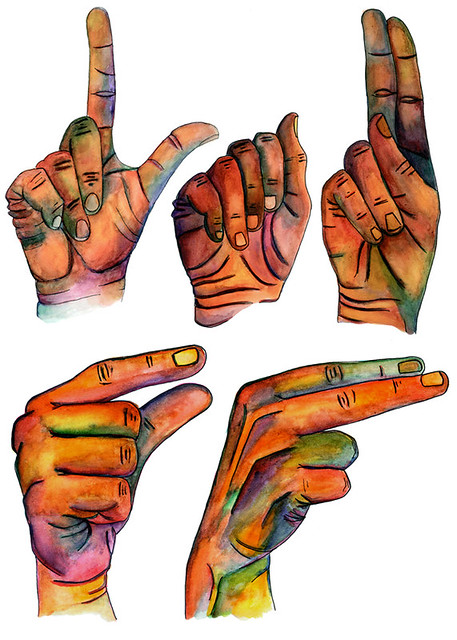
Fingers and Toes

Words for finger, toe and related things in Celtic languages.

Laugh

Proto-Celtic *makro = finger
Old Irish (Goídelc) mér [mʲeːr] = finger, digit, toe
Middle Irish (Gaoidhealg) mér, mer, meóir, meúir = finger, digit, toe
Irish (Gaeilge) méar [mʲeːɾˠ] = finger, digit, toe, leg (of crustaceans, mollusks, etc), arm (of a cuttle fish)
an mhéar thosaigh/cholbha = the forefinger, index finger
an mhéar fhada/láir/mheáin = (the) middle finger
méar an fháinne = ring finger
an mhéar bheag / lúidín / lúideog = (the) little finger
méar coise = toe
Scottish Gaelic (Gàidhlig) meur [miar] = finger, digit, branch (of an organisation/family), key (in music), point (of an antler), knot (in wood)
meur-meomhair = forefinger, index finger
meur-meadhain / (am) meur fada / (am) meur meadhanach = middle finger
màthair na lùdaige / mac an aba / am madadh fada = ring finger
meur beag an airgid / plaoisgeag = little finger
Manx (Gaelg) mair = finger, digit, prong, ray, (piano) key, hand (of clock), tributary (of river)
corrag / corvair = the forefinger, index finger
mair vooar = the middle finger
mair ny fainey = ring finger
mair veg = the little finger
mair chass / mair choshey = toe
mair choshey veg / mair veg ny coshey = little toe

Etymology: possibly from the Proto-Indo-European *mh₂ḱros (lean, meager), which is also the root of the English word meagre/meager, the French word maigre (meagre, skinny, lean, thin), and the Spanish word magro (lean)[source].

Proto-Celtic *bissī / *bistis = finger
Old Irish (Goídelc) biss = icicle
Middle Welsh (Kymraec) biss, byss, bys = finger, toe, latch
Welsh (Cymraeg) bys [bɨːs / biːs] = finger (of hand/glove), toe; medium, agency; hand (of clock); latch
bys bawd = thumb
bys blaen = forefinger, index finger
bys y cogwrn = middle finger (“knuckle finger”)
bys y gyfaredd = ring finger
bys bach = little finger, ear-finger; minute-hand
bys(i)aid = as much as can be held on or taken up by the finger, a pinch
byseddaf, byseddu, bysedda = to finger, thumb, use the fingers
byseddog = having fingers, fingered
byseg = thimble
bysfedd = finger’s breadth, digit
byson = ring for the finger
Old Cornish bis/bes = finger
Middle Cornish (Cernewec) bis, bes = finger
bis truit = toe
bisou, besaw = ring
Cornish (Kernewek) bys, bes = finger, digit
bys bras = thumb
bys rag = index finger
bys kres = middle finger
bys bysow = ring finger
bys byghan / bes bian = little finger
byskon = thimble
bysow, besow = ring
Middle Breton (Brezonec) bes, bys, bis = finger
besou, bisou = ring
Breton (Brezhoneg) biz [biːs] = finger, hand (of clock), tooth (of tool), leg (of anchor), tentacle, tendril
biz-meud = thumb
biz-yod = index finger
biz bras = middle finger
biz-gwalenn / biz bizou = ring finger
biz bihan / skouarnel = little finger
bizou, bizoù [ˈbiːzu] = ring, jewel
bizouier = jeweller
bizour = jewel

Etymology: from the Proto-Indo-European *gʷist- (twig, finger). The French word bijou (a piece of jewellry), comes from the same root, via the Breton bizoù (ring), from biz (finger) [source].

Proto-Celtic *māto = finger
Old Welsh (Kymraec) máut = finger, toe, latch
Middle Welsh (Kymraec) mawd, baut, bawd = finger, toe, latch
Welsh (Cymraeg) bawd = thumb, big toe; claw (of crab), hoof
bawd troed = big toe
bawdheglaf, bawdheglu = to hitch-hike
Middle Cornish (Cernewec) meut = thumb
Cornish (Kernewek) meus = thumb
meusva = inch
meusya = to hitchhike
Middle Breton (Brezonec) meut = thumb
Breton (Brezhoneg) meud [ˈmøːt] = thumb, pincer, claw
meud-troad = big toe, toe
meudadenn = grip (of the thumb)
meudata = to knead with one’s thumb

Etymology: from the Proto-Indo-European *mē- [source].

Old Irish (Goídelc) ordu = thumb, big toe
Middle Irish (Gaoidhealg) ordu, órdu = thumb, big toe
Irish (Gaeilge) ordóg [ˈəuɾˠd̪ˠoːɡ] = thumb, big toe, claw, pincers, bit, piece, fragment
ordóg coise = big toe
Scottish Gaelic (Gàidhlig) òrdag [ɔːr̪ˠdag] = thumb, big toe
òrdag-coise / òrdag-mhór = big toe
òrdag-làimhe = thumb
òrdag bheag an airgid = little toe, little finger
Manx (Gaelg) ordaag = thumb
ordaag chass / ordaag choshey / ordaag vooar = big toe

Etymology: possibly from the Old Irish ord/ordd (hammer, piece, fragment, stub), from the Proto-Celtic *ordos (hammer) [source].

Old Irish (Goídelc) ladar = grasp, grip
Middle Irish (Gaoidhealg) ladar, ladair = fork or space between the fingers or between the thumb and the rest of the hand; grip, grasp; space between the toes
Irish (Gaeilge) ladhar [lˠaiɾˠ] = space between toes or fingers, toe, claw, prong, (clawed) hand
ladhar mhór = big toe
ladhar bheag = little toe
laidhricín = little toe, little finger
lúidín / lúideog = little finger, little toe
lúidín coise = little toe
Scottish Gaelic (Gàidhlig) ladhar [l̪ˠɤ.ər] = hoof, prong, toe, claw (of lobster)
ladhrag [l̪ˠɤːrag] = toe, prong, hoof
an ladhar mór = big toe
lùdag / lùdag bheag / lùdag dhubh na catha [l̪ˠuːdag] = little finger, hinge

Etymology: unknown [source].

The Fastest Way to Learn Japanese Guaranteed with JapanesePod101.com

Sources: Wiktionary, Am Faclair Beag, Online Manx Dictionary, Teanglann.ie, eDIL – Electronic Dictionary of the Irish Language, In Dúil Bélrai English – Old Irish glossary, Geiriadur Prifysgol Cymru, Gerlyver Kernewek, Dictionaire Favereau, TermOfis, English – ProtoCeltic WordList (PDF), Etymological Dictionary Of Proto Celtic

Unlimited Web Hosting - Kualo

Seals

Words for seal and other creatures in Celtic languages.

Seals

Species of seals that may be found around the Celtic lands include the common or harbour seal (Phoca vitulina) and the grey seal (Halichoerus grypus). Other species are available.

Words marked with a * are reconstructions.

Old Irish (Goídelc) rón = seal
Middle Irish (Gaoidhealg) rón, ron = seal
Irish (Gaeilge) rón = seal
rón beag = harbour/common seal
rón glas = grey seal
rónach = seals, abounding in seals
cladach rónta = shoal of seals
Scottish Gaelic (Gàidhlig) ròn [r̪ˠɔːn] = seal
ròn cumanta / ròn-dubh = harbour/common seal
ròn glas = grey seal
rònan [r̪ˠɔːnan] = little seal
rònach [r̪ˠɔːnəx] = pertaining to or abounding in seals
rònanach [r̪ˠɔːnanəx] = pertaining to or abounding in little seals
Manx (Gaelg) raun = seal
raun beg = harbour/common seal
raun glass/ghlass = grey seal
raunagh = seal-like, seal hunt
Middle Welsh (Kymraec) moelronyeit, moelrawn, moelrhawn = hippopotamus, seal
Welsh (Cymraeg) moelrhon, moelrhawn = seal, porpoise, dophin, hippopotamus
moelrhonaidd = seal-like
moelrhoniwr = seal hunter
Cornish (Kernewek) reun = seal
reun kemmyn = harbour/common seal
reun loos = grey seal
Breton (Brezhoneg) reunig = seal
reunig morleue = harbour/common seal
reunig gris = grey seal

Etymology: possibly from Old English hran (whale), from Proto-Germanic *harza/harza- (a kind of fish). Incidentally, the Irish name Rónán means “little seal” [source].

Middle Welsh (Kymraec) morhwch, morwch = seal, porpoise, dolphin
Welsh (Cymraeg) morwch, môr-hwch = seal, porpoise, dolphin
Old Cornish morhoch = porpoise
Middle Cornish (Cernewec) morhoch = porpoise
Cornish (Kernewek) morhogh = porpoise
Middle Breton (Brezonec) morhouch, mourouch, moroch = porpoise
Breton (Brezhoneg) morhoc’h = porpoise

Etymology (Welsh): from môr (sea) and hwch (calf). The words in Cornish and Breton come from similar roots [source].

Middle Welsh (Kymraec) morylo = seal
Welsh (Cymraeg) morlo [ˈmɔrlɔ] = seal, sealskin
morlo cyffredin = common seal
morlo llwyd = grey seal
Breton (Brezhoneg) leue-mor = seal

Etymology (Welsh): from môr (sea) and llo (calf). The word in Breton come from similar roots [source].

The Fastest Way to Learn Japanese Guaranteed with JapanesePod101.com

Sources: Wiktionary, Am Faclair Beag, Online Manx Dictionary, Teanglann.ie, eDIL – Electronic Dictionary of the Irish Language, In Dúil Bélrai English – Old Irish glossary, Geiriadur Prifysgol Cymru, Gerlyver Kernewek, Dictionaire Favereau, TermOfis, English – ProtoCeltic WordList (PDF), Etymological Dictionary Of Proto Celtic

Unlimited Web Hosting - Kualo

Salmon

Words for salmon in the Celtic languages. The species of salmon most common found around Celtic speaking lands is the Atlantic salmon (Salmo salar). Other species of salmon are available.

There are three words for salmon in Proto-Celtic: *esoxs / *esāk, *φenk-īnjo and *φorko. Only the first one has descendents in the modern Celtic languages.

Proto-Celtic *esoxs / *esāk = salmon
Gallaecian *īsis = salmon
Gaulish *esoks = salmon
Old Irish (Goídelc) eo [eːo̯] = salmon
Irish (Gaeilge) eo [oː / ɔː] = salmon; noble being, prince
Scottish Gaelic (Gàidhlig) [jɔː] = salmon (archaic)
eog = salmon
Proto-Brythonic *esāx = salmon
Middle Welsh (Kymraec) ehawc = salmon
Welsh (Cymraeg) eog [ˈɛ.ɔɡ / ˈeː.ɔɡ] = salmon, sea-trout, sewin, samlet
Old Cornish ehoc = salmon
Cornish (Kernewek) eghek = salmon
Middle Breton eheuc = salmon
Breton (Brezhoneg) eog = salmon

Etymology: possibly from the Proto-Indo-European *peysḱ- (fish).

Old Irish (Goídelc) bratán = salmon
Irish (Gaeilge) bradán [bˠɾˠəˈd̪ˠaːn̪ˠ / ˈbˠɾˠad̪ˠaːnˠ / ˈbˠɾˠɑd̪ˠɑnˠ] = salmon
Scottish Gaelic (Gàidhlig) braden [bradan] = salmon
Manx (Gaelg) braddan = salmon

Etymology: from the Old Irish brat (captivity, bondage, robbery) and án (diminutive suffix).

Welsh (Cymraeg) samon / samwn = salmon
Cornish (Kernewek) sowman = salmon
Breton (Brezhoneg) somon = salmon

Etymology: from the English salmon, from the Middle English samoun, samon, saumon (salmon), from the Anglo-Norman saumon (salmon), from the Old French saumon, from the Latin salmō (salmon), either from the Proto-Celtic *esoxs / *esāk, or from the Latin saliō (to leap).

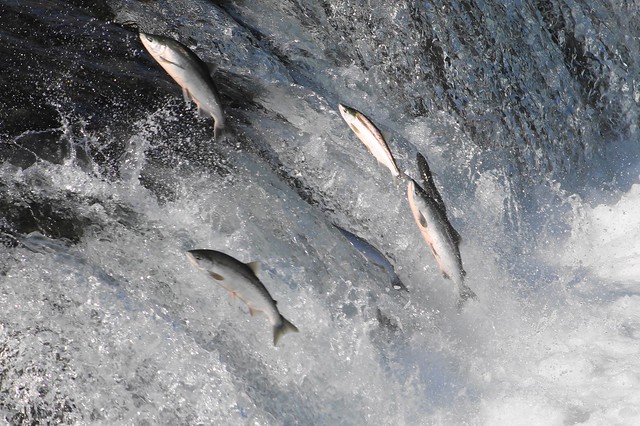
Salmon Jumping Falls (NPS/D. Jacob)

Sources: Wiktionary, Am Faclair Beag, MacBain’s Dictionary, In Dúil Bélrai English – Old-Irish Glossary, teanglann.ie, On-Line Manx Dictionary, Geiriadur Prifysgol Cymru, Gerlyver Kernewek, Dictionnaire Favereau, TermOfis

Fish

Words for fish and related things in the Celtic languages.

Fish

Proto-Celtic *ɸēskos = fish
Old Irish (Goídelc) íasc = fish
íascach = fish, fishing
Middle Irish (Gaoidhealg) íasc, iasc, īesc, éisc, escc = fish
íascach, iasccach = abounding in fish
íascaire, iscaire = fisherman
íasmar, iascchmar = full of fish, productive in fish
Irish (Gaeilge) iasc [iəsˠk] = fish, to fish
iasc = fishing, fishery
iascaire = fisherman
iascaireacht = fishing, fishery
iasceolaíocht = ichthyology (scientific study of fish)
iasciteach = fish-eating, ichthyophagous
iascúil = abounding in fish, easy to fish, good at fishing
Scottish Gaelic (Gàidhlig) iasg [iəsg] = fish, Pisces
iasgach [iəsgəx] = fishing, angling, fishery
iasgachadh [iəsgəxəɣ] = (act of) fishing
iasgadair [iəsgədɪrʲ] = fisher(man)
iasgail [iəsgal] = fishy, pertaining to fish, good for fishing
iasgan [iəsgan] = small fish, mussel
Manx (Gaelg) (y)eeast = fish
eeastagh(ey) = to angle, to fish, angling, fishing
eeasteyr = fisherman
eeasteyraght = fishery, fishing
eeasteyrys = fishing
eeastoil = abounding in fish, fishy
eeast-oaylleeaght = ichthyology
Proto-Brythonic *uisk = fish
*Uɨsk = fish, river name (originally meaning “abundant in fish”)
Welsh (Cymraeg) Wysg [uːɨ̯sk / ʊi̯sk] = Usk (a river and town in south Wales)
Caerwysg = Exeter

Etymology: from the Proto-Indo-European *pisḱ-/peysḱ- (fish) [source]. The name of the river Exe in Devon comes from the same root, as does Exmoor, where the river rises, Exmouth, where it meets the sea, and Exeter, which stands on the river. The rivers Esk (North Yorkshire, Cumbria, Dumfries and Galloway, and East Lothian) and Axe (one in Dorset, Somerset, Devon; and another in Somerset) get their names from the same root [source].

Proto-Brythonic *pɨsk [pɨsk] = fish
*pɨskọd [pɨˈsˑkɔːd] = fish (pl)
Middle Welsh (Kymraec) pisscaud, psycgaut, pesgod = fish(es), Pisces
pysgodfwyd = ichthyophagous, piscivorous, fish-eating, fish-meal
pysgodlyn, pyscotlyn = fish-pool, fish-pond
peskod ha, pyscotta, pyscota = to fish, angle, fishing
pyscodwr, pyscod-wr, pyscottwr = fisherman, fisher
Welsh (Cymraeg) pysgod [ˈpəsɡɔd] = fish(es), Pisces
pysgodaidd = fishy, piscine, piscatory, piscatorial
pysgodfwyd = ichthyophagous, piscivorous, fish-eating, fish-meal
pysgodig = full of fish
pysgodlyn = fish-pool, fish-pond
pysgota = to fish, angle, fishing industry
pysgotwr = fisherman, fisher, angler, kingfisher, fishmonger
Middle Cornish (Cernewec) pisc, pysc = fish
piscadur, pysgadyr = fisherman
pisclin = fishpond
pisgetta, pysgetta = to fish
Cornish (Kernewek) pysk [pɪːsk] / pesk = fish
pyskador, peskador = fisherman
pyskadores, peskadores = fisherwoman
pyskessa, peskecha = to fish
pysklyn, pesklyn = fishpond
pyskva, peskva = aquarium
Middle Breton (Brezonec) pesq(uet) = fish
Breton (Brezhoneg) pesk(ed) [ˈpes.k(et)] = fish
pesker [ˈpeskɛʁ] = fishmonger, fisher(man)
pesketa [pɛs.ˈke.ta] = to fish
pesketaerezh [pɛs.ke.ˈtɛː.rɛs] = fishing, fisheries

Etymology: from the Latin piscātus, past participle of piscor (to fish), from piscis (fish), from Proto-Indo-European *péysks (fish) [source]. Words from the same PIE root include peshk (fish) in Albanian, pesce (fish) in Italian, poisson (fish) in French, fish, piscine (pertaining to fish), Pisces in English, and fisk (fish, Pisces) in Danish [source].

Interesting idioms related to fish:

  • Irish: Iasc as uisce i do bhéal! = Restrain your tongue! (“Fish out of water in your mouth”)
  • Irish: Ar iascadh libh? = Did you catch fish / succeed in your quest
  • Irish: Ar iascach ar dhuine = to fish information from sb
  • Scottish Gaelic: gaoth an iar, iasg is bainne = wind from the West, fish and milk
  • Welsh: pysgota mewn dŵr llwyd = to fish in troubled waters (“to fish in grey water”)

The Fastest Way to Learn Japanese Guaranteed with JapanesePod101.com

Sources: Wiktionary, Etymological Dictionary Of Proto Celtic, In Dúil Bélrai English – Old Irish glossary, eDIL – Electronic Dictionary of the Irish Language, Teanglann.ie, Am Faclair Beag, An etymological dictionary of the Gaelic language, Fockleyreen: Manx – English Dictionary, Online Manx Dictionary, Gaelg Corpus, Geiriadur Prifysgol Cymru, Lexicon cornu-britannicum : a dictionary of the ancient Celtic language of Cornwall, Gerlyver Kernewek, Devri : Le dictionaire diachronique du breton, Dictionnaires bilingues de Francis Favereau / Edition Skol Vreizh, TermOfis

Unlimited Web Hosting - Kualo

Ducks

Words for ducks in Celtic languages.

Old Irish (Goídelc) *lachu [ˈl͈axu] = duck
Irish (Gaeilge) lacha [ˈl̪ˠaxə] = duck
lacha bhreac / lacha chriosrua / seil lacha = shelduck (Tadorna tadorna)
iolar mara / coirneach / mallard = mallard (Anas platyrhynchos)
Scottish Gaelic (Gàidhlig) lach [l̪ˠax] = (wild) duck
crà-ghèadh / cràighiadh / crà-eun = shelduck
lach-Mhoire / lach-riabhach = mallard
Manx (Gaelg) laagh = duck, wild goose
laagh chryss-ruy = shelduck
laagh voirrey / mallard = mallard

Etymology: possibly from the same Proto-Indo-European root as the Lithuanian word lak (to fly).

Irish (Gaeilge) tonóg = duck; dumpy little woman
Scottish Gaelic (Gàidhlig) tunnag [ˈtʰun̪ˠak] = duck
tunnag-mhonaidh / tunnag-fhiadhaich = mallard
Manx (Gaelg) thunnag = duck
thunnag vreck = shelduck

Etymology: unknown

Proto-Celtic *awis = bird (?)
Irish (Gaeilge) aí / ai / aoi = swan
Scottish Gaelic (Gàidhlig) ai = swan
Proto-Brythonic *(s)awyetos = duck (?)
Middle Welsh (Kymraec) hwyat / hwyeit = duck
Welsh (Cymraeg) hwyad(en) [ˈhʊɨ̯.ad / ˈhʊi̯.ad] = (female) duck
hwyaden yr eithin / hwayaden fraith = shelduck
hwyaden wyllt / meilad = mallard
Old Cornish hoet = duck
Cornish (Kernewek) hos = duck
hos eythyn = shelduck
hos gwyls / mallart = mallard
Breton (Brezhoneg) houad = duck
tadorn toveel = shelduck
houad-korz = mallard

Etymology: from the Proto-Indo-European *h₂éwis (bird) [source], which is also the root of such English words as avian, aviary, aviation and aviator, via the Latin avis (bird).

The species of ducks included here are found in Celtic-speaking lands. Other types of ducks are available.

Ducks!

Sources: Wiktionary, Am Faclair Beag, MacBain’s Dictionary, In Dúil Bélrai English – Old-Irish Glossary, teanglann.ie, On-Line Manx Dictionary, Geiriadur Prifysgol Cymru, Gerlyver Kernewek, Dictionnaire Favereau, TermOfis

Geese

Celtic words for goose, waterfowl of the genus of the family Anatidae.

Geese / Gwyddau

Words marked with a * are reconstructions.

Proto-Celtic *gezdā = goose
Old Irish (Goídelc) géd = goose
Irish (Gaeilge) [ɟeː] = goose
gé ghlas = greylag goose (Anser anser)
gé ghiúrainn = barnacle goose (Branta leucopsis)
cadhan = brent goose (Branta bernicla)
gé Cheanadach = Canada goose (Branta canadensis)
Scottish Gaelic (Gàidhlig) gèadh [gʲiəɣ] = goose
gèadh-glas = greylag goose
cathach [ka.əx] = barnacle goose
gèadh-got = brent goose
gèadh Canadach = Canada goose
Manx (Gaelg) guiy = goose
guiy glass = greylag goose
guiy twoaie = barnacle goose
guiy breck = brent goose
guiy Canadagh = Canada goose
Middle Welsh (Kymraec) guit = goose
Welsh (Cymraeg) gŵydd [ɡuːɨ̯ð / ɡʊi̯ð] = goose, simpleton
gŵydd wyllt (gyffredin) = greylag goose, wild goose
gŵydd (g)wyrain = barnacle goose
gŵydd ddu brent goose
gŵydd Ganada = Canada goose
Old Cornish guit = goose
Cornish (Kernewek) goedh = goose
goth wyls = greylag goose, wild goose
morwoth = barnacle goose
goth mannow = brent goose
goth kanada = Canada goos
Breton (Brezhoneg) gwaz = goose
gwaz louet = greylag goose, wild goose
garreli dremm wenn = barnacle goose
garreli boutin = brent goose
garreli-Kanada = Canada goose

Note: the types of goose mentioned here are commonly found in Celtic-speaking areas. Other types of geese are available.

Here’s a tune I wrote inspired by a couple of geese (pictured above) who used to live on the seashore in Bangor, and who I called Bertie and Gertie: Goosing Around / Gwyddio o Gwmpas

Sources: Wiktionary, Am Faclair Beag, MacBain’s Dictionary, In Dúil Bélrai English – Old-Irish Glossary, teanglann.ie, fócloir.ie, On-Line Manx Dictionary, Geiriadur Prifysgol Cymru, Gerlyver Kernewek, Dictionnaire Favereau, TermOfis

Gulls

Celtic words for (sea)gull, seabirds of the genus Larus or of the family Laridae.

Blackheaded gulls

Words marked with a * are reconstructions.

Proto-Celtic *wailannā / *voilenno- = seagull
Old Irish (Goídelc) faílenn, foílenn = seagull
Irish (Gaeilge) faoileán, faoileog = gull, seagull
faoileán bán = common gull (Larus canus)
faoileán ceanndubh, faoileán an chaipín = black-headed gull (Chroicocephalus ridibundus)
faoileán droma duibh = greater black-backed gull (Larus marinus)
foillan scadán = (Larus argentatus)
Scottish Gaelic (Gàidhlig) faoileann [fɯːlən̪ˠ], faoileag [fɯːlag] = gull, seagull, common gull
faoileann-bheag = common gull
faoileann-dubh = black-headed gull
faoileann a’ chinn dhuibh = greater black-backed gull
faoileann-mhór = herring gull
Manx (Gaelg) foillan, foilleig, fooilleig = gull, seagull
foillan bane = common gull
foillan kione doo = black-headed gull
foillan saggyrt = greater black-backed gull
foillan skeddan = herring gull
Proto-Brythonic *gwuɨlann = seagull
Middle Welsh (Kymraec) gwylan = seagull
Welsh (Cymraeg) gwylan [ˈɡʊɨ̯lan / ˈɡʊi̯lan] = sea-gull, sea-mew; fair maiden; glutton
gwylan gyffredin = common gull
gwylan goes goch / gwylan benddu = black-headed gull
gwylan gefnddu = greater black-backed gull
gwylan y penwaig = herring gull
Old Cornish guilan = seagull
Cornish (Kernewek) golan [ˈɡoːlan / ˈɡʊlɐn] = gull, seagull
gwylan gemyn = common gull
skraw / skrawik / scraw = black-headed gull
gwylan keyn du = greater black-backed gull
gwylan hern = herring gull
Old Breton guilann = seagull
Middle Breton goelann = seagull
Breton (Brezhoneg) gouelan [ˈɡweːlãn] = seagull
gouelan loue = common gull
gouelanig maskl du = black-headed gull
gouelan bras = greater black-backed gull
gouelan gris = herring gull

Etymology: thought to be from the Proto-Indo-European *wáy (oh! ah! woe! alas!), possibly related to *waylos (howler, wolf) [source].

The English word gull comes from the Middle English gulle (gull, water bird) and is thought to have been borrowed from a Brythonic language (Welsh or Cornish) [source].

The French word goéland (gull, herring gull) comes from the Breton gouelan [source].

Note: the types of gulls mentioned here are commonly seen in Celtic-speaking areas. Other gulls are available.

Here’s a song I wrote in Manx and English about seagulls and their love of chips: Spollagyn son tey / Chips for tea

The Fastest Way to Learn Japanese Guaranteed with JapanesePod101.com

Sources: Wiktionary, Etymological Dictionary Of Proto Celtic, In Dúil Bélrai English – Old Irish glossary, eDIL – Electronic Dictionary of the Irish Language, Teanglann.ie, Am Faclair Beag, An etymological dictionary of the Gaelic language, Fockleyreen: Manx – English Dictionary, Online Manx Dictionary, Gaelg Corpus, Geiriadur Prifysgol Cymru, Lexicon cornu-britannicum : a dictionary of the ancient Celtic language of Cornwall, Gerlyver Kernewek, Devri : Le dictionaire diachronique du breton, Dictionnaires bilingues de Francis Favereau / Edition Skol Vreizh, TermOfis

Unlimited Web Hosting - Kualo

Swallows

Words for swallows, swifts and martins in Celtic languages.

Proto-Celtic *wesnālā = swallow
Old Irish (Goídelc) ainnel, fannall = swallow
Middle Irish (Gaoidhealg) áilleóc, fainleóc = swallow
Irish (Gaeilge) fáinleog, áinleóg = swallow
Scottish Gaelic (Gàidhlig) (f)ainnleag [(f)ãĩn̪ʲl̪ʲag] = swallow, martin, storm(y) petrel
Proto-Brythonic *gwennọl = swallow
Old Welsh guennol = swallow
Middle Welsh (Kymraec) gwennawl = swallow
Welsh (Cymraeg) gwennol [ˈɡwɛnɔl] = swallow, martin; weaver’s shuttle
Cornish (Kernewek) gwennol = swallow
Old Breton guennol = swallow
Middle Breton guennel = swallow
Breton (Brezhoneg) gwennel = swallow

Etymology: from the Proto-Indo-European *wós-r̥/*wés-n̥s (spring) [source].

Irish (Gaeilge) gabhlán = martin
gabhlán-binne = house martin (delichon urbicum))
gabhlán gainimh = sand martin (riparia riparia)
gabhlán gaoithe = swift (apus apus)
Scottish Gaelic (Gàidhlig) gòbhlan [gɔːl̪ˠan] = swallow, martin; prong, small fork
gòbhlan-gaoithe [goːl̪ˠan’gɤjə] = barn swallow (hirundo rustica)
gòbhlan-gainmhich [goːl̪ˠan gɛnɛvɪç] = sand martin, bank swallow
gòbhlan-dubh [goːl̪ˠan du] = (common) swift
gòbhlan-mara [goːl̪ˠan marə] = storm(y) petrel (hydrobatidae)
Manx (Gaelg) gollan = swift, martin; fork
gollan geayee = swallow
gollan gheinnee = sand martin
gollan mooar = swift
gollan thie = house martin

Etymology: from the Old Irish gabul (fork, forked branch), from the Proto-Celtic *gablā (fork, branch, gallows), from the Proto-Indo-European *gʰeh₁bʰ- (to grab, take) [source].

Words marked with a * are reconstructions.

Flying swallow

Here’s a tune I wrote called The Swallow / Y Wennol:

Sources: Wiktionary, Am Faclair Beag, MacBain’s Dictionary, In Dúil Bélrai English – Old-Irish Glossary, teanglann.ie, On-Line Manx Dictionary, Geiriadur Prifysgol Cymru, Gerlyver Kernewek, Dictionnaire Favereau

Swans

Words for swan (cygnus) in Celtic languages.

Swans, etc

Proto-Celtic *eli- = swan
Gaulish ala = swan
alauda = skylark
Old Irish (Goídelc) elu = swan
Middle Irish (Gaoidhealg) ela(e) = swan
Irish (Gaeilge) eala [ˈalˠə] = swan
ealach = frequented by swans
eala bhalbh = mute swan (Cygnus olor)
eala ghlorach = whooper swan (Cygnus cygnus)
Scottish Gaelic (Gàidhlig) eala [jal̪ˠə] = swan
eala bhàn = mute swan
eala fhiadhaich = whooper swan
ealag, eala-ghlas = cygnet, young swan
eala-bheag = Bewick’s (tundra) swan (Cygnus columbianus bewickii)
Manx (Gaelg) olla, ollay = (mute) swan
ollay chiaulee = whooper swan
eean olla = cygnet
Proto-Brythonic alarkos = swan
Middle Welsh (Kymraec) alarch = swan
Welsh (Cymraeg) alarch [ˈalarχ/ˈaːlarχ] = swan, the constellation Cygnus
alarchaidd = pertaining to a swan, swanlike
alarchen = cygnet
alarches = female swan
alarchwedd = swanlike
alarch dôf, alarch mud = mute swan
alarch y gogledd, alarch chwibanol, alarch gwyllt = whooper swan
Old Cornish elerch = swan
Middle Cornish (Cernewec) elerch = swan
Cornish (Kernewek) alargh = (mute) swan
Middle Breton (Brezonec) alarc’h = swan
alarc’hez = female cygnet
Breton (Brezhoneg) alarc’h = swan
alarc’h roueel = mute swan
alarc’h-kristilh = whooper swan

Etymology: from the Proto-Indo-European *h₁el- (swan, bird, waterfowl) [source].

Words from the same Proto-Celtic root include alondra (lark) in Spanish, alouette (lark) in French, and allodola (skylark) in Italian. They were probably borrowed from the Gaulish alauda (skylark), from ala (swan) [Source].

Words from the same PIE root include auk (swan) in English, alke (auk) in Danish and Norwegian, and álka (razorbill) in Faroese and Icelandic [Source].

Words marked with a * are reconstructions.

Sources: Wiktionary, Am Faclair Beag, Online Manx Dictionary, Teanglann.ie, eDIL – Electronic Dictionary of the Irish Language, In Dúil Bélrai English – Old Irish glossary, Geiriadur Prifysgol Cymru, Gerlyver Kernewek, Dictionaire Favereau, TermOfis, English – ProtoCeltic WordList (PDF), Etymological Dictionary Of Proto Celtic
The Fastest Way to Learn Japanese Guaranteed with JapanesePod101.com

Starlings

Words for starling (sturnus vulgaris) in Celtic languages.

Proto-Celtic *trozdis = starling
Old Irish (Goídelc) truit = starling
Middle Irish (Gaoidhealg) truit = starling
Irish (Gaeilge) druid [d̪ˠɾˠɪdʲ] = starling
Scottish Gaelic (Gàidhlig) druid [drɯdʲ] = starling, thrush
Manx (Gaelg) truitlag = starling
Middle Welsh (Kymraec) trydw, drydwen, drudwy, drydw, drudw = starling
Welsh (Cymraeg) drudw [ˈdrɨ̞dʊ/ˈdrɪdʊ], drudwy, drydwy, drydw = starling, stare
Old Cornish troet = starling
Cornish (Kernewek) trojen = starling
Middle Breton (Brezonec) tret = starling
Breton (Brezhoneg) tred [ˈtʁeːt], tridig = starling

Etymology: from the Proto-Indo-European *trosdos (thrush) [source].

Words marked with a * are reconstructions.

Starlings

Sources: Wiktionary, Am Faclair Beag, MacBain’s Dictionary, In Dúil Bélrai English – Old-Irish Glossary, teanglann.ie, On-Line Manx Dictionary, Geiriadur Prifysgol Cymru, Gerlyver Kernewek, Dictionnaire Favereau