Ears

Words for ears, hares and related things in Celtic languages.

Ears

Words marked with a * are reconstructions.

Proto-Celtic *kloustā = ear, hearing
Old Irish (Goídelc) clúas [kluːa̯s] = ear, hearing
Middle Irish (Gaoidhealg) clúas, cluas = (sense of) hearing, ear
clúasach, clūasach = pleasing to the ear, having (big) ears or handles, big-eared
Irish (Gaeilge) cluas [klˠuəsˠ] = ear; ear-shaped object; lug, handle; cleat; tab; corner, margin
cluasach = having ears, long-eared
cluasachán = long-eared person or animal
cluasaí = listener, eavesdropper
cluasaíocht = eavesdropping, whispering, listening, talking in a furtive manner
cluasán = earphone, headphone
cluasánach = listless, inattentive person
cluasántacht = listlessness, inattention
Scottish Gaelic (Gàidhlig) cluas [kl̪ˠuəs] = ear, lug, handle
cluasach [kl̪ˠuəsəx] = pertaining to ears, aural, having (a) handle(s)
cluasachan [kl̪ˠuəsəxan] = pillow
cluasag [kl̪ˠuəsag] = pillow, bolster
cluasagach [kl̪ˠuəsagəx] = pertaining to or abounding in pillows
cluasaire [kl̪ˠuəsɪrʲə] = (person with) bigs ears
cluasan [kl̪ˠuəsan] = earphone, headset
Manx (Gaelg) cleaysh [kleːʃ] = ear, cleat, handle, lug, top corner of net, corner of sail
cleayshagh = aural, (large-)eared, lugged
cleayshtynagh = audible, listener
Proto-Brythonic *klʉst = ear
Middle Welsh (Kymraec) clust = ear, hearing, handle
clustueinyd, clustfeinydd = attentive or eager listener, eavesdropper
clustiog, klustioc = (large-/long-) eared, having a handle, pertaining to the ear
clustot, clustog, clustoc = cushion, pillow, bolster
Welsh (Cymraeg) clust [klɨːst / klɪst] = ear, sense of hearing, attention, willingness to listen; handle of a vessel, tag of a boot, top part of a bell; creek or inlet; auricle (of the heart)
clustfeinio = to listen closely or attentively, prick up the ears, eavesdrop
clustfeiniol = listening attentively or intently
clustfeiniwr, clustfeinydd = attentive or eager listener, eavesdropper
clustffon, clustffôn = earphone, headphone
clustiog = (large-/long-) eared, having a handle, pertaining to the ear
clustog = cushion, pillow, bolster
clustogi = to cushion, pillow, bolster up, upholster

Etymology: from Proto-Indo-European *ḱlow-steh₂, from *ḱlew- (to hear) [source]. Words from the same roots include clement, client, listen and loud in English, quaj (to call, name, value, declare) in Albanian, luid (loud, sound, assertion) in Dutch, sláva (fame, glory) in Czech, and hljóður (quiet, silent) in Icelandic [source].

Words for Hearing, Fame and Renown in Celtic languages also come from the same PIE roots.

Hare

Scottish Gaelic (Gàidhlig) sgiarnag, sgibearnag = hare
Proto-Brythonic *skuβarn = ear
*skuβarnọg = hare
Middle Welsh (Kymraec) esgyuarn, ysgyuarn, yscyfarn, yskyuarn = ear
ysgyuarnauc, yscyfarnawc, y scyuarnaỽc, ysgyuarnawc, yscyfarnoc = hare
Welsh (Cymraeg) ysgyfar(n) = ear
(y)sgyfarnog, sgwarnog = hare
ysgyfarnogaidd = harelike, leporine
Old Cornish scouarn = ear
scouarnoc = hare
Middle Cornish (Cernewec) scovarn, scouarn, scovern, scovorn, scoforn = ear
scovarnog, scowarnak, scowarnog = hare
Cornish (Kernewek) skovarn [‘skɔvarn / ‘skɔvɐrn] = ear, handle
skovarnek = hare
Old Breton scobarn = ear
Middle Breton (Brezonec) scouarn = ear
scouarnec = having large or long ears, long-eared, having handles
Breton (Brezhoneg) skouarn [skwarn] = ear, gills, handle
skouarnad [ˈskwar.nat] = a slap (on the ear)
skouarnañ = to garnish with an ear or handle
skouarnata [skwarˈnatːa] = to slap, to rub or pull ears
skouarneg [ˈskwar.nɛk] = hare
skouarnek [ˈskwar.nɛk] = having large or long ears, long-eared, having handles

Etymology: possibly from Proto-Indo-European *(s)kewh₁- (to observe, perceive) [source]. Words from the same PIE root include cautious, caveat and show in English, schouwen (to inspect, examine) in Dutch, schauen (to look, watch, view) in German, and cauto (prudent, cautious, sly) in Italian [source].

Irish (Gaeilge) giorria [ˈɟɪɾˠiə/ˈɟaɾˠiə] = hare
Scottish Gaelic (Gàidhlig) geàrr [gʲaːr̪ˠ] = hare
gearrach [gʲar̪ˠəx] = hare
giorrasach [gʲir̪ˠəsəx] = hare
geàrr-fhiadh = hare
gearrag [gʲar̪ˠag] = leveret, young hare

Etymology: from Old Irish gerr (short) and fíad (deer, wild animal(s)) [source].

Old Irish (Goídelc) míl maige = hare
Middle Irish (Gaoidhealg) míl maige = hare
Scottish Gaelic (Gàidhlig) maigheach [mɤjəx] = hare
Manx (Gaelg) mwaagh = hare
cha follan as mwaagh = brimful of health (“as healthy as a hare”)

Etymology: from Old Irish míl (animal) and mag (plain, field) [source].

Proto-Celtic *kasnī = hare
Old Irish (Goídelc) Cainnech = personal name
Middle Welsh (Kymraec) ceinach = hare
Welsh (Cymraeg) ceinach [ˈkei̯naχ] = hare (archaic – originally meant “(the) grey/white one”)
ceinachgi = harrier, hare-hound

Etymology: from Proto-Indo-European *ḱeh₂s- (hare). Words from the same PIE root include hare in English, haas (hare) in Dutch, Hase (hare) in German, and hase (female rabbit, hare) in French [source].

Middle Cornish (Cernewec) gad = hare
Middle Breton (Brezonec) gat = hare
Breton (Brezhoneg) gad [ɡɑːt] = hare

Etymology: unknown [source].

The Fastest Way to Learn Japanese Guaranteed with JapanesePod101.com

Sources: Wiktionary, Etymological Dictionary Of Proto Celtic, In Dúil Bélrai English – Old Irish glossary, eDIL – Electronic Dictionary of the Irish Language, Teanglann.ie, Am Faclair Beag, An etymological dictionary of the Gaelic language, Fockleyreen: Manx – English Dictionary, Online Manx Dictionary, Gaelg Corpus, Geiriadur Prifysgol Cymru, Lexicon cornu-britannicum : a dictionary of the ancient Celtic language of Cornwall, Gerlyver Kernewek, Devri : Le dictionaire diachronique du breton, Dictionaire Favereau, TermOfis

Unlimited Web Hosting - Kualo

Lips, Mouths & Throats

Words for lip, mouth, throat and related things in Celtic languages.

Horses mouth

Words marked with a * are reconstructions.

Proto-Celtic *weblos = lip
Old Irish (Goídelc) bél [bʲeːl] = lip, mouth, opening
belach = gap, pass, road
bélat = crossroads
bélbach = horse’s bit
bélrae = speech, language
Middle Irish (Gaoidhealg) bél, beoil, beóil, beolu, beula = lip, mouth, edge, rim, orifice, opening
belach, bealach, beluch = gap, pass, defile, (narrow) passage, road, path, way
bélaire = reciter
bélairecht = (oral) tradition
bélat, belach = place where several roads meet, crossway, pass, frontier
bélbach = horse’s bit
bélrae = speech, language, people, nation
Irish (Gaeilge) béal [bʲia̯l̪ˠ / bʲeːlˠ] = mouth, opening, entrance, lip, edge, sound, front, face, beginning
béalach = loquacious, loose-tongued
béalán = mouthful
béalbhinn = mellifluous, flattering
béalóg = small opening, gap, mouthpiece, grip, bite, mouthful, muzzle
béaloideas = oral tradition, folklore
béaltais = soft-lipped, bland, damp, drizzly
Scottish Gaelic (Gàidhlig) beul [bial̪ˠ] = mouth, beginning, opening, edge, gunwale, oral
beulach [bial̪ˠəx] = plausible, two-faced, talkative, smooth-talking
beulachas [bial̪ˠəxəs] = flattery, being mealy-mouthed
beuladair [bial̪ˠədɪrʲ] = gossip (person)
beulaiche [bial̪ʲɪçə] = speaker, talker, reciter, newsmonger
beulas [bial̪ˠəs] = prattling, babbling, orality
Manx (Gaelg) beeal [ˈbiəl] = mouth, muzzle, rictus, flue, outlet, orifice, cone, crater, rim, approach, passage
beealagh = imprudent, impudent, thick-lipped
beealeraght = babble, chatter, talk
beealerey = babbler, talkative person
beealragh(yn) = (horse’s) bit, snaffle

Etymology: unknown [source].

Old Irish (Goídelc) gíall [ˈɡʲiːa̯l̪] = jaw
Middle Irish (Gaoidhealg) gíall, giall = jaw
Irish (Gaeilge) giall [ɟiəl̪ˠ] = jaw, cheek, (door) jamb, corner (of gable-end)
giallach = jaw-like, long-jawed
giallachán = a long-jawed / lantern-jawed person
Scottish Gaelic (Gàidhlig) giall [gʲiəl̪ˠ] = jaw, jowl, gill
Proto-Brythonic *gweβl = lip
Middle Welsh (Kymraec) guefl, gwefl, gwefyl = lip, jaw(s)
Welsh (Cymraeg) gwefl = lip, jaw(s)
gweflaf, gweflu, gweflo = to grin, grimace, pout, fret, snivel, blubbler, mouth (sth)
gweflaid = mouthful
gwefliad = labial
gweflog = large-lipped, blubber-lipped, thick-lipped
gweflwr = pouter, flatterer
Middle Cornish (Cernewec) gwelv = lip
Middle Breton (Brezonec) gweol = lip

Etymology: possibly from or related to Old English ċeafl (jaw, cheeck, bill, beak, snout), from Proto-West Germanic *kafl (jaw, cheek), from Proto-Germanic *kaflaz (jaw), from PIE *ǵep- (to eat, chew). Words from the same roots include jowl in English, gueule (gullet, snout, face, mouth) in French, and kæbe (jaw) in Danish [source].

Proto-Celtic *bussus = lip
Gaulish *bussus = lip (?)
Middle Irish (Gaoidhealg) bus = lip
Irish (Gaeilge) pus [pˠʊsˠ / pˠʌsˠ] = (protruding) mouth, sulky expression, pout, snout
pusach = pouting, in a huff, whimpering, ready to cry
pusachán = pouter, sulky person, sucking calf
pusaire = sulky person, blubberer
pusaireacht = (act of) pouting, sulking
puisín = lip, calf’s muzzle
Scottish Gaelic (Gàidhlig) bus [bus] = mouth, cheek, lip, muzzle, snout, grimace, pout
busach [busəx] = glum, sullen, pouting, blunt
busag [busag] = slap on the mouth, smacking kiss, smack, dummy (sucking preventer)
Manx (Gaelg) puiss = cheek, jowl, muzzle, pout
puissagh = pouting, sullen, puffy, chubby
Proto-Brythonic *gweβus =
Middle Welsh (Kymraec) gueus, gwëus, gweus = (human) lip, edge, brim, language, speech
Welsh (Cymraeg) gwefus, gwëus, gweus = (human) lip, edge, brim, language, speech
gwefuso = to lip, touch with the lips, kiss, murmur, utter
gwefusflew = moustache
gwefusog = having (large) lips, large-lipped
Old Cornish gueus = lip
Middle Cornish (Cernewec) gueus, gweuz = lip
Cornish (Kernewek) gweus = lip
Middle Breton (Brezonec) geux, gueux, gueus = lip
gueusiec, gueusyec = lippy, blubber-lipped
Breton (Brezhoneg) gweuz [ˈɡwøːs / ˈɡɥøːs] = lip, labial
gweuzek [ˈɡɥøːzɛk / ˈɡwøːzɛk] = lippy, blubber-lipped, labiate
gweuzkenn = lip, pout

Etymology: uncertain, possibly a sound-symbolic word [source].

Proto-Celtic *monis = neck
*moniklos = neck
Old Irish (Goídelc) muinél = neck, narrow part
Middle Irish (Gaoidhealg) muinél, muinel, muineol = neck, narrow part
Irish (Gaeilge) muineál [ˈmˠɪnɑːl] = neck
muineálach = of the neck, cervical, long-necked
Scottish Gaelic (Gàidhlig) muineal [mun̪ʲəl̪ˠ] = neck
muinealach [mun̪ʲəl̪ˠəx] = necked, long-necked
Manx (Gaelg) mwannal [ˈmonal] = neck
mwannalagh = cheeky, impudent, long-necked, giraffe
Proto-Brythonic *munugl = neck
Middle Welsh (Kymraec) mvnugyl, mwnvgyl, mynwgyl, mwnwgl = neck, throat
Welsh (Cymraeg) mwnwg(l), mynwgl [ˈmʊnʊɡl] = neck, throat, instep, collar, necklace
mwnwglwair = torque, collar
mwnwg(l) y troed = instep

Etymology: from PIE *mónis (neck), from *mon- (neck, nape). Words from the same roots include mane in English, Mähne (mane) in German, and maan (mane) in Dutch [source].

Proto-Celtic *wodwos = spoils
Old Irish (Goídelc) fodb = spoils
Middle Irish (Gaoidhealg) fodb, fadb = booty, spoils
Irish (Gaeilge) fadhbh = dead man’s possessions, plunder, spoils (literary)
fadhbhach = spoil-laden
faofa = stripped, despoiled, bare, naked
Scottish Gaelic (Gàidhlig) fadhbh [fɤːv] = spoils, booty (esp. of a dead person), windfall
fadhbh a’ chogaidh = the spoils of war
fadhbhachadh [fɤːvəxəɣ] = (act of) stripping (bare), denuding, despoiling, plundering, looting
Middle Welsh (Kymraec) gedueu, gwdwc, gwdyf, gwdwf, gwddw = neck, crag, throat
Welsh (Cymraeg) gwddf, gwddw(g) [ɡʊðv / ˈɡuːðu(g)] = neck, crag, throat
gyddfol [ˈɡəðvɔl] = jugular, gutteral, throaty, hoarse
Old Breton (Brethonoc) guodoc = throat, neck
Middle Breton (Brezonec) gouzouc = throat, neck
Breton (Brezhoneg) gouzoug = throat, neck

Etymology: uncertain, possibly related to Proto-Celtic *wodwo- (cutting), from Proto-Indo-European *wedʰH- (strike) [source].

Middle Welsh (Kymraec) ceg, ceeg, cêg = throat, gullet, windpipe, neck, mouth
Welsh (Cymraeg) ceg [keːɡ] = throat, gullet, windpipe, neck, mouth, opening, entrance, roup, pip, thrush
cega(f), cegu, cego = to swallow, consume greedily, guzzle, gulp, choke, throttle, scold, wrangle, gossip, shout
cegaid = mouthful, draught
cegen = gorge, gullet, windpipe
cegog = mouthy

Etymology: possibly from Old English ċēce (jaw, jawbone, cheek), from Proto-West Germanic *kākā (jaw, cheek), from Proto-Germanic *kēkǭ. The English words cheek and choke come from the same roots, as does kaak (jaw, cheek, gill) in Dutch [source].

Sources: Wiktionary, Etymological Dictionary Of Proto Celtic, In Dúil Bélrai English – Old Irish glossary, eDIL – Electronic Dictionary of the Irish Language, Teanglann.ie, Am Faclair Beag, An etymological dictionary of the Gaelic language, Fockleyreen: Manx – English Dictionary, Online Manx Dictionary, Gaelg Corpus, Geiriadur Prifysgol Cymru, Lexicon cornu-britannicum : a dictionary of the ancient Celtic language of Cornwall, Gerlyver Kernewek, Devri : Le dictionaire diachronique du breton, Geriafurch, TermOfis

Thick

Words for thick and related things in Celtic languages.

Thick & Thin

Words marked with a * are reconstructions.

Proto-Celtic *tegus = thick
Old Irish (Goídelc) tiug [tʲiu̯ɣ] = thick, dense
tiget = thickness
Middle Irish (Gaoidhealg) tiug = thick, dense, solid, density, press, crowd
tiugaigid = to thicken
Irish (Gaeilge) tiú = thick, dense
tiubh [tʲuː / tʲʊ(w)] = thick, dense, closely set; fast
tiubhaigh = to thicken, conventrate
tiúchan = concentration
Scottish Gaelic (Gàidhlig) tiugh [tʲu] = thick; stout, portly, buxom; fat, viscous (paint); frequent
strong>tiughachadh [tʲu.əxəɣ] = (act of) thickening, squeezing
strong>tiughad(as) [tʲu.əd(əs)] = thickness
strong>tiughaich [tʲu.ɪç] = thicken, squeeze
strong>tiughalach [tʲu.əl̪ˠəx] = dregs
Manx (Gaelg) chiu = stout, thick, heavy, blubber, thick-set ( hedge), strong (solution), whipped (cream), intense; foggy, turbid
cheeid = thickness, density, grossness
chiughey = to become heavy, to clot, to concentrate, to congeal, to thicken
Proto-Brythonic *teɣ = thick
Old Welsh teu = thick
Middle Welsh (Kymraec) tew, teỽ, tev = thick, strong, sturdy, deep
teỽder, tewder thickness, depth, density, fatness
tewet, tewhet, teỽet = thickness, depth, fat
tewhau, tevhau = to make or become fat, to fatten, to thicken, to congeal
Welsh (Cymraeg) tew [teːu̯ / tɛu̯] = thick; made of thick cloth; strong, sturdy, powerful; deep
tewder thickness, depth, density, fatness, corpulence, obesity, hardness (of hearing)
tewed = thickness, depth, fat
tewhad = fattening, thickening, coagulation, condensation
tewhau = to make or become fat, to fatten, to thicken, to congeal
Middle Cornish (Cernewec) tew = thick, gross, fat, foggy
tewder = thickness, grossness, fatness
tewraga = to thicken
Cornish (Kernewek) tew [tɛˑʊ] = fat, bulky, dense, thick, chubby
tewder = bulk, consistency, density, thickness
tewhe = to thicken, fatten
Middle Breton teu, teo = thick, fat, big
teuhat = to thicken, grow
teuder, teoder = thickness, size
Breton (Brezhoneg) tev [ˈtew] = thick, fat, big, obese, opaque
tevaat {teˈvɑːt] = to thicken, grow
tevded [ˈtew.det] = thickness, size
tevder [ˈtew.dɛr] = thickness, size
tevdur = thickening, enlargment, coagulation

Etymology: from Proto-Indo-European *tégus (thick), from *teg- (to cover) [source]. Words from the same roots include thick, protect, thatch, thug and tile in English, dik (thick, fat, cool, nice) in Dutch, dick (thick, fat) in German, tjock (thick, fat) in Swedish, tykky (thick snow or rime on trees) in Finnish, and deahkki (muscle) in Northern Sami [source].

Proto-Celtic *remros = fat, thick
Old Irish (Goídelc) remor [ˈr͈ʲeβ̃or] = fat, stout, thick
Middle Irish (Gaoidhealg) remor, reamur, remar = stout, thick, bulky, corpulent
remraigid = to thicken, fatten, make stout
Irish (Gaeilge) ramhar [ɾˠauɾˠ / ˈɾˠãuəɾˠ] = fat, thick
ramharaigh = to fatten, thicken, batter, stupefy
ramharú = fattening, coagulation, fulling, dulling stupefying, beating
Scottish Gaelic (Gàidhlig) reamhar [r̪ˠãũ.ər] = fat, plump, meaty, fleshy
reamhrachd [r̪ˠɛ͂ũrəxg] = fatness, state of being overweight
ro-reamhar = obese
Manx (Gaelg) roauyr = fat, thick, stout, gross, bulky, plump, overweight
roauyragh = fattening, fatness, fat person
roauyraghey = to fatten, to thicken, to gain weight, fattening, thickening
roauyrey = fat
Proto-Brythonic *rreβ̃ = (?)
Middle Welsh (Kymraec) ref = thick, stout, great, large
Welsh (Cymraeg) rhef = thick, stout, great, large, bundle
rhefder = thickness, stoutness, girth

Etymology: unknown [source].

Sources: Wiktionary, Etymological Dictionary Of Proto Celtic, In Dúil Bélrai English – Old Irish glossary, eDIL – Electronic Dictionary of the Irish Language, Teanglann.ie, Am Faclair Beag, An etymological dictionary of the Gaelic language, Fockleyreen: Manx – English Dictionary, Online Manx Dictionary, Gaelg Corpus, Geiriadur Prifysgol Cymru, Lexicon cornu-britannicum : a dictionary of the ancient Celtic language of Cornwall, Gerlyver Kernewek, Devri : Le dictionaire diachronique du breton, Geriafurch, TermOfis


Young

Words for young in Celtic languages.

Young

Words marked with a * are reconstructions.

Proto-Celtic *yowankos = young
Gaulish Iouinca = name (?)
Old Irish (Goídelc) óc [oːɡ] = young, young man, warrior
ócbad = young people, youths
óclach = young man, warrior, servant
Middle Irish (Gaoidhealg) óc = young, young man, warrior, poet
ócbad, ócbud = young folk, youths, youth
óclach, ócleach = young man, warrior, attendant, servant, vassal
Irish (Gaeilge) óg [oːɡ/ɔːɡ] = young (person, animal, bird), youth, junior, minor, new, fresh, early
ógánach = young man, youth, crafty person, boyo, trickster
óigeanta = youthful, youthful-looking
óigeantacht = youthfulness
óglach = young man, (young) warrior), attendant, servant, vassal, volunteer
óglachas = manhood, warriorship, armed service, vassalage
ógra = young people, youths
Scottish Gaelic (Gàidhlig) òg [ɔːg] = young, youthful
ògail [ɔːgal] = adolescent, youthful
ògalachd [ɔːgəl̪ˠəxg] = youthfulness, youth, youthful conduct
ògan [ɔːgan] = tendril, twig, seedling, lambkin
òganach [ɔːganəx] = youth, young man, bough
òganta [ɔːgən̪ˠdə] = juvenile
Manx (Gaelg) aeg [ɛːɡ] = young, adolescent, immature, juvenile
aegey = young, juvenile
aegid = adolescence, immaturity, young people, youth
aeglagh = adolescent, juvenile, young ones, youth
aegoil = youngish, youthful
Proto-Brythonic *jowank = young
Middle Welsh (Kymraec) ieuangc, yeueing, yeuejg, yefeink, ieuanc, ieueinc = young, juvenille, unmarried
ieu, iau = younger
yeuhaf, yeuaw, ieuhaf, ieuaf = (the) youngest
euectyt, euenctit, ieuegtit, ieuengtit = youth, adolescence
Welsh (Cymraeg) ifanc [ˈɪvaŋk / ˈiːvaŋk] = young, youthful, adolescent; inexperienced, immature; recent; unmarried, newly wed
iau, ieuach, ifach = younger, not as old
ieuaf, i(e)faf = (the) youngest, the younger (of two), junior
ieuant = young person, youth, adolescence
ieuenctid = youth, adolescence
Old Cornish iouenc, youonc = young
Middle Cornish yowync, iouenc, youonc = young, youthful
yonc = young, youthful, juvenile
yowyncneth = youth, youthfulness
Cornish (Kernewek) yowynk, yonk [‘jɔwɪŋk/jɔˑŋk] = juvenille, young, youthful
yowynka, yonka = younger
yonker, yonkores = youngster, youth
yowynkneth, yonkneth = youth
Middle Breton youanc, ioanc, iouanc = young
yaouancquat, youancat, youanchat = to rejuvenate
yaouanctet, iaouanctet = youth(fulness)
Breton (Brezhoneg) yaouank = young
yaouankaat = to rejunvenate
yaouankadur = rejunvenation
yaouank(t)iz = youth
yaouankted = youth(fulness)

Etymology: from the Proto-Indo-European *h₂yuh₁n̥ḱós (young), from *h₂yéwHō (young), from *h₂óyu (long time, lifetime) [source].

Words from the same roots include young and youth in English, jeudg (youth) in Dutch, Jugend (youth) in German, jeune (young) in French and joven (young(ster), youth(ful), young person) in Spanish [source].

The Fastest Way to Learn Japanese Guaranteed with JapanesePod101.com

Sources: Wiktionary, Am Faclair Beag, Online Manx Dictionary, Teanglann.ie, eDIL – Electronic Dictionary of the Irish Language, In Dúil Bélrai English – Old Irish glossary, Geiriadur Prifysgol Cymru, Gerlyver Kernewek, Lexicon Cornu-britannicum: A Dictionary of the Ancient Celtic Language of Cornwall, Dictionaire Favereau, TermOfis, Le dictionnaire diachronique du breton, Etymological Dictionary Of Proto Celtic

Bad

Words for bad and related things in Celtic languages.

Good

Words marked with a * are reconstructions.

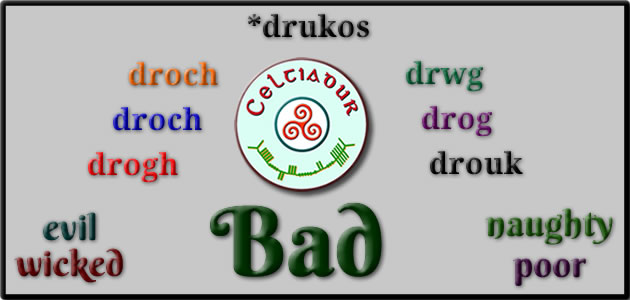
Proto-Celtic *drukos = bad
Gaulish druco- = bad
Old Irish (Goídelc) droch [drox] = bad, ill
Middle Irish (Gaoidhealg) droch = bad
Irish (Gaeilge) droch [drɔx] = bad, poor, evil, ill, un-
drochbhéas = vice, bad habit
drochmheas = contempt
drochobair = bad work, mischief
drochrath = ill luck, misfortune
drochrud = bad thing, inferior thing, bad/evil person, devil
drochrún = evil intention
drochuair = evil hour, unfortunate occasion
Scottish Gaelic (Gàidhlig) droch [drɔx] = bad, evil, wicked, mischievous, sad, calamitous, dark, obscure, secretive
droch-aigne = ill-will
droch-allaidh = libel
droch-chòrdadh = disagreement
droch-fhàistinneach = ominous
droch-mhèin = malice
droch-thuarach = sinister
Manx (Gaelg) drogh [drɔx] = evil, wicked, bad, abusive, unenviable, misfortune, badness, ill, sinister, vile
drogh aghtalys = misbehaviour, misconduct
drogh chaaynt = bad language, smut, swearing
drogh chonagh = misfortune
drogh hraghtey = to smuggle, smuggling
drogh oor = bad luck, ill-times, misfortune
Proto-Brythonic *drug = bad
Middle Welsh (Kymraec) druc, dryg, drỽc, drwc = bad
drycaruer , drygarver, drycarver = bad habit, abuse, misuse
drygdafod = scurrilous language, evil tongue
Welsh (Cymraeg) drwg [druːɡ] = bad, rotten, putrid; poor, piteous, wretched; sorry, grievous, sad; unfavourable, causing disquiet; injurious, harmful; unpleasant (taste); indecent, obscene (words); counterfeit, false; bad; harsh, cruel, severe, ruthless; corrupt, depraved, sinful, wicked, mischievous, naughty
strong>drwgabsen = malicious defamation, slander
drwgafer = bad habit, abuse, misuse
drwgdafod = scurrilous language, evil tongue
drwgenwog = infamous, notorious, disreputable
Middle Cornish (Cernewec) droc, drôg, drog = evil, wickedness, harm, injury, wrong, bad, wicked, hurtful, mischievous
droca, droga = worst
drocoleth = an evil deed, ill doing, injury, damage
droga, droaga = to do harm, hurt, injure
drogbrederys = evil-minded, malicious, envious
drogbres = ill will, spite, grudge
drogdavasec = ill-tongued, foul-mouthed, back-biting, reviling
drogger = ill report, infamy, reproach
droggeriit = infamous, reproachful
droggras = revenge, requital
drogober, drôk-ober = an evil deed, a crime
Cornish (Kernewek) drog [drɔ:g / dro:g] = bad, harm, hurt, ill, wrong, evil, invalid, nasty, naughty, wicked, wrong
drogdybi = to suspect
drogedh = vice
drogfara = to behave badly
drogga = wrong
droghandla = to abuse, mishandle
droglam = accident, crash, mishap
drogober = crime
drogboeror, drogoberores criminal, culprit
drogura = to smear
drokoleth = widkedness
drokter = wickedness
Middle Breton (Brezoneg) drouc = bad, illness, anger
drouc Ælez = the devil, bad angel
drouc auantur = misfortune, bad luck
droucyez, drouguyez = wickedness, malice, animosity
drouc =
drouc =
Breton (Brezhoneg) drouk [druːk] = bad, evil, naughty
droug [druːk] = bad, wickedness
drougiezh [druˈɡiːɛs] = wickedness, malice, animosity
droukrañsus [druˈɡrãsːys] = angry, resentful
droukaat = to become bad, make bad
drouziwezh [dru.ˈziː.wɛs] = defeat, disaster
dizrouk [ˈdi.zruk] = inoffensive, without anger

Etymology: possibly from the Proto-Indo-European *dʰrewgʰ- (to deceive) [source]. Word from the same roots include dream in English, droom (dream) and driegen (to deceive) in Dutch, Traum (dream) and trügen (to deceive, be deceptive) in German [source].

Proto-Celtic *dognawos = badly grown (?)
Old Irish (Goídelc) dona [ˈdona] = unlucky, unfortunate
Middle Irish (Gaoidhealg) dona = unfortunate, unlucky, wretched
donaide = ill-disposed, wretched
donán = miserable creature, wretch
donas = ill-luck, misfortune, calamity
donogad = act of making wretched
Irish (Gaeilge) dona [ˈd̪ˠɔn̪ˠə/ˈd̪ˠʌnˠə] = unfortunate, unlucky, bad, poor, wretched, ill
donacht = badness, wretchedmess, misfortune, illness
donagar = bad condition, misfortune
donaigh = to make worse, aggravate, become word, deteriorate, injure, maim
donaire = wretch
donaireacht = wretchedness
donaisín = little wretch, weakling
donas = ill-luck, misfortune, affliction, misery, mischief
Scottish Gaelic (Gàidhlig) dona [dɔnə] = bad, not well
donachas [dɔnəxəs] = mischief, harm, bad luck, mishap, devil
donachd [dɔnəxg] = mischief, harm, bad luck, mishap
donad [dɔnəd] = degree of badness, severity
donadas [dɔnədəs] = badness, evil
donas [dɔnəs] = mischief, harm, bad luck, devil
donasag [dɔnəsag] = imp
Manx (Gaelg) donney [ɔlk] = calamitous, ill-advised, inauspicious, unfortunate, unlucky, very ill, woeful, unhappy
donnan = dolt, dunce, stupid person, worse
donnys = affliction, bad luck, mischief, woe

Etymology: possibly from the Proto-Indo-European *ǵneh₃- (to recognise, know) [source]. Words from the same root include can, canny, gnome, ignore, know and quaint in English [source].

Proto-Celtic *ulkos = evil, bad
Old Irish (Goídelc) olc [olk] = bad, evil
olcas = badness
Middle Irish (Gaoidhealg) olc, olcc = evil, bad, wrong, misfortune
olcach = hurtful, injurious, harm, injury
olcas = badness
Irish (Gaeilge) olc [ɔl̪ˠk] = evil, harm, bad, harmful, poor, wretched, ill-disposed, hardly, scarcely
olcach = causing evil, harmful, injurious.
olcas = badness, evil, bad state, bad nature, spite
Scottish Gaelic (Gàidhlig) olc [ɔl̪ˠxg] = evil, wicked, bad, infamous, ill, iniquity
olcag [ɔl̪ˠxgag] = little brat (female)
olcair [ɔl̪ˠxgɛrʲ] = evildoer
olcas [ɔl̪ˠxgəs] = wickedness, badness
Manx (Gaelg) olk [ɔlk] = bad, evil, ill, injury, lousy, truculence, unfavourable, vicious, wicked, mischief, naughty, sinful
olkeyr = criminal, culprit, evil-doer, offender, mischief-maker
olkid = badness, evilness
olkys = badness, evilness, iniquity, mischief
olkyssagh = baleful, elfish, diabolical, iniquitous, malicious, malignant, mischievous, naughty, vicious, wicked

Etymology: from the Proto-Indo-European *h₁elḱ- (bad [?]) [source]. Words from the same root include ill and possibly ulcer in English, illa (badly, poorly, not well) in Swedish, and ilkeä (bad, mean, wicked, evil) in Finnish [source].

Sources: Wiktionary, Am Faclair Beag, Online Manx Dictionary, Teanglann.ie, eDIL – Electronic Dictionary of the Irish Language, In Dúil Bélrai English – Old Irish glossary, Geiriadur Prifysgol Cymru, Gerlyver Kernewek, Lexicon Cornu-britannicum: A Dictionary of the Ancient Celtic Language of Cornwall, Dictionaire Favereau, TermOfis, Le dictionnaire diachronique du breton, Etymological Dictionary Of Proto Celtic