Villainous Sharks

In one of the Danish lessons I did recently, I learnt the word skurk, which means villain or baddie, and wondered where it comes from and what other words it’s related to. Let’s find out.

shark

According to Den Danske Ordbog, a skurk [ˈsguɐ̯g] is a person who behaves in an unattractive, dishonest, or malicious manner, or a fictional character in a piece of fiction with the role of the hero’s evil counterpart and enemy or a person or thing that is or is made responsible for trouble or misfortune. In other words, a villain, baddie, wretch, cuplrit, reprobate or rogue [source].

It comes from Low German schurke (villian, scoundrel), from Middle High German schurgen (to shove, push, egg on), possibly from Old High German scuren (to stir, stoke up), from Proto-West-Germanic *skeran (to shear, cut), from Proto-Germanic *skeraną (to shear), from Proto-Indo-European *(s)ker- (to cut) [source].

Related words in Danish include skurkagtig (villainous), skurkeagtig (miscreant) and superskurk (super villain).

Related words in other languages include Schurke (villain, scoundrel) in German, skurk (crook, bad guy, rogue, villain) in Swedish, and skurk (crook) in Norwegian [source].

The English shark, as in someone who exploits others by trickery, lies, extortion, etc, also comes from the same roots, as might shark, as in a scaleless, predatory fish of the superorder Selachimorpha [source].

Another English word that possibly comes from the same roots is shirk, as in to avoid responsibility, duty, obligations, etc [source].

Incidentally, before the word shark arrived in English, such fish were known as dogfish or hayes, which comes from Dutch haai (shark, a ruthless or greedy person) or from West Flemish haaie (shark), from Old Norse hái, an abbreviation of hákarl (shark), from hár (shark) and karl (a man). Related words include Hai (shark) in German, haj (shark) in Swedish and Danish, and акула (akula – shark) in Russian, Belarusian, Bulgarian and Ukrainian [source].

The Fastest Way to Learn Japanese Guaranteed with JapanesePod101.com

Satorial Tailoring

What links the word satorial with the words tailor in various languages? Let’s find out.

PenHaligon's Sartorial

The word sartorial means:

  • Of or relating to the tailoring of clothing.
  • Of or relating to the quality of dress.
  • Of or relating to the sartorius muscle ( a long muscle in the leg.

It comes from New Latin sartorius (pertaining to a tailor), from Late Latin sartor (mender, patcher, tailor), from Latin sarcire (to patch, mend), sarciō (to patch, botch, mend, repair, restore, to make amends, recompense), from Proto-Indo-European *serḱ- (to mend, make good, recompense) [source].

Words from the same roots include sastre (tailor) in Spanish, Tagalog and Chavacano, xastre (tailor) in Asturian, Galician and Portuguese, sarto (tailor) in Italian, sertir (to crimp, set, socket [jewellery]) and the surname Sartre in French, and the obsolete English word sartor (tailor) [source].

The English word tailor, which refers to a person who makes, repairs, or alters clothes professionally, especially suits and men’s clothing, comes from Middle English taillour (tailor), from Anglo-Norman tailloru (tailor), from Old French tailleor (tailor), from taillier (to cut, shape), from Late Latin tāliō (retaliation, to cut, prune), from Latin tālea (rod, stick, stake, a cutting, twig, sprig), the origins of which are uncertain [source].

Related words include tally (any account or score kept by notches or marks) in English, taille (size, waist) and tailler (to cut) in French, Teller (plate, dish) in German, táille (fee, charge) in Irish, talea (cutting, scion) in Italian, and taior (woman’s suit) in Romanian tajar (to cut, slice, chop) in Spanish [source].

I was inspired to write this post after learning that tailor in Spanish is sastre, and wondering where it comes from.

By the way, Happy New Year! Blwyddyn newydd dda! Bonne année ! ¡Feliz Año Nuevo! 新年快樂! 新年快乐! Felice anno nuovo! 新年おめでとうございます! Bliain úr faoi shéan is faoi mhaise duit! Bliadhna mhath ùr! Blein Vie Noa! Ein gutes neues Jahr! Feliĉan novan jaron! Поздравляю с Новым Годом! Šťastný nový rok! Godt nytår! Gott nytt år! La Mulți Ani! Onnellista uutta vuotta! 🎆🎉🥂🥳

The Fastest Way to Learn Japanese Guaranteed with JapanesePod101.com

Hat Tricks

A hat trick usually involves achieving three things in a row, and has little or nothing to do with hats. So where does this expression come from?

hat-trick

A hat trick (also written hat-trick or hattrick) can refer to

  • Any magic trick performed with a hat, especially one involving pulling an object (traditionally a rabbit) out of an apparently empty hat.
  • (sport) Three achievements in a single game, competition, season, etc., such as three consecutive wins, one player scoring three goals in football or ice hockey), or a player scoring three tries in rugby
  • Three achievements or incidents that occur together, usually within a certain period of time. For example, selling three cars in a day
  • Historically, it referred to a means of securing a seat in the (UK) House of Commons by a Member of Parliament placing their hat upon it during an absence.

The sporting senses of the expression come from cricket – in the past, a bowler who took three wickets in three consecutive balls would be presented with a commemorative hat as a prize. It was first used in this sense in 1858, when H. H. Stephenson (1833-1896) achieved such as feat in a game of cricket at Hyde Park in Sheffield. On that occasion, fans held a collection and presented Stephenson with a hat, or possibly a cap – I like to think it was a bowler hat, but haven’t been able to confirm this.

So in the magical sense, the sporting sense, and the political sense, hats were originally involved.

Hat trick has been borrowed into many languages. In Czech, Danish, Dutch, Faroese and Swedish it’s hattrick. In Portuguese, Romanian, Slovenian and Vietnamese it’s hat-trick, in German it’s Hattrick, in Japanese it’s ハットトリック (hatto torikku), in Korean it’s 해트트릭 (haeteuteurik), and in Greek it’s χατ τρικ (khat trik).

In Welsh, it’s hat-tric, camp lawn (in rugby and football), or trithro (in cricket). Camp means feat, exploit, accomplishment, achievement, game, sport, etc., and llawn means full, complet, whole, etc., so camp lawn could be translated literally as “a full feat”. Trithro also means three turns, three times or three occasions, and comes from tri (three) and tro (rotation, turn, lap, etc).

Are there interesting expressions in other languages with similar meanings?

Incidentally, the practise of awarding people caps for representing a team in a particular sport comes from the UK as well. In the early days of rugby and football, players on each side didn’t necessarily all wear matching shirts, and they started wearing specific caps to show which team they were on. From 1886, it was proposed that all players taking part for England in international matches would be presented with a white silk cap with red rose embroidered on the front. These were known as International Caps. This practise spread to other sports, although the caps in question are often imaginary rather than real.

Sources: https://en.wiktionary.org/wiki/hat_trick#English
https://en.wikipedia.org/wiki/Hat-trick
https://en.wikipedia.org/wiki/H._H._Stephenson
https://en.wikipedia.org/wiki/Cap_(sport)

The Fastest Way to Learn Japanese Guaranteed with JapanesePod101.com

Pans of Cream

The Italian word panna looks like it could mean pan or something similar, but in fact means cream.

A lot of Italian words are similar to words in Spanish, French or English, so you can often guess their meanings, but sometimes you come across words like this that don’t mean what you might expect them to mean.

Panna Montata Bimby

Panna [ˈpan.na] comes from panno, which means cloth, as cream covers milk like a cloth, from Latin pānnus (cloth, rag, garment), possibly from Proto-Indo-European *peh₂n- (fabric). Or from Latin patina (a broad, shallow dish, a pan, a kind of cake, a crib, a manger), from Ancient Greek πατάνη (patánē – a kind of flat dish) [source].

Types of panna in Italian include:

  • panna acida = sour(ed) cream
  • panna da cucina = long-life cream used for cooking, double cream (UK)
  • panna montata = whipped cream [source]
  • panna cotta = panna cotta – a northern Italian dessert consisting of flavoured double cream set with gelatine, often served with fruit sauce or caramel syrup.). Lit. “cooked cream” [source]

Other words that come from the Latin pānnus include (window) pane in English, pan (piece, part, side, face, flap, patch) in French, pano (cloth, rag) in Portuguese, paño (cloth, wipe) in Spanish, and πανί (paní – cloth, fabric, sail) in Greek [source].

Other words from the Latin patina and/or Ancient Greek πατάνη include pan, patina (a coat, film, glaze) in English, patena (paten – the plate used to hold the host during the Eucharist) in Italian, panela (a solid piece of unrefined sugar; a Mexican cheese) in Spanish, pan (pan, cooking pot) in Dutch, Pfanne (frying pan) in German, panna (forehead, brow, pan, boiler) in Swedish, pande (forehead, pan) in Danish [source].

The word crema [ˈkrɛ.ma] is also used in Italian for cream, particularly to cleaning creams, lotions, the colour cream or cream flavour. For example, crema solare is sun cream, crema per il viso is face cream, crema detergente is cleansing cream, crema da barba is shaving cream and so on [source].

Crema comes from French crème (cream, cool), from Middle French chresme (cream), from Old French cresme (cream), from Latin crāma, from crāmum (cream), possibly from Gaulish *crama (?), from Proto-Celtic *krammen (?), from Proto-Indo-European *(s)krama- (?) [source].

Related words include:

  • cremino = a chocolate truffle, a creamy cheese
  • cremoso = creamy
  • cremosamente = creamily
  • cremosità = creaminess
  • scremàre = to skim, to cream off

The Fastest Way to Learn Japanese Guaranteed with JapanesePod101.com

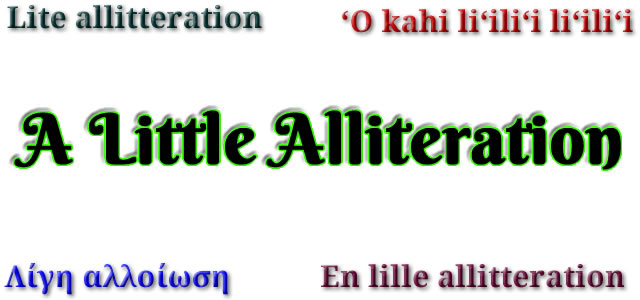
A Little Alliteration

I like a little alliteration, don’t you?

A Little Allteration

Alliteration is “The repetition of consonant sounds at the beginning of two or more words immediately succeeding each other, or at short intervals.” [source]. As in the sentence above. It comes from Modern/New Latin alliterationem, from alliterare (to begin with the same letter), from Latin ad (to, near) and lītera (letter, script) [source].

Other names for this include consonance (the repetition of consonants sounds) [source] and head rhyme. If similar or indentical vowel sounds are being repeated, as in “How now, brown cow?”, it’s called assonance [source] or slant rhyme.

Other kinds of rhymes include:

  • syllabic rhyme: the last syllable of each word sounds the same but does not necessarily contain stressed vowels. E.g. cleaver, silver; pitter, patter.
  • imperfect (or near) rhyme: a rhyme between a stressed and an unstressed syllable. E.g. wing, caring
  • weak (or unaccented) rhyme: a rhyme between two sets of one or more unstressed syllables. E.g. hammer, carpenter
  • semirhyme: a rhyme with an extra syllable on one word. E.g. bend, ending
  • forced (or oblique) rhyme: a rhyme with an imperfect match in sound. E.g. green and fiend; one, thumb)
  • pararhyme: all consonants match. E.g. tick, tock; bing, bong

Other types of rhyme, and other ways of classifying rhymes are available [More details].

I use a variety of rhymes in the songs I write. For example, my latest song was inspired by a phrase from the Irish course in Duolingo “Léann na lachan na nuachtán.” (The ducks read the newspaper). I made a more alliterative version: “Tá lacha ag léamh leabhar sa leabhrlann le leon agus luch.” (A duck is reading a book in the library with a lion and a mouse). The English version is only slightly alliterative, and that’s what often happens with translations, and why songs and poems are difficult to translate.

Here are the words of the song. Parts are quite alliterative, in Irish at least.

Eachtraí na Lacha (The Duck’s Adventures)

Tá an lacha ag léamh sa leabharlann
The duck is reading in the library
Tá an lacha ag léamh sa leabharlann
le leon agus luch (with a lion and a mouse)

Tá an lacha ag siúl go Sligeach
The duck is walking to Sligo
Tá an lacha ag siúl go Sligeach
ag lorg lámhainní (looking for gloves)

Tá an lacha ag canadh amhrán
The duck is singing a song
Tá an lacha ag canadh amhrán
faoi sionach an-sionnachúil (about a very cunning fox)

Tá an lacha ag labhairt Laidin
The duck is speaking Latin
Tá an lacha ag labhairt Laidin
lena lucht leanúna (with its supporters)

Tá an lacha ina coladh ina leabaidh
The duck is sleeping in its bed
Tá an lacha ina coladh ina leabaidh
Agus sin deireadh an scéil
And that’s the end of the tale
Agus sin deireadh an scéil

Here’s a rough recording:

I’ve been thinking of making it trilingual in Irish, English and Welsh, but haven’t got round to it yet.

Here’s an alliterative phrase I came up with that seems to translate well into a variety of languages:

  • English: Singers sing songs
  • Albanian: Këngëtarët këndojnë këngë
  • Armenian: Երգիչները երգեր են երգում (Yergich’nery yerger yen yergum)
  • Aymara: Q’uchunakax q’uchunak q’uchupxi
  • Bengali: গায়কেরা গান গায় (Gāẏakērā gāna gāẏa)
  • Bulgarian: Певците пеят песни (Pevtsite peyat pesni)
  • Catalan: Els cantants canten cançons
  • Corsican: I cantanti cantanu canti
  • Croatian: Pjevači pjevaju pjesme
  • Danish: Sangere synger sange
  • Dhivehi (Maldivian): (lavakiyuntherin lavakiyaeve) ލަވަކިޔުންތެރިން ލަވަކިޔައެވެ
  • Esperanto: Kantistoj kantas kantojn
  • Estonian: Lauljad laulavad laule
  • Finnish: Laulajat laulavat lauluja
  • French: Les chanteurs chantent des chansons
  • Galician: Os cantantes cantan cancións
  • Greek: Οι τραγουδιστές τραγουδούν τραγούδια (Oi tragoudistés tragoudoún tragoúdia)
  • Haitian Creole: Chantè chante chante
  • Hindi: गायक गीत गाते हैं (gaayak geet gaate hain)
  • Lingala: Bayembi bayembaka banzembo
  • Mongolian: Дуучид дуу дуулдаг (Duuchid duu duuldag)
  • Romanian: Cântăreții cântă cântece
  • Russian: Певцы поют песни (Pevtsy poyut pesni)
  • Swedish: Sångare sjunger sånger
  • Turkish: Şarkıcılar şarkılar söylüyor
  • Welsh: Cantorion yn canu caneuon

Translations by Google Translate. More are available

It’s unusual to find a phrase like this that has alliterative translations into so many different languages.

Are there other kinds of rhymes that you like / use / know?

The Fastest Way to Learn Japanese Guaranteed with JapanesePod101.com

Unlimited Web Hosting - Kualo

Saturn’s Bathing Day

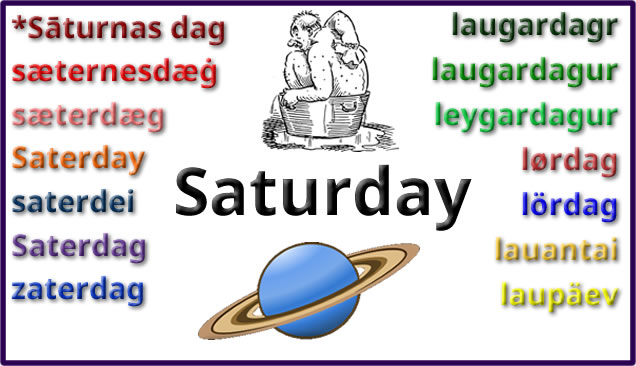
The English word Saturday comes ultimately from the Proto-West Germanic *Sāturnas dag (Saturn’s day), which is a calque (translation) of the Latin diēs Saturnī (day of Saturn).

Saturday

There are similar words in other West Germanic languages, such as West Frisian (saterdei), Low German (Saterdag), and Dutch (zaterdag), all of which mean Saturday [source].

There German word for Saturday, Samstag, comes from Middle High German sam(e)ztac, from Old High German sambaztag (Sabbath day), from Gothic *𐍃𐌰𐌼𐌱𐌰𐍄𐍉 (*sambatō), a version 𐍃𐌰𐌱𐌱𐌰𐍄𐍉 (sabbatō – Saturday, the Sabbath day), from Koine Greek σάββατον (sábbaton – Sabbath), from Hebrew שַׁבָּת‎ (šabbāṯ – Sabbath), possibly from Akkadian 𒊭𒉺𒀜𒌈 (šapattum – the middle day of the lunar month).

Words from the same roots include samedi (Saturday) in French, sâmbătă (Saturday) in Romanian, and szombat (Saturday, Sabbath) in Hungarian [source].

In northern and eastern Germany, another word for Saturday is Sonnabend (“Sunday eve”), as apparently in Germanic recking, the day begins at sunset. It a calque of the Old English sunnanǣfen (Saturday evening) [source].

Words for Saturday in the North Germanic languages have a different root, however. These include lördag in Swedish, lørdag in Danish and Norwegian, leygardagur in Faroese and laugardagur in Icelandic. They all come from the Old Norse laugardagr, from laug (pool) and dagr (day), so literally “bathing day” [source].

These words have also been borrowed into Finnic languages: Saturday is lauantai in Finnish, laupäev in Estonian and lavvantaki in Ingrian.

Are there any other languages in which Saturday means something like “bathing day”, or something else interesting?

See also: Days of the week in many languages on Omniglot.

Snudging & Snuggling

Do you like to snudge?

Snuggling

To snudge is an old word that means to lie snug or quiet, to save in a miserly manner, or to hoard, and a snudge is a miser or sneaking fellow.

You might also snudge along, which means to walk looking down, with an abstracted appearance. Many people do this while staring at their phones. Or on a cold day, you might snudge over the fire, that is, keep close to the fire.

Snudge is related to snug, which apparently means tight or handsome in some English dialects, and possibly comes from Old Norse snoggr (short-haired), from Proto-Germanic *snawwuz (short, quick, fast).

Related words in other languages include snöggur (short, swift, fast) in Icelandic, snög (neat) in Danish, and snygg (handsome, good-looking, proper, nice) in Swedish.

Snug originally meant compact or trim (of a ship), and especially protected from the weather. Later it came to mean in a state of ease or comfort, then to fit closely, as in snug as a bug in a rug or as in snug as a bee in a box. It also means warm and comfortable, cosy, safisfactory, and can be a small, comfortable back room in a pub (in the UK).

Then there’s snuggle, which means an affectionate hug, or the final remnant left in a liquor bottle, and as a verb, it means to lie close to another person or thing, hugging or being cozy/cosy, or to move or arrange oneself in a comfortable and cosy position.

Instead of snuggling, you might prefer snerdling, croozling, snoodling, snuzzling or even neezling, which all mean more or less the same thing – being cozy and snug.

Do you know any other interesting words for snudging or snuggling?

How about versions of the phrase as in snug as a bug in a rug in other languages?

In Scottish Gaelic there’s cho seasgair ri luchag ann an cruach (“as snug as a mouse in a haystack”), and cho blàth ‘s cofhurtail ri ugh ann an tòn na circe (“as warm and comfortable as an egg in the backside of a hen”),

Sources:
https://www.scotsman.com/news/opinion/columnists/scots-has-more-than-400-words-for-snow-and-we-may-need-them-if-snowmageddon-descends-susie-dent-3959696
https://en.wiktionary.org/wiki/snudge#English
https://en.wiktionary.org/wiki/snug#English
https://www.etymonline.com/search?q=snug
https://en.wiktionary.org/wiki/snuggle#English
https://westcountryvoices.co.uk/weird-and-wonderful-words-week-3/

Just a Smidgen

How much is a smidgen? How about a tad, dash, drop or pinch?

Jot and Title

These are all terms that refer to small amounts of things. You might see them in a recipe, or use them to refer to other small quantities or amounts. You can even get measuring spoons for some of them.

Apparently a tad is ½ a teaspoon, a dash is ⅛ of a teaspoon. a pinch is 116 of a teaspoon, a smidgen is 132 of a teaspoon, and a drop is 164 of a teaspoon. Other amounts are available. A smidgen could be anything between 125 and 148, with 132 of a teaspoon being the most commonly used.

A tad is a small amount or a little bit, and used to mean a street boy or urchin in US slang. It probably comes from tadpole, which comes from Middle English taddepol, from tadde (toad) and pol(le) (scalp, pate).

A dash is a small quantity of a liquid and various other things. It comes from Middle English daschen/dassen (to hit with a weapon, to run, to break apart), from Old Danish daske (to slap, strike).

A smidgen is a very small quantity or amount. It is probably based on smeddum (fine powder, floor), from Old English sme(o)dma (fine flour, pollen meal, meal). Or it might be a diminutive of smitch (a tiny amount), or influenced by the Scots word smitch (stain, speck, small amount, trace). Alternative forms of smidgen include smidge, smidget, smidgeon and smidgin.

A pinch is a small amount of powder or granules, such that the amount could be held between fingertip and thumb tip, and has various other meanings. It comes from Middle English pinchen (to punch, nip, to be stingy), from Old Northern French *pinchier, possibly from Vulgar Latin *pinciāre (to puncture, pinch), from *punctiāre (to puncture, sting), from Latin punctiō (a puncture, prick) and *piccāre (to strike, sting).

A drop a very small quantity of liquid, or anything else. It comes from the Middle English drope (small quantity of liquid, small or least amount of something) from Old English dropa (a drop), from Proto-West Germanic *dropō (drop [of liquid]), from Proto-Germanic *drupô (drop [of liquid]),from Proto-Indo-European *dʰrewb- (to crumble, grind).

Do you know any other interesting words for small amounts or quantities?

Sources:
https://en.wiktionary.org/wiki/smidgen#English
https://practical-parsimony.blogspot.com/
https://en.wiktionary.org/wiki/tad#English
https://en.wiktionary.org/wiki/dash#English
https://en.wiktionary.org/wiki/pinch#English
https://quod.lib.umich.edu/m/middle-english-dictionary/dictionary/
https://en.wiktionary.org/wiki/smidgen#English
https://en.wiktionary.org/wiki/drop#English

Sailing Away

While putting together a post on my Celtiadur blog about words for ships and boats in Celtic languages, I realised that words for boats, ships and other nautical things in English come from many different languages. So I thought I’d write a blog post about them.

Laxey / Laksaa

The word boat comes from Middle English bot (boat, the path or course of one’s life), from Old English bāt (boat), from Proto-West Germanic *bait, from Proto-Germanic *baitaz (boat, small ship), from Proto-Indo-European *bʰeyd- (to break, split) [source].

The French word bateau (ship, boat), the Dutch word boot (boat), and the German word Boot (boat) were all borrowed from Middle or Old English.

Words for boat in North Germanic languages, such as Swedish (båt), Danish (båd) and Icelandic (bátur), were borrowed from Old Norse bátr, which was borrowed from Old English bāt (boat) [source].

Some words for boat in Irish (bád), Scottish Gaelic (bàta), Manx (baatey) and Welsh (bad) were also borrowed from Old English or Old Norse [source].

ship-13

The word ship comes from Middle English schip (ship, boat), from Old English scip (ship), from Proto-West Germanic *ship (ship), from Proto-Germanic *skipą (ship), from unknown origins [source].

Ship can be used to refer to a water-borne vessel generally larger than a boat, while boat usually refers to vessels smaller than a ship but larger than a dinghy. Boat also refers to submarines of any size, and lakers (ships used in the Great Lakes trade in North America).

Dinghy Sailing

A dinghy is a small open boat, propelled by oars or paddles, carried as a tender, lifeboat, or pleasure craft on a ship; a sailing dinghy, or an inflatable rubber life raft. It comes from Bengali ডিঙি (ḍiṅi – canoe), probably from Sanskrit द्रोण (droṇa – wooden vessel, bucket, trough), Proto-Indo-Iranian *dráwnam (wooden object), from Proto-Indo-European *dréw-no-m, from *dóru (tree, wood) [source].

Untitled

A yacht is a sailing boat larger than a dinghy but smaller than a sailing ship, often with a cabin. It can also be a motor-powered private boat. It comes from yeaghe (light, fast sailing ship) from Dutch jacht (yacht, hunt), from jaghtschip (light sailing vessel, fast pirate ship: lit. “pursuit ship”).

Apparently the original Dutch jaghtschip were built to chase pirates and smugglers from the coast. In 1660 the Dutch East India Company presented one to King Charles II, who used it as a pleasure boat. It was then copied by British shipbuilders as a pleasure craft for wealthy gentlemen [source].

Tall Ships 015 Gloriaa_C

Another type of boat is a barque, which is a sailing vessel with three or more masts, with all masts but the sternmost square-rigged. It comes from Middle English barke (boat), from Middle French barque, from Latin barca (baris – a type of flat-bottomed freighter used on the Nile in Ancient Egypt), from Ancient Greek βᾶρις (bâris – Egyptian boat), from Coptic ⲃⲁⲁⲣⲉ (baare – small boat), from Demotic br, from Ancient Egyptian bꜣjr (transport ship, type of fish) [source].

Barge

The word barge (A large flat-bottomed towed or self-propelled boat used mainly for river and canal transport of heavy goods or bulk cargo), comes from the same roots, as does the Spanish barco (boat), the Galician barco (ship, boat, barge) and the Portuguese barco (boat) [source].

Green Canoe

The word canoe (a small long and narrow boat, propelled by one or more people) comes from Spanish canoa (canoe), probably from Taino *kanowa (canoe), from Proto-Arawak *kanawa (caone) [source].

Inuit kayak

Canoes are generally open on top, while kayaks are covered over except for the cockpit where the paddler sits. Kayak comes from Inuktitut ᖃᔭᖅ (qayaq – kayak, man’s boat), from Proto-Eskimo *qayaʁ (kayak) [source].

Umiak

If kayaks are men’s boats, are there women’s boats as well? There are – they are the umiak (a large, open boat made of skins stretched over a wooden frame that is propelled by paddles), from Inuvialuktun ᐅᒥᐊᖅ (umiaq – women’s boat) [source].

Incidentally, navy (a country’s entire sea force, including ships and personnel) comes from Middle English nave (navy), navye, from Old French navie (navy), from Latin nāvigia, from nāvigium (vessel, ship boat, from nāvis (ship, boat, vessel), from Proto-Indo-European *néh₂us (boat). In Old English navy was sciphere (“ship army”) [source].

English words from the same roots include navigate, nave, nautical and astronaut (lit. “star sailor”) [source].