Burgling Burg(h)ers

Are the words (ham)burger, burgher and burglar related? Let’s find out.

Burghers of Calais

Burger [ˈbɜː(ɹ)ɡə(ɹ)] is a rebracketing of the word hamburger, which is:

  • A hot sandwich consisting of a patty of cooked ground beef or a meat substitute, in a sliced bun, usually also containing salad vegetables, condiments, or both.
  • The patty used in such a sandwich.

Hamburger is an abbreviation of Hamburger sandwich / steak, which comes from Hamburg steak, a patty of ground beef [source].

The idea of the Hamburg steak was brought to America by German immigrants in the 19th century, and is based on similar German dishes such as the Frikadelle, which have existed since the 17th century. It first appeared on menus in restaurants in New York in 1873. By the the 1930s, Hamburg steaks were being served as parts of sandwiches, and became known as (ham)burgers [source].

The name Hamburg comes from Old High German Hamme (bend, angle) and burg (castle, city), from Proto-West-Germanic *burg (fortification, (fortified) city), from Proto-Germanic *burgz (fortification, stronghold, (fortified) city), from Proto-Indo-European *bʰerǵʰ- (to rise up, to ascend, be elevated, to be up high) [source].

A burgher [ˈbɜː(ɹ)ɡə(ɹ)] is

  • A citizen of a borough or town, especially one belonging to the middle class.
    • A member of the medieval mercantile class.
    • A citizen of a medieval city.
  • A prosperous member of the community

It comes from Middle English burgher (a freeman of a borough, a burgess), likely merged with and reinforced by Middle Dutch burgher, from Middle High German burger, from Old High German burgāri (inhabitant of a fortress), from burg (fortress, citadel), from Proto-West-Germanic *burg (fortification, (fortified) city), etc. [source].

A burglar [ˈbɜːɡlə(ɹ) / ˈbɝɡlɚ] is

  • A person who breaks in to premises with the intent of committing theft.

It comes from Medieval Latin burglātor (a freeman of a borough, a burgess), from burgō (to commit burglary), from Latin Latin burgus (fortified town), probably from Frankish *burg (fortress), from Proto-Germanic *burgz (fortification, stronghold, (fortified) city), etc. It was possibly influence by the Latin word latro (thief) and/or the Old French word burgeor (burglar), which comes from Latin [source].

So, burger and burgher are related, and burglar is probably related to them.

Other words that share the same roots include: barrow, borough, burrow, comfort, force and fort in English, bourgeois in French, Burg (castle) in German, burcht (citadel, castle, borough, burrow) in Dutch, bwrw (to cast, throw, hit, precipiate) and brenin (king, monarch, sovereign) in Welsh, forte (fort(ress), strength, talent, strong, stressed) in Italian, fuerte (strong, loud, hard) in Spanish [source].

The Fastest Way to Learn Japanese Guaranteed with JapanesePod101.com


Yielding Payment

What links the word yield with payments, tax and gold? Let’s find out.

Yield sign

Meanings of yield include:

  • To give as a result or outcome; to produce or render.
  • To give up; to surrender or capitulate.
  • A product.
  • The quantity of something produced.

And it used to mean payment, money or tribute.

The verb comes from Middle English yẹ̄lden (to relinquish, give up, surrender, to pay, to fullfil an obligation), from Old English ġieldan (to pay, to reward, to worship), from Proto-West Germanic *geldan (to pay for), from Proto-Germanic *geldaną (to pay, to have/give value), from Proto-Indo-European *gʰeldʰ- (to pay, to repay).

The noun comes from the same PIE root, via Middle English yẹ̄ld (tax, agricultural yield, reward, recompense), Old English ġield (payment, tax, tribute, cost), Proto-West Germanic *geld (payment), and Proto-Germanic *geldą (reward, gift, money) [source].

Words from the same roots include guild in English, geld (money) and gelden (to apply, count, be considered) in Dutch, Geld (money) and gelten (to be valid, count, be worth) in German, gjald (fee, payment) and gjalda (to pay) in Icelandic, gæld (debt, debts) and gælde (to hold good, be valid) in Danish, gille (feast, guild) in Swedish, and geall (pledge, pawn, token, bet, asset, prize) in Irish [source].

Dreidels & Gelt - Hanukkah 2022

The English word gelt means money, tribute, tax, or chocolate coins usually eaten on Hanukkah (a.k.a. Hanukkah gelt). It originated in thieves’ cant and Polari in the UK, and was later adopted by Jews and used in general slang. It comes from the same roots as yield, etc, via Middle High German gelt (money) and Yiddish געלט (gelt – money) [source].

The English word geld, which historically meant a payment, particularly a medieval form of land tax, also comes from the same roots [source]. It is found in Danegeld, a tax raised originally to pay tribute or protection money to the Viking raiders in the 10th and 11th centuries and later continued as a land tax [source].

The Fastest Way to Learn Japanese Guaranteed with JapanesePod101.com


Gigs, Jigs & Fiddles

What links the words gig and jig, and what do they have to do a German word Geige (violin)? Let’s find out.

Tildon Krautz at Blue Sky Café

A gig [ɡɪɡ] can mean:

  • A live performance by a musician, band, musicial group or comedian
  • A job or role for a performer (in film, television, theatre, etc.)
  • Any job, especially one that is freelance or temporary, or done on an on-demand basis. Other meanings are available [source].

Its origins are lost in the mists of etymology, but its possibly related to the Old French word gigue (a string instrument similar to a mandolin, a kind of dance), which comes from Frankish *gīge (dance, fiddle), from Proto-Germanic *gīganą (to move, wish, desire), from Proto-Indo-European *gʰeyǵʰ- (to yawn, gape, long for, desire) [source].

The German word Geige [ˈɡaɪ̯ɡə] (violin, fiddle) possibly comes from the same roots, via Middle High German gīge, Old High German gīga and Proto-Germanic *gīganą (to move, wish, desire), etc [source].

The English word jig refers to such things as a light, brisk musical movement; a lively traditional Irish dance in 6/8 time, also known as a double jig (other types of jig are available); or an English Morris dance performed by one or two individual dancers. It shares the same roots as gig and Geige – maybe via Middle English gyge (fiddle), from Old French gigue etc. [source].

Guinguette..

Another word from the same roots is guinguette, which in English and French is an old name for a sort of outdoor tavern that once existed in the suburbs of Paris, and appears to be used in modern French to refer to any outdoor bar (see above). It comes from French guinguet (a rough wine produced near Paris), from ginguer (to run, play, move a lot), from giguer (to dance, jump), from gigue (a string instrment, a jig, etc), and so on [source].

Heading for the Line

The word gig can also refer to:

  • A small, narrow, open boat carried in a larger ship, and used for transportation between the ship and the shore, another vessel, etc.
  • A similar rowing boat or sailboat, especially one used for racing; specifically, a six-oared sea rowing boat commonly found in Cornwall and the Isles of Scilly (see above).
  • A two-wheeled carriage drawn by a single horse.

It comes from Middle English gigg (spinning object, a top), possibly from Old Norse (?), from Proto-Germanic *gīganą (to move, wish, desire), etc, or ultimately onomatopoeic [source].

The Fastest Way to Learn Japanese Guaranteed with JapanesePod101.com


Villainous Sharks

In one of the Danish lessons I did recently, I learnt the word skurk, which means villain or baddie, and wondered where it comes from and what other words it’s related to. Let’s find out.

shark

According to Den Danske Ordbog, a skurk [ˈsguɐ̯g] is a person who behaves in an unattractive, dishonest, or malicious manner, or a fictional character in a piece of fiction with the role of the hero’s evil counterpart and enemy or a person or thing that is or is made responsible for trouble or misfortune. In other words, a villain, baddie, wretch, cuplrit, reprobate or rogue [source].

It comes from Low German schurke (villian, scoundrel), from Middle High German schurgen (to shove, push, egg on), possibly from Old High German scuren (to stir, stoke up), from Proto-West-Germanic *skeran (to shear, cut), from Proto-Germanic *skeraną (to shear), from Proto-Indo-European *(s)ker- (to cut) [source].

Related words in Danish include skurkagtig (villainous), skurkeagtig (miscreant) and superskurk (super villain).

Related words in other languages include Schurke (villain, scoundrel) in German, skurk (crook, bad guy, rogue, villain) in Swedish, and skurk (crook) in Norwegian [source].

The English shark, as in someone who exploits others by trickery, lies, extortion, etc, also comes from the same roots, as might shark, as in a scaleless, predatory fish of the superorder Selachimorpha [source].

Another English word that possibly comes from the same roots is shirk, as in to avoid responsibility, duty, obligations, etc [source].

Incidentally, before the word shark arrived in English, such fish were known as dogfish or hayes, which comes from Dutch haai (shark, a ruthless or greedy person) or from West Flemish haaie (shark), from Old Norse hái, an abbreviation of hákarl (shark), from hár (shark) and karl (a man). Related words include Hai (shark) in German, haj (shark) in Swedish and Danish, and акула (akula – shark) in Russian, Belarusian, Bulgarian and Ukrainian [source].

The Fastest Way to Learn Japanese Guaranteed with JapanesePod101.com

Kinder Kinder

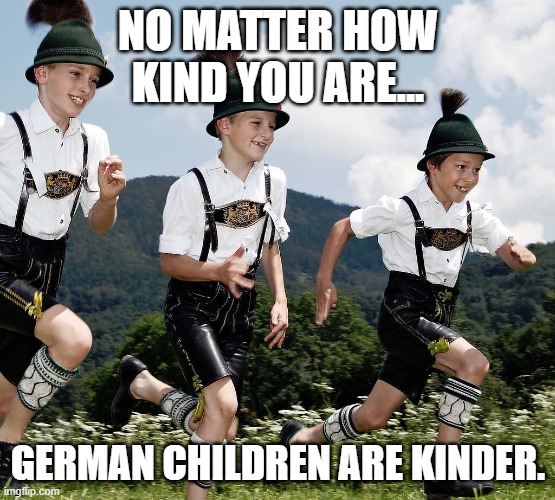
There’s a joke / meme that goes something like No matter how kind you are … German children are Kinder.


from Imgflip Meme Generator

This is a bilingual pun – in German Kinder means children, while in English kinder means nicer, more gentle, generous, affectionate, etc. These two words look alike, but are they related? Let’s find out.

The German word Kind (child, kid, offspring) comes from Middle-High German kint (child), from Old High German kind (child, descendants), from Proto-West-Germanic *kind (child), from Proto-Germanic *kindą, *kinþą (child), from Pre-Germanic *ǵénh₁tom, from Proto-Indo-European *ǵenh₁- (to produce, beget, give birth) [source].

Kind in English means such things as having a benevolent, courteous, friendly, generous, gentle, liberal, sympathetic or warm-hearted nature or disposition; affectionate, favourable, mild, gentle or forgiving. It can also mean a type, category (What kind of nonsense is this?); goods or services used as payment (They paid me in kind), or a makeshift or otherwise atypical specimen (The box served as a kind of table).

Kind as in benevolent comes from Middle English kinde, kunde, kende (kind, type, sort), while kind as in type comes from Middle English cunde (kind, nature, sort) / kynde (one’s inherent nature; character, natural disposition), and both come from Old English cynd (sort, kind, type, gender, generation, race) / ġecynd (nature, kind, class), from Proto-West-Germanic *kundi / *gakundiz, from Proto-Germanic *kinþiz (kind, race), from Proto-Indo-European *ǵénh₁tis (birth, production), from *ǵenh₁- (to produce, beget, give birth) [source].

So, the German Kind and the English kind do ultimately come from the same roots. Are German Kinder kinder though, or are they the Wurst, and somewhat gross?

Other words produced, beget and given birth to by the Proto-Indo-European root *ǵenh₁- include: kind (child), koning (king, monarch) and kunne (gender, sex) in Dutch, cognate, engine(er), gender, gene, general, genesis, genetic, genial, genius, gentle, kin, king, nature, oxygen and progeny in English, König (king) in German, nascere (to be born, bud, sprout) in Italian, gentis (tribe, genus, family, kin) in Lithuanian, geni (to be born, birth) in Welsh [source].

Incidentally, the English word child is not related to the German word Kind. It comes from Middle English child (baby, infant, toddler, child, offspring), from Old English ċild (child, baby), from Proto-West Germanic *kilþ, *kelþ, from Proto-Germanic *kelþaz (womb; fetus), from Proto-Indo-European *ǵelt- (womb), or from Proto-Indo-European *gel- (to ball up, amass). It is related to kuld (brood, litter) in Danish, and kelta (lap) in Icelandic though, and possibly kalt (cold, chilly, calm) and kühl (cool, calm, restrained) in German [source].

The Fastest Way to Learn Japanese Guaranteed with JapanesePod101.com

Life Writing

In Russian, a painting or picture is a живопись [ʐɨvəpʲɪsʲ]. This comes from живой [ʐɨˈvoj] (alive, living, live, lively) and писать [pʲɪˈsatʲ] (to write). So you could say that a Russian painter is “writing life” and that their paintings are “life writing” [source].

An English word with a similar literal meaning, but a different actual meaning, is biography.

Another Russian word for picture, and also image or scene, is a картина [kɐrˈtʲinə], which comes from the Italian cartina (fine paper, map), from carta (paper, map, menu, card), from the Latin charta (papyrus, paper, poem), from the Ancient Greek χάρτης (khártēs – papyrus, paper), from χαράσσω (kharássō – I scratch, inscribe), from the Proto-Indo-European *ǵʰer- (to scratch) [source].

If languages were logical and consistant, you might expect that Russian words for art, artist, painter, picture and to paint might be related to живопись. Most of them aren’t:

Art is искусство [ɪˈskustvə], which also means skill, craftsmanship, craft. It comes from the Old Church Slavonic искусьство (iskusĭstvo), from искоусъ (iskusŭ – test, experiment), probably from the Proto-Germanic *kustiz (choice, trail), from the Proto-Indo-European *ǵews- (to taste, try), which is also the root of the English words choice, cost and gusto [source].

An artist or painter is a художник [xʊˈdoʐnʲɪk]. It comes from the Old East Slavic художьникъ (xudožĭnikŭ – artist, painter, master), from худогъ (xudogŭ – skillful, experienced, lucky), from the Proto-Slavic *xǫdogъ, from the Proto-Germanic *handugaz (handy, skilful, dextrous), which is also the root of the English word handy [source].

There are several Russian words for to paint:

  • рисовать [rʲɪsɐˈvatʲ] means to draw, paint, depict, and comes from the Polish rysować (to draw, sketch), from the Middle High German rīzen, from the Old High German rīzan (to scratch) [source].
  • красить [ˈkrasʲɪtʲ] means to paint, dye or adorn. It is related to the word краска (paint, dye, ink, colours), which comes from the Old Church Slavoic краса (krasa – decoration) [source].
  • писать [pʲɪˈsatʲ] means to write or paint (a painting). It comes from the Old East Slavic писати (pisati – to write, paint), from the Proto-Slavic *pisati (to draw depict, write), from the Proto-Indo-European *peyḱ- (to hew, cut out; stitch, embroider, sting; paint, mark, colour), which is also the root of the English words paint and picture [source].

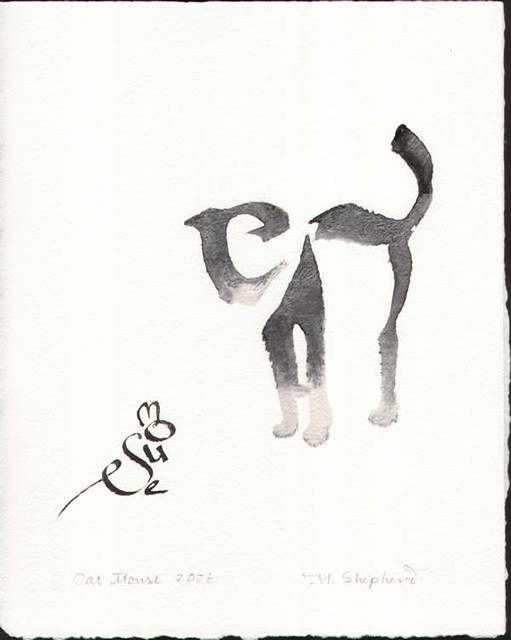
mouse cat

An example of calligraphic art by Margaret Shepherd. More examples