Better Safe than Sorry

In the past week or so I’ve had a number of vaccinations to prepare for my trip to China, and have more to come. As they say, better safe than sorry, but what do they say in other languages?

The Big Spill

The phrase better safe than sorry means it is preferable to be cautious in one’s choices and actions than to act recklessly and suffer afterwards.

Phrases with similar meanings in English include:

  • err on the side of caution
  • measure twice, cut once
  • play it safe
  • prevention is better than cure
  • an ounce of prevention is worth a pound of cure

Equivalent phrases in other languages include:

  • Azerbaijani – htiyat igidin yaraşığıdır
    (“prudence is the adornment of a brave man”)
  • Bulgarian – който сам се пази и Бог го пази (koĭto sam se pazi i Bog go pazi) – (“He who protects himself and God protects him”)
  • Chinese (Mandarin) – 小心驶得万年船 [小心駛得萬年船]
    (xiǎoxīn shǐ dé wànnián chuán) – (“If you are careful, you can steer your ship safely for a myriad of years”)
  • French – mieux vaut prévenir que guérir
    (“prevention is better than cure”)
  • German – Vorsicht ist besser als Nachsicht
    (“caution is better than clemency”)
  • Greek – κάλλιο γαϊδουρόδενε παρά γαϊδουρογύρευε (kállio gaïdouródene pará gaïdourogýreve) – (“Better to tie a donkey than to ride a donkey.”)
  • Irish – is fearr glas ná amhras
    (“better a lock than a doubt”)
  • Japanese – 転ばぬ先の杖 (korobanu saki no tsue) – (“a walking stick before stumbling”)
  • Korean – 돌다리도 두들겨 보고 건너라 (doldalido dudeulgyeo bogo geonneola) – (“even if you cross a stone bridge, test it first.”)
  • Polish – żeby kózka nie skakała, toby nóżki nie złamała
    (“if the goat had not been jumping, it would not have broken its leg”)
  • Welsh – gwell diogel nac edifar
    (“better safe than sorry”)

Source: https://en.wiktionary.org/wiki/better_safe_than_sorry

How about in other languages?

Language skills in just 10 minutes a day with Ling


Once in a Blue Moon

If something doesn’t happen very often, you might say that it happens once in a blue moon English. What about in other languages?

Blue Moon Daytime Moon

The phrase once in a blue moon first appeared in first around 1821 and refers to something that happens very rarely, very infrequently or almost never. An alternative version is apparently once in a purple moon [source].

A blue moon is a second full moon during a calendar month, which happens once every 32 months. A blue moon can also refer to a full moon that appears to be blue and bigger than usual [source].

In (Mandarin) Chinese, the equivalent is 千载难逢 [千載難逢] (qiān​zǎi​nán​féng), which means “an opportunity difficult to come by even in a thousand years”. This expression comes from folk tales, in which such rare opportunities might lead to success or life-changing events [source].

In Czech, the equivalent is jednou za uherský rok , which means ‘once in a Hungarian year’. Apparently this idiom dates from the Turkish wars, when Czech soldiers were hired in Hungary for a certain period of time, which was constantly extended [source]. The Slovak equivalent, raz za uhorský rok (“once a Hungarian year”), probably comes from the same roots.

In Polish, they say raz na ruski rok (“once in a Ruthenian year”), which refers to the fact that the Gregorian calendar used by East Slavs has longer months [source]. Alternatively, they say od wielkiego dzwonu (“from the big bell”), which refers to The Sigismund Bell, the largest of the five bells in the Sigismund Tower of Wawel Cathedral in Kraków, which is used only on special occasions [source].

In French, you might say tous les trente-six du mois (“every 36th of the month”) or une fois toutes les lunes (“once every moon”) [source].

In German, you could say alle Jubeljahre (“every jubilee year”), which refers to biblical jubliees that come round every 50 years [source].

In Russian, they say раз в сто лет (“once every hundred years”) [source].

In Spanish, they say cada muerte de obispo (“every death of a bishop”), or de Pascuas a Ramos (“from Easter (Day) til Palm Sunday”) – Palm Sunday comes before Easter Day [source].

In Welsh, one equivalent is unwaith yn y pedwar amser (“once in the four seasons”) and another is unwaith yn y pedwar gwynt (“once in the four winds”) [source].

Are there interesting similar idioms in other languages?

The Fastest Way to Learn Japanese Guaranteed with JapanesePod101.com


Swallowing Camels

This week my Danish lessons have been focusing on idioms, and an interesting idiom that came up is sluge en kamel, which literally means ‘to swallow a camel’, but what other meanings does it have? Let’s find out.

Kameler

According to Wiktionary, this idioms means ‘to accept a change or amendment (to a proposal)’ or ‘to agree to something one would not have if one had fully understood the implications from the beginning’.

According to Den Danske Ordbog, it means ‘acceptere eller gå med til noget der egentlig strider imod ens idealer og ønsker’ (to accept or agree to something that actually goes against one’s ideals and desires), and another version of the idiom is sluge kamelen (to eat the camel).

According to SpeakAndLearn.dk, it means ‘to admit that you are wrong, even though you have clearly stated that you were absolutely sure, that you were right’.

So it seems it has a variety of meanings. Are there similar idioms involving camels in other languages?

In English, you might liken doing something unpleasant or undesirable to swallowing a frog – Mark Twain is sometimes quoted as having said or written “Eat a live frog first thing in the morning and nothing worse will happen to you the rest of the day.” There’s apparently no evidence that he did in fact say or write this. The idea of eating a frog in the morning possibly comes from Nicolas Chamfort, a French writer, who wrote in the 1790s:

… il faudrait avaler un crapaud tous les matins, pour ne trouver plus rien de dégoûtant le reste de la journée, … (it would be necessary to swallow a toad every morning so as not to find anything else disgusting during the rest of the day)

[source]

Other interesting Danish idioms involving animals include:

  • klap lige hesten (‘just pat the horse’) = shut up, relax, take it easy
  • det blæser en halv pelikan (‘it’s blowing half a pelican’) = it’s very windy and the weather is awful
  • Jeg har ikke en rød reje (‘I don’t have a red shrimp’) = I’m skint, I have no money
  • ingen ko på isen (‘no cow on the ice’) = everything is okay – whatever the problem is, it’s not a big deal so don’t worry about it
  • så er den ged barberet (‘then the goat is shaved’) = the work has been done, or the problem has been resolved

Source: https://ling-app.com/da/funny-danish-phrases/

The Fastest Way to Learn Japanese Guaranteed with JapanesePod101.com

Falling Apples

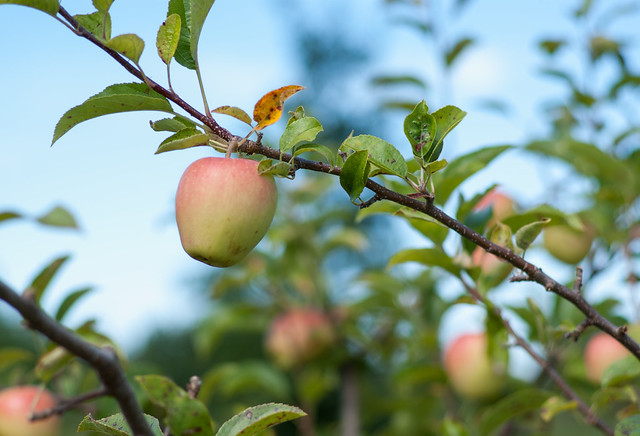
A friend asked me to look into the origins of the saying An acorn doesn’t fall far from the tree. I can only find a few examples of this saying online, but lots of examples of the apple never falls far from the tree and similar sayings. It refers to the idea that people inevitably share traits with or resemble their parents or family.

Apple Tree

According to The Phrase Finder, the origins of this saying are uncertain. The earliest known example of its use in English appears in 1830 in Benjamin Thorpe’s translation of Rasmus Rask’s Grammar of the Anglo-Saxon Tongue:

Traces still exist in the daily language of the Icelanders, for instance in the proverb, eplit fellr ekki lánt frá eikinni the apple falls not far from the tree (the oak!).

In a letter by Ralph Waldo Emerson published in 1839, he quotes the German proverb ‘der Apfel fällt nicht weit von Stamm’ – “As men say the apple never falls far from the stem.”

In 1843, The Bible in Spain by George Henry Borrow includes the line:

“The apple”, as the Danes say, “had not fallen far from the tree;” the imp was in every respect the counterpart of the father, though in miniature.

According to English Language & Usage, a Welsh version of this saying appears in A Dictionary of the Welsh Language, Explained in English:

Ni fell zygwyz aval o avall
The apple will not fall far from the tree

The spelling here is unusal and non-standard: z = dd and v = f, so in modern standard spelling it would be “Ni fell ddygwydd afal o afall”, I think.

There are also versions of this saying from Turkish – Iemisch agatsdan irak dushmas (The apple does not fall far from the tree), and Old English – Se æppel næfre þæs feorr ne trenddeð he cyð hwanon he com. (The apple never rolls so far that it does not make known whence it came.)

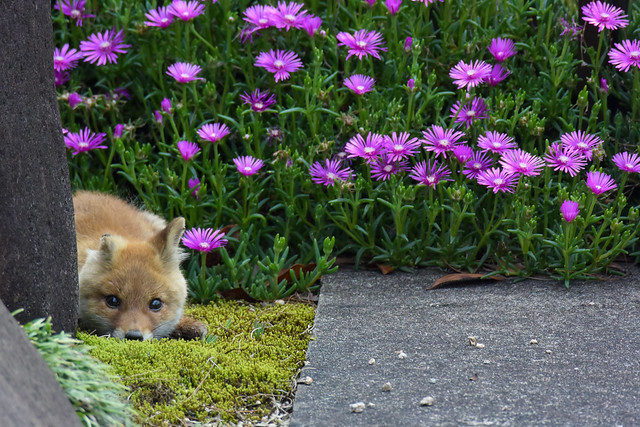
子狐

I also found an idiom with a similar meaning in Japanese: 狐の子は頬白 (kitsune no ko wa tsurajiro), which means “fox cubs have white cheeks” [source].

Do you know of examples of this saying in other languages?

As Happy As A Shoe

When you’re happy, there are various idioms to express this in English, including:

  • as happy as a clam (at high water)
  • as happy as a sandboy
  • as happy as Larry
  • as happy as a lark
  • as happy as a pig in muck/clover
  • as happy as a dog with two tails

Do you know/use any others?

Clams are apparently free from predators at high water, therefore might be thought to be happy. Or, their shape when open looks like they’re smiling

Sandboys were men, and boys, who delivered sand to pubs, homes and other establishments in the 18th and 19th centuries. They had a reputation for being happy perhaps because they were often drunk.

Larry was possibly Larry Foley (1847-1917), an Australian boxer who never lost a fight, or might come from the slang term larrikin, which originated in Cornwall, and ended up in Australia and New Zealand. It refers to a rough type or hooligan who tends to lark around.

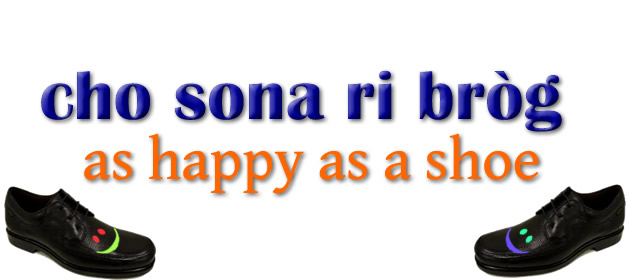
cho sona ri bròg (as happy as a shoe)

Idioms meaning you’re happy in Scottish Gaelic are a bit different:

  • cho sona ri bròg = as happy as a shoe
  • cho sona ri luchag an lofa = as happy as the mouse of the loaf
  • cho sona ri bò ann an loch = as happy as a cow in a lake
  • cho sona ris na h-uisegan = as happy as the larks
  • cho sona ri òthaisg = as happy as a one year old ewe
  • cho sona ri crodh an Taoibh Siar = as happy as cattle of the West Side
  • cho sona ri cuthag ann an nead a coimhearsnaich = as happy as a cuckoo in the nest of the neighbour
  • cho sona ris an Rìgh = as happy as the King
  • cho sona ‘s a tha an latha fada = as happy as the day is long

Are there interesting equivalents in other languages?

Sources: The Phrase Finder, Am Faclair Beag

Sleep like a …

If you have slept well, you might say that you have slept like a baby, like a log, like a rock, like a top or like a lamb. Apparently in Chaucer’s time you might have said that you had slept like a swine, or whatever that was in Middle English [source].

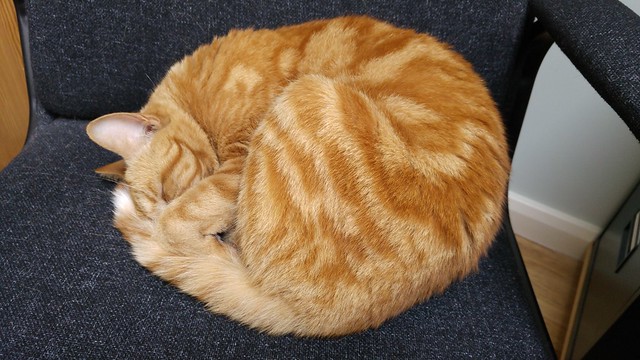
Curled up sleeping cat

If you search for “sleeping” on Flickr, as I just did, you mainly get photos of sleeping cats and sleeping babys, so maybe you could also say that you slept like a cat. The cat in the photo above is my sister’s cat Fletcher, by the way.

In Welsh you might sleep like a hog / wild boar (cysgu fel twrch), or like a hedge (fel clawdd), like a sow (fel hwch), like a pig (fel mochyn), like a small rope/cord (fel cordyn), like a nail (fel hoelen), like a stone (fel carreg) or like a mole (fel gwadd) [source].

In Scottish Gaelic you could say bha cadal nam maigheach orm (I slept like a hare), and cadal nam maigheach ort!, or literally “sleep of the hare on you”, is how you say “sweet dreams, sleep tight!” or something similar [source].

In French you might sleep like a dormouse (dormir comme un loir), like a marmot (comme une marmotte), like a stump (comme une soche), like a baby (comme un bébé) or with closed fists (à poings fermés) [source].

What about in other languages?

Six Ways to Sunday

Six ways to Sunday is apparently an American expression that means ‘in every possible way, with every alternative examined’ or ‘in every possible direction’.

The first meaning can be found in “we checked him out six ways to Sunday before offering him that big loan.” while the second meaning is in “my necklace broke and the beads went six ways to Sunday”.

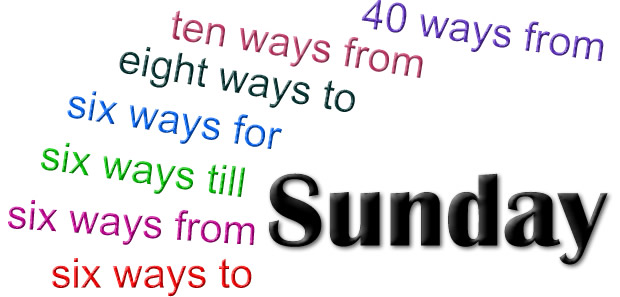
There are many variants on this phrase involving different numbers of ways ranging from two to a thousand. Some versions use different, both or many instead of numbers, and some replace to with from or for.

6 ways to Sunday

According to The Phrase Finder, the earliest known version of the phrase appeared in the American Turf Register and Sporting Magazine in July 1832:

“[The horse] Nullifier, led to the post by a small dry looking man, with a hat that stands nine ways for Sunday, and whose antagonists quake at the sight of that old slouched beaver, as do the Bourbons still at the cocked hat of Napoleon.”

Another example from the same year, which appears in the novel Westward Ho! by James Kirke Paulding goes:

“Look!; they were stitched with a compass that pointed nine ways from Sunday

The ‘six ways to Sunday’ version first appeared in The Chicago Tribune in November 1925.

World Wide Words quotes an earlier sighting of the phrase in Captain Francis Grose’s Dictionary of the Vulgar Tongue from 1785:

“SQUINT-A-PIPES. A squinting man or woman; said to be born in the middle of the week, and looking both ways for Sunday; or born in a hackney coach, and looking out of both windows; fit for a cook, one eye in the pot, and the other up the chimney; looking nine ways at once.”

According to The Free Dictionary, this phrase means ‘Thoroughly or completely; in every possible way; from every conceivable angle.’ and variants include six ways to Sunday, six ways from Sunday, eight ways to Sunday, eight ways from Sunday, forty ways to Sunday and forty ways from Sunday.

Other variants of the phrase on Wiktionary include every way to Sunday, six ways till Sunday, six ways for Sunday, six ways before Sunday, ten ways from Sunday and nine ways to Sunday.

Have you heard this phrase before? Do you use it? Do you know any similar phrases in English or other languages?

Tatami Swimming

If a Japanese person compared something to practising swimming on a tatmi mat, what would you think they meant?

畳

The idiomatic expression 畳の上の水練 (tatami no ue no suiren) means literally “swimming practise on tatami”, and refers to “useless book learning; knowing the theory but being unable to put it into practice”. It is also written 畳水練 (tatami suiren) .

Other tatami-related idioms include:

  • 畳の上で死ぬ (tatmi no ue de shinu) = to die a natural death, to die in one’s own bed​ (“to die on tatami”)
  • 畳み掛ける (tatmi o kakeru) = to press for an answer, to shower questions on someone​ (“to hang up tatami”)

The character 畳 (tatami / jō) refers to the traditional Japanese straw floor coverings​, also known as tatami or tatami mats. The area of rooms in Japanese houses is measured by the number of tatami they contain or could contain. One tatami is 1.82 sqm or 1.54 sqm. An older version of the character is 疊. The same character means folding paper-case or kimono wrapping paper when pronounced tatō.

The verb 畳む (tatamu) means to fold (clothes, umbrellas, etc), to close (a shop or business) or to vacate. 畳み地図 (tatami chizu) is a folding map, 畳みじわ (tatamijiwa) is a crease, and 畳み椅子 (tatami isu) is a folding chair.

Source: jisho.org

Sleeve Monkeys

There’s an interesting idiom in Dutch – Nu komt de aap uit de mouw – which means ‘now the monkey comes out of the sleeve’ and is roughly the equivalent of the English idioms to let the cat out of the bag and to spill the beans. They mean to reveal a secret, or to reveal one’s true intentions.

opdracht 10 De aap komt uit de mouw DSC_1804

Other versions of the Dutch idiom include:

  1. De aap springt uit de mouw = The monkey jumps out of the sleeve
  2. De aap kijkt uit de mouw = The monkey looks out of the sleeve
  3. De aap uit de mouw schudden = To shake the monkey out of the sleeve
  4. Toen kwam de aap uit de mouw = Then the money came out of the sleeve = Then the true meaning became clear
  5. Hij heeft de aap in de mouw = He has the monkey up his sleeve = He’s sneaky (hides his true nature)

The origins of the idiom to let the cat out of the bag are uncertain, although we do know it was first used in writing in The London Magazine in 1760 [source].

The origins of the idiom to spill the beans are also uncertain. It was first used in American in the early 20th century, so it’s unlikely to have come from the Ancient Greek practice of using coloured beans to vote, as many sources claim [source].

The Dutch idioms come from the practice of performers hiding an actual monkey up their sleeves which would appear unexpectedly at a certain moment. Alternatively they might refer to our inner ape/monkey or mischievous character which is usually hidden metaphorically up our sleeve [source].

Are there any similar idioms in other languages?

Sources: Reverso, Ensie

Fiery Lakes

The French idiom Il n’y a pas le feu au lac [il n‿j‿a pa l(ə) fø o lak], or literally “There’s no fire on the lake”, is used when there is no hurry to do something. It could be translated as “What’s the big hurry?”, “What’s the rush?” or “Where’s the fire?”.

Fire Fountains

It has been used since the mid-20th century and apparently refers to Lac Léman (Lake Geneva) in Switzerland and the inability of Swiss people to hurry even in an emergency. It is also sarcastic in suggesting that water might be on fire [source].

Variations on this idiom, and phrases with similar meanings, include:

  • Il n’y a pas le feu = There’s no fire (on the lake)
  • Ya pas l’feu = There’s no fire (informal pronunciation)
  • Il n’y a pas de quoi paniquer = There’s no reason to panic
  • Il n’y a pas de quoi fouetter un chat = That’s not a reason to whip a cat
  • Rien ne presse = There’s no hurry, there’s no need to hurry
  • Ça ne presse pas = There’s no hurry / rush

Are there any interesting idioms in other languages involving fiery lakes?