Adventures in Etymology – Sadly Satisfied

In this Adventure in Etymology we find out whether the words sad and satisfied are connected.

sad

Sad [sæd] means various things, including:

  • Feeling sorrow; sorrowful, mournful.
  • Appearing sorrowful.
  • Causing sorrow; lamentable.
  • Poor in quality, bad; shameful, deplorable, regrettable, poor.

It can mean unfashionable, socially inadequate or undesirable (in slang), and in the past it meant:

  • Sated, having had one’s fill; satisfied, weary.
  • Steadfast, valiant.
  • Dignified, serious, grave.
  • Heavy; weighty; ponderous; close; hard.

It comes from Middle English sad [sa(ː)d] (sated, weary; firm, solid, hard, thoughtful, serious, sad (sorrowful), authentic, true, genuine; dark, deep [colours]), from Old English sǣd [sæːd] (full, sated, weary), from Proto-West-Germanic *sad (sated, full) from Proto-Germanic *sadaz [ˈsɑ.ðɑz] (sated, full), Proto-Indo-European *seh₂- (to satiate, satisfy) [source].

Words from the same roots include satt [zat] (not hungry, satiated, full, fed up) in German, sāts (moderation, satiation, fill) in Latvian, sáith [sˠaːç] (sufficiency, enough, fill) in Irish, and satiate, satisfied and insatiate in English [source].

The Welsh word sad was borrowed from Middle English, and means firm, stable, steady, solid, certain, sure, wise, discreet, sober, grave, melancholy, and various other things. Related words include sadiwr (stabilizer) and sadeiddio (to make or become firm or stable) [source].

You can also listen to this podcast on: Apple Podcasts, Amazon Music, TuneIn, Podchaser, Podbay or Podtail and other pod places.

If you would like to support this podcast, you can make a donation via PayPal or Patreon, or contribute to Omniglot in other ways.

Radio Omniglot podcasts are brought to you in association with Blubrry Podcast Hosting, a great place to host your podcasts. Get your first month free with the promo code omniglot.

The Fastest Way to Learn Japanese Guaranteed with JapanesePod101.com

I also write about words, etymology and other language-related topics on the Omniglot Blog, and I explore etymological connections between Celtic languages on the Celtiadur blog.

Unlimited Web Hosting - Kualo

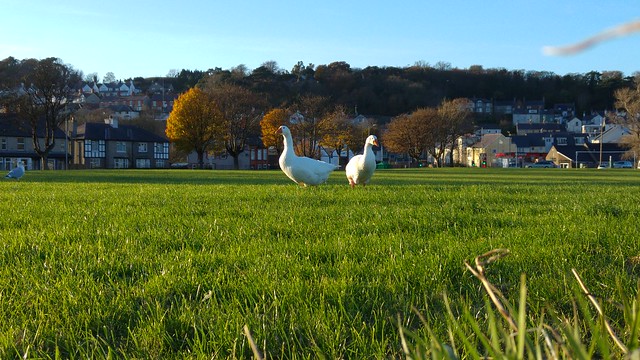
Adventures in Etymology – Grass

In this Adventure in Etymology we find out whether the words grass, graze and green are connected.

Gertie and Bertie

Grass [ɡɹɑːs/ɡɹas/ɡɹ̠æs] is:

  • Any plant of the family Poaceae, characterized by leaves that arise from nodes in the stem and leaf bases that wrap around the stem, especially those grown as ground cover rather than for grain.

It comes from Middle English gras [ɡras] (grass, herb, pasture, meadow, fodder), from Old English græs [ɡræs] (grass), from Proto-Germanic *grasą [ˈɣrɑ.sɑ̃] (grass) from Proto-Indo-European *gʰreh₁- (to grow, become green) [source].

Words from the same roots include grow, green, gray/grey, graze and herb in English, groen (green) in Dutch, grasen (to graze) in German, and rohi (grass, medicine) in Estonian [source].

Incidentally, in British slang, a grass is an informer, police informer, or one who betrays a group (of criminals, etc) to the authorities. This is probably an abbreviation of grasshopper (police officer, informant), which is rhyming slang for copper (police officer) or shopper (informant).

So we’d better not let the grass grow under our feet and kick this into the long grass, because the grass is always greener on the other side of the fence and if we listen carefully, we can hear the grass grow.

Other grass-related idioms and expressions are available, and I wrote a song about the grass appearing greener called The Other Side. It goes something like this:

You can also listen to this podcast on: Apple Podcasts, Amazon Music, TuneIn, Podchaser, Podbay or Podtail and other pod places.

If you would like to support this podcast, you can make a donation via PayPal or Patreon, or contribute to Omniglot in other ways.

Radio Omniglot podcasts are brought to you in association with Blubrry Podcast Hosting, a great place to host your podcasts. Get your first month free with the promo code omniglot.

The Fastest Way to Learn Japanese Guaranteed with JapanesePod101.com

I also write about words, etymology and other language-related topics on the Omniglot Blog, and I explore etymological connections between Celtic languages on the Celtiadur blog.

Unlimited Web Hosting - Kualo

Celtic Pathways – Tin

In this episode, we’re looking into the Celtic roots of some Romance tins.

french tinned butter biscuits

The Proto-Celtic word *stagnos means tin and probably comes from the Proto-Indo-European *sth₂gʰ-nó-s (standing, firm), from *steh₂- (to stand) [source].

Related words in the modern Celtic languages include:

  • stán = tin, tin vessel in Irish
  • staoin [sdɯːn̪ʲ] = tin, pewter in Scottish Gaelic
  • stainney = tin, can, tin-plate in Manx
  • (y)staen [ˈ(ə)staɨ̯n] = tin, pewter in Welsh
  • sten [stɛːn / steːn] = tin in Cornish
  • staen [ˈstɛːn] = tin in Breton

Words from the same Celtic roots, via Gaulish *stagnom (tin) and Latin stannum (tin, silver-lead alloy), include estany (tin) in Catalan, étain (tin) in French, stagno (tin) in Italian, and estanho (tin) in Portuguese [source].

I forgot to mention in the recording that the symbol for the element tin is Sn, which comes from Latin stannum, and the English words such as stannary (of or pertaining to tin mining, especially in Cornwall), and stanniferous (containing or producing the metal tin) come from the same roots [source].

Words from the same PIE roots include cost, distant, estate, instant, obstinate, stand, stem and stool in English [source], and words from heel in Celtic languages, such as sawdl in Welsh and sáil in Irish [source].

Incidentally, the word tin comes from Middle English tyn(ne) (tin), from Old English tin (tin), from Proto-Germanic *tiną (tin), probably from a pre-Indo-European language [source].

More about words for Tin and related tools in Celtic languages.

You can find more connections between Celtic languages on the Celtiadur blog. I also write about words, etymology and other language-related topics on the Omniglot Blog.

Radio Omniglot podcasts are brought to you in association with Blubrry Podcast Hosting, a great place to host your podcasts. Get your first month free with the promo code omniglot.

The Fastest Way to Learn Japanese Guaranteed with JapanesePod101.com

Celtic Pathways – Boring Tools

In this episode we’re drilling down to find the possibly Celtic roots of words for drill, auger and related tools in some Romance languages.

Auger, shipwright's (x8)

The Proto-Celtic word *taratrom means auger and comes from the Proto-Indo-European *térh₁trom (tool for drilling), from *terh₁- (to rub, turn, drill, pierce) [source].

Related words in the modern Celtic languages include:

  • tarathar = auger in Irish
  • tora [tɔrə] = auger, gimble, gimlet in Scottish Gaelic
  • tarrar = drill in Manx
  • taradr [ˈtaradr] = auger, drill, borer, awl, gimlet in Welsh
  • tarder = drill in Cornish
  • tarar [ˈtɑː.rar] = augur, chignole (a hand drill), shipworm (mollusk) in Breton

Words that possibly come from the same Celtic roots, via Gaulish taratron (auger) and Late Latin taratrum, include taradre (to bore) in Catalan, trade (auger) in Galician, taladro (drill) in Spanish and tarière (auger) in French [source].

Words from the same PIE roots include thread, thresh, trout and throw in English, settentrione (north) in Italian, třít (to rub) in Czech, and drehen (to turn) in German [source].

Incidentally, an auger is a carpenter’s tool for boring holes longer than those bored by a gimlet (a small screw-tipped tool for boring holes); a plumber’s snake (a plumbing tool for removing obstructions from pipes); a tool used to bore holes in the ground, or a hollow drill used to take core samples of soil, ice, etc. for scientific study [source].

In Middle English it was a nauger [ə ˈnau̯ɡər], which was rebracketed as an auger in modern English. It comes from Old English nafugār (nave drill, lit. “nave spear”) – nave refers to the hub of a wheel and not the body of a church, and is related to navel [source].

The gār part of nafugār means spear, arrow or dart, and is possibly the root of the ger part of my surname Ager [source].

Auger should not be confused with augur, which refers to a diviner who foretells events by observing the behaviour of birds or other animals, or by signs derived from celestial phenomena, or unusual occurrences. In ancient Rome, an augur was an official who interpreted omens before the start of public events [source].

More about words for Drills & Augers and related tools in Celtic languages.

The theme tune for this episode is one I wrote in 2017 called The Clockwork Octopus / Yr Wythdroed Clocwaith. You can hear a longer version here:

You can find more connections between Celtic languages on the Celtiadur blog. I also write about words, etymology and other language-related topics on the Omniglot Blog.

Radio Omniglot podcasts are brought to you in association with Blubrry Podcast Hosting, a great place to host your podcasts. Get your first month free with the promo code omniglot.

The Fastest Way to Learn Japanese Guaranteed with JapanesePod101.com

Adventures in Etymology – Folk

In this Adventure in Etymology we’re looking into the origins of the word folk.

Ciarán Ó Maoinigh, Caitlín Nic Gobhann and Cathal Ó Curráín at Oideas Gael, Donegal, Ireland, July 2017
Some folk playing folk music

Folk [fəʊk / foʊk] can refer to:

  • People, persons
  • One’s relatives, especially one’s parents (e.g. my folks)
  • Short for folk music
  • A people; a tribe or nation; the inhabitants of a region, especially the native inhabitants. (Archaic)

It comes from Middle English folk [fɔlk] (people, nation, group, family, kin, relatives, humanity), from Old English folc [folk] (people, nation, tribe, crowd) from Proto-Germanic fulką [ˈɸul.kɑ̃] (people, tribe), *fulkaz (crowd, army), possibly from PIE *pleh₁- (to fill) [source].

Words from the same roots include fill, pleb, plenty, plural, plus and public in English, pul̃kas [ˈpʊlkɐs] (flock, crowd, regiment) in Lithuanian, pułk [puwk] (regiment) in Polish, and Volk [fɔlk] (people, native, tribe) in German [source].

The French word plouc [pluk] (country bumpkin, yokel) also comes from the same roots, via Breton plouk [pluːk] (yokel), from ploue [pluːe] (parish, countryside) Proto-Brythonic *pluɨβ (countryside, parish, common people) and Latin plēb(ē)s (common people, plebians) [source].

Related words in other Celtic languages include pluw (parish) in Cornish, and plwy(f) [pluːɨ̯(v) / plʊi̯(v)] (parish, poor relief, parishioners, people) in Welsh [source].

For more details, see the post about Land, Parishes & Enclosures on the Celtiadur.

You can also listen to this podcast on: Apple Podcasts, Amazon Music, TuneIn, Podchaser, Podbay or Podtail and other pod places.

If you would like to support this podcast, you can make a donation via PayPal or Patreon, or contribute to Omniglot in other ways.

Radio Omniglot podcasts are brought to you in association with Blubrry Podcast Hosting, a great place to host your podcasts. Get your first month free with the promo code omniglot.

The Fastest Way to Learn Japanese Guaranteed with JapanesePod101.com

I also write about words, etymology and other language-related topics on the Omniglot Blog, and I explore etymological connections between Celtic languages on the Celtiadur blog.

Unlimited Web Hosting - Kualo

Adventures in Etymology – Door

In this Adventure in Etymology, we’re opening doors to find the origins of the word door.

Arched blue door at Dublin City Gallery

A door [dɔː / dɔɹ] is:

  • A portal of entry into a building, room, or vehicle, typically consisting of a rigid plane movable on a hinge. It may have a handle to help open and close, a latch to hold it closed, and a lock that ensures it cannot be opened without a key.

It comes from Middle English dor(e) [ˈdɔːr(ə)] (door), from Old English duru [ˈdu.ru] (door, opening) from Proto-West-Germanic *dur (door, hatch, flap) from Proto-Germanic *durz (door, hatch, flap), from PIE *dʰwer- (door) [source].

Words from the same roots include forum, forensic and thyroid in English, dörr (door) in Swedish, drws (door, doorway) in Welsh, dvor (court, courtyard) in Slovak and ترس (tors – shield, buckler) in Persian [source].

Incidentally, in Old English one word for window was ēagduru [ˈæ͜ɑːɡˌdu.ru], or literally “eye-door”. Another was ēagþyrel [ˈæ͜ɑːɡˌθy.rel], or “eye-hole” [source].

You can also listen to this podcast on: Apple Podcasts, Amazon Music, TuneIn, Podchaser, Podbay or Podtail and other pod places.

If you would like to support this podcast, you can make a donation via PayPal or Patreon, or contribute to Omniglot in other ways.

Radio Omniglot podcasts are brought to you in association with Blubrry Podcast Hosting, a great place to host your podcasts. Get your first month free with the promo code omniglot.

The Fastest Way to Learn Japanese Guaranteed with JapanesePod101.com

I also write about words, etymology and other language-related topics on the Omniglot Blog, and I explore etymological connections between Celtic languages on the Celtiadur blog.

Unlimited Web Hosting - Kualo

Celtic Pathways – Heather

In this episode we look into the Celtic roots of words for heather in some Romance languages.

Heather

The Proto-Celtic word *wroikos means heather. Its origins are uncertain, and it possibly comes from a non-Indo-European substrate source [source].

Related words in the modern Celtic languages include:

  • fraoch [fˠɾˠeːx] = heather, heath, moor in Irish
  • fraoch [frɯːx] = heather in Scottish Gaelic
  • freoagh = heather, heath in Manx
  • grug [ɡrɨːɡ / ɡriːɡ] = heather, heath in Welsh
  • grug [ɡryːɡ / ɡriːɡ] = heather, heath in Cornish
  • brug [bryːk] = heather in Breton

Words from the same Proto-Celtic roots, via Gaulish and Latin, include brezo (heath) in Spanish, breixo (heather) in Galician, brugo (heather) and brughiera (heath, moor) in Italian, and bruyère (heath, heather, brier) in French [source].

Related words in other languages possibly include vřes (heather) in Czech, wrzos (heather) in Polish, viržis (heather) in Lithuanian, and ericaceous (Of or pertaining to the heath family; Acid-loving, acidic) in English [source].

Incidentally, the word heather comes from Old English *hǣddre (heather), from hǣþ (wasteland, wilderness, heath), from Proto-Germanic *haiþī [ˈxɑi̯.θiː] (heath, wasteland), possibly from PIE *kóy-t-os (forest, wasteland, pasture) [source].

Other words from the same roots include heath in English, heide (heath, heathland, heather) in Dutch, Heide (heath, heathland, nation, country) in German [source], and also coed (forest, wood, trees) in Welsh, koos (forest) in Cornish, and koad (wood, forest) in Breton [source].

More about words for Heather, and Trees, Wood(s) & Forests, in Celtic languages.

You can find more connections between Celtic languages on the Celtiadur blog. I also write about words, etymology and other language-related topics on the Omniglot Blog.

Radio Omniglot podcasts are brought to you in association with Blubrry Podcast Hosting, a great place to host your podcasts. Get your first month free with the promo code omniglot.

The Fastest Way to Learn Japanese Guaranteed with JapanesePod101.com

Adventures in Etymology – Stable Stables

In this Adventure in Etymology we find out whether the words stable (a building for horses) and stable (steady, permanent) are related.

Stables

A stable is:

  • a building for the lodging and feeding of horses, cattle, etc.
  • a collection of animals housed in such a building. [other meanings are available]

It comes from Middle Englsh stable (a building for horses), from Anglo-Norman stable (a place for keeping animals), from Latin stablum (dwelling, stable, hut, tavern), from stō (to stand, stay, remain) and‎ -bulum (instrumental suffix) [source].

In Old English, a stable was a horsern [ˈhorˠzˌerˠn] (“horse place”) [source] or a steall [stæ͜ɑll], from which we get the word stall (a compartment for a single animal in a stable or cattle shed) [source].

As an adjective stable means:

  • Relatively unchanging, steady, permanent; firmly fixed or established; consistent; not easily moved, altered, or destroyed

It comes from Middle English stable, from Anglo-Norman stable / stabel (stable, firm), from Latin stabilis (firm, steadfast), from stō (to stand, stay, remain) and -abilis (able). It displaced the Old English word for stable, staþolfæst [ˈstɑ.ðolˌfæst] [source].

So it seems that these two words do come from the same roots. Other words from the same roots include stage, stand, state and stamina in English, stabbio (pen, fold, pigsty) in Italian, estar (to be) in Spanish, and ystafell (room, building, house) in Welsh [source].

I forget mention on the podcast, but the reason I chose the word stable for this adventure is because it’s related to the Scottish Gaelic sabhal [sa.əl̪ˠ] (barn), which comes from Middle Irish saball, from Latin stabulum [source], and I’ve just spent a week doing a course in Scottish Gaelic songs at Sabhal Mòr Ostaig (“Ostag’s Big Barn”), the Gaelic college on the Isle of Skye [more details].

You can also listen to this podcast on: Apple Podcasts, Amazon Music, TuneIn, Podchaser, Podbay or Podtail and other pod places.

If you would like to support this podcast, you can make a donation via PayPal or Patreon, or contribute to Omniglot in other ways.

Radio Omniglot podcasts are brought to you in association with Blubrry Podcast Hosting, a great place to host your podcasts. Get your first month free with the promo code omniglot.

The Fastest Way to Learn Japanese Guaranteed with JapanesePod101.com

I also write about words, etymology and other language-related topics on the Omniglot Blog, and I explore etymological connections between Celtic languages on the Celtiadur blog.
Unlimited Web Hosting - Kualo

Adventures in Etymology – Shambling Shambles

In this Adventure in Etymology we’re looking into the origins of the word shamble (and shambles).

Shambles
The Shambles in York

To shamble means to walk while shuffling or dragging the feet, and a shamble is one of a succession of niches or platforms, one above another, to hold ore which is thrown successively from platform to platform, and thus raised to a higher level in a mine.

It comes from Middle English schamel / schambyll [ˈʃaːməl] (footstool), from Old English sċamol [ˈʃɑ.mol] (stool), from Proto-West Germanic *skamil (stool, bench), from Latin scabellum (footstool, a kind of percussion instrument played with the foot), from scamnum (stool, step, bench, ridge), from PIE *skabʰ- (to hold up) [source].

Words from the same roots include scanno (seat, bench, stool) in Italian, escano (bench, footstool) in Portuguese, scaun (chair, seat, stool, throne, residence, butcher’s block) in Romanian, Schemel (footstool) in German, and iskemle (chair) in Turkish [source].

In the plural, shambles means a scene of great disorder or ruin, a great mess or clutter, a scene of bloodshed, carnage or devastation, or a slaughterhouse, and it used to mean a butcher’s shop. It comes from the same roots as the singular shamble [source].

There’s a street in York in the north of England called The Shambles (see the photo above), that was once home to many butchers. They originally displayed their wares on stalls or benches known as shamels or schambylls, which gave the street its name. There are several similarly-named streets in other parts of the UK and Ireland [source].

Incidentally, a German equivalent of shamble is schlurfen [ˈʃlʊɐ̯fn̩], which means to shuffle (walk without picking up one’s feet). It’s related to the English word slurp [source].

Now it’s time to shamble off. I made a bit of an omnishambles of this post – I wrote most of it, then accidentally deleted half of it and had to rewrite it as I couldn’t retrieve the lost bits. I hope it’s not too shambolic.

You can also listen to this podcast on: Apple Podcasts, Amazon Music, TuneIn, Podchaser, Podbay or Podtail and other pod places.

If you would like to support this podcast, you can make a donation via PayPal or Patreon, or contribute to Omniglot in other ways.

Radio Omniglot podcasts are brought to you in association with Blubrry Podcast Hosting, a great place to host your podcasts. Get your first month free with the promo code omniglot.

The Fastest Way to Learn Japanese Guaranteed with JapanesePod101.com

I also write about words, etymology and other language-related topics on the Omniglot Blog, and I explore etymological connections between Celtic languages on the Celtiadur blog.

Unlimited Web Hosting - Kualo

Adventures in Etymology – Quagmire

In this Adventure in Etymology we’re looking into the origins of the word quagmire.

quagmire

A quagmire [ˈkwɒɡ.maɪər/ˈkwæɡ.maɪr] is:

  • A swampy, soggy area of ground.
  • A perilous, mixed up and troubled situation; a hopeless tangle.
  • To embroil (a person, etc.) in complexity or difficulty.

The quag part is an obsolete English word meaning quagmire, marsh or bog, from Middle English quabbe (marsh, bog), from Old English cwabba (that which shakes or trembles, something soft and flabby) [source].

The mire part comes from Middle English mire (marshy or swampy land), from Old Norse mýrr (moor, swamp, bog), from Proto-Germanic *miuzijō (bog, swamp, moor), from PIE *mews-yeh₂, from *mews- (moss) [source].

The English word quaggy/quoggy (marshy, soft, flabby) is related to quag, and the Dutch words kwab (a weak, blubbery mass), kwebbelen (to chatter) come and kwebbelkous (chatterbox) from the same roots [source].

Words from the same roots as mire include moss and mousse and moist in English, mos (moss, lichen) in Dutch, Moos (moss, bog, fen, marsh) in German, and mýri (marsh, swamp, bog) in Icelandic [source].

You can also listen to this podcast on: Apple Podcasts, Amazon Music, TuneIn, Podchaser, Podbay or Podtail and other pod places.

If you would like to support this podcast, you can make a donation via PayPal or Patreon, or contribute to Omniglot in other ways.

Radio Omniglot podcasts are brought to you in association with Blubrry Podcast Hosting, a great place to host your podcasts. Get your first month free with the promo code omniglot.

The Fastest Way to Learn Japanese Guaranteed with JapanesePod101.com

I also write about words, etymology and other language-related topics on the Omniglot Blog, and I explore etymological connections between Celtic languages on the Celtiadur blog.

Unlimited Web Hosting - Kualo