When is a moose not a moose?

Moose

In North America a moose is a large member of the deer family, also known by its Latin name alces alces. The word moose comes from Algonquian languages, such as the Naragansett moos or the Eastern Abenaki mos. These words are thought to come from moosu (“it strips”), from the Proto-Alonquian mo.swa.

The same animal is known as an elk in British English, and is called something similar in quite a few other European languages: elc in Welsh, Elch in German, elg in Icelandic, Danish and Norwegian, älg in Swedish, alce in Italian, Portuguese and Spanish, and alnis in Latvian [source].

Elk

The word elk refers to a different species of deer in North America, however, which is also known as the wapiti or cervus canadensis in Latin [source]. The name wapiti comes from the Cree or Shawnee waapiti (elk; white rump) [source].

In French a moose or elk is élan [eɪˈlɑːn], wapiti [wa.pi.ti] or orignal [ɔ.ʁi.ɲal]. Élan probably comes from Lativan [source]. Orignal refers to the Canadian moose and comes from the Basque word oreinak, plural of orein (deer) [source].

Moose is also a way to write mouse in Scots – it’s pronouned [mus], and features in the famous saying “there’s a moose loose aboot this hoose”, which comes from the song Hoots Mon by Harry Robinson [source].

So a moose is a moose, except when it’s an elk or a mouse.

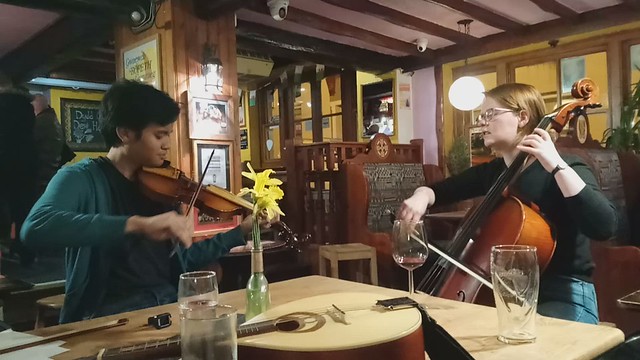
Here’s a tune I wrote called The Loose Moose / Yr Elc Rhydd:

Photos by Faris Algosaibi and Andrew E. Russell. Found on Flickr.

Time flies when you’re learning Irish

The Irish language and singing courses I’ve been doing this week finished today. Tonight there is a concert with a singer from Belfast, followed by a céilí. The week seems to have gone by quickly when I look back at it, but as I was experiencing it, it seemed to last longer.

Gleann Cholm Cille

I learnt some interesting things in the Irish language class, including proverbs, idioms, bits of grammar, and a few songs. In the sean-nós class I learned some new songs, and re-learned some old ones. Our teacher also told us about the background to the songs and the people who wrote them, which was fasciniating.

As well as speaking plenty of Irish this week, I’ve also spoke some Russian, French, Breton, Welsh and Scottish Gaelic. I can understand most of the Irish I hear, though find songs in Irish more difficult to follow. I can sing them, but don’t necessarily know all the words. This is partly because songs, especially the sean-nós ones, often include obscure words and dialect variations.

Spot the sheep

Caora. Sheep. Dafad

Tomorrow I’m off to Dublin, then I’ll return to Bangor on Sunday.

Angelic voices

Yesterday morning I studied some more Swedish, Danish and Russian, did a bit of work, and went for a walk around the misty glen.

Glenn Cholm Cille

In the afternoon we saw an interesting film in Irish – Ag Lorg Annie (Searching for Annie), which was made for the BBC by Kevin Magee, who is studying Irish here this week. The film is about a painting of a local girl, Annie McGinley, that was painted in the 1920s by the American artist, Rockwell Kent, who spent quite a bit of time in this area. Kevin wanted to find out more about the painting and where the original is now. He found the painting in a private collection in New York, and other paintings by Rockwell Kent in St Petersburg.

In the evening the local chapel was packed for a concert by Anúna, an Irish choir who sing beautiful arrangements of songs in Irish, English, Latin, Spanish. They specialize in old songs, and the oldest they sang last night was written in the 9th century, and sounded angelic.

Anúna

There was another concert after that in Oideas Gael featuring Sean Mac Corraidh from Belfast, his daughter, and a singer from Tory island. They sang traditional Irish songs, and told some interesting stories.

In the Irish language class we talked about verbs and other things this morning, and in the sean-nós class this afternoon we learnt four songs, three of which were already familiar to me. This evening there is a talk about Féiniúlacht agus Teanga (Identity and Language) by a lecturer in psychology from Dublin.

The Misty Glen

After quite a long journey, I arrived on Glenn Cholm Cille last night. I met some people I know on the way and spent much the journey chatting with them, so it didn’t seem so long. We talked in a mixture of Irish and English, with odd bits of German and Spanish. Last night I also spoke quite a bit of French. I found at first that Scottish Gaelic kept interfering with the other languages, especially Irish. Now I’m in Irish mode though.

As the bus went further north and west into Donegal the mist and rain came down, and by the time we arrived in Gleann Cholm Cille, the mountains had disappeared. Hence the title of this post.

Here are some photos of Gleann Cholm Cille from previous visits. The ones I took today of the misty geln are not online yet, but will appear soon.

Gleann Cholm Cille

I’m here for the Irish Language and Culture Summer School (Scoil Samhraidh Teanga agus Cultúir) at Oideas Gael, the Irish language and culture centre I’ve been to for a week or two every summer since 2005.

There will be Irish language classes in the mornings, a choice of cultural workshops in the afternoons, and various events in the evenings – concerts, talks, music sessions, and so on.

One new worksop this year is an introduction to Welsh. Quite a few of my friends here have said they’re interested.

There are also a couple of film crews here who will be interviewing people during the week.

I plan to interview a few people about their Irish learning adventures for the next episode of my podcast.

Aarhus

I had a great time in Aarhus. I arrived on Friday afternoon, and am currently on a train on my way to Copenhagen. I’ll be flying back to Manchester this evening, and should arrive back in Bangor late tonight.

In Aarhus I stayed with a Czech friend who teaches linguistics at the local university. She introduced me to some of her colleagues and friends, and showed me round the city. We also went for walks in the woods, round a nearby lake – Årslev Engsø – and to the beach.

Aarhus is quieter and smaller than Copenhagen – easy to explore on foot, and it seems like a friendly place, and its nickname is the ‘City of Smiles’.

I spoke a bit of Danish, though found it difficult to understand what people said to me in Danish. I also spoke some Welsh and a fair bit of English – all the locals I talked to speak English well, and they didn’t all switch to English when they heard my less than perfect attempts to speak Danish.

Here are some photos:

https://flic.kr/s/aHsmdEppBj

Exploring Copenhagen / Udforskning af København

Today I am in Copenhagen on the way to see a friend in Aarhus. I left Bangor at way-too-early o’clock this morning, and arrived in Copenhagen early this afternoon. I’m staying in an AirBnB in Sydhavn, not far from the centre of the city. One of my hosts is from Moldova, and the other is a Dane, who I haven’t met yet. I spoke a bit of Russian and Romanian with my Moldovan host, which she seemed pleased to hear.

This afternoon I explored the touristy part of Copenhagen, and saw some nice parks, a castle, lots of boats, including a tall ship, a little mermaid, and some interesting buildings. I heard quite a few different languages being spoken, including Dutch, Spanish, Italian, Portuguese, Mandarin, Cantonese and other flavours of Chinese, English, French and even a bit of Danish. My knowledge of Danish is limited – I can read Danish quite well, and speak and understand it a little.

Cycling seems to be a popular way to get around here, perhaps because Copenhagen is so flat. There are plenty of cycle paths, and even traffic lights for cyclists. There are also many cargo bikes – three-wheeled contraptions with a large container on the front for shopping, children, pets or other things. Some cyclists indicate they’re stopping by raising their arm, as if asking a question, which is practical, but looks quite funny to me.

Here are a few photos:

Copenhagen / København

Tomorrow I’m off to Aarhus to see a Czech friend who teaches Linguistics at the university there. We usually speak a mixture of Czech, English and Welsh, and now we can add some Danish to the mix.

Later addition – I’ve met both my hosts now – the guy is actually from the Faroe Islands, and we’ve just had a very interesting conversation about Faroese and other languages. He told me that they used to borrow a lot of words into Faroese, especially from Danish, but now tend to create new words from Faroese roots. He finds it hard to understand some of the new words, as he’s not used to using them. They speak English to each other, by the way, as he doesn’t speak Russian or Romanian, and she speaks only a little Danish, and no Faroese.

Back in Bangor / Yn nôl ym Mangor

Janko Kráľ Park

Yesterday morning I went for a wander around Bratislava, had lunch, then headed to the airport. I got there a bit early, and spent my time mainly listening to an audiobook. There were a couple of other polyglots (from Russian) there, so I had a little chat with them as well.

Bore ddoe mi wnes crwydro o gwmpas Bratislava, ges i ginio, ac yna es i i’r maes awyr. Mi wnes i gyrraedd yna tipyn bach yn gynnar, a mi wnes i gwario fy amser yn gwrando ar llyfr sain yn bennaf. Roedd dau amlieithogwyr (o Rwsia) yna, felly mi wnes i cael sgwrs bach â nhw hefyd.

When I was queueing for the flight, a mother with two daughters was in front of me speaking Slovak and English to each other. By coincidence, they were the same ones who were in the queue in front of me in Birmingham on the way to Bratislava.

Pan ro’n i’n ciwio am yr ehediad, roedd mam efo dwy ferch o’m blaen i yn siarad Slofaceg a Saesneg efo’i gilydd. Fel cyd-ddigwyddiad, roedden nhw yr un pwy oedd yn y res o’m blaen i yn Birmingham ar y ffordd i Bratislava.

On the train from the airport there was a man speak and singing loudly in a language that sounded like Arabic. He appeared to be talking and singing to someone on his phone, though may have just been doing it to himself – he was rather drunk, I think.

Ar y trên o’r maes awyr roedd dyn yn siarad ac yn canu mewn iaith sy’n swnio fel Arabeg. Roedd fel petai roedd o’n siarad ac yn canu efo rhywun ar ei ffôn, ond mae’n bosib roedd o’n gwneud hynny efo’i gilydd – roedd o wedi meddw, dw i’n meddwl.

I arrived back in Bangor last night, and today I’m catching up with things I couldn’t do while away

Mi wnes i gyrraedd yn ôl ym Mangor neithiwr, a heddiw dw i’n gwneud y pethau ro’n i ddim medru gwneud wrth i mi bod i ffwrd.

Language quiz

This week the quiz is a bit different. As I’m currently at the #PolyglotGathering, I thought I’d come up with a question related to the event.

So, the question is, can you guess which of these languages has not been talked about here (in one of the talks or lectures): Ukrainian, Warlpiri, Rapa Nui, Southern Sami, Manx, Tunica, or Shanghainese.

No cheating by looking at the program now 🙂

Yesterday was a good day with some interesting talks and conversations. At the International Culutural Evening I sang a Welsh folk song (Gwcw Fach) on my own, and two songs with a few others – one in Spanish (Cielito Lindo), and one in Māori (Ngā iwi e).

It’s not just about languages

Dance workshop at the Polyglot Gathering

As well as talks about language learning, languages and related topics, this year’s #PoylgotGathering includes workshops in singing songs in various languages, calligraphy, knitting and dancing. Yesterday I caught the end of a dancing workshop, and learnt a bit of belly dancing, and a folk dance from Brittany. It was a lot of fun.

I also did a bit of juggling and poi spinning with a few other polyglots yesterday, and there was a musical jam session with a few people who had instruments with them. I don’t have any instruments with me this year as I’m travelling light with only one small bag.

Tonight there’s an international cultural evening, and I plan to sing a Welsh folk song (Gwcw Fach), and maybe a Scottish Gaelic song (Illean Bithibh Sunndach). Some of us who took part in the singing workshop on Thursday with be singing songs in Maori and Spanish.

Languages I spoke yesteday – English, French, German, Spanish, Welsh, Irish, Swedish, Slovak, Mandarin, Dutch, Esperanto, Portuguese.

Polyglotting

My name tag for the 2018 Polyglot Gathering

Today is the second full day of the #PolyglotGathering. It’s been a lot of fun, with some very interesting talks, and I’ve met a lot of people I know from previous polyglot events, and many new people too.

So far I’ve had conversations in English, French, German, Spanish, Welsh, Irish, Mandarin, Swedish, Russian and Esperanto, and have spoken odd bits of Manx, Danish, Icelandic, Czech, Italian, Portuguese and Slovak. I’ve learnt about Warlpiri, Bengali and Ukrainian, and have sung songs in Spanish, Italian, Serbian and Maori.

This morning I’ll be giving my presentation on Deconstructing Language. My original plan was to talk mainly about how grammar works and how it develops, but What I’ll actually talk about is where words come from and how and why they change over time.