Sylvan Forests

When is a forest not a forest?

A view from the train

In modern English, the word forest [ˈfɒɹɪst / ˈfɔɹəst] means:

  • A dense uncultivated tract of trees and undergrowth, larger than woods.
  • Any dense collection or amount – e.g. a forest of criticism

Historically it referred to ‘defined area of land set aside in England as royal hunting ground or for other privileged use’, and didn’t necessarily contain trees.

It comes from Middle English forest (forest, wood, a preserve for hunting exclusive to royalty), from Old French forest (royal hunting ground, forest), from Early Medieval Latin forestis (a large area reserved for the use of the King or nobility, often a forest and often for hunting or fishing, forest), from Proto-West-Germanic *furhisti (forest), from *furhiþi (forest, woodland) and *hursti (thicket, wood, grove, nest) [source].

*furhiþi (forest) comes from *furhu (fir, pine), from Proto-Germanic *furhō (fir, pine, forest [of fir or pine trees]), from Proto-Indo-European *pérkus (oak), from *perkʷ- (oak) [source].

Words from the same roots include pērkons (thunder) in Latvian, perkūnas (sound of thunder, god of thunder) in Lithuanian, perth (bush, hedge) in Welsh, quercia (oak) in Italian, forêt (forest) in French, vorst (copse, grove, woodland) in Dutch, fjör (vitality, energy, fun, life) in Icelandic, and cork, fir and farm in English [source].

*hursti (thicket, wood, grove, nest) comes from Proto-Germanic *hurstiz, from Proto-Indo-European *kʷr̥s-ti-s, from *kʷres- [source].

Words from the same roots include hirst (a barren, unproductive piece of ground, usually a hillock, knoll or ridge) in Scots, horst (an elevated land overgrown with shrub) in Dutch, Horst (the nest of a bird of prey, eyrie, bush, thicket, small forest) in German, and hurst (wood, grove – found mainly in place names such as Sissinghurst) in English [source].

The Irish word crann (tree, mast), the Welsh word pren (timber, wood, tree), and related words in other Celtic languages also come from the same roots, via Proto-Celtic *kʷresnom (tree, wood) [source].

In Middle English, the word wode was used to refer to a living tree, a group of trees, a grove, a copse, a wood, a forest, wood, etc. As a verb, it meant to hunt, to take to the woods, or to hide oneself in the woods, and a wodeward was a forester or forest warden.

Wode comes from Old English wudu / ᚹᚢᛞᚢ (wood, forest, woods, tree), from Proto-Germanic *widuz (wood, tree, forest), from Proto-Indo-European *h₁widʰ-u-s [source].

Words from the same roots include wood in English, viður (trees or brambles, forest, wood, timber) in Icelandic, viita (a thicket of young deciduous trees) in Finnish, gwedhen (tree) in Cornish, gwezenn (tree) in Breton, and fiodh (wood, timber) in Scottish Gaelic [source].

Another forest-related word in English is sylvan, which means pertaining to the forest or woodlands, residing in a forest or wood, wooded, or covered in forest.

Related words include silviculture (forestry – the care and development of forests in order to obtain a product or provide a benefit), silvology (the scientific study of forests), and names such as Syliva, Transylvania (“across the forest”), Spotsylvania and Pennsylvania (“woodland of William Penn”).

It comes from Medieval Latin sylvanus, from Latin silvanus, from silva (forest), from Proto-Indo-European *s(w)el- (beam, board, frame, threshold) [source]. Words from the same roots include selva (forest, wood, mass, multitude) in Italian, selva (jungle, woods, forest) in Portuguese, and silva (bramble, blackberry bush) in Galician [source].

The Fastest Way to Learn Japanese Guaranteed with JapanesePod101.com


Nesting Niches

What connects the word niche with nests? Let’s find out.

Niches

A niche include:

  • A cavity, hollow, or recess, generally within the thickness of a wall, for a statue, bust, or other erect ornament.
  • A function within an ecological system to which an organism is especially suited.
  • Any position of opportunity for which one is well-suited, such as a particular market in business.

There are several ways to pronounce it, including [niːʃ], which rhymes with leash, [nɪʃ], which rhymes with fish, and [nɪtʃ], which rhymes with pitch. Which one do you prefer?

It comes from French niche [niʃ] (niche, kennel), from Middle French niche, from Old French niche, from nicher (to make a nest), from Latin *nīdicāre (to nest), from nīdus (nest), Proto-Italic *nizdos (nest), from Proto-Indo-European *nisdós (nest), from *ni (down) & *sed- (sit) – literally “where [the bird] sits down” [source].

Words from the same PIE roots include neth (sprout, bud) in Albanian, նստել [nəsˈtel] (to sit, sink, fit, shrink) in Armenian, ligzda (nest) in Latvian, gniazdo (nest, socket) in Polish, नीड़ (nīṛ – nest) in Hindi, nead (nest, bed, lair, home, den) in Irish, and nido (nest, home, nursery school) in Italian [source].

The English word nest comes from the same PIE roots, via Middle English nest (nest), Old English nest (nest), Proto-West Germanic *nest (nest), and Proto-Germanic *nestą (nest, provisions, food and supplies) [source].

The English word nidus (an aggregate of neurons; a nest of insects or small animals) also comes from the same roots, via Latin nīdus (nest), as do nidation (the implantation of the early embryo in the uterus), nidificate (to make or build a nest), nidolody (the study of nests) and nidifugous (that leaves the nest shortly after hatching) [source].

The archaic English words nid(e) (a nest of pheasants) and nye (a brood or flock of pheasants), also share the same roots. They were probably borrowed from Middle French nid (nest), from Latin nīdus (nest) [source].

The Fastest Way to Learn Japanese Guaranteed with JapanesePod101.com


Strong Strings

Are the words string, strong, strength, strait, stretch and strict related? Let’s find out.

Ball of string

String comes from Middle English streng (rope, cord, line, thread, string, ribbon, muscle, tendon, ligament, filament), from Old English strenġ (string, rope, cord), from Proto-West Germanic *strangi (string), from Proto-Germanic *strangiz (string), from Proto-Indo-European *strengʰ- (to twist; rope, cord), possibly from *sterh₃- (to spread, extend, stretch out) [source].

English words from the same roots include constrict, constrain, restrict, strong, strength, strain, strait, stress, strict, stricture and stringent.

Words from the same roots in other languages include stringere (to clasp, grasp, squeeze) in Italian, étreindre (to hug, clutch, grip) in French, streng (strict, severe, rigorous, unbending, cruel) in Dutch, sträng (strict, stern, severe) in Swedish, strangs (brave, brisk, fresh) in Latvian, rankka (burdensome, hard, intense, harsh, tough) in Finnish [source].

So, the odd one out in the list above is stretch, which comes from Middle English strecchen (to stretch out, spread, extend), from Old English streċċan (to stretch, extend, spread out, prostrate), from Proto-West Germanic *strakkjan (to stretch, make straight), from *strak (stretched, straight), from Proto-Germanic *strakaz (stretched, straight) from Proto-Indo-European *(s)treg- (stiff, rigid).

Words from the same roots include stark in English, stark (strong) in German, strak (taut, tight) in Dutch, strække (to stretch) in Danish, and shtriqem (to stretch) in Albanian [source].

Here’s a tune from the music session I went to last night called The Bishop of Bangor’s Jig. It’s played on string instruments (fiddle, guitar and banjo), so is sort connected to the theme of this post.

You can find the dots: https://www.folktunefinder.com/tunes/94828

The Fastest Way to Learn Japanese Guaranteed with JapanesePod101.com

What’s that noise?

Did you know that the Italian word rumore doesn’t mean rumo(u)r, as you might expect, but rather noise, rumble, sound or clatter. Is it connected to the English word rumo(u)r? Let’s find out.

Rumore

Rumore comes from Latin rūmōrem (vague noises, rumours), from rūmor (rumo(u)r), hearsay, gossip, rustle, murmur, a murmuring, the voice of the people), from Proto-Italic *roumōs, from Proto-Indo-European *h₃rewH- (to shout, to roar) [source]. A related word in Latin is rūmusculus (idle gossip) [source].

Related words and expressions in Italian include:

  • rumoreggiare = to rumble, clamo(u)r
  • rumoreggiare = to rumble, clamo(u)r
  • rumorista = noisemaker, foley artist
  • rumoroso = noisy, loud
  • rumorosamente = noisily
  • antirumore = anti-noise, soundproof, noise-cancelling, noise-reducing
  • un rumore sordo = a thud
  • rumore bianco = white noise
  • rumore di sottofondo = background noise
  • la notizia ha fatto molto rumore = the news aroused great interest [source]

Words from the same Latin roots include rumoer (rumo(u)r, noise) in Dutch, rumo(u)r in English, rumeur (rumo(u)r) in French, rumur (rumo(u)r, continuous noise) in Portuguese, and rumor (rumo(u)r, murmur) in Spanish [source].

Words from the same PIE roots include řvát (to yell, roar) in Czech, реветь [rʲɪˈvʲetʲ] (to roar, bellow, howl, cry, weep) in Russian, and possibly ωρύομαι [oˈri.o.me] (to howl) in Greek, and rāvis (hoarseness) in Latvian [source].

So the English word rumo(u)r is related. It means “A statement or claim of questionable accuracy, from no known reliable source, usually spread by word of mouth.” or “Information or misinformation of the kind contained in such claims.”. It used to mean a report, new, information in general, fame, reputation, clamour, din or outcry [source].

It comes from Middle English rumour (rumour, gossip, hearsay; a report, tidings, news; loud shouting, noise, din; outcry of protest or disapproval; a disturbance, stir, tumult) [source], from Old French rimur (noise [produced by an army on the march]), from Latin rūmōrem [source].

In Old English, the word hlýd meant rumo(u)r or the noise made in discussing an event [source], and also noise, sound, tumult, disturbance or dissension. Another word for rumour was hlísa, which also meant sound, fame or glory [source].

The Fastest Way to Learn Japanese Guaranteed with JapanesePod101.com

Lost in the Geese

The French word oie means goose, but how do you pronounce it?

Geese

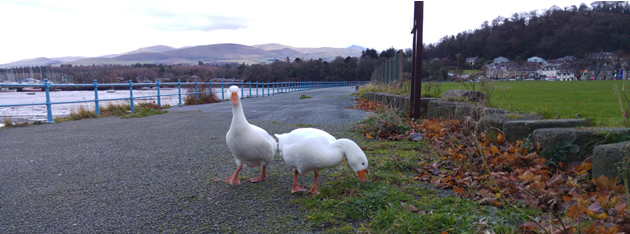
Last night at the French Conversation Group, we were talking about geese, as you do, and while I could remember how to write the word for goose in French, I wasn’t sure how to pronounce it. Then one of my friends suggested it was foie as in foie gras [fwa ɡʁa]. I knew this means “fat liver”, so foie must mean liver, and that oie probably sounds similar to foie.

My guess was right, oie is pronounced [wa] and rhymes with foie [fwa]. It comes from the Old French oie (goose), from Vulgar Latin auca (goose), a contraction of *avica, from Latin avis (bird), from Proto-Italic *awis (bird), from Proto-Indo-European *h₂éwis (bird). The Old French word was originally written oe or oue. The i was added by the end of the 12th century as analogy to oisel/oiseau (bird) [source].

Words from the same roots include հավ [hɑv] (hen, chicken) in Armenian, ave (bird) in Galician, Spanish and Portuguese, vista (chicken, hen) in Latvian, hwyad (duck) in Welsh, οἰωνός [i.oˈnos] (large bird, bird of prey, omen) in Greek [source].

The French word oiseau (bird) also comes from the same roots, via the Late Latin aucellus (little bird), as do uccello (bird) in Italian, and ocell (bird) in Catalan [source].

Incidentally, goose comes from Middle English go(o)s (goose, fool, idiot), from Old English gōs (goose), from Proto-West Germanic *gans (goose), from Proto-Germanic *gans (goose), from Proto-Indo-European *ǵʰh₂éns (goose), which is likely of imitative origin [source].

A French equivalent of to loose one’s marble (become crazy, loose one’s mind) is se perdre les oies (“to get lost in the geese”) [source].

Are there any interesting goose-related expressions in other languages?

Gardens and Castles

The word for garden in Russian, and also in Belarusian, Ukrainian and Serbian, is сад [sat], which also means orchard. It comes from the Proto-Slavic word *sadъ (plant, garden).

The word for garden in most other Slavic languages is the same: sad in Croatian, Slovenian, Polish, Slovak and Sorbian. There are also similar words in Latvian (sads) and Lithuanian (sõdas) [source].

The word sad also exists in Czech, but just means orchard. The Czech word for garden is zahrada [ˈzaɦrada], which comes from za (for, in, behind), and hrad (castle), from the Proto-Slavic *gȏrdъ* (settlement, enclosed place). So zahrada could be translated as “in/behind the castle” [source].

*The Proto-Slavic *gȏrdъ comes ultimately from the Proto-Indo-European *ǵʰórtos (enclosure), which is also the root of the Irish gort (wheatfield), the Welsh garth (hill, enclosure), the Latin hortus (garden), and the English horticulture, yard and garden, and related words in other languages.

Powis Castle

Famous outside words

beseda (word in Slovenian)

In Slovenian beseda [bɛˈséːda] is the word for word or term.

Some expressions featuring beseda include:

– besedna igra = wordplay, pun, play on words
– brez besed = speechless (with shock etc.)
– častna beseda = word of honour
– dati častno besedo = to give one’s word
– držal te bom za besedo = I am going to take you at your word
– mož beseda = man of hono(u)r
– z besedo na dan! = spit it out! let the cat out (of the bag)!

This comes from the Proto-Slavic *besěda, which originally meant sitting outdoors (at night), then an outdoor gathering, or a conversation or speech at such a gathering.

*besěda comes from *bez (outside) and *sěděti (to sit).

In other Slavic languages the same root became:

– Belarusian: бяседа (bjasjeda) = banquet
– Russian: беседа (beséda) = conversation, talk, discussion
– Ukrainian: бесіда (besida) = talk, conversation, discussion
– Bulgarian: беседа (beséda) = talk, conversation
– Macedonian: беседа (beseda) = speech, oration, sermon
– Serbo-Croatian: бесједа / besjeda = speech, word (archaic)
– Czech: beseda = discussion
– Slovak: beseda = discussion
– Polish: biesiada = feast, banquet

Words for word in other Slavic languages include:

– Belarusian: слова (slova)
– Russian: слово (slovo)
– Ukrainian: слово (slovo)
– Bulgarian: дума (duma); слово (slovo)
– Macedonian: збор (zbor)
– Serbian: реч (reč)
– Croatian: rije
– Czech: slovo
– Slovak: slovo
– Polish: słowo

Slovo, and variations, comes from the Proto-Slavic *slovo (word), from the Proto-Indo-European *ḱléwos (fame), which is also the root of the Welsh clyw (hearing), the Irish clú (honour, praise, fame), the Latvian slava (rumor, reputation, fame), and the Greek κλέος (kléos – renown, fame, honour).

Sources: Wiktionary, PONS, dict.com