
Blackfoot is an Algonquian language spoken by about 2,900 Blackfoot (Niitsitapi) people in the Blackfeet Nation (Aamsskáápipikani) in Montana in the USA, and in the Piikani, Siksika and Kainai Nations in southern Alberta in Canada. It is classified as definitely endangered.
The dialect of Blackfoot spoken in Montana is known as Aamsskáápipikani (Southern Piegan). The dialects spoken in Canada are known as Siksiká(Blackfoot), Kainai (Blood, Many Chiefs), and Aapátohsipikani (Northern Piegan). The name Blackfoot is thought to derive from the black soles of the leather shows worn by Blackfoot people.
Older speakers of Blackfoot speak Old Blackfoot, which is also known as High Blackfoot, while younger speakers speak New Blackfoot, which is also known as Modern Blackfoot. There are significant differences between these two varieties.
Since the late 20th century efforts have been made to revitalize the Blackfoot language. Blackfoot is taught as a subject, or through immersion, in primary and secondary schools in the Blackfoot Nations, and there is a Blackfeet Community College in Montana. There are also some programmes in Blackfoot on a radio station in Browning, Montana.
The Blackfoot syllabary was devised by John William Tims (1857-1945), an Anglican missionary from England who spent 12 years from 1883 to 1895 among the Blackfoot people in the North-West Territories of Canada (now Alberta). Tims based his Blackfoot syllabary on James Evans' Ojibwe syllabary and used it to produce a dictionary of the Blackfoot language and translations of a number a biblical texts.
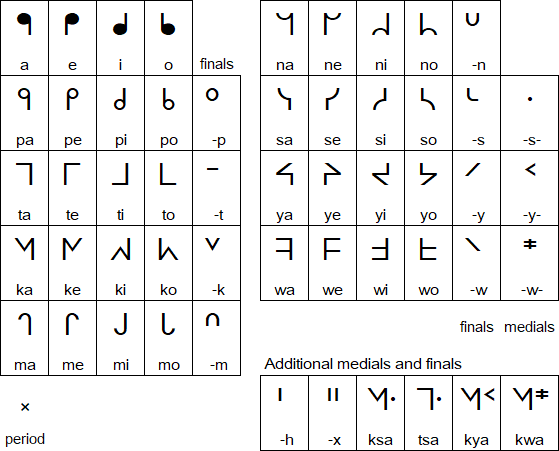
Nowadays the syllabary is rarely used as the Latin alphabet is prefered.
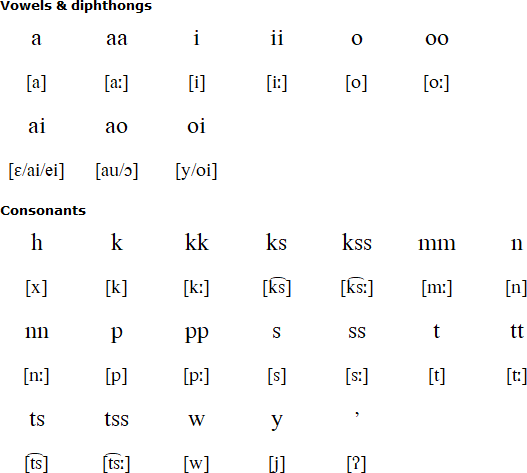
A standarized orthography for Blackfoot using the Latin alphabet was created in 1975 by Blackfoot people from the Siksiká, Káínai, and Aapátohsipikani (Piikáni) reserves.
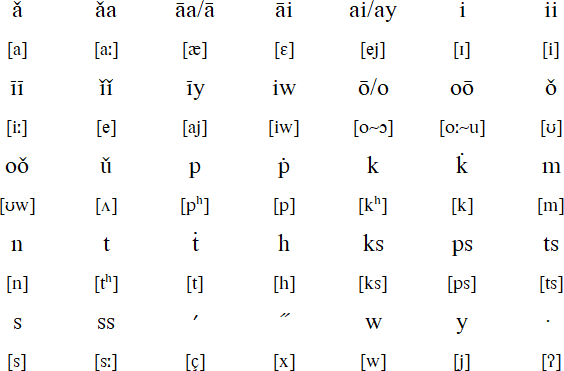
Another way to write Blackfoot with the Latin alphabet was created by William Big Bull (k̇īyǎa•s), a Piikani teacher at the Blackfeet Community College. It is known as the Big Bull Writing System (niitsiiꞏṗoʹꞏʺsin), and is used particularly in some schools in the Blackfeet Nation and in the Blackfeet Community College.
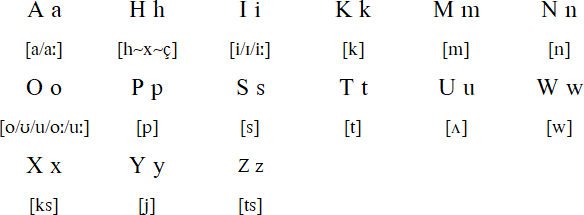
The Holterman Writing System was developed by Jack Holterman, a scholar of Blackfoot, and is used in the Piegan Institute to teach Blackfoot, and om Nizi Puh Wah Sin (Cuts School) and some places in the Blackfeet Nation (Aamsskáápipikani).
This script was developed by Elder Wayne Weatherwax and is used in some schools and other places in the Blackfeet Nation.
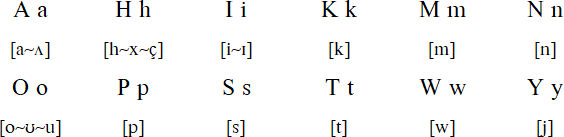
Download script charts for Blackfoot (Excel)
A new syllabic script for Blackfoot was devised in about 2015 by Thomas Floyd Heavyrunner, a member of the Kainai tribe, who introduced it to Elder Sheldon First Rifer, another member of the Kainai tribe. It was inspired by the Cherokee syllabary, and aims to promote the use of Blackfoot, to enhance cultural identity among the Blackfoot people, and to make Blackfoot easier for learners to grasp/
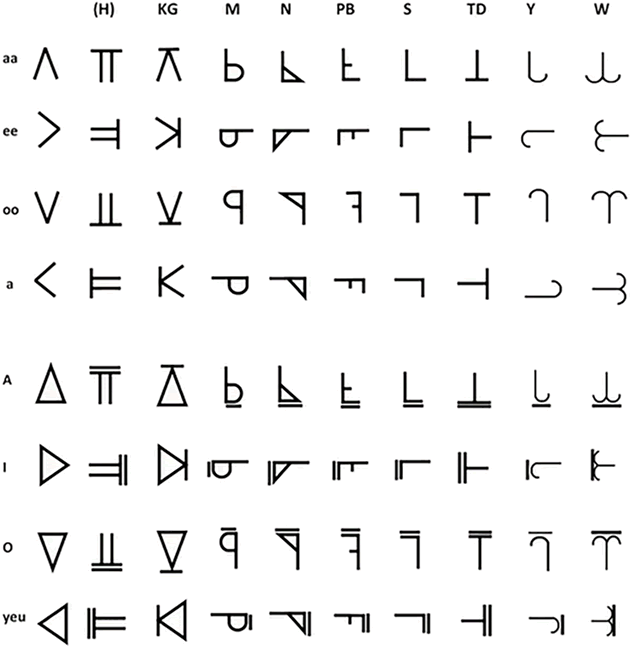
Source: https://blackfootlanguagerevival.com/

Transliteration
Aamohka nitaayakitsinikatawahka kiaayaowahka ki omahka kipitakiwahka anistawa Ksistsikomaaki. Iitoisiyihk. Iiksipihtsi omii otsitotoispima miini.
Source: http://www.languagegeek.com/algon/siksika/sik_example.html
Aayo kinnoon, Spoohtsi kitsitaopi Kitsinihkaʼsimi ikainaiiyiʼtsiʼp; Naakoohk itoʼtoohpinaan anniihk kitsiʼtaamipaitapiiyssini, Aann kaanistaiʼtaam iksimsstatoʼpi kookoowaayi spoohtsi, Aann akoohkattanistaisiiwa anno ksaahkoyi. Kokkinaan naahksowatoʼpinnaani annohk ksiistoikoi; Noohk aisskahsiʼtsit nipahtsaʼpssinnaanistsi, Aann naanistaisskahsiʼtsiʼpinnaani naanistaipahtsiistotootsipinnaani. Miinoohk itoʼtsiipiookinnaan iiyikoyi, ooki noohksikamotssiipiookinnaan Aamoistsiyay noohkaohsiihkatooʼpi. Amen.
Our Father, who art in heaven, hallowed be thy name; thy kingdom come; thy will be done; on earth as it is in heaven. Give us this day our daily bread. And forgive us our trespasses, as we forgive those who trespass against us. And lead us not into temptation; but deliver us from evil. Amen.
Source: https://en.wikipedia.org/wiki/Blackfoot_language#Sample_text
Information about Blackfoot | Numbers
Information about the Blackfoot language and syllabary
http://www.languagegeek.com/algon/siksika/blk_syllabarium.html
https://en.wikipedia.org/wiki/Blackfoot_language
http://www.native-languages.org/blackfoot.htm
http://www.glenbow.org/blackfoot/teacher_toolkit/english/culture/language.htm
http://www.blackfootcrossing.ca/language.html
Information about Blackfoot Syllabics
http://scriptum.bplaced.net/america/blackfoot.html
https://blackfootlanguagerevival.com/
Online Blackfoot dictionary
http://dictionary.blackfoot.atlas-ling.ca/
Abenaki, Algonquin, Arapaho, Atikamekw, Blackfoot, Cheyenne, Chippewa, Cree (East), Cree (Moose), Cree (Plains), Cree (Swampy), Cree (Woods), Fox, Innu (Montagnais), Kickapoo, Malecite-Passamaquoddy, Loup, Massachusett (Wampanoag), Menominee, Miami, Míkmaq, Mohegan, Mohican, Munsee, Narragansett, Naskapi, Ojibwe, Oji-Cree, Ottawa, Penobscot, Powhatan, Potawatomi, Quiripi, Sauk, Shawnee, Unami (Lenape)
Blackfoot, Carrier, Chipewyan, Cree (East), Cree (Moose), Cree (Plains), Cree (Swampy), Cree (Woods), Inuinnaqtun, Inuktitut, Naskapi, Ojibwe, Oji-Cree
Languages written with the Latin alphabet
Ahom, Aima, Arleng, Badagu, Badlit, Basahan, Balinese, Balti-A, Balti-B, Batak, Baybayin, Bengali, Bhaiksuki, Bhujimol, Bilang-bilang, Bima, Blackfoot, Brahmi, Buhid, Burmese, Carrier, Chakma, Cham, Cree, Dehong Dai, Devanagari, Dham Lipi, Dhankari / Sirmauri, Ditema, Dives Akuru, Dogra, Ethiopic, Evēla Akuru, Fox, Fraser, Gond, Goykanadi, Grantha, Gujarati, Gunjala Gondi, Gupta, Gurmukhi, Halbi Lipi, Hanifi, Hanuno'o, Hočąk, Ibalnan, Incung, Inuktitut, Jaunsari Takri, Javanese, Kaithi, Kadamba, Kamarupi, Kannada, Kawi, Kharosthi, Khema, Khe Prih, Khmer, Khojki, Khom Thai, Khudabadi, Kirat Rai, Kōchi, Kodava Lipi, Komering, Kulitan, Kurukh Banna, Lai Tay (Tai Yo), Lampung, Lanna, Lao, Leke, Lepcha, Limbu, Lontara/Makasar, Lota Ende, Magar Akkha, Mahajani, Malayalam, Meitei (Modern), Manpuri (Old), Marchen, Meetei Yelhou Mayek, Meroïtic, Masarm Gondi, Modi, Mon, Mongolian Horizontal Square Script, Multani, Nandinagari, Newa, New Tai Lue, Ojibwe, Odia, Ogan, Pahawh Hmong, Pallava, Phags-pa, Purva Licchavi, Qiang / Rma, Ranjana, Rejang (Kaganga), Sasak, Savara, Satera Jontal, Shan, Sharda, Sheek Bakrii Saphaloo, Siddham, Sinhala, Sorang Sompeng, Sourashtra, Soyombo, Sukhothai, Sundanese, Syloti Nagri, Tagbanwa, Tai Noi, Takri, Tamil, Tanchangya (Ka-Pat), Tani, Thaana, Telugu, Thai, Thirke, Tibetan, Tigalari, Tikamuli, Tocharian, Tolong Siki, Vatteluttu, Warang Citi
Page last modified: 17.05.26
[top]

Note: all links on this site to Amazon.com


You can support this site by Buying Me A Coffee, via PayPal or Patreon, or by contributing in other ways.
If you find all the adverts annoying, there is now an Ad-free version of Omniglot which you can access for a small monthly or annual donation.

This website and its content is copyright of Simon Ager - © Simon Ager 1998-2026. All rights reserved. All images were created by me, unless otherwise indicated. More details

[top]


