Here’s a recording in a mystery language.
Can you identify the language, and do you know where it’s spoken?
Here’s a recording in a mystery language.
Can you identify the language, and do you know where it’s spoken?
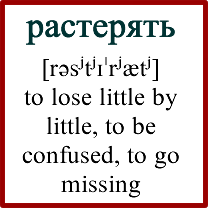
An interesting Russian word I learnt today is растерять [rəsʲtʲɪˈrʲætʲ], which means ‘to lose little by little, to be confused, to go missing. The first meaning comes from Wiktionary, but I can’t find any examples of it being used in that way.
It comes from the prefix рас- [rəs] & терять [tʲɪˈrʲætʲ] (to lose, waste, shed).
Here are some examples of how it’s used:
Related words include:
The adjective потерянный [pɐˈtʲerʲɪn(ː)ɨj] is used when an object is lost. It can also mean embarrassed, perplexed, hopeless or ruined. However, if a person is lost, пропавший [prɐˈpafʂɨj] is used, and also means missing, hopeless or long-lost.
There are probably other ways to talk about losing things, getting lost and being lost in Russian. What about in other languages?
Sources: Wiktionary, Reverso
I just registered for the Polyglot Gathering in Bratislava at the end of May / beginning of June. This will be the fifth time I’ve been to the Gathering – the second in Bratislava, and I’m looking forward to it.
I’ll be staying in the same AirBnB as last time, which is close to the Gathering venue, and not too far from the centre of Bratislava. It’s easier that way as I already know my way around the area.
I haven’t decided if I’ll give a presentation or run a workshop at the Gathering. At previous polyglot events I’ve given talks on writing systems, the origins of languages, the origins of words, Manx, and language death and revival, and helped with a Welsh language workshop. Any suggestions for what I could talk about at this and future polyglot events?
At the end of January I’m going to Edinburgh for LingoFringo, a fringe event to the main polyglot conferences and gatherings with a focus on workshops, community and networking events. I’ll be running a workshop on traditional Scottish Gaelic songs there.
So this month I’ll be brushing up my Scottish Gaelic, preparing for the workshop, and continuing to work on other languages. The languages I’m focusing on currently are Swedish, Danish, Russian, Esperanto, Cornish and Scots. This year I also plan to learn some more British Sign Language and Slovak, and maybe some German, Czech and Spanish.
I don’t plan to start any new languages this year – we’ll see how that works out.
What are your language-related plans for this year?
Here’s a recording in a mystery language.
Can you identify the language, and do you know where it’s spoken?
Have you ever wondered how many alphabets and other writing systems are used regularly?
I show this in the writing system indices on Omniglot, although it isn’t always easy for less well-known writing systems to be sure how much they are used.
Also, how many different writing systems can you recognise?
This video explains how to recognise all the writing systems in regular use:
It covers the following scripts:
Alphabets
Latin, Cyrillic, Greek, Armenian Georgian and Mongolian
Abugidas
Bengali, Devanagari, Gujarati, Gurmukhi, Tibetan, Odia, Telugu, Kannada, Malayalam, Sinhala, Burmese, Khmer, Lao, Thai and Thaana
East-Asian scripts
Chinese, Japanese and Korean
Rare scripts
Tifinagh, N’Ko, Samaritan, Syriac, Inuktitut/Cree, Cherokee, Yi, Ol Chiki, Fraser and Tai Le
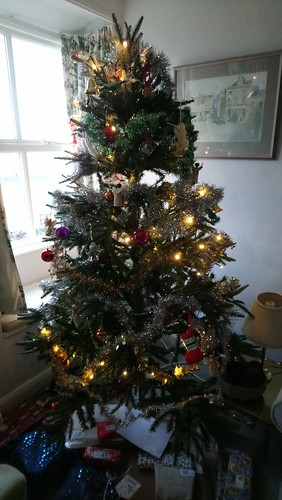
Did you get any language-related goodies for Christmas?
Are you planning to start learning any new languages next year?
I got a British Sign Language (BSL) course, The Accidental Dictionary by Paul Anthony, and a t-shirt with hello on it in many languages.
I plan to concentrate on improving my knowledge of the languages I already know, rather than starting any new ones. Whether I stick to this remains to be seen.
Oh and Merry Christmas
Nadolig Llawen
Joyeux Noël
Nedeleg Laouen
Frohe Weihnachten
Nadelik Lowen
聖誕快樂
Nollaig shona
メリークリスマス
Nollick Ghennal
¡Feliz Navidad!
Nollaig Chridheil
С Рождеством
God jul
Veselé vánoce
Glædelig jul
Ĝojan Kristnaskon
Here’s a recording in a mystery language.
Can you identify the language, and do you know where it’s spoken?
Last night I saw FARA, a brilliant group from Orkney, in our local arts centre. One of the songs they sang, Speir Thoo The Wast Wind, was in Orcadian dialect and based on a poem by Christina Costie from Orkney.
Orcadian dialect is a type of Insular Scots that combines elements of the extinct Norn language and Scots. There isn’t a lot of information available about Orcadian, but I will try to put together a page about it on Omniglot.
Each verse of the song and the poem finishes with the line “Speir thoo the wast wind, bit speir no me”, which means “Ask the west wind, and don’t ask me”, I think.
The word speir [spiːr], which is also written speer, means to enquire or ask, according to The Orkney Dictionary. When I heard it in the song, I thought I might be related to words for to ask in North Germanic languages, and it turns out that it is.
It comes from the Old English spyrian (to track, inquire, investigate, examine), from the Proto-Germanic *spurjaną (to search; to examine; to ask) [source], which is also the root of the Danish word spørge (to ask, inquire), Norwegian word spørre (to ask, inquire), and the word spyrja (to ask) in Icelandic and Faroese [source].
A few other words from Orkney dialect: hoodjiekapiv, hoodjiekapiffle, hoodjiekaboogle, which are all Orcadian equivalents of whatsit, thingy, doobry, thingamajig, whatjumacallit, thingamebob, etc [source]. What do you call something when you can’t remember it’s normal name?
You can hear the song here:
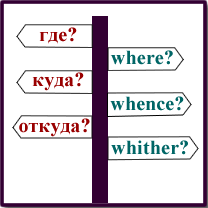
In Russian, there are several different words meaning where. Each one means something slightly different, although in English they can all be translated as where.
где [ɡdʲe] means where, as in what location, and can also mean anywhere or somewhere. For example:
Related words include:
где comes the from Old East Slavic къде (kŭde – where), from the Proto-Slavic kъde (where), from the Proto-Indo-European *kʷú-dʰe (where).
куда [kʊˈda] means where (to), and also what, why or much. It is the equivalent of whither in English, although that is rarely used these days. For example:
Related words include:
куда comes from the Proto-Slavic *kǫda ( where, whither), from the Proto-Indo-European *kʷom-dʰ- (where).
откуда [ɐtˈkudə] means where from, from where, from which or whence (another rarely-used word). For example:
Related words include:
откуда comes from the same root as куда.
Sources: Reverso, Wiktionary
Here’s a recording in a mystery language.
Can you identify the language, and do you know where it’s spoken?