Adventures in Etymology – Dinkus

In this Adventure in Etymology we find out what the dickens a dinkus is, and what to do with an asterism.
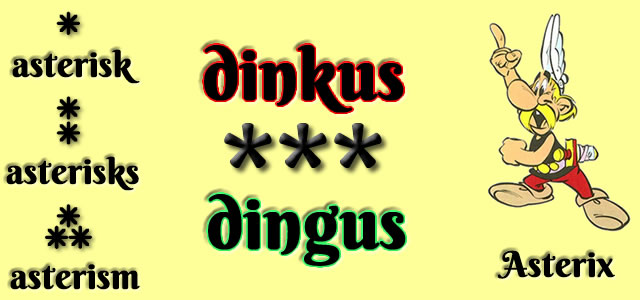
Dinkus

A dinkus is:

  • A small drawing or artwork used for decoration in a magazine or periodical.
  • A small ornament, usually a line of three asterisks (* * *), especially for the purpose of breaking up sections of a chapter, article, or other text
⁎⁎⁎

It comes from German Ding (thing), from Old High German thing [ðinɡ] (thing, object, matter, case), from Proto-West Germanic *þing (court session, lawsuit, affair, matter, thing, object), from Proto-Germanic *þingą (date, appointment, meeting, assembly, matter, issue) [source].

Words from the same roots include thing in English, ding (matter, thing) in Dutch, þing [θiŋk] (assembly, meeting, council, parliament) in Icelandic, and ting (thing, court of law, legislative assembly) in Swedish [source].

Dinkus should not be confused with dingus, which can refer to something whose name you’ve forgot, i.e. a thingamajig, whatchamacallit, etc in North American and South African. In the USA and Canada it can also refer to a foolish, incompetent, or silly person [source].

Dingus was possibly borrowed from Dutch and/or Afrikaans dinges (thingamajig, whatshisname) and ding (thing).

An asterism is:

  • A rarely used typographical symbol (⁂, three asterisks arranged in a triangle), used to call attention to a passage or to separate subchapters in a book (like a dinkus).
  • An unofficial constellation (small group of stars that forms a visible pattern).

It comes from Ancient Greek ἀστερισμός [ˈæs.təˌɹɪz.əm] (a group of stars), from ἀστήρ [asˈtir] (star, planet, illustrious person, starfish) [source].

Asterism is also the name of a Japanese band:

The word asterisk (*) comes from the same roots, via Late Latin asteriscus (small star and Ancient Greek ἀστερῐ́σκος [as.teˈris.kos] (small star) [source].

Two asterisks on top of each other (⁑) are apparently used in texts to denote emphasis, comments, footnotes, corrections, or other similar annotations [source].

Parc Asterix

Incidentally, Asterix, the Gaulish hero of the comic books by René Goscinny and Albert Uderzo, gets his name from the French word astérisque (asterisk) combined with the Gaulish word *rīx (king) [source].

You can also listen to this podcast on: Apple Podcasts, Amazon Music, TuneIn, Podchaser, Podbay or Podtail and other pod places.

If you would like to support this podcast, you can make a donation via PayPal or Patreon, or contribute to Omniglot in other ways.

Radio Omniglot podcasts are brought to you in association with Blubrry Podcast Hosting, a great place to host your podcasts. Get your first month free with the promo code omniglot.

The Fastest Way to Learn Japanese Guaranteed with JapanesePod101.com

I also write about words, etymology and other language-related topics on the Omniglot Blog, and I explore etymological connections between Celtic languages on the Celtiadur blog.

Unlimited Web Hosting - Kualo

Celtic Pathways – Brooms

In this episode we’re sweeping French floors with Celtic shrubs.

brooms

The Proto-Celtic word *banatlo- means broom, as in the shrub Cytisus scoparius (a.k.a. common broom / Scotch broom) or similar plants. It comes from Proto-Indo-European *bʰenH-tlom (way, path) in the sense of “cleared path (in a wood)” [source].

Related words in the modern Celtic languages include:

  • bealaidh [bɛl̪ˠɪ] = broom in Scottish Gaelic
  • banadl [ˈbanadl] = broom in Welsh
  • banadhel = broom in Cornish
  • balan [ˈbɑːlãn] = broom in Breton

They all mean broom, as in the shrub, although the exact species of broom plant they refer to may vary from language to language.

According to An Etymological Dictionary of the Gaelic Language by Alexander MacBain (1982), there is a cognate in Irish: beally/i, however it doesn’t appear in any of the Irish dictionaries I’ve checked.

The French word balai (broom, broomstick, brush) ultimately comes from the same Proto-Celtic root, via Old French balain (bundle of broom), Middle Breton balain, balazn, Old Breton balan (broom) and Gaulish *balano- (broom, broom plant), as does bálago (straw, Spanish broom) in Spanish and balea (broom) in Galician, possibly via Celtiberian *bálago-, *bálaco- [source].

Words same PIE roots possibly include bana (course, path, trajectory) in Swedish, baan (road, path, track, job, orbit) in Dutch, and Bahn (route, trail, railway) in German [source].

More about words for Brushes and Broom and related things in Celtic languages.

Incidentally, the tune at the beginning of this episode is one of my own compositions called Apple Blossom / Blodau Afal. Here’s a longer recording of it:

You can find more connections between Celtic languages on the Celtiadur blog. I also write about words, etymology and other language-related topics on the Omniglot Blog.

Radio Omniglot podcasts are brought to you in association with Blubrry Podcast Hosting, a great place to host your podcasts. Get your first month free with the promo code omniglot.

The Fastest Way to Learn Japanese Guaranteed with JapanesePod101.com

Celtic Pathways – Fortified Dunes

In this episode we uncover Celtic fortresses among the sand dunes.

Killinallan

A dune is a ridge or hill of sand piled up by the wind. It comes from Proto-West Germanic *dūn(ā) (sand dune, hill), via French or Dutch, from Proto-Germanic *dūnaz (accumulation, pile, heap, mound), or from Gaulish dunum (hill), from Proto-Celtic *dūnom (stronghold, rampart), all of which come from Proto-Indo-European *dʰuHnom (enclosure) [source].

Related words in the modern Celtic languages include:

  • dún [d̪ˠuːnˠ] (fort(ress), place of refuge, residence, house) in Irish
  • dùn [duːn] (fortress, heap) in Scottish Gaelic
  • doon [duːn] (fort, stronghold) in Manx
  • din [dɪn] (city, fortress, stronghold), and dinas (city) in Welsh
  • din [di:n] (fort) in Cornish
  • din [ˈdĩːn] (fortress) in Breton

Apart from dinas in Welsh, these words are mostly found in placenames, such as Dún Dealgan (Dundalk) in Ireland, Dún Dè(agh) (Dundee) in Scotland, Dinbych (Denbigh) in Wales, Dinmeur (Dunmere) in Cornwall, and Dinan in Brittany.

Words from the same Celtic roots possibly include town and down (a [chalk] hill, rolling grassland) in English, tuin (garden, yard) in Dutch, tún (hayfield) in Icelandic, and тын [tɨn] (fence [especially one made of twigs]) in Russian [source].

Words same PIE roots include dusk, dust and fume in English, dagg (dew) and dy (mud, mire, sludge) in Swedish, and fem (dung, manure) in Catalan [source].

More about words for Castles & fortresses and related things in Celtic languages.

You can find more connections between Celtic languages on the Celtiadur blog. I also write about words, etymology and other language-related topics on the Omniglot Blog.

Radio Omniglot podcasts are brought to you in association with Blubrry Podcast Hosting, a great place to host your podcasts. Get your first month free with the promo code omniglot.

The Fastest Way to Learn Japanese Guaranteed with JapanesePod101.com

Adventures in Etymology – Noodling About Noodles

In this Adventure in Etymology we’re noodling around with the word noodle.

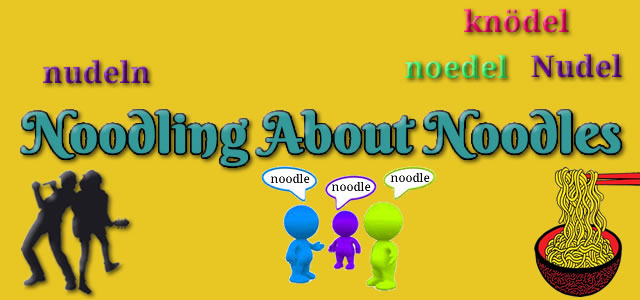
Noodling About Noodles

As a noun, a noodle can refer to:

  • A string or flat strip of pasta or other dough, usually cooked (at least initially) by boiling, and served in soup or in a dry form mixed with a sauce and other ingredients.
  • An object which is long and thin like a noodle.

It comes from Dutch noedel (noodle), or from German Nudel (a piece of pasta, noodle). The origin of these words is uncertain [source].

Apparently in the USA noodle can refer to Asian noodles and Italian pasta, whereas in the UK, noodle only refers to Asian noodles.

As a verb, to noodle can mean:

  • To play a musical instrument or to sing in an improvisatory or light-hearted manner
  • To ponder or think, especially in an unproductive or unsystematic manner
  • To attempt in an informal or uncertain manner; to fiddle.

In Shetland dialect, to noddle means to hum or sing (a tune) at a low pitch or volume. This may be a blend of the Shetland word nune (to sing softly, croon, hum) and doodle (to play the bagpipes) in Scottish English.

The English verb to noodle may come from the Shetland word, or from German nudeln (to make music or sing listlessly, at a low pitch or volume, or in an improvisatory manner). It was possibly influenced by doodle (to draw or scribble aimlessly).

In informal British English, to noodle can also mean to engage in frivolous behaviour, or to fool around or waste time, and it used to mean a person with poor judgement, a fool, or to fool or trick someone.

Other meanings of noodle are available.

Incidentally, I like to noodle on my various musical instruments, and with my voice, and wrote a little ditty about this the other day, which goes something like this:

I’m just noodling away quite happily
and nothing can get in my way
I could noodle all day down by the bay
and noodle all through the night

Will you noodle with me down by the sea?
Will you noodle along the shore?
Will you noodle and moodle and all that caboodle?
We’ll have a lot of fun you’ll see

We can noodle and doodle and eat some strudel
with oodles of custard and cream
And then noodle some more it won’t be a bore
Just noodling down on the shore

Just noodling down on the shore

To moodle means to dawdle aimlessly, to idle time away [source], oodles means an unspecified large amount, number, or quantity; lots, tons [source], and cabdoodle means any large collection of things or people [source]

You can also listen to this podcast on: Apple Podcasts, Amazon Music, TuneIn, Podchaser, Podbay or Podtail and other pod places.

If you would like to support this podcast, you can make a donation via PayPal or Patreon, or contribute to Omniglot in other ways.

Radio Omniglot podcasts are brought to you in association with Blubrry Podcast Hosting, a great place to host your podcasts. Get your first month free with the promo code omniglot.

The Fastest Way to Learn Japanese Guaranteed with JapanesePod101.com

I also write about words, etymology and other language-related topics on the Omniglot Blog, and I explore etymological connections between Celtic languages on the Celtiadur blog.

Unlimited Web Hosting - Kualo

Celtic Pathways – Horny Peaks

In this episode we find Romance horns among Celtic peaks and mountains.

Panoramic view from Snowdon / Golygfa panoramig o'r Wyddfa

In Proto-Celtic, the word *bandā means top, peak or horn, and *benno means peak or top. They are thought to be related, and possibly come from the PIE *bendʰ- (pin, point).

Related words in the modern Celtic languages include:

  • beann = horn, antler or fork prong in Irish
  • beann [bjaun̪ˠ] = horn, peak or top; and beinn [bein̪ʲ] = mountain or high hill in Scottish Gaelic
  • beinn = mountain, summit or pinnacle in Manx
  • ban [ban] = top, tip, summit or peak in Welsh
  • ban = prominence in Cornish
  • bann = rising, uphill, post or column in Breton

Words from the same Celtic roots include ben (mountain, hill) in Scots, as in Ben Nevis (Beinn Nibheis), etc, banya (horn) and banyut (horned, unfaithful) in Catalan, and bana (horn) in Occitan [source].

Words same PIE roots include peak and pin in English, pinne (chopstick, perch, point) in Swedish, pind (stick, perch, peg) in Danish, and pin (peg, pin) in Dutch [source].

More about words for Peaks and related things in Celtic languages.

You can find more connections between Celtic languages on the Celtiadur blog. I also write about words, etymology and other language-related topics on the Omniglot Blog.

Radio Omniglot podcasts are brought to you in association with Blubrry Podcast Hosting, a great place to host your podcasts. Get your first month free with the promo code omniglot.

The Fastest Way to Learn Japanese Guaranteed with JapanesePod101.com

Adventures in Etymology – Shambling Shambles

In this Adventure in Etymology we’re looking into the origins of the word shamble (and shambles).

Shambles
The Shambles in York

To shamble means to walk while shuffling or dragging the feet, and a shamble is one of a succession of niches or platforms, one above another, to hold ore which is thrown successively from platform to platform, and thus raised to a higher level in a mine.

It comes from Middle English schamel / schambyll [ˈʃaːməl] (footstool), from Old English sċamol [ˈʃɑ.mol] (stool), from Proto-West Germanic *skamil (stool, bench), from Latin scabellum (footstool, a kind of percussion instrument played with the foot), from scamnum (stool, step, bench, ridge), from PIE *skabʰ- (to hold up) [source].

Words from the same roots include scanno (seat, bench, stool) in Italian, escano (bench, footstool) in Portuguese, scaun (chair, seat, stool, throne, residence, butcher’s block) in Romanian, Schemel (footstool) in German, and iskemle (chair) in Turkish [source].

In the plural, shambles means a scene of great disorder or ruin, a great mess or clutter, a scene of bloodshed, carnage or devastation, or a slaughterhouse, and it used to mean a butcher’s shop. It comes from the same roots as the singular shamble [source].

There’s a street in York in the north of England called The Shambles (see the photo above), that was once home to many butchers. They originally displayed their wares on stalls or benches known as shamels or schambylls, which gave the street its name. There are several similarly-named streets in other parts of the UK and Ireland [source].

Incidentally, a German equivalent of shamble is schlurfen [ˈʃlʊɐ̯fn̩], which means to shuffle (walk without picking up one’s feet). It’s related to the English word slurp [source].

Now it’s time to shamble off. I made a bit of an omnishambles of this post – I wrote most of it, then accidentally deleted half of it and had to rewrite it as I couldn’t retrieve the lost bits. I hope it’s not too shambolic.

You can also listen to this podcast on: Apple Podcasts, Amazon Music, TuneIn, Podchaser, Podbay or Podtail and other pod places.

If you would like to support this podcast, you can make a donation via PayPal or Patreon, or contribute to Omniglot in other ways.

Radio Omniglot podcasts are brought to you in association with Blubrry Podcast Hosting, a great place to host your podcasts. Get your first month free with the promo code omniglot.

The Fastest Way to Learn Japanese Guaranteed with JapanesePod101.com

I also write about words, etymology and other language-related topics on the Omniglot Blog, and I explore etymological connections between Celtic languages on the Celtiadur blog.

Unlimited Web Hosting - Kualo

Celtic Pathways – Bijou Fingers

In this episode we find Celtic fingers among French jewelery.

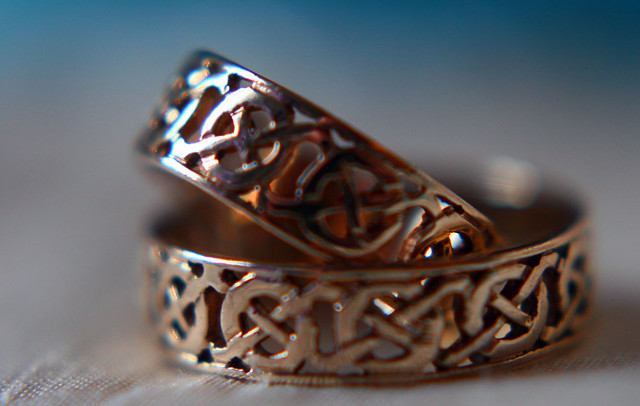
celtic wedding rings

The French word bijou means a jewel or piece of jewellry. It was borrowed from the Breton bizou (ring, jewel), which comes from biz (finger), which is ultimately comes from the Proto-Celtic *bistis (finger), from the PIE *gʷist- (twig, finger) [source].

Related words in the modern Celtic languages include:

  • bys [bɨːs / biːs] = finger (of hand/glove), toe, medium, agency, hand (of clock) or latch and byson = ring in Welsh
  • bys = finger, digit, and bysow = ring in Cornish
  • biz [biːs] = finger, hand (of clock), tooth (of tool), leg (of anchor), tentacle or tendril, and bizou [ˈbiːzu] = ring, jewel in Breton

Words from the same PIE roots possibly include kvist (twig, stick) in Norwegian and Swedish, and gisht (finger) in Albanian [source].

The French word bijou was borrowed into English and means a jewel, a piece of jewellery, a trinket, or a small intricate piece of metalwork, which are collectively called bijouterie / bijoutry [source].

Bijou in English can also mean small and elegant (residence), or something that is intricate or finely made. This sense comes via Sabir (Mediterranean Lingua Franca) from Occitan pichon (small, little), which possibly has Celtic roots: from Proto-Celtic *kʷezdis (piece, portion) [source].

In Polari, a cant used in the London fishmarkets, in the British theatre, and by the gay community in the UK, bijou means small or little (often implying affection), and a bijou problemette is a little fault or problem [source].

More about words for Fingers and Toes in Celtic languages.

You can find more connections between Celtic languages on the Celtiadur blog. I also write about words, etymology and other language-related topics on the Omniglot Blog.

Radio Omniglot podcasts are brought to you in association with Blubrry Podcast Hosting, a great place to host your podcasts. Get your first month free with the promo code omniglot.

The Fastest Way to Learn Japanese Guaranteed with JapanesePod101.com

Adventures in Etymology – Guide

In this Adventure in Etymology we’re looking into the origins of the word guide.

Guided Tour

Guide [ɡaɪd] means:

  • Someone who guides, especially someone hired to show people around a place or an institution and offer information and explanation, or to lead them through dangerous terrain.
  • A document or book that offers information or instruction; guidebook.

It comes from Middle English gīde / gidde / guide (guide, pilot, helmsman), from Old French guide (guide) from Old Occitan guida (guide), from guidar (to guide, lead), from Frankish *wītan (to show the way, lead), from Proto-Germanic *wītaną (to see, know, go, depart), from PIE *weyd- (to see, know) [source].

Words from the same roots include druid, history, idea, vision, wise and wit in English, gwybod (to know) in Welsh, fios (knowledge, information) in Irish and veta (to know) in Swedish [source].

The English word guide has been borrowed into various other languages, including Japanese: ガイド (gaido – guide, tour guide, conductor, guiding, leading, guidebook) [source], and Korean: 가이드 (gaideu – tour guide, guidebook, user’s manual) [source].

By the way, there’s an episode of the Celtic Pathways podcast about the word druid, and there’s a post on my Celtiadur blog about words related to knowledge in Celtic languages.

You can also listen to this podcast on: Apple Podcasts, Amazon Music, TuneIn, Podchaser, Podbay or Podtail and other pod places.

If you would like to support this podcast, you can make a donation via PayPal or Patreon, or contribute to Omniglot in other ways.

Radio Omniglot podcasts are brought to you in association with Blubrry Podcast Hosting, a great place to host your podcasts. Get your first month free with the promo code omniglot.

The Fastest Way to Learn Japanese Guaranteed with JapanesePod101.com

I also write about words, etymology and other language-related topics on the Omniglot Blog, and I explore etymological connections between Celtic languages on the Celtiadur blog.
Unlimited Web Hosting - Kualo

Celtic Pathways – Needles and Scythes

In this episode we discover Romance scythes in a stack of Celtic pins and needles.

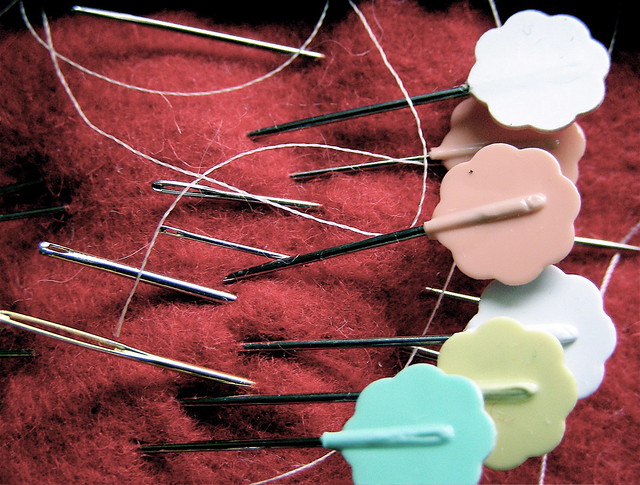
Pins and Needles

The Proto-Celtic word *delgos means pin or needle. It comes from Proto-Indo-European *dʰelg- (sting) [source].

Related words in the modern Celtic languages include:

  • dealg [ˈdʲal̪ˠəɡ] = thorn, prickle, spine, spike, pin, peg or brooch in Irish
  • dealg [dʲal̪ˠag] = pin, skewer or knitting needle in Scottish Gaelic
  • jialg = needle, prick, quill, thorn or pin in Manx
  • dala [ˈdala] = sting or bite in Welsh

Words from the same Proto-Celtic roots, via Gaulish *dalgis (scythe) and Latin *daculum (scythe) , possibly include dall (mowing, billhook) in Catalan, dalle (scythe) in Spanish, and dalha (scythe) in Occitan (Languedoc) [source].

The English word dagger, and related words in other languages, such as daga (dagger) in Spanish, and Degen (rapier, épée) in German, might come from the same Celtic roots [source].

Words from the same PIE root include dálkur (spine of a fish, knife, dagger, newspaper column) in Icelandic, dilgus (prickly) in Lithuanian, falce (scythe, sickle) in Italian, and falcate (shaped like a sickle) and falcifer (sickle-bearing, holding a scythe) in English [source].

More about words for Pins and Needles in Celtic languages.

You can find more connections between Celtic languages on the Celtiadur blog. I also write about words, etymology and other language-related topics on the Omniglot Blog.

Radio Omniglot podcasts are brought to you in association with Blubrry Podcast Hosting, a great place to host your podcasts. Get your first month free with the promo code omniglot.

The Fastest Way to Learn Japanese Guaranteed with JapanesePod101.com

Adventures in Etymology – Quagmire

In this Adventure in Etymology we’re looking into the origins of the word quagmire.

quagmire

A quagmire [ˈkwɒɡ.maɪər/ˈkwæɡ.maɪr] is:

  • A swampy, soggy area of ground.
  • A perilous, mixed up and troubled situation; a hopeless tangle.
  • To embroil (a person, etc.) in complexity or difficulty.

The quag part is an obsolete English word meaning quagmire, marsh or bog, from Middle English quabbe (marsh, bog), from Old English cwabba (that which shakes or trembles, something soft and flabby) [source].

The mire part comes from Middle English mire (marshy or swampy land), from Old Norse mýrr (moor, swamp, bog), from Proto-Germanic *miuzijō (bog, swamp, moor), from PIE *mews-yeh₂, from *mews- (moss) [source].

The English word quaggy/quoggy (marshy, soft, flabby) is related to quag, and the Dutch words kwab (a weak, blubbery mass), kwebbelen (to chatter) come and kwebbelkous (chatterbox) from the same roots [source].

Words from the same roots as mire include moss and mousse and moist in English, mos (moss, lichen) in Dutch, Moos (moss, bog, fen, marsh) in German, and mýri (marsh, swamp, bog) in Icelandic [source].

You can also listen to this podcast on: Apple Podcasts, Amazon Music, TuneIn, Podchaser, Podbay or Podtail and other pod places.

If you would like to support this podcast, you can make a donation via PayPal or Patreon, or contribute to Omniglot in other ways.

Radio Omniglot podcasts are brought to you in association with Blubrry Podcast Hosting, a great place to host your podcasts. Get your first month free with the promo code omniglot.

The Fastest Way to Learn Japanese Guaranteed with JapanesePod101.com

I also write about words, etymology and other language-related topics on the Omniglot Blog, and I explore etymological connections between Celtic languages on the Celtiadur blog.

Unlimited Web Hosting - Kualo