Hearing, fame & renown

Words for hearing, fame renown and related things in Celtic languages.

Hall of Fame

Words marked with a * are reconstructions.

Proto-Celtic *klowos = hearing, fame, renown
Old Irish (Goídelc) clú [kluː] = fame
Middle Irish (Gaoidhealg) clú, clúu, clū = good repute, reputation, fame, good name, rumour, sound
clúach = famous, famed, renowned, celebrated
clúitech = famous, renowned
clúmar = famous, renowned
clúugud = act of singing the praises of, glorifying
Irish (Gaeilge) clú [klˠuː] = reputation, honour, renown
clúiteach = of good repute, honoured, renowned
Scottish Gaelic (Gàidhlig) cliù [kluː] = reputation, repute, fame, renown, prestige; credit; glory, praise
cliùteach [kluːhdʲəx] = celebrated, famous, renowned, commendable, laudable
cliùteachadh [kluːdʲəxəɣ] = celebrating, praising, lauding
cliùteachd [kluːhdʲəxg] = celebrity, fame, renown
cliùtich [kluːhdʲɪç] = celebrate, praise, laud
cliùmhor [kluː(v)ər] = famous, renowned, prestigious
Middle Welsh (Kymraec) clywet, clywit, keleuuet = to hear, listen, feel, smell, taste, hearing, earshot, report
Welsh (Cymraeg) clyw [ˈklɨu̯ / ˈklɪu̯] = hearing, earshot
clywaf, clywed = to hear, listen, feel, smell, taste, hearing, earshot, report
Middle Cornish (Cernewec) clevet = the hearing
clewas, clowas = to hear, perceive, feel, smell
clowans = the hearing, an echo
Cornish (Kernewek) klew [klɛˑʊ] = hearing
klewansek = aesthetic
klewell = hearing aid
klewes = to feel, hear, perceive, sense, smell
klewwelyek = audio-visual
Middle Breton (Brezonec) cleuet, claeuet, cleufuet = hearing
Breton (Brezhoneg) klev [klew/klef] = hearing
klevedenn = hearsay
kleved = hearing, hearsay
klevigezh = to hear, feel
klevijer = acoustic
klevout = to hear

Etymology: from Proto-Indo-European *ḱléwos (fame), from *ḱlew- (to hear) [source]. Words from the same roots include clement, client, listen and loud in English,
luid (loud, sound, assertion) in Dutch, sláva (fame, glory) in Czech, and hljóður (quiet, silent) in Icelandic [source].

Some words for Ears in Celtic languages also come from the same PIE roots.

Proto-Celtic *klutom = rumour, fame, reputation
Celtiberian *kolouton = fame (?)
Gaulish *kl(o)uton = fame (?)
Old Irish (Goídelc) cloth [kluː] = fame, reputation
Middle Irish (Gaoidhealg) cloth, clóth = report, rumour, tidings, fame, reputation, generosity
Irish (Gaeilge) cloth [klˠuː] = report, rumour, fame, renown
clothach = renowned
clothaigh = to praise extol (literary)
Scottish Gaelic (Gàidhlig) clòth† [klˠɔː] = victory, fame, praise, wind
Proto-Brythonic *klod = praise, fame (?)
Middle Welsh (Kymraec) clod, clot, klod = praise, fame, renown, reputation, honour, credit, famous, renowned
clod ueith, clotueith = renowned, celebrated, famed
Welsh (Cymraeg) clod [ˈklɨu̯ / ˈklɪu̯] = hearing, earshot
clodach = vain praise, flattery
clodadwy = laudable, commendable, praiseworthy
clodaf, clodi = to fill with praise, to praise
clodebus = eulogistic, commendatory
clodfolaf, clodfoli = to praise, eulogize, laud, extol
Middle Cornish (Cernewec) clos = glory, happiness, praise
Old Breton (Brethonoc) clot = fame, glory
Middle Breton (Brezonec) clot = fame, glory
Breton (Brezhoneg) klod [kloːt] = fame, glory
diglod = without glory

Etymology: from Proto-Indo-European *ḱlutós (famous) *ḱlew- (to hear) [source] – see above.

Manx words for fame include ard-ennym (eminence, fame, renown, title), ard-ghoo (fame, illustriousness, renown), and goo (voice, word, utterance, reputation, fame). Goo is cognate with guth (voice) in Irish and Scottish Gaelic.

The Fastest Way to Learn Japanese Guaranteed with JapanesePod101.com

Sources: Wiktionary, Etymological Dictionary Of Proto Celtic, In Dúil Bélrai English – Old Irish glossary, eDIL – Electronic Dictionary of the Irish Language, Teanglann.ie, Am Faclair Beag, An etymological dictionary of the Gaelic language, Fockleyreen: Manx – English Dictionary, Online Manx Dictionary, Gaelg Corpus, Geiriadur Prifysgol Cymru, Lexicon cornu-britannicum : a dictionary of the ancient Celtic language of Cornwall, Gerlyver Kernewek, Devri : Le dictionaire diachronique du breton, Dictionaire Favereau, TermOfis

Unlimited Web Hosting - Kualo

Silver & Money

Words for silver, money and related things in Celtic languages.

Silver Coins From a Hoard

Words marked with a * are reconstructions.

Proto-Celtic *argantom = silver
Gaulish arangto- / *argantom = silver
Celtiberian arkanta / arkato- = silver
Old Irish (Goídelc) argat [ˈarɡad] = silver, money
airgdide = silver
Middle Irish (Gaoidhealg) argat = silver, currency, money
airgdide = (made of ) silver
airgetlach = mine
Irish (Gaeilge) airgead [ˈaɾʲɪɟəd̪ˠ / ˈæɾʲɪɟəd̪ˠ] = silver, money, sum of money
airgeadaí = financier
airgeadaigh = to silver, electroplate
airgeadaíocht = monetary policy, management
airgeadas = finance
airgeadóir = cashier, (bank) teller
airgeadra = currency
airgeadúil = silvery, financial, moneyed, profitable
Scottish Gaelic (Gàidhlig) airgead [ɛrʲɛgʲəd] = money, silver, cash, currency
airgead-beò = mercury (Me), quicksilver
airgead-làimhe = cash
airgead-urrais = insurance
airgeadach [ɛrʲɛgʲədəx] = silver(y), well-off, moneyed, lucrative
airgeadachadh = silvering, silverplating, monetizing
airgeadaichte [ɛrʲɛgədɪçdʲə] = silvered
airgeadas [ɛrʲɛgʲədəs] = finance
airgeadra [ɛrʲɛgʲədrə] = currency
Manx (Gaelg) argid = money, silver, coinage, wages, finance, exchequer
argidagh = fiscal, moneyed, financier, (the) rich, silver(ed)
argidaghey = silver, silver plate
argid-roie, argid cadjin = currency
argideyr = cashier, financier, teller
argidoil = financial, monetary
argidys = finance
Proto-Brythonic *arɣant [arˈɣant] = silver, money
Old Welsh (Kembraec) argant = silver
Middle Welsh (Kymraec) aryant, ariant, arian = silver
arandûy, ariandy = bank
arianllais = (having) a clear or melodious voice or sound
arianna, aryanna = to collect or accumulate money, beg for (money)
ariannu = to give money to, fund, finance
aryanheyt, areanneit, aryaneit = silvered, silver-plated, make of silver, silvery, wealthy, rich, moneyed
ariannog = wealthy, rich, moneyed, silver(y)
Welsh (Cymraeg) arian [ˈarjan] = silver, silvery; silver vessel; money, coin(s), coinage, currency, wealth
arianllais = (having) a clear or melodious voice or sound
arianna = to collect or accumulate money, beg for (money)
ariannaf, ariannu = to give money to, fund, finance, silver, inlay, plate
ariannaid = silvered, silver-plated, make of silver, silvery, wealthy, rich, moneyed
arianneg = financial management, finance
Ariannin = Argentinia, Argentinian
ariannog = wealthy, rich, moneyed, silver(y)
ariannwr, ariannydd = cashier, financier, banker, sponsor
Old Cornish argan, arʒant, argans = silver
Middle Cornish (Cernewec) archans, arhans, arrans = silver
Cornish (Kernewek) arghans [‘arhans / ‘ærhɐnz] = money, silver
arghans bew/byw = quicksilver
arghansek = financial, silvery
arghanser, arghansores = banker
arghans-gweres = subsidy
arghanti = bank
Arghantina = Argentina
Old Breton (Brethonoc) argant = silver
Middle Breton (Brezonec) archant = silver
Breton (Brezhoneg) arc’hant [ˈar.ɣãnt] = silver, money
arc’hantadur = silvering
arc’hantaj = silverware
arc’hantan, arc’hantañ = to silver, realize (in money), capitalize, sponsor, convert
arc’hantek = silver (adj)
arc’hanter = silverer
arc’hantiri = silverware
arc’hantus = money-producing, lucrative, capitalizable

Etymology: from Proto-Indo-European *h₂erǵn̥tom (silver), from *h₂erǵ- (white, glittering) [source]. Words from the same PIE root include Argentina and argentous (of, pertaining to or containing silver) in English, արծաթ (arcatʿ – silver) in Armenian, argento (silver) in Italian, argent (silver, money, cash) in French [source].

The Fastest Way to Learn Japanese Guaranteed with JapanesePod101.com

Sources: Wiktionary, Am Faclair Beag, Online Manx Dictionary, Teanglann.ie, eDIL – Electronic Dictionary of the Irish Language, In Dúil Bélrai English – Old Irish glossary, Geiriadur Prifysgol Cymru, Gerlyver Kernewek, Dictionaire Favereau, TermOfis, English – ProtoCeltic WordList (PDF), Etymological Dictionary Of Proto Celtic

Unlimited Web Hosting - Kualo

Fresh & New

Words for fresh and new in Celtic languages.

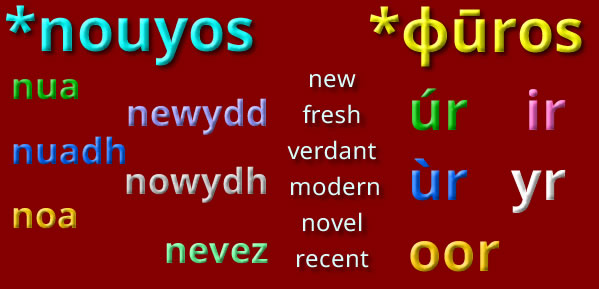
Words for new in Celtic languages

Proto-Celtic *ɸūros = new
Old Irish (Goídelc) úr = fresh, new
Middle Irish (Gaoidhealg) úr = fresh, new, bright, noble, generous, fair, active, recent
Irish (Gaeilge) úr [uːɾˠ] = fresh; free, liberal, moist
úrach = green timber
úraigh = to freshen, scour, cleanse, become moist, damp
úras = new milk
úrchneasach = fresh-complexioned
Scottish Gaelic (Gàidhlig) ùr [uːr] = new, fresh
ùrachadh = refreshing, renewing, renovating, renewal
ùr-ghnàthaich = innovative, innovatory
ùr-ghnàthaichear = innovator
ùrad = degree of newness, novelty
Manx (Gaelg) oor = new, sweet, novel, sappy, crisp, span, fresh, hour, raw
ooragh = hourly, refreshing
ooraghey = to freshen, purify, refresh, relieve, sweeten
ooraghtoil, oorey = refreshing
Welsh (Cymraeg) ir [iːr] = verdant, green, juicy, sappy, moist, succulent, not withered, not dried up or coagulated, fresh, undried; mild; alive, thriving, lively, vigorous; new, fresh, young, unripe
iraidd = fresh, verdant, green, juicy, sappy, moist, liquid
Cornish (Kernewek) yr [ɪ:r/iːr] = fresh

Etymology: from the Proto-Indo-European *puHrós (wheat), possibly from *pewH- (to be clean, pure) [Source].

Words from the same PIE roots include pure in English, პური (ṗuri – bread, wheat) in Georgian, and պուրի (puri – a type of bread) in Armenian [Source].

Proto-Celtic *nouyos = new
Gaulish *novios = (used in place names)
Celtiberian nouiza = new
Old Irish (Goídelc) núa [n͈uːa̯] = new
Middle Irish (Gaoidhealg) núa(e) = new, recent, fresh, lusty, vigorous, fair, clear, bright, lately, anew, again, recently
Irish (Gaeilge) nua [n̪ˠuə / n̪ˠuː] = new, fresh, recent, novel; newness, new thing
nua-aimseartha = modern
nuachan = novation
nuacht = news, novelty
nuachtóir = reporter, journalist
Scottish Gaelic (Gàidhlig) nuadh [nuəɣ] = new, fresh, recent, novel, modern, unfamiliar
a-nuadh = anew
nua-aimsireach = modern, up to date
nua-fhasanta = newfangled
nuadhachadh = renewing, renovating
nuadhachas = novelty, innovation
Manx (Gaelg) noa = fresh, modern, new, novel, original, recent, unused
noa-emshiragh = modern
noaght = freshness, modernity, newness, novelty
noaid = freshness, innovation, newness, novelty, originality
aanoaghey = to rejuvenate, renew, renovate
Proto-Brythonic *newɨð = new
Old Welsh neguid = new
Middle Welsh (Kymraec) newyt, newyd = new, recent, modern, late, novel
newydhau, newyddhau = to renew, renovate, restore
Welsh (Cymraeg) newydd [ˈnɛu̯.ɨ̞ð/ˈnɛu̯.ɪð] = new, recent, newly-grown, modern, late, novel, changed, different; new (moon), unused, fresh
newyddaf, newyddu = to renew, renovate, restore, be renewed or restored, replace, change, reform, modernize, innovate
newyddaidd = newish, new, modern, newfangled, fresh, renewed
newyddair = neologism, new word or spelling
newyddeb = novelty, innovation
newyddiadur = newspaper
newyddiadura = to be a journalist
newyddiadureg = jouralese, journalism
Middle Cornish (Cernewec) newydh, nowydh, nowedh = new, fresh, late, recent
Cornish nowydh = fresh, new, novel, newly, just
nowydh flamm = brand new
nowydh genys = newborn
Old Breton nouuid = new
Breton (Brezhoneg) nevez [ˈne.ve] = new
nevezadeg restoration campaign
nevezadenn = innovation
nevezadenniñ = to innovate
nevezadur = innovation, updating, actualisation
nevezer = innovator

Etymology: from the Proto-Indo-European *néw(y)os (new) [Source]. The town of Noia in A Coruña in Galicia in the northwest of Spain probably gets its new from the same Proto-Celtic root possibly via Celtiberian [Source].

Words marked with a * are reconstructions.

Sources: Wiktionary, Am Faclair Beag, Online Manx Dictionary, Teanglann.ie, eDIL – Electronic Dictionary of the Irish Language, In Dúil Bélrai English – Old Irish glossary, Geiriadur Prifysgol Cymru, Gerlyver Kernewek, Dictionaire Favereau, TermOfis, English – ProtoCeltic WordList (PDF), Etymological Dictionary Of Proto Celtic

The Fastest Way to Learn Japanese Guaranteed with JapanesePod101.com

Gods and Goddesses

Words for gods, deities & days in Celtic languages.

celts - the horse goddess epona
The Gallo-Roman Horse Goddess Epona

Proto-Celtic *dēwos = god, deity, day
*dēwā = goddess
Gaulish deuognata, teuoxtonio-, dēuos, dēwos, dēvona = god
Celtiberian teiuoreikis, deobriga = god
Old Irish (Goídelc) día [dʲiːa̯] = god
bandía = goddess
díadae, deoda = godly, divine, holy
deacht = godhead
Middle Irish (Gaoidhealg) día, dea, déa, de, dee = god, goddess, supernatural being, object of worship
deacht, déacht = godhead, divity
díadae, díade, diadu = divine, godly, holy
Irish (Gaeilge) dia [dʲiə] = god, deity
bandia = goddess
diaga = divine, godly, godlike, sacred, holy
diagacht = divinity, godhood, godliness, piety, theology
diagaigh = to deify, apotheosize
diagaire = divine, theologian
diaganta = godly, pious
dia-aithis = blasphemy
Scottish Gaelic (Gàidhlig) dia [dʲiə] = god, God
ban-dia = goddess
diadhachd [dʲiə.əxg] = deity, divinity, godhead
diadhaidh [dʲiə.ɪ] = divine, godly, pious
diadhaireachd [dʲiə.ɪjəxg] = godliness
diadhaidheachd [dʲiə.ɛrʲ] = theologian
diadhair [dʲiə.ɛrʲ] = theologian
Manx (Gaelg) jee = god, deity, godhead
ben jee = deity, goddess
jeeoil = divine, godlike, godly
jeeoilys = divinity, theology
jeeoilagh = divine, theologian
jeeaght = deity, divinity
jeeaghteyr = theologian
Proto-Brythonic *duɨw [ˈduɨ̯w] = god
Old Welsh duiu = god
Middle Welsh (Kymreac) duiu, duu, dyu, diu, duw = god
dwyes, dwywes = goddess, noble lady, queen
dywdap, dywdot, duwdab = the divine nature, divinity, theology
dywol, duwiol = godly, devout, religious, pious, good, holy, sanctimonious
Welsh (Cymraeg) duw / Duw [dɨu̯ / dɪu̯] = god, the Supreme Being, the Almighty, the Christian Trinity; O God!
duwies, dwywes, dwyes = goddess, noble lady, queen
duwdeb = the divine nature, divinity, theology
duweiddiad = deification, apotheosis
duweiddiaf, duweiddio = to deify, make a god of, turn into an object of worship
duwgar = loving God, pious, devout
duwiol, duwol = godly, devout, religious, pious, good, holy, sanctimonious
Old Cornish duy = god
Middle Cornish (Cernewec) dew, du, duy = god, God, a divinity
dues = goddess
Cornish (Kernewek) duw [dyˑʊ / diˑʊ] = god
duwes = goddess
duwonieth = theology
duwonydh, duwonydhes = theologian
Duw genes = goodbye (“god with you”)
Old Breton doi = god
Middle Breton doe, doué, dou = god
doueadur = apotheosis, deification
doueañ = to deify
doueadur = apotheosis, deification
doueañ = to deify
doueegezh = divinity, deity
doueek, doeel, doueel = divine
Breton (Brezhoneg) doue [du] = god
doueez =goddess
douead = theist
doueadegezh = deism
doueegezh = divinity
doueel = divine

Etymology: from Proto-Indo-European *deywós (god), from *dyew- (sky, heaven) [source]. The Deva rivers in Galicia get their name from the same Proto-Celtic root, and the Latin name for the city of Chester, Deva, possibly comes from the same Celtic root [source].

Words marked with a * are reconstructions.

Sources: Wiktionary, Etymological Dictionary Of Proto Celtic, In Dúil Bélrai English – Old Irish glossary, eDIL – Electronic Dictionary of the Irish Language, Teanglann.ie, Am Faclair Beag, Fockleyreen: Manx – English Dictionary, Online Manx Dictionary, Geiriadur Prifysgol Cymru, Lexicon cornu-britannicum : a dictionary of the ancient Celtic language of Cornwall, Gerlyver Kernewek, Devri : Le dictionnaire diachronique du breton, Dictionaire Favereau, TermOfis
Blubrry podcast hosting
