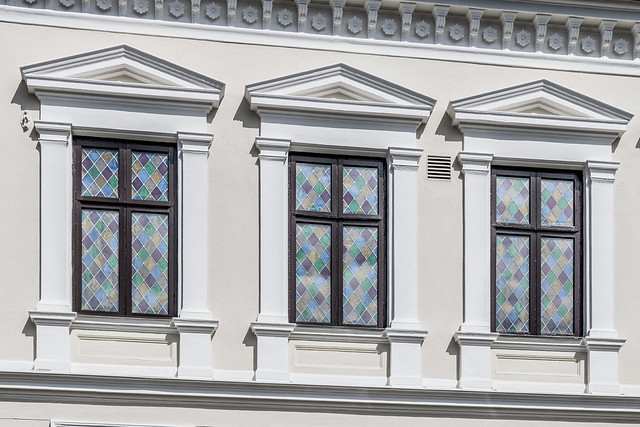
Today we are looking at the word window [ˈwɪndəʊ / ˈwɪndoʊ].
Definition: an opening in the wall of a building, the side of a vehicle, etc., for the admission of air or light, or both, commonly fitted with a frame in which are set movable sashes containing panes of glass [source].
Window comes from the Middle English windowe/windohe/windoge, from the Old Norse vindauga (window) or literally “wind-eye/wind-hole”, as windows were originally unglazed holes in walls or roofs that allowed the wind to pass through [source].
Another word for window in Middle English was fenestre/fenester, which was used in parallel with windowe/windohe/windoge until the mid 16th century. It comes from the Old French fenestre (window), from the Latin fenestra (window, breach, loophole, orifice, inlet), which possibly came from Etruscan.
In Old English a window was known as an eagþyrel [ˈæ͜ɑːɣˌθyː.rel] (“eye-hole”) or ēagduru [ˈæ͜ɑːɣˌdu.ru] (“eye-door”). This fell out of use by about 1200 AD [source].
Words for window in some other Germanic languages are similar to window, including vindue [ˈvend̥u] in Danish, vindu in Norwegian, vindeyga [ˈvɪntˌɛiːja] in Faroese, and vindöga in Swedish, although that is no longer used, and fönster is used instead.
Words for window in the Goidelic languages were borrowed from Old Norse: fuinneog [ˈfˠɪn̠ʲoːɡ] in Irish, uinneag [ɯn̪ʲag] in Scottish Gaelic and uinnag [onˈjaɡ] in Manx [source].
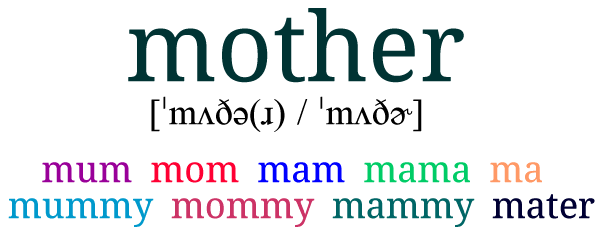
As today is Mother’s Day in many countries around the world, though not here in the UK, we are looking at the origins of the word mother.
Mother comes from the Middle English moder [ˈmoːdər/ˈmoːðər], from the Old English mōdor [ˈmoː.dor], from the Proto-Germanic *mōdēr [ˈmɔː.ðɛːr], from Proto-Indo-European *méh₂tēr [source].
Words for mother in most Indo-European languages come from the same root, including moeder [ˈmu.dər] in Dutch, Mutter [ˈmʊtɐ] in German, and móðir [ˈmouːðɪr] in Icelandic [source].
Some related words include matriarch, matron, maternal, matrimony, material, matriculate, matrix and matter, all of which come ultimately from the Latin māter (mother, matron, woman, nurse) via French [source].
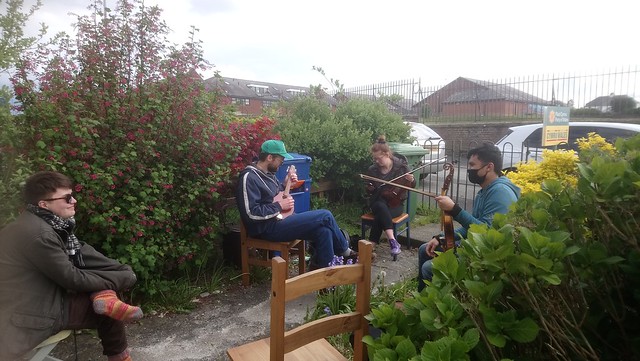
On today’s adventure we are looking at the origins of the word session, because this afternoon I took part in a music session in a friend’s garden, and I thought I’d find out where the word comes from.
Session comes from the Old French session (sitting, (court) session), from the Latin sessiō (a sitting, a seat, loitering), from sedeō (I sit), from the Proto-Indo-European *sed- (to sit) [source].
Words for to sit in Romance languages, such as sentar in Spanish and Portuguese, asseoir in French, come from the same Latin root [source], and from same the Proto-Indo-European root we get English like assess, dissident, insidious, obsess, possess, reside, seat, sedentary, sedate, sit and siege [source].
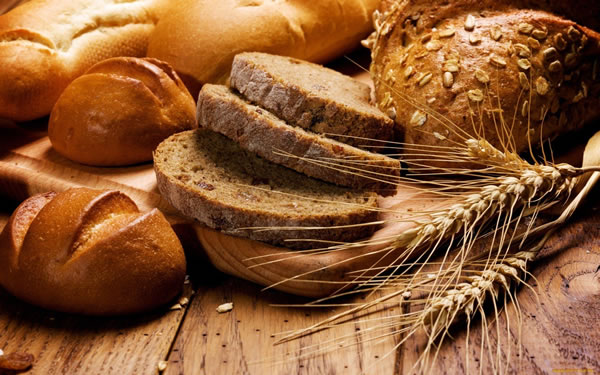
On today’s adventure we are looking at the origins of the word bread, which comes from the Middle English word bre(e)d [brɛːd] (bread, pastry, food, nourishment), from the Old English brēad [bræ͜ɑːd] (bit, piece, morsel, crumb, bread). from the Proto-Germanic *braudą [ˈbrɑu̯.ðɑ̃] (fragment, piece, bread), from the Proto-Indo-European *bʰrew(h₁-) (to boil, seethe) and Proto-Indo-European *bʰera- (to cut, scratch, split, rub) [source].
A more common Old English word for bread, and loaf, was hlāf [xlɑːf], which became loaf in modern English. The word lord is related as it comes from hlāfweard/hlāford [ˈxlɑːfˌwæ͜ɑrd/ˈl̥ɑː.vorˠd] (“bread guard”), as is the word lady, which comes from hlæfdige [ˈl̥æːvˌdiː.je] (“bread kneader”) [source].
Today we are looking at the origins of the word music, which is something that is quite important to me as I like to sing, play various musical instruments, and to write songs and tunes.
Music comes from the Middle English word musyke [ˈmiu̯ziːk], which was borrowed from the Anglo-Norman musik/musike, which came from the Old French musique [myˈzikə], from the Latin mūsica [ˈmuː.si.ka].
This was borrowed from the Ancient Greek μουσική (mousikḗ) [moː.si.kɛ̌ː], which means ‘music, poetry or art’, and comes from Μοῦσα (Moûs – Muse), inspirational Ancient Greek goddesses of literature, science, and the arts. Of uncertain origin, possibly from the Proto-Indo-European root *men- (to think).
Other words from the same Greek root include Muse, museum and mosaic.
In Old English the word for music (and also joy, frenzy and ecstasy) was drēam [dræ͜ɑːm], from the Proto-West Germanic *draum (dream), from the Proto-Germanic *draumaz [ˈdrɑu̯.mɑz] (dream), from the Proto-Indo-European *dʰrewgʰ- (to deceive, injure, damage). The word dream comes from the same root.
As we are in the month of April, I thought I’d look at the origins of that word.
April comes from the Middle English apprile, which was originally aueril, from the Old French avrill, but was re-Latinised to make it like the Latin word Aprīlis (of the month of the goddess Venus), which possibly came from the Etruscan 𐌀𐌐𐌓𐌖 (apru), from the Ancient Greek Ἀφροδίτη (Aphrodítē), the goddess of love and beauty [source].
The originally Old English word for April was ēastermōnaþ, or “Eastermonth”, named after the goddess Ēastre, whose name is related to a Proto-Indo-European word for dawn and east (*h₂ews-). The word Eastermonth also exists in modern English, but is only used in poetry [source].
As it is Easter – Happy Easter to those of you who celebrate it, or Happy Sunday to those who don’t – I thought I’d look into the origins of an important Easter-related word, no not Easter, but egg.
The word egg comes the Middle English egge, from Old Norse egg, from Proto-Germanic *ajją [ˈɑj.jɑ̃], from Proto-Indo-European *h₂ōwyóm (egg), probably from *h₂éwis (bird) [source].
Egg, with the same spelling, is also found in Icelandic, Faroese and Norwegian, and with different spelling in Swedish and Danish, pronounced slightly different in each language – egg [ˈɛkː] in Icelandic, egg [ɛkː] in Faroese, egg [ɛɡ] in Norwegian, ägg [ɛɡː] in Swedish, and in æg [ˈɛˀɡ̊] Danish. In Dutch and German, words for egg are like the original English word: Ei [aɪ̯] in German and ei [ɛi̯] in Dutch [source].
The originally English word for egg was ey [ei] from the Old English ǣġ [æːj], from the same Proto-Germanic root as egg. It was used until the 16th century, when it was replaced with egg, possibly because it got confused with the word eye, as in the thing you see with [source].
Here’s a video I made of this information:
Video made with Doodly – an easy-to-use animated video creator [affiliate link].
Today I have some exciting news from the world of language learning for you. Technology that will amaze and astound you. What is it? You’ll have to listen to this episode to find out.
On today’s adventure we are looking at the origins of the word clock, as today is the day when clocks are put forward an hour, at least here in the UK.
So as we leave Greenwich Mean Time and sail off into British Summer time – appropriately it’s lovely wet and windy day – let us consider the clock, a device for measuring and indicating the time.
The word clock comes from the Middle Dutch clocke (bell, clock), from the Old Northern French cloque (bell), from the Medieval Latin clocca (bell), probably from a Gaulish word, from the Proto-Celtic *klokkos (bell), which is either onomatopeic, or from the Proto-Indo-European *klek (to laugh or cackle). From the same root we get the Welsh cloch (bell, prize, feat, clock) and related words in other Celtic languages.