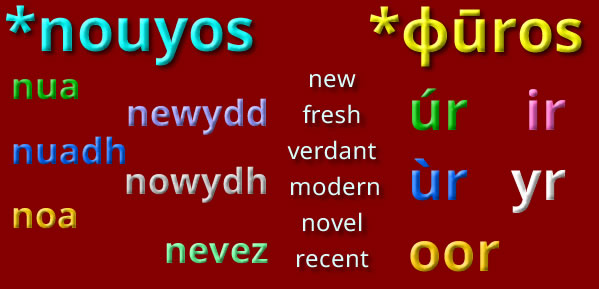
Fresh & New

Words for fresh and new in Celtic languages.

Words for new in Celtic languages

Proto-Celtic *ɸūros = new
Old Irish (Goídelc) úr = fresh, new
Middle Irish (Gaoidhealg) úr = fresh, new, bright, noble, generous, fair, active, recent
Irish (Gaeilge) úr [uːɾˠ] = fresh; free, liberal, moist
úrach = green timber
úraigh = to freshen, scour, cleanse, become moist, damp
úras = new milk
úrchneasach = fresh-complexioned
Scottish Gaelic (Gàidhlig) ùr [uːr] = new, fresh
ùrachadh = refreshing, renewing, renovating, renewal
ùr-ghnàthaich = innovative, innovatory
ùr-ghnàthaichear = innovator
ùrad = degree of newness, novelty
Manx (Gaelg) oor = new, sweet, novel, sappy, crisp, span, fresh, hour, raw
ooragh = hourly, refreshing
ooraghey = to freshen, purify, refresh, relieve, sweeten
ooraghtoil, oorey = refreshing
Welsh (Cymraeg) ir [iːr] = verdant, green, juicy, sappy, moist, succulent, not withered, not dried up or coagulated, fresh, undried; mild; alive, thriving, lively, vigorous; new, fresh, young, unripe
iraidd = fresh, verdant, green, juicy, sappy, moist, liquid
Cornish (Kernewek) yr [ɪ:r/iːr] = fresh

Etymology: from the Proto-Indo-European *puHrós (wheat), possibly from *pewH- (to be clean, pure) [Source].

Words from the same PIE roots include pure in English, პური (ṗuri – bread, wheat) in Georgian, and պուրի (puri – a type of bread) in Armenian [Source].

Proto-Celtic *nouyos = new
Gaulish *novios = (used in place names)
Celtiberian nouiza = new
Old Irish (Goídelc) núa [n͈uːa̯] = new
Middle Irish (Gaoidhealg) núa(e) = new, recent, fresh, lusty, vigorous, fair, clear, bright, lately, anew, again, recently
Irish (Gaeilge) nua [n̪ˠuə / n̪ˠuː] = new, fresh, recent, novel; newness, new thing
nua-aimseartha = modern
nuachan = novation
nuacht = news, novelty
nuachtóir = reporter, journalist
Scottish Gaelic (Gàidhlig) nuadh [nuəɣ] = new, fresh, recent, novel, modern, unfamiliar
a-nuadh = anew
nua-aimsireach = modern, up to date
nua-fhasanta = newfangled
nuadhachadh = renewing, renovating
nuadhachas = novelty, innovation
Manx (Gaelg) noa = fresh, modern, new, novel, original, recent, unused
noa-emshiragh = modern
noaght = freshness, modernity, newness, novelty
noaid = freshness, innovation, newness, novelty, originality
aanoaghey = to rejuvenate, renew, renovate
Proto-Brythonic *newɨð = new
Old Welsh neguid = new
Middle Welsh (Kymraec) newyt, newyd = new, recent, modern, late, novel
newydhau, newyddhau = to renew, renovate, restore
Welsh (Cymraeg) newydd [ˈnɛu̯.ɨ̞ð/ˈnɛu̯.ɪð] = new, recent, newly-grown, modern, late, novel, changed, different; new (moon), unused, fresh
newyddaf, newyddu = to renew, renovate, restore, be renewed or restored, replace, change, reform, modernize, innovate
newyddaidd = newish, new, modern, newfangled, fresh, renewed
newyddair = neologism, new word or spelling
newyddeb = novelty, innovation
newyddiadur = newspaper
newyddiadura = to be a journalist
newyddiadureg = jouralese, journalism
Middle Cornish (Cernewec) newydh, nowydh, nowedh = new, fresh, late, recent
Cornish nowydh = fresh, new, novel, newly, just
nowydh flamm = brand new
nowydh genys = newborn
Old Breton nouuid = new
Breton (Brezhoneg) nevez [ˈne.ve] = new
nevezadeg restoration campaign
nevezadenn = innovation
nevezadenniñ = to innovate
nevezadur = innovation, updating, actualisation
nevezer = innovator

Etymology: from the Proto-Indo-European *néw(y)os (new) [Source]. The town of Noia in A Coruña in Galicia in the northwest of Spain probably gets its new from the same Proto-Celtic root possibly via Celtiberian [Source].

Words marked with a * are reconstructions.

Sources: Wiktionary, Am Faclair Beag, Online Manx Dictionary, Teanglann.ie, eDIL – Electronic Dictionary of the Irish Language, In Dúil Bélrai English – Old Irish glossary, Geiriadur Prifysgol Cymru, Gerlyver Kernewek, Dictionaire Favereau, TermOfis, English – ProtoCeltic WordList (PDF), Etymological Dictionary Of Proto Celtic

The Fastest Way to Learn Japanese Guaranteed with JapanesePod101.com

Free

Words for free and related things in Celtic languages.

Freedom

Words marked with a * are reconstructions.

Proto-Celtic *su-wiros = free (“good man”)
Old Irish (Goídelc) saer [soːi̯r] = free, freeman, noble, craftsman
saeraid [ˈsoːi̯rɨðʲ] = to free, liberate, deliver, save, exempt
saire [ˈsai̯.rʲe] = freedom, liberty
Middle Irish saer, soer, sóer = free, freeman, noble, ready, skilled,
sáeraid = to free, liberate, save, rescue, deliver
saíre, sóire = freedom, liberty, nobility,
Irish (Gaeilge) saor [sˠeːɾˠ/sˠiːɾˠ] = free, enfranchised; noble; independent
saoradh = liberation, deliverance, release, acquittal, assurance, confirmation
saoráid = ease, facility, ease, freedom from constraint
saoráideach = easy, facile
saoráidí = easiness, facileness
saoráil = freedom, bargin
saorálach = voluntary, free, unconstrained
saorálaí = volunteer
saoirse = freedom, immunity, exemption
Scottish Gaelic (Gàidhlig) saor [sɯːr] = free (not captive); cheap; frank
saora [sɯːr̪ˠsə] = freedom, liberty, redemption
saorachd [sɯːrəxg] = freedom, cheapness
saoradair [sɯːrədɪrʲ] = liberator
saoradh [sɯːrəɣ] = freeing, libterating, liberation
saorsach = [sɯːr̪ˠsəx] = free, unrestrained
saorsachd = [sɯːr̪ˠsəxg] = freedom, exemption
saorsainn [sɯːr̪ˠsɪn̪ʲ] = liberty
Manx (Gaelg) seyr [seːr] = free, gratuitous, gratis, complimentary, immune, floating, independent, unforced
seyrsnys = autonomy, exemption, freedom, immunity, independence
seyrey = absolution, exemption, liberation; to absolve, acquite, exempt, free, libterate

Etymology: from Proto-Celtic *su- (good, well), from PIE *h₁su- (good, well), and Proto-Celtic *wiros (man, husband), from PIE *wiHrós (man, husband) [source]

The Irish name Fearghal (Fergal, Feargal), and the English name Farrell come from the Proto-Celtic name *Wirogalos, from *wiros (man) and‎ *galā (valour, ability) [source], and the Irish name Fearghas and the English version, Fergus, come from the Proto-Celtic name *Wirogustus, from *wiros (man) and‎ *gustus (excellence, force) [source]

Proto-Celtic *ɸriyos = free
Proto-Brythonic *rɨð [ˈrɨːð] = free
Middle Welsh (Cymraeg) ryd, rit = free, nonconformist; unrestricted, unrestrained; open; liberal
ryddd-dab, rydd-deb = freedom, liberation, deliverance, immunity
ryddhâd, rhyddhaad = release, libteration, freedom
rydhaw, rydhaa, rytha = to free, release, liberate
Welsh (Cymraeg) rhydd [r̥ɨːð / r̥iːð] = free, nonconformist; unrestricted, unrestrained; open; liberal
rhyddd-deb = freedom, liberation, deliverance, immunity
rhyddhad = release, libteration, freedom
rhyddhaf, rhyddhau = to free, release, liberate
Old Cornish rid = free
Middle Cornish (Cernewec) rid, ruid = free, unconstrained
Cornish (Kernewek) rydh [rɪ:ð / ri:ð] = free
rydhses = freedom, liberty
Old Breton (Brethonoc rid = free

Etymology: possibly from Proto-Indo-European *priHós (dear, beloved, happy, free), from *preyH- (like, love) [source]. English words from the same PIE roots include free(dom), friend and proper [source].

The Fastest Way to Learn Japanese Guaranteed with JapanesePod101.com

Sources: Wiktionary, Am Faclair Beag, Online Manx Dictionary, Teanglann.ie, eDIL – Electronic Dictionary of the Irish Language, In Dúil Bélrai English – Old Irish glossary, Geiriadur Prifysgol Cymru, Gerlyver Kernewek, Lexicon Cornu-britannicum: A Dictionary of the Ancient Celtic Language of Cornwall, Dictionaire Favereau, TermOfis, Le dictionnaire diachronique du breton, Etymological Dictionary Of Proto Celtic

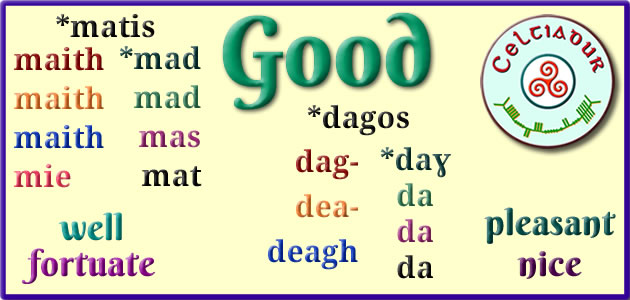
Good

Words for good and related things in Celtic languages.

Good

Proto-Celtic *matis = good
Old Irish (Goídelc) maith [maθʲ] = good
maithe = goodness
Middle Irish (Gaoidhealg) maith, maid = good, profiable, excellent, fitness, proficiency, wealth
Irish (Gaeilge) maith [mˠa(h) / mˠaɪ(h)] = good; goodness, kindness; good things; fertility
maithe = goodness, good
maitheamh = forgiveness, pardon, abatement, remission
maitheas = goodness, good, good thing, kindness, gift
maitheasach = good, useful, kind, obliging
maitheasaí = good worker
maithiúnas = forgiveness, pardon
Scottish Gaelic (Gàidhlig) math [mah] = good, well
maitheadh = forgiving, pardoning
maitheas = goodness
maitheanas = forgiveness, pardon
maitheamhnas = forgiveness
Manx (Gaelg) mie [maɪ] = good, nice, moral, fair, pious, ready, goodness, favourable, virtuous, virtue, goodly
mienys = favourableness, good, goodness
Proto-Brythonic *mad = good
Middle Welsh (Kymraec) mad, mat [maːd] = fortunate, lucky, good, etc
matweith, madwaith = good work, goodness
Welsh (Cymraeg) mad [maːd] = fortunate, lucky, auspicious, happy, suitable, proper, good, beneficial, holy, fair, pleasant, beautiful, goodness, fairness, benefit, good deed, kindness
madedd = goodness, generosity, bounteousness
madog = good man, good, just, righteous
madol = fair, good, beneficial
madwaith = good work, goodness
madwr = benefactor, patron
Old Cornish mad = good
Middle Cornish (Cernewec) mas, mat, mâs, mâd = good, beneficial
Cornish (Kernewek) mas [ma:z / mæ:z] = good, respectable, moral, virtuous
maseth = morality
Old Breton mat = good
Middle Breton (Brezonec) mat, mad = good
Breton (Brezhoneg) mat, mad [mɑːt/maːd] = good, good product, moral, well (done), sweet
madek = wealthy, gentle, soft
madelezh = kindness, benevolence
madelezhus = beneficent, generous
madig = sweet, bonbon
madoberer = benefactor, patron
mataat = to improve, moralize
demat [deˈmɑːt] = hello, good day
demata = to greet, say hello
peurvat [ˈpør.vat] = perfect

Etymology: from Proto-Indo-European *meh₂tis (ripe, good), from *meh₂- (to ripen, to mature) [source].

Words from the same roots include demure and mature in English, matin (morning) and mûr (mature, ripe) in French, and , mañana (tomorrow, soon, morning) and maduro (mature, ripe) in Spanish [source].

Proto-Celtic *dagos = good
Gaulish dagos = good
Old Irish (Goídelc) dag- = good
Middle Irish (Gaoidhealg) dag = good, well
Irish (Gaeilge) dea- [dʲa/ dʲeː] = good, well
dea-bhéasach = well-mannered, well-behaved
dea-chruthach = well-shaped, shapely, handsome
dea-dhéanta = well-made, of good figure, physique
Scottish Gaelic (Gàidhlig) deagh [dʲoː] = good, fine, nice, pretty, rather well
deagh-rùn = good intention
deagh-aithnichte = well-known
deagh-chliù = good reputation, fame
deagh-spiorad = good spirit
deagh-ghean = goodwill, benevolence
Proto-Brythonic *daɣ = good
Middle Welsh (Kymraec) dá, da = good, beneficial, acceptable, suitable, useful
daeoni, dayoni, daioni = goodness, uprightness, graciousness, kindness, bravery
daionvs, daionus, dayonus = good, beneficial, bountiful, kind, loving, gracious
Welsh (Cymraeg) da [daː] = good, beneficial, acceptable, suitable, useful
daeder = goodness, quality, of goodness
daionedd = goodness, benefit
daioni = goodness, uprightness, graciousness, kindness, bravery
daionus = good, beneficial, bountiful, kind, loving, gracious
daionusrwydd = goodness
daionuster = goodness, beneficence, benefit
Middle Cornish (Cernewec) da = good
dader = goodness, excellence
Cornish (Kernewek) da [da:] = good
da lowr = alright, mediocre, OK, passable
da-ober = good deed
dader = goodness
mellyer/melyores dader = do-gooder
Old Breton da = good
Middle Breton (Brezonec) da = good
Breton (Brezhoneg) da [da] = pleasant, agreeable, satifactory; good (archaic)

Etymology: related to the Proto-Indo-European *déḱos (that which is proper), from *deḱ- (to take, perceive) [source].

Words from the same roots include dech (best) in Old Irish and dainty, decent, decor, dignity, docile doctor and dogma in English [source].

Words marked with a * are reconstructions.

Blubrry podcast hosting

Sources: Wiktionary, Am Faclair Beag, Online Manx Dictionary, Teanglann.ie, eDIL – Electronic Dictionary of the Irish Language, In Dúil Bélrai English – Old Irish glossary, Geiriadur Prifysgol Cymru, Gerlyver Kernewek, Gerlyvyr Cernewec, Lexicon Cornu-britannicum: A Dictionary of the Ancient Celtic Language of Cornwall, Dictionaire Favereau, TermOfis, Le dictionnaire diachronique du breton, Geriafurch, English – ProtoCeltic WordList (PDF), Etymological Dictionary Of Proto Celtic

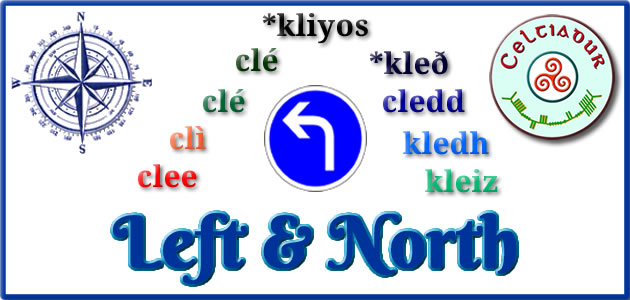
Left & North

Words for left, north and related words in Celtic languages.

Left & North

Words marked * are reconstructions.

Proto-Celtic *kliyos = left (hand)
*uɸokliyom = north
Old Irish (Goídelc) clé = left
fochlae = the north, seat of honor
Middle Irish (Gaoidhealg) clé = left
fochla = the north, seat of honour
Irish (Gaeilge) clé [clʲeː / clʲiː] = left, left hand, left-hand side
clébhord = port, larbord
Scottish Gaelic (Gàidhlig) clì [kliə] = left
clì-làmhach = left-handed
làmh chlì = left hand, left wing (in politics)
clè [kleː] = left, left-handed, mistaken, wrong, lar-board, sinister (in heraldry)
Manx (Gaelg) clee = left. leftist
skian clee = left wing
cleeid = left handedness
Proto-Brythonic *kleð = left, northern
*gwogleð [ɡwoˈɡlɛːð] = north
Old Welsh cled = left hand, left side
gogled = north
Middle Welsh (Kymraec) cled, kled = left, left hand, left side
argled = left, unlucky, unfortunate
guocled, goglet, gogled, gogledd = north
Welsh (Cymraeg) cledd [kleːð] = left, left hand/side
argledd = left, unlucky, unfortunate
gogledd = north, northern, northerly, North Wales, north wind
Middle Cornish (Cernewec) cledh, clêdh = left, north
cledhec = left-handed
dorn-kledh = left-handed
Cornish (Kernewek) kledh [klɛ:ð / kle:ð] = left, left-handed, northern
kledhbarth = north
Kledhbarthyas, Kledhbarthyades = Northerner
kledhek = awkward, clumsy, left-handed
kledhek hy thowlow / y dowlow = impractical
gogledh = north
a-gledh = on the left
a-gledh dhe = to the left of
a-gledhbarth = on the north side
Middle Breton (Brezonec) cleiz = left
Breton (Brezhoneg) kleiz [klɛj(s)] = left, north, northern, irrascible
kleizell = left
kleizenn = north wind
kleiziad – left-handed, left-hander
kleizour = left winger
a-gleiz [aˈɡlɛj(s)] = to the left
gougleiz, gouglez [ˈɡuɡlɛj(s)] = north (archaic)

Etymology: from the Proto-Indo-European *ḱléyteh₂ (leaning, sloped, inclined) from *ḱley- (to lean, incline) [source].

Words from the same PIE roots include clement, client, climate, climax, clinic, ladder and to lean in English [source].

Proto-Celtic *(s)kīttos = left, left-handed, clumsy, awkward, wrong, sinister, sad
Middle Irish (Gaoidhealg) cittach = left-handed, awkward
Irish (Gaeilge) ciotach [ˈcɪt̪ˠəx / ˈcɪt̪ˠa(h)] = left-handed, awkward, clumsy, difficult, troublesome, inconvenient
ciotachán = left-handed person, awkward, clumsy person
ciotóg = left hand, left fist, lefthanded person
ciotógach = left-handed, left-fisted, awkward
Scottish Gaelic (Gàidhlig) ciotach [kʲihdəx] = left-handed, awkward, sinister
ciotachan = left-handed person
Manx (Gaelg) kiuttag = left hand
kyttagh = left-handed
kiuttaght = left-handedness
Middle Welsh (Kymraec) chwith, hwidd = left, left-handed
Welsh (Cymraeg) chwith [χwiːθ] = left; left-handed, awkward, bungling, uncouth, unfortunate, sinister, sad, strange, unaccustomed, unusual, wrong, amiss; the left (hand); the Left
chwithig = left, left-handed; strange, awkward, clumsy, bungling, wrong, inauspicious, unpleasant, suspicious
chwithlyd = sinister, chilly
gochwith, go chwith = contrary, opposite, inside out, clumsy, awkward, left-handed; evil, mishap, misfortune

Etymology: from the Proto-Indo-European *skh₂ey- (left) [source].

Proto-Celtic *towto = left, north
Old Irish (Goídelc) túaid, thúaid = north, in the north
túaidemain = in the north, northwards
fa thuaith, fo thuaidh = northwards, to the north
Middle Irish (Gaoidhealg) túaid, thúaid = north, in the north, northern, northwards
túaidebar = the north
túaidemain = in the north
túaiscert = the north, the left, northerly
túaiscertach = northern, left hand, a northerner
atúaid = from the north, to the north of
Irish (Gaeilge) thuaidh [huəɟ / huə / huəj] = (in the) north, northern
ó thuaidh = to the north, northwards
aduaidh = from the north
tuaisceart = north, northern part
Tuaisceart Éireann = Northern Ireland
tuaisceartach = Northerner, northern, awkward to deal with, surly, rude
tuaisceartacht = awkwardness, surliness, rudeness
Scottish Gaelic (Gàidhlig) tuath [tuə] = north
gu tuath = northward(s)
tuathach [tuəhəx] = northerner, person from North Uist; northerly, northern, boreal
tuathal = anti-clockwise, unlucky, ill-omended, confused, agitated, disorientated
tuathar = place with a northerly aspect, land facing north
tuathlach = unlucky, awkward, left-handed
Manx (Gaelg) twoaie = north, northerly, northern, boreal, northward
twoaieagh = northerner, northsider, northern (Manx) person
goal twoaie = rainbow (“going north”)
my hwoaie = north, northerly, northward
Nerin Hwoaie = Northern Ireland
Old Breton tut = good, favorable
tuthe = a kind of demon

Etymology: possibly from the Proto-Indo-European *tewto- or *tewH- (to look favorably, protect, observe). Cognate with the Latin tūtus (safe, prudent, secure, protected), which is the root of English words like tutor and intuition [source].
Blubrry podcast hosting

Blubrry podcast hosting

Sources: Wiktionary, Am Faclair Beag, Online Manx Dictionary, Teanglann.ie, eDIL – Electronic Dictionary of the Irish Language, In Dúil Bélrai English – Old Irish glossary, Geiriadur Prifysgol Cymru, Gerlyver Kernewek, Gerlyvyr Cernewec, Lexicon Cornu-britannicum: A Dictionary of the Ancient Celtic Language of Cornwall, Dictionaire Favereau, TermOfis, Le dictionnaire diachronique du breton, Geriafurch, English – ProtoCeltic WordList (PDF), Etymological Dictionary Of Proto Celtic

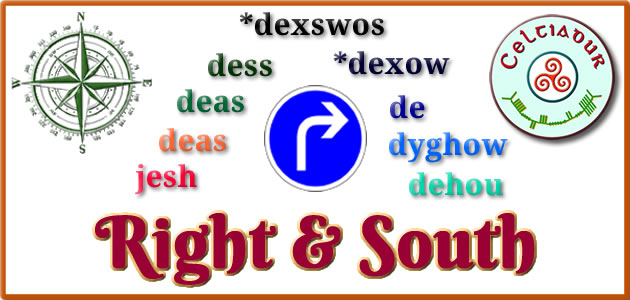
Right & South

Words for right & south in Celtic languages.

Right & South

Proto-Celtic *dexswos = right (side), south
Old Irish (Goídelc) dess = right (side), right-hand; south; right, just; convenient, agreeable
desse = right side, rightness
andess = (from the) south
Middle Irish (Gaoidhleag) dess = right, right hand (side), south, just, meet, well-arranged, neat, pretty, fine
desse = the right side, right hand, rightness, fairness
dessebar = the south, southern aspect
dessel = direction of the sun, right-hand course, sunwise
andess = from the right, from the south
Irish (Gaeilge) deas [dʲasˠ / dʲæsˠ] = south, southerly, to the south; right, right-hand
deasach = right-handed, suitable for use with right hand
deaslámh = right hand
deaslámhach = right-handed, dexterous, handy
deaslámhaí = handiness, dexterity
deasóg = right hand, right fist, right-handed punch
Scottish Gaelic (Gàidhlig) deas [dʲes] = south; southern; right (side); ready, finished; accomplished, expert, skilful; active, alert, quick, snappy; to hand, handy; clever, sharp; deft, dexterous
deasach [dʲesəx] = southerly, southern, southerner
deasag [dʲesag] = right hand
deasail [dʲesal] = clockwise
deasad [dʲesad]= neatness, readiness
deasalt [dʲesəl̪ˠd] = clockwise/sunwise turn
deasalachd [dʲesəl̪ˠəxg] = readiness, convenience, dexterity
Manx (Gaelg) jesh = rightwing, righthand, starboard, nice, smart, felicitous, elegant, ready, tidy, groomed, adept, neat, seemly, becoming, suitable, fancy, trim
jiass [d͡ʒas] = south, southern, southerly, southward
jeshag = righthander, right-handed blow
jeshagh = illumination, right-handed blow
jeshid = applicability, elegance, neatness, propriety, right-handedness, seemliness, smartness, suitability, tidiness
neearass = southwest
niar ass = southeast
niass = southerly
cheu-jiass = southward
Proto-Brythonic *dexow = right, southern
Middle Welsh (Kymraec) dehev, deheu, deau = right, south, southern, right (hand, side)
dehau ddwyrain = southeast
deau-’orllewyn, deheûorllewin = southwest
Dehaubarth = the medieval kingdom of South Wales
dehevbôl = south pole
deheuec = dexterous, skilful, adroit, right
dehevawl = south, southern, of the south, austral, facing southwards
Welsh (Cymraeg) deau = right, south, southern
de [deː] = south; dexterous, skilful, clever; ready; useful, handy; suitable, appropriate, proper, right, just; favourable, auspicious
de(au)-ddwyrain = southeast
de(au)-orllewin- = southwest
Dehaubarth = South Wales, the medieval kingdom of South Wales, southern part
Dehaubarth Cymru (Newydd) = (New) South Wales
deheubol = south pole
deheuder, deheudra = dexterity, adroitness, cleverness
deheueg = dexterous, skilful, adroit, right; South Welsh dialect
deheuol = south, southern, of the south, austral, facing southwards
Middle Cornish (Cernewec) dehou, dyhow, dyow = right, south
dehoules = southernwood
Cornish (Kernewek) dyghow [dɪ’hɔʊ / də’hɔʊ] = south, right-handed, southern, right
dyghow dhuryen = southeast
dyghow orlewin = southwest
dyghowbarth = south
Old Breton dehou, deou = right, south
Middle Breton (Brezonec) dehou, deho, dehaou = right, south
dehouyat, deouiad = right-handed
Breton (Brezhoneg) dehou [ˈde(h).u] = right, south
dehouiad = right-handed
dehoubarzh = southern zone
a-zehou = to the right

Etymology
From Proto-Indo-European *deḱswo-, from *deḱs- (right-hand side) [source].

Words from the same PIE root include dexterity, dextrose and (ambi)dextrous in English, diestro (right, right-handed, skillful, dextrous) in Spanish, and destro (clever, able, right, right-hand) in Italian [source].

Words marked with a * are reconstructions.
Blubrry podcast hosting

Sources: Wiktionary, Am Faclair Beag, Online Manx Dictionary, Teanglann.ie, eDIL – Electronic Dictionary of the Irish Language, In Dúil Bélrai English – Old Irish glossary, Geiriadur Prifysgol Cymru, Gerlyver Kernewek, Gerlyvyr Cernewec, Lexicon Cornu-britannicum: A Dictionary of the Ancient Celtic Language of Cornwall, Dictionaire Favereau, TermOfis, Le dictionnaire diachronique du breton, Geriafurch, English – ProtoCeltic WordList (PDF), Etymological Dictionary Of Proto Celtic

Low

Words for low and related things in Celtic languages.

Brock of Clickimin

Proto-Celtic *ɸīsselos = low
Old Irish (Goídelc) ísel [ˈiːsʲel] = low
ísle – lowness
ísligidir = to lower, to humble
Middle Irish (Gaoidhealg) isil, ísel = low, low-laying, of low stature, hollow, the depths
ísle – lowness, lowliness, humility, meanness, depression
ísligidir = lower, brings, low, humbles
Irish (Gaeilge) íseal [ˈiːʃəlˠ] = low, low-lying, lowly person
ísealaicme = lower class, lower order
ísealchéim = low step, low rank, low degree
ísealchríoch = low land
Scottish Gaelic (Gàidhlig) ìosal [iəsəl̪ˠ] = low, humble, mean lowly
os ìosal = secret, covert, quietly
gu h-ìosal = below
ìseal [iːʃəl̪ˠ] = low, commoner
Manx (Gaelg) ishil = low
injil = low, low-necked, low-lying, low-level, low down, low-built, low-pitched, low-grade, common (vulgar), depressed, subdued, subaltern
inshley = lower, minimum, nether
injilaghey = to change down, condescend, cut down, depress, humiliate
Middle Welsh (Kymraec) isel, issel = low
iselir, isely, iselu = to make low, lower
iselder = lowness, meekness, modesty, humility
iselfryd, issel-fryd, isel-fryd = humble-minded, meek, lowly, modest
Welsh (Cymraeg) isel [ˈɨ̞sɛl / ˈiːsɛl / ˈɪsɛl] = low, low down, low-lying, low-flying; lower than the average or usual level, running low, shallow (water, lake)
iselaf, iselu = to make low, lower, debase, disparage, subdue
iselder = lowness, meekness, modesty, humility; depth
Iseldiroedd = the Netherlands
Iseldiraidd = Dutch (adj)
Iseldireg = Dutch (language)
isel(-)fryd = humble-minded, meek, lowly, modest
Middle Cornish (CerneweC) isel, yssel, ysel = low, humble, lowly
iseldor = the lowest or deepest part, the bottom
isella = lowest
Cornish (Kernewek) isel [‘izɛl / ‘izɐl] = low, modest, vulgar; soft
Iseldiryek = Dutch (language)
iseldiryek = Dutch (adj)
Iseldiryow = the Netherlands
iselhe = to decrease, lower
iselheans = decrease, lowering
iselella = inferior, lower, lowest
iselweyth = depression
Old Breton isel = low
Middle Breton (Brezonec) jsel, isel = low, humble
izellât, iseléet, izelaat = to lower, go down
izelec, izelleq = modest, poor, humble
Breton (Brezhoneg) izel = low
izelaat = to lower, go down
izelder = baseness, base act
izelegezh = humility, modesty
izelek = modest
izelenn = depression
izelfenn = to imply

Etymology: from Proto-Indo-European pedsú, from *pṓds (foot), from *ped- (to walk, step) [source].

Words from the same roots include síos (down, downwards) in Irish, shìos (down, below) in Scottish Gaelic, sheese (below, down, downward) in Manx, is (under, underneath, beneath, below, lower than) in Welsh, a-is (below, lower) in Cornish, is (under, below, inferior) in Breton, foot in English, and pied (foot) in French [source].

Words marked with a * are reconstructions.

Sources: Wiktionary, Am Faclair Beag, Online Manx Dictionary, Teanglann.ie, eDIL – Electronic Dictionary of the Irish Language, In Dúil Bélrai English – Old Irish glossary, Geiriadur Prifysgol Cymru, Gerlyver Kernewek, Dictionaire Favereau, TermOfis, English – ProtoCeltic WordList (PDF), Etymological Dictionary Of Proto Celtic
Blubrry podcast hosting

Broad & Wide

Words for broad, wide and related things in Celtic languages.

An trá mór

Proto-Celtic *ɸlitanos = broad, wide
Gaulish litana = broad, wide
Old Irish (Goídelc) lethan [l͈ʲeθan] = broad, wide
Middle Irish (Gaoidhealg) lethan, = broad, wide, wide-spread
leithet, leithne = breadth, width
lethaid, lethad = speads out, extends
Irish (Gaeilge) leathan [ˈl̠ʲahənˠ] = broad, wide, extensive
leathanaigeanta = broad-minded
leathanduilleach = broad-leaved, broad-brimmed
leathanghiallach = square-jawed
leathanghuailleach = broad- / square-shouldered
leathanas = wide extent, wideness
leathnú = widening, expension, extension
Scottish Gaelic (Gàidhlig) leathann [l̪ʲɛhən̪ˠ] = broad, wide, extensive
bann-leathann = broadband
aimhleathan [ãĩl̪ʲan] = narrow
cas-leathann = broad-footed, webbed, web-footed
Manx (Gaelg) lhean = wide, sheet, sweeping, flat of nose, extensive, broad, full (of chin)
lheanagh = broad, flattening
bann lhean = broadband
beeal lhean = wide-mouthed, yawning (chasm)
lhean cheeillagh = square-jawed
Proto-Brythonic *lɨdan [lɨˈdan] = broad, wide
Middle Welsh (Kymraec) litan, lledan, llydan = broad, wide
llydany = to widen
llydander, lledander = breadth, width
Welsh (Cymraeg) llydan [ˈɬədan] = broad, wide, long or wide (stride); sturdy, stout; extensive, spacious, plentiful, numerous
llydanaf, llydanu = to widen, make/become wide(r), enlarge, dilate
llydander, lledander = breadth, width, broadness, latitude, amplitude, extent, latitude
llydanedd, lledanedd = breadth, broadness, extent
llydan
llydan
Middle Cornish (Cernewec) ledan [‘lɛdan] = broad, wide, ample, spacious, extensive
ledanles = plantain
Cornish (Kernewek) ledan [‘lɛdan] = broad, wide, widely
ledandewlel = broadcast
ledanhe = to widen
bond ledan = broadband
Old Breton letan, litan = broad, wide
Middle Breton (Brezonec) ledan = broad, wide
ledañ, lediñ, ledek = to extend, spread, expand
ledanaat = to enlarge
ledanded = width, scope, calibre
Breton (Brezhoneg) ledan [ˈleː.dãn] = wide, broad
ledanded = width, scope, calibre
ledander = width, breadth, wideness

Etymology
From Proto-Indo-European *pl̥th₂-enos (wide, broad), from *pleth₂- (flat) [source].

The Welsh name for Brittany, Llydaw, comes from the same roots, via the Old Welsh Litau, the Proto-Brythonic *Llɨdaw (continent, mainland [Europe], Brittany), the Proto-Celtic *ɸlitawī (country, earth) and the PIE *pl̥th₂éwih₂ (country). The Old English word Lid-wiccas (Breton people, Brittany), as does the old French name for Brittany, Létavie [source].

Some English words from the same roots include field, flan, flat, plaza, plantain, plate, plateau [source].

Words marked with a * are reconstructions.

Sources: Wiktionary, Am Faclair Beag, Online Manx Dictionary, Teanglann.ie, eDIL – Electronic Dictionary of the Irish Language, In Dúil Bélrai English – Old Irish glossary, Geiriadur Prifysgol Cymru, Gerlyver Kernewek, Dictionaire Favereau, TermOfis, English – ProtoCeltic WordList (PDF), Etymological Dictionary Of Proto Celtic
Blubrry podcast hosting

Gods and Goddesses

Words for gods, deities & days in Celtic languages.

celts - the horse goddess epona
The Gallo-Roman Horse Goddess Epona

Proto-Celtic *dēwos = god, deity, day
*dēwā = goddess
Gaulish deuognata, teuoxtonio-, dēuos, dēwos, dēvona = god
Celtiberian teiuoreikis, deobriga = god
Old Irish (Goídelc) día [dʲiːa̯] = god
bandía = goddess
díadae, deoda = godly, divine, holy
deacht = godhead
Middle Irish (Gaoidhealg) día, dea, déa, de, dee = god, goddess, supernatural being, object of worship
deacht, déacht = godhead, divity
díadae, díade, diadu = divine, godly, holy
Irish (Gaeilge) dia [dʲiə] = god, deity
bandia = goddess
diaga = divine, godly, godlike, sacred, holy
diagacht = divinity, godhood, godliness, piety, theology
diagaigh = to deify, apotheosize
diagaire = divine, theologian
diaganta = godly, pious
dia-aithis = blasphemy
Scottish Gaelic (Gàidhlig) dia [dʲiə] = god, God
ban-dia = goddess
diadhachd [dʲiə.əxg] = deity, divinity, godhead
diadhaidh [dʲiə.ɪ] = divine, godly, pious
diadhaireachd [dʲiə.ɪjəxg] = godliness
diadhaidheachd [dʲiə.ɛrʲ] = theologian
diadhair [dʲiə.ɛrʲ] = theologian
Manx (Gaelg) jee = god, deity, godhead
ben jee = deity, goddess
jeeoil = divine, godlike, godly
jeeoilys = divinity, theology
jeeoilagh = divine, theologian
jeeaght = deity, divinity
jeeaghteyr = theologian
Proto-Brythonic *duɨw [ˈduɨ̯w] = god
Old Welsh duiu = god
Middle Welsh (Kymreac) duiu, duu, dyu, diu, duw = god
dwyes, dwywes = goddess, noble lady, queen
dywdap, dywdot, duwdab = the divine nature, divinity, theology
dywol, duwiol = godly, devout, religious, pious, good, holy, sanctimonious
Welsh (Cymraeg) duw / Duw [dɨu̯ / dɪu̯] = god, the Supreme Being, the Almighty, the Christian Trinity; O God!
duwies, dwywes, dwyes = goddess, noble lady, queen
duwdeb = the divine nature, divinity, theology
duweiddiad = deification, apotheosis
duweiddiaf, duweiddio = to deify, make a god of, turn into an object of worship
duwgar = loving God, pious, devout
duwiol, duwol = godly, devout, religious, pious, good, holy, sanctimonious
Old Cornish duy = god
Middle Cornish (Cernewec) dew, du, duy = god, God, a divinity
dues = goddess
Cornish (Kernewek) duw [dyˑʊ / diˑʊ] = god
duwes = goddess
duwonieth = theology
duwonydh, duwonydhes = theologian
Duw genes = goodbye (“god with you”)
Old Breton doi = god
Middle Breton doe, doué, dou = god
doueadur = apotheosis, deification
doueañ = to deify
doueadur = apotheosis, deification
doueañ = to deify
doueegezh = divinity, deity
doueek, doeel, doueel = divine
Breton (Brezhoneg) doue [du] = god
doueez =goddess
douead = theist
doueadegezh = deism
doueegezh = divinity
doueel = divine

Etymology: from Proto-Indo-European *deywós (god), from *dyew- (sky, heaven) [source]. The Deva rivers in Galicia get their name from the same Proto-Celtic root, and the Latin name for the city of Chester, Deva, possibly comes from the same Celtic root [source].

Words marked with a * are reconstructions.

Sources: Wiktionary, Etymological Dictionary Of Proto Celtic, In Dúil Bélrai English – Old Irish glossary, eDIL – Electronic Dictionary of the Irish Language, Teanglann.ie, Am Faclair Beag, Fockleyreen: Manx – English Dictionary, Online Manx Dictionary, Geiriadur Prifysgol Cymru, Lexicon cornu-britannicum : a dictionary of the ancient Celtic language of Cornwall, Gerlyver Kernewek, Devri : Le dictionnaire diachronique du breton, Dictionaire Favereau, TermOfis

Blubrry podcast hosting

Big, Large & Great

Words for big, large & great in Celtic languages.

Tasmania: The Big Tree

Words marked with a * are reconstructions.

Proto-Celtic *māros = big, great
*māyūs = bigger, greater
*mārāti = to enlarge, magnify
Gaulish maros
Lepontic 𐌌𐌀𐌓𐌖𐌉 (marui)
Old Irish (Goídelc) mór = big, great
mó, moü, moä = bigger
Middle Irish (Gaoidhealg) mór, már = big, great
= bigger, greater
mórán, moran = a large quantity or number
anmor = huge, enormous
Irish (Gaeilge) mór [mˠoːɾˠ / mˠɔːɾˠ] = big, great, large
[mˠoː/mˠuː] = bigger, greater, larger
mórán = much, many
anmhór = huge, enormous, very friendly
anmhórán = huge amount, hugh number
athair mór = grandfather
baile mór = large town, city
Scottish Gaelic (Gàidhlig) mòr [moːr] = big, great, large, grand, strapping; ample, bulky; high, lofty, tall; spacious; large amount
= bigger, greater, larger
mòran = a lot, many, much, multitude
ana-mhòr = huge, innense, enormous, prominent
baile-mòr = town, city
mòr-chuid = majority, most
Manx (Gaelg) mooar [muːr / muːɹ̝ / muːə̯ / muː] = big, great, grand, heavy, tall, chief, major, familiar, powerful, marked, commodious, intimate, capacious, extravagant, intense, extensive, grievous, bold (promintary), loose-fitting, difficult
moo = bigger, larger
mooaran = many, much
mooarane = great deal, lot, many, much, multitude
mooar-earroo, mooar-eash = majority
Proto-Brythonic *mọr [mɔːr] = great, large
Old Welsh maur = great
Middle Welsh (Kymraec) máúr, maur, mawr = large, big
moi, muy, mui, mwy = larger, bigger, greater
muyhaw, mvihaw, mvyhaf, mwyhaf = biggest, largest, greatest
mawraidd, mawredd = great, fine, grand, majestic
mawr eir, mawrair, mawreir = boast, bragging, eloquence, elevated language
mawrdec, mawrdeg = great and fair, very fine, magnificent, splendid
mawrder, mowrder = largeness, bigness, immensity, greatness
Welsh (Cymraeg) mawr [mau̯r / mou̯r] = large, big; fully grown; capital (letter); heavy (rain); long (hair/time); deep (water), great, greater, stormy, rough
mwy [muːɨ̯/mʊi̯] = larger, bigger, greater, louder, more, longer, further
mwyaf = biggest, largest, greatest, most, loudest, longest
mawraidd = great, fine, grand, majestic
mawrair = boast, bragging, eloquence, elevated language
mawrdeg = great and fair, very fine, magnificent, splendid
mawrder = largeness, bigness, immensity, greatness
Old Cornish maur = big
Middle Cornish (CerneweC) maur, meur, mûr = great, large, big, much
moy = more, greater, bigger
moya, moycha, mocha, mochya = greatest, most
Cornish (Kernewek) meur [mø:r / me:r ] = great, grand, large, substantial, much
moy = another, extra, more
moyha = maximum, most
meur lowr = considerably
meur ras = thank you
meuredh = majesty
meurgara = to admire
meurgarer = admirer
meurgeryans = admiration
meurgeryek = admirable
meurgerys = beloved
Old Breton mor = big
Middle Breton (Brezonec) meur = big, very, many
muy, mui = more
meurbet = very, a lot, big
meurded, meurdet = size, magnitude, greatness
meurdez = majesty
meurniver = multitude
meurvor = ocean
Breton (Brezhoneg) meur [møʁ] = big, many
mui = more
moyha = maximum, most
meurded = magnificance
meurdez = majesty
meurvor = ocean

Etymology: from Proto-Indo-European *moh₁ros (great) [source].

Words from the same Proto-Celtic root, via Byzantine Greek μάραον (máraon – sweet chestnut), include marrone (brown, chestnut) in Italian, marron (chestnut, brown) in French, Morone (sweet chestnut) in German [source].

Proto-Celtic *brassos = great, violent
Old Irish (Goídelc) bras = boastful, strident, violent
Middle Irish (Gaoidhealg) bras, brass, brassa = boastful, defiant, forceful, violent
Irish (Gaeilge) bras = great, strong, swift (literary)
brasach = lively, quick-spoken
brasaire = lively, quick-spoken, talkative person
Scottish Gaelic (Gàidhlig) bras [bras] = swift, precipitous, rapid, hasty, impetuous, impulsive, rash, quick-tempered, exuberant, heady
bras-astarach =fleet-footed
bras-mhacnas = exuberant mirth, extreme debauchery
bras-uisgeach = swift/white-watered
bras-shruth = rapids, torrent
Welsh (Cymraeg) bras [braːs] = thick, fat, plump, stout, bulky, fatted, large, strong; coarse (sand); heavy (rain)
Middle Cornish (Cernewec) bras, brâs = great, gross, big, large, coarse
brasder = greatness, largeness, bigness, pride
braslavar = grandiloquent
brasoberys = magnificent
brassa = greater
Cornish (Kernewek) bras [bra:z] = big, bulky, large
braslavar = boast, threat
brasoberys = magnificent
brassa = bigger, major
braster = bulk, size
brastereth = majesty
brastir = continent
Middle Breton (Brezonec) bras, braz = big, large, deep, important, strong
brassaat, braçzaat, braçzeët, brasat = to grow, increase, put on weight, swell, extend, enlarge
brasadur = extension, enlargement
brasentez, brazentez = size, pride
Breton (Brezhoneg) bras [bʁaz] = big, huge, important
brazentez = size, magnitude, greatness

Etymology: from Proto-Indo-European *gʷrod-to- from *gʷred- from *gʰer- (to rub, stroke, grind, remove) [source].

Words from the same PIE root include gros (big, thick, fat, coarse, rough) in French, gross in English, and grosso (big, large, fat, thick, heavy, rough) in Italian [source].

Words marked with a * are reconstructions.

Blubrry podcast hosting

Sources: Wiktionary, Am Faclair Beag, Online Manx Dictionary, Teanglann.ie, eDIL – Electronic Dictionary of the Irish Language, In Dúil Bélrai English – Old Irish glossary, Geiriadur Prifysgol Cymru, Gerlyver Kernewek, Gerlyvyr Cernewec, Lexicon Cornu-britannicum: A Dictionary of the Ancient Celtic Language of Cornwall, Dictionaire Favereau, TermOfis, Le dictionnaire diachronique du breton, Geriafurch, English – ProtoCeltic WordList (PDF), Etymological Dictionary Of Proto Celtic