A Slew of Servants

When putting together a post on my Celtiadur today, I discovered that the English word slew (a large amount) is related to words in Celtic languages for troop, army, host or throng, and to words for servant in Slavic languages.

Slew was in fact borrowed from Irish – from the word slua (host, force, army; crowd, multitude, throng), from the Old Irish slúag / slóg (army, host; throng, crowd, company, assembly), from Proto-Celtic *slougos (troop, army), from the Proto-Indo-European *slowgʰos / *slowgos (entourage).

Manchester Day Parade

There are similar words in the other Celtic languages, including llu in Welsh, which means host, multitude, throng, crowd, flock, army, or regiment, and appears in the Welsh word for police: heddlu (hedd = peace).

In Manx the equivalent is sleih, which is the general word for people, and also means public, family, relations, inhabitants, crowd or populace.

Words for servant in Slavic languages, such as sluha in Czech and Slovak, sługa in Polish, and слуга (sluga) in Russian, Ukrainian, Serbian, Bulgarian and Macedonian, all come from the same root, via the the Proto-Slavic word sluga (servant).

Another English word that comes from the same root is slogan, from the Scottish Gaelic sluagh-ghairm (battle cry), from the Old Irish slúag / slóg (army) and gairm (a call, cry) [source].

Sources: Wiktionary, On-Line Manx Dictionary, Geiriadur Prifysgol Cymru
Cards, charts & papyrus

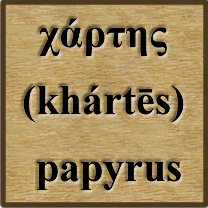
χάρτης / Papyrus

What do cards, charts and papyrus have in common?

The words card and chart both come from the Ancient Greek word χάρτης (khártēs – papyrus), via the Old French carte / charte / chautre (charter, record, letter), from Latin charta (see below) [source].

χάρτης comes from χαράσσω (kharássō – I scratch, inscribe), from the Proto-Indo-European *ǵʰer- (to scratch) [source].

χάρτης is also the root of the Latin word charta (papyrus, paper, poem, a writing, map, the papyrus plant), from which we get words in many languages, including the Italian carta (paper, map, menu), the Spanish carta (letter, map, menu, playing card), the German Charta (charter), the Irish cárta (card), the Icelandic kort (map, card, credit card), and the Czech charta (charter).

I discovered this when looking into the origins of the Spanish word cartera (wallet, handbag), which comes from the same root, as do the English words cartel, cartography and charter.

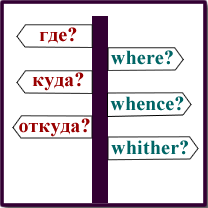
Where? Whence? Whither?

Where, Whence, Whither?

In Russian, there are several different words meaning where. Each one means something slightly different, although in English they can all be translated as where.

где [ɡdʲe] means where, as in what location, and can also mean anywhere or somewhere. For example:

  • Где Вы живёте? = Where do you live?
  • Подумайте, не забыли ли где = Try and think whether you left it anywhere / somewhere

Related words include:

  • где-нибудь = somewhere, anywhere
  • где-то = somewhere
  • негде = nowhere
  • кое-где = here and there

где comes the from Old East Slavic къде (kŭde – where), from the Proto-Slavic kъde (where), from the Proto-Indo-European *kʷú-dʰe (where).

куда [kʊˈda] means where (to), and also what, why or much. It is the equivalent of whither in English, although that is rarely used these days. For example:

  • Куда ты идёшь? = Where are you going?
  • Куда мне столько денег? Why would I want so much money?
  • Мой дом куда больше = My house is much bigger
  • Он прекрасно знал, куда бежать = This kid knew exactly what he was doing

Related words include:

  • кое-куда = this place and that
  • куда-нибудь = anywhere, somewhere
  • куда-то = somewhere

куда comes from the Proto-Slavic *kǫda ( where, whither), from the Proto-Indo-European *kʷom-dʰ- (where).

откуда [ɐtˈkudə] means where from, from where, from which or whence (another rarely-used word). For example:

  • Откуда ты? = Where are you from?
  • Откуда ты это знаешь? = How do you know about that?
  • Откуда я знаю? = How do I know?

Related words include:

  • откуда-нибудь = from somewhere (or other)
  • откуда-то = from somewhere

откуда comes from the same root as куда.

Sources: Reverso, Wiktionary

Bibbling bibblers

Bibble

I came across a wonderful word yesterday – bibble – which means to eat and/or drink noisily, or to tipple. Or in Yiddish it means to worry.

It comes from the Middle English bibben (to drink), from the Latin bibō (I drink), from Proto-Indo-European *peh₃- (to drink) [source].

If you’re a bibbling bibbler, you may need a bib, which comes from the same root, and originally meant to drink heartily [source]. While bibbling, maybe you’ll engage in some bibble-babble (idle talk, babble), possibly in a bibbery (drinking house), which would be bibacious.

The words imbibe, potion and potable come from the same root, as do words for to drink in various languaages, including: ól (Irish), òl (Scottish Gaelic), yfed (Welsh), eva (Cornish), boire (French), and beber (Spanish, Portuguese, Galician, Asturian & Aragonese).

Words for beer Slavic languages come from the same root as well: pivo (Croatian, Czech, Slovak & Slovenian), piwo (Polish, Sorbian), and пиво (Russian, Ukrainian, Bulgarian, Macedonian & Serbian).

Crotchets & Quavers

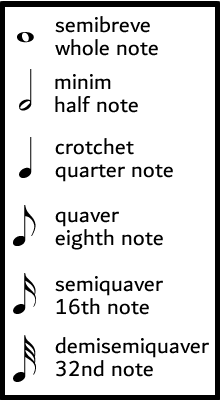
An illustration of musical notes

Yesterday I finally worked out how to create musical scores on my computer (using musescore). It’s something I’ve tried before, but couldn’t get the hang of. So now I’m going write out all the tunes I’ve composed. As I’m doing this, I thought I’d look into the names of some musical notes and their origins.

The commonly-used types of musical notes are shown in the image. Their names are different in British English and American English. The American English names are self-explanatory, and a bit boring. The British English ones are more interesting, so let’s look at where they come from:

  • A semibreve is the longest note in common-use. The breve, or double whole note, does exist, but is quite rare. The word breve comes from the Old French brieve / breve (brief), from the Latin brevis (short) – in medieval music the brevis was one of the shortest notes. A semibreve is half the length of a breve.
  • A minim is half the length of a semibreve, and comes from the French minime (minimal), from the Latin minimus (smallest, shortest, youngest), a superlative of minor (smaller) from the Proto-Indo-European *mey- (few, small).
  • A crotchet is half the length of a minim, and comes from the Old French crochet (little hook), a diminutive of croc, from the Frankish *krōk (hook) or from Old Norse krókr (hook, bend, bight), from the Proto-Germanic *krōkaz (hook), from Proto-Indo-European *gerg- (tracery, basket, twist).
  • A quaver is half the length of a crotchet, and comes from the Middle English quaveren, a form of quaven / cwavien (to tremble), from quave (a shaking, trembling)

A semiquaver is half the length of a quaver, and a demisemiquaver is half the length of a semiquaver. Shorter, and less commonly-used notes include:

  • Hemidemisemiquaver or 64th note
  • Semihemidemisemiquaver or quasihemidemisemiquaver or 128th note
  • Demisemihemidemisemiquaver or 256th note

Sources: Wikipedia, Wiktionary, Online Etymology Dictionary

Can Hens Sing?

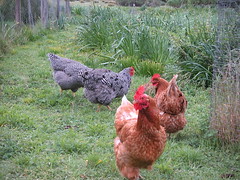
Four hens

What is the connection between singing and hens?

Hens don’t sing, but the words for to sing / speak in Celtic languages come from the same root as the English words hen and chant.

The root is the Proto-Indo-European *keh₂n- (to sing) [source].

This became *kan- (to sing) in Proto-Celtic, which became canaid (to sing) in Old Irish, and can (to chant, sing, speak, talk) in modern Irish. In Scottish Gaelic it became can (to sing, rehearse, say, name or call), and in Manx it became caayn (to bray, whine; song).

In Proto-Brythonic it became *kėnɨd (to sing), which became canam (to sing) in Old Welsh, canu (to sing, intone, chant, state, say) in modern Welsh, kana (to sing) in Cornish, canaff (to sing) in Middle Breton and kanañ (to sing) in Breton [source].

In Proto-Germanic *keh₂n- became *hanô (rooster), *hanjō (hen) and *hōnaz (fowl). The English word hen developed from *hanjō, via the Old English hænn / henn (hen). In other Germanic languages these words became: Huhn (hen, chicken) and Henne (hen) in German; hen (hen) in Dutch [source]; and höna (hen) in Swedish [source].

*keh₂n- is also the root of the Latin canō (I sing), from which words for to sing in Romance language developed, such as chanter (to sing) in French and cantar (to sing) in Spanish [source], and the English word chant [source].

See also the Celtiadur

Frowning nosey nostrils!

Frowny face

What is the connection between frown, nose and nostrils?

The English word frown comes from the Middle English frounen (to frown as an expression of disapproval, displeasure, shame, fear, or jealousy), from the Old French frognier (to frown or scowl), from Gaulish *frognā (nostril), from the Proto-Celtic *srognā, from the Proto-Indo-European *sregʰ- (snore) [source].

The Proto-Celtic word *srognā is the root of the following words in the modern Celtic languages:

  • Irish (Gaeilge): srón [sˠɾˠoːnˠ] = nose; sense of smell; prow, projection
  • Scottish Gaelic (Gàidhlig): sròn [sdrɔːn] = nose, snout, trunk; promontory; snout (of a glacier); toe (of a shoe)
  • Manx (Gaelg): stroin [strɛin] = nose, promontory, headland, ness, naze, nose-piece
  • Welsh (Cymraeg): ffroen = nostril; muzzle of a gun, mouth of a cannon, nozzle of a pair of bellows; hole, entrance, opening (of a pipe), spout
  • Cornish (Kernewek): frig [fri:g] = nostril
  • Breton (Brezhoneg): froen = nostril, fri = nose

I’m not sure if the Cornish word frig comes from the same root, but it seems likely.

The French word renfrogner (to scowl), the Galician word enfurruñar (to frown, to get angry), the Spanish word enfurruñarse (to get angry, get cross, to sulk, to cloud over) also come from the same root.

Sources: Wiktionary, Am Faclair Beag, Online Manx Dictionary, Teanglann.ie, Geiriadur Prifysgol Cymru, Gerlyver Kernewek, Dictionnaire Favereau, Reverso

This is one of the connections I found recently while working on the Celtiadur, my collection of Celtic cognates.

Furtive ferrets

What do the words furtive and ferret have in common?

ferret

They come from the same root – the Latin word fūr (thief).

Furtive comes from the French furtif (stealthy), from the Latin fūrtīvus (stolen), from fūrtum (theft), from fūr (thief) [source].

Ferret (Mustela putorius furo) comes from the Middle English furet / ferret (ferret), from the Anglo-Norman firet / furet (ferret), a diminutive of the Old French fuiron (weasel, ferret), from the Late Latin furo (cat; robber), a diminutive of the Latin fūr (thief) [source].

Alternatively ferret comes from the Latin furittus (little thief) [source].

The Latin name of the ferret, mustela putorius furo, means something like “stinking robber weasel” [source].

Fūr comes from the Proto-Italic *fōr (thief), from the Proto-Indo-European *bʰṓr (thief), from *bʰer- (to carry) [source], which also the root of words for child in Germanic languages, such as bairn in Scots, barn in Danish, Faroese, Icelandic, Norwegian and Swedish, and barn/bern in West Frisian [source].

Glass eyes

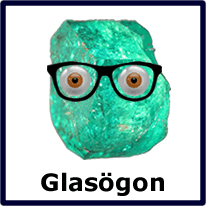
Glasögon

Recently I learnt an interesting word in Swedish – glasögon, which means glasses or spectacles, and literally means “glass eyes”.

Glas means glass, and comes from the Proto-Germanic *glasą (glass), from the Proto-Indo-European *ǵʰel- (to shine, shimmer, glow) [source].

Ögon is the plural of öga (eye), and comes from the Old Swedish ø̄gha (eye), from Old Norse auga (eye), from Proto-Germanic *augô (eye), from Proto-Indo-European *h₃ekʷ- (eye; to see) [source].

The Swedish word glas reminds me of the Russian word for eye, глаз (glaz), which I remember by thinking of a glass eye. Глаз comes from the Old East Slavic глазъ (glazŭ – ball, eye), from the Proto-Slavic *glazъ (ball), from Proto-Indo-European *g(ʰ)el- (round, spherical, stone) [source].

The Russian word for glasses is очки (ochki), which comes from очи (ochi), the plural of око (oko), the old Russian word for eye, which comes from the same Proto-Indo-European root as öga and eye [source].

In Danish and Norwegian, the word for glasses is briller, which means ‘a person wearing glasses’ in Dutch, and to shine or sparkle in French [source]. The German word for glasses is simliar – Brille, and the Dutch is bril [source].

Briller, Brille and bril come from the Middle High German berillus (beryl), from the Latin beryllus (beryl), probably from the Ancient Greek βήρυλλος (bḗrullos – beryl), from Sanskrit वैडूर्य (vaidurya – a cat’s eye gem; a jewel), from Dravidian. Probably named after the city Velur (modern day Belur / ಬೇಲೂರು) in Karnataka in southern India. The first glasses, made in about 1300 in Italy, were made from beryl [source].

Beryl is a mineral which comes from three forms: morganite (orange), aquamarine (blue-green – pictured top right) and heliodor (green-yellow).

The French word for glass, lunettes, means “little moons” [source].

Are there interesting words for glasses, spectacles, specs, or eyes in other languages?

Bulging Budgets!

What do the words bulge, budge and budget have in common?

The answer is, they all come from the same root.

Bulge comes from the Old Northern French boulge (leather bag), from the Late Latin bulga (leather sack), from the Gaulish *bulga / *bulgos, from the Proto-Celtic *bolgos (sack, bag, stomach) [source], from the Proto-Indo-European *bʰelǵʰ- (to swell) [source].

Budge, in the sense of “a kind of fur prepared from lambskin dressed with the wool on, formerly used as an edging and ornament, especially on scholastic habits”, comes from the Middle English bouge (to swell out, to bilge) from the Late Latin bulga (leather sack) [source].

Budget comes from the Middle English bogett / bouget / bowgette (leather pouch), from the Old French bougette (purse for carrying coins), the diminutive of bouge (leather bag, wallet), from the Late Latin bulga (leather sack) [source].

The Proto-Celtic word *bolgos is also the root of bolg, which means belly, stomach, abdomen, buldge or hold in Irish; belly, stomach, abdomen, corporation, bilge or bowl in Manx; and blister, bilge, bulb or womb in Scottish Gaelic [source].

In the Brythonic languages *bolgos became bol (belly, paunch, abdomen, stomach, bowels; tripe; appetite, desire, gluttony, liking) in Welsh [source], bolgh (breach, gap, opening) in Cornish [source], and bolc’h in Breton [source].

Budge, in the sense of to move, comes from a different root: from the Middle French bougier, from Old French bougier, from the Vulgar Latin *bullicāre (to bubble; seethe; move; stir), from the Latin bullīre (to boil; seethe; roil) [source].