
Meru is a Northeast Bantu language spoken in central Kenya by about 2 million people. It is particularly spoken in Meru County, and also in the counties of Tharaka Nithi, Embu and Nyeri, and in other parts of Kenya, such as Nairobi and Mombasa. It is used in daily conversations, markets, primary schools and community gatherings, while Swahili and English are used in secondary schools, government and the media.
Meru is also known as Kimeru or Kĩmĩrũ, and the people who speak it call their language Kĩmĩĩrũ and themselves Amĩĩrũ. Dialects include Igemba, Tigania, Imenti, Tharaka, Igoji, Mwimbi-Muthambi and Chuka. Meru is closely related to Gikuyu and Embu.
The dialect with the most speakers is Imenti, which is spoken in Nkubu, Timau, Kibirichia, Meru and Ruiri in Meru County. The Chuka and Mwimbi-Muthambi dialects are spoken in the Igoji, Chogoria and Chuka regions of Meru County and Tharaka Nithi County. The Tigania and Igembe dialects are spoken in Muthara, Karama, Kangeta, Maua, Laare and Mutuati in Meru County, and the Tharaka dialect is spoken in Tharaka areas of Tharaka Nithi County.
Meru is written with the Latin alphabet, and there is a translation of the Bible and other religious works, and some original literature in Meru.
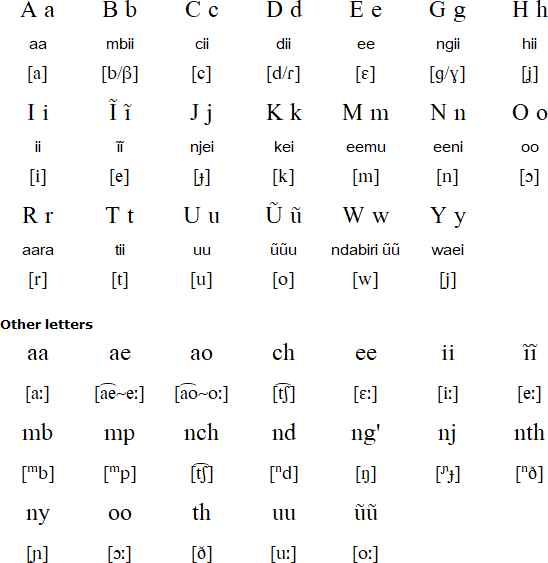
Download an alphabet chart for Meru (Excel)
Details of the Meru alphabet provided by Wolfram Siegel (PDF)
Source: https://www.bible.com/bible/2929/MAT.6.KIMERUBIBLE
Source: https://www.bible.com/bible/1/MAT.6.KJV
Information about Meru | Numbers | Phrases | Tower of Babel
Information about Meru
https://en.wikipedia.org/wiki/Meru_language
https://worldschoolbooks.com/meru-language/
https://ourkenya.com/Meru/Meru-Language
https://kimeruonline.co.ke
https://kimeruinstitute.com/
https://www.everyalphabet.com/kimeru
Aka, Aushi, Bafaw-Balong, Bangi, Bangubangu, Basaa, Bemba, Bembe, Bena, Benga, Bhaca, Bila, Bube, Budu, Bujeba, Bukusu, Bulu, Bushong, Central Kilimanjaro, Central Teke, Chichewa, Chokwe, Chopi, Chuwabu, Comorian, Dciriku, Digo, Duala, Eton, Ewondo, Fang, Fuliiru, Fwe, Ganda/Luganda, Giryama, Gogo, Gungu, Gusii, Gwere, Gyele, Ha, Haya, Hehe, Herero, Ibinda, Idaxo-Isuxa-Tiriki, Ikizu, Ikoma, Jita, Kabwa, Kako, Kalanga, Kamba, Kanyok, Kgalagadi, Kiga, Kikuyu, Kimbundu, Kinyarwanda, Kirundi, Kisi, Kobo, Kogo, Komo, Kongo, Konjo, Koti, Kuhane, Kukuya, Kunda, Kuria, Kwambi, Kwangali, Kwasio, Lambya, Lega, Lengola, Lingala, Loma, Lomwe, Lozi, Luba-Katanga, Luchazi, Lunda, Luvale, Luyana, Makaa, Makonde, Makhuwa, Mandekan, Maore, Masaaba, Mbama, Mbere, Mbosi, Mbugu, Mbukushu, Mbunda, Mbuun, Mende, Mongo, Mpiemo, Mushungulu, Mwani, Myene, Nambya, Nande, Ndau, Ndonga, Ngoni, Ngwii, Njebi, Nkore, North Teke, Northern Ndebele (South Africa), Northern Ndebele (Zimbabwe), Northern Sotho, Nyamwezi, Nyakyusa, Nyemba, Nyole, Nyoro, Nyungwe, Nzadi, Oroko, OshiWambo, Pagibete, Pare, Phuthi, Punu, Rangi, Ronga, Safwa, Seki, Sena, Sengele, Shambala, Shi, Shona, Soga, Songe, Southern Ndebele, Southern Sotho, Suba, Sukuma, Swahili, Swati, Taita, Talinga, Tanga, Tembo, Tetela, Tonga, Tongwe, Tooro, Tshiluba, Tsonga, Tswa, Tswana, Tumbuka, Turu, Umbundu, Venda, Vili, Vwanji, Wanzi, West Teke, Xhosa, Yakam, Yansi, Yao, Yasa, Yeyi, Zigula, Zinza, Zulu
Languages written with the Latin alphabet
Page created: 24.09.26. Last modified: 24.09.26
[top]

Note: all links on this site to Amazon.com


You can support this site by Buying Me A Coffee, via PayPal or Patreon, or by contributing in other ways.
If you find all the adverts annoying, there is now an Ad-free version of Omniglot which you can access for a small monthly or annual donation.

This website and its content is copyright of Simon Ager - © Simon Ager 1998-2026. All rights reserved. All images were created by me, unless otherwise indicated. More details

[top]


