
Mongo is a Bantu language spoken by about 400,000 people in northwest of the Democratic Republic of the Congo, particularly between the towns of Boende and Wema in the centre of Tshuapa Province.
Mongo is also known Nkundo, Mongo-Nkundu, Lomongo or Lonkundu. Dialects in Kutu, Bokote, Booli, Bosaka, Konda, Ekota, Emoma, Ikongo, Iyembe, Lionje, Yamongo and Mbole.
There are several ways to write Mongo with the Latin alphabet that were created by missionaries in the 1930s. The Bible has been translated into Mongo.
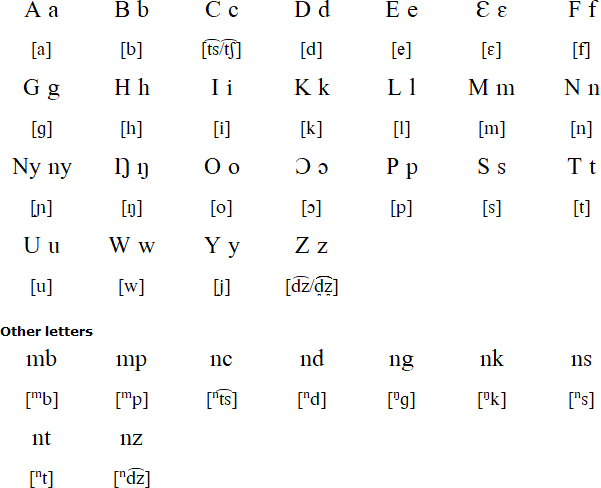
Download an alphabet chart for Mongo (Excel)
Details of the Mongo alphabet provided by Wolfram Siegel
Mongo has tones which can be marked with accents, such as the acute accent (á) for the high tone. Tone marking appears to be optional.
Source: https://www.bible.com/bible/2917/LUK.11.LOL87
Source: https://www.bible.com/bible/1/LUK.11.KJV
Information about Mongo | Tower of Babel
Information about the Mongo language
https://en.wikipedia.org/wiki/Mongo_language
http://www.panafril10n.org/wikidoc/pmwiki.php/PanAfrLoc/MongoNkundo
http://www.language-archives.org/language/lol
https://www.sil.org/resources/search/language/lol
Aka, Aushi, Bafaw-Balong, Bangi, Bangubangu, Basaa, Bemba, Bembe, Bena, Benga, Bhaca, Bila, Bube, Budu, Bujeba, Bukusu, Bulu, Bushong, Central Kilimanjaro, Central Teke, Chichewa, Chokwe, Chopi, Chuwabu, Comorian, Dciriku, Digo, Duala, Eton, Ewondo, Fang, Fuliiru, Fwe, Ganda/Luganda, Giryama, Gogo, Gungu, Gusii, Gwere, Gyele, Ha, Haya, Hehe, Herero, Ibinda, Idaxo-Isuxa-Tiriki, Ikizu, Ikoma, Jita, Kabwa, Kako, Kalanga, Kamba, Kanyok, Kgalagadi, Kiga, Kikuyu, Kimbundu, Kinyarwanda, Kirundi, Kisi, Kobo, Kogo, Komo, Kongo, Konjo, Koti, Kuhane, Kukuya, Kunda, Kuria, Kwambi, Kwangali, Kwasio, Lambya, Lega, Lengola, Lingala, Loma, Lomwe, Lozi, Luba-Katanga, Luchazi, Lunda, Luvale, Luyana, Makaa, Makonde, Makhuwa, Mandekan, Maore, Masaaba, Mbama, Mbere, Mbosi, Mbugu, Mbukushu, Mbunda, Mbuun, Mende, Mongo, Mpiemo, Mushungulu, Mwani, Myene, Nambya, Nande, Ndau, Ndonga, Ngoni, Ngwii, Njebi, Nkore, North Teke, Northern Ndebele (South Africa), Northern Ndebele (Zimbabwe), Northern Sotho, Nyamwezi, Nyakyusa, Nyemba, Nyole, Nyoro, Nyungwe, Nzadi, Oroko, OshiWambo, Pagibete, Pare, Phuthi, Punu, Rangi, Ronga, Safwa, Seki, Sena, Sengele, Shambala, Shi, Shona, Soga, Songe, Southern Ndebele, Southern Sotho, Suba, Sukuma, Swahili, Swati, Taita, Talinga, Tanga, Tembo, Tetela, Tonga, Tongwe, Tooro, Tshiluba, Tsonga, Tswa, Tswana, Tumbuka, Turu, Umbundu, Venda, Vili, Vwanji, Wanzi, West Teke, Xhosa, Yakam, Yansi, Yao, Yasa, Yeyi, Zigula, Zinza, Zulu
Languages written with the Latin alphabet
Page created: 09.01.24. Last modified: 14.09.26
[top]

Note: all links on this site to Amazon.com


You can support this site by Buying Me A Coffee, via PayPal or Patreon, or by contributing in other ways.
If you find all the adverts annoying, there is now an Ad-free version of Omniglot which you can access for a small monthly or annual donation.

This website and its content is copyright of Simon Ager - © Simon Ager 1998-2026. All rights reserved. All images were created by me, unless otherwise indicated. More details

[top]


