
Bangi is a Bantu language spoken by about 120,000 people in the centre of the Republic of Congo and in west of the Democratic Republic of the Congo (DRC). In the DRC it is spoken in the territories of Bolobo and Yumbi in Mai-Ndombe Province, and in the territory of Bomongo in Équateur Province. In the Republic of Congo it is spoken in the Cuvette Department.
Bangi is also known as Bobangi, Bubangi, Bungi, Dzamba or Lobobangi. There are three dialects: Lokonga, Mpama and Losonia. It is written with the Latin alphabet, and a Bangi version of the Bible was published in 1916.
Bangi was used as a regional trade language along the Congo River until the late 19th century when Europeans started arriving in the area. After that, it became a lingua franca in the region, and was used by missionaries and in administration. Over time it became simplified and borrowed words from other languages and developed into Lingala, which today has about half its vocabulary from Bangi.
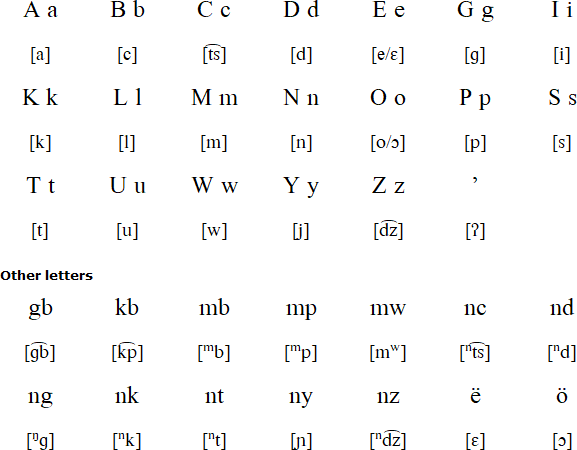
Download an alphabet chart for Bangi (Excel)
Source: https://www.bible.com/bible/3431/GEN.1.BANGI
Information about Bangi | Tower of Babel
Information about Bangi
https://en.wikipedia.org/wiki/Bangi_language
https://fr.wikipedia.org/wiki/Bobangi_(langue)
https://de.wikipedia.org/wiki/Bangi
https://ja.wikipedia.org/wiki/ボバンギ語
https://archive.org/details/grammaranddicti00whitgoog/page/n4/mode/2up
Aka, Aushi, Bafaw-Balong, Bangi, Bangubangu, Basaa, Bemba, Bembe, Bena, Benga, Bhaca, Bila, Bube, Budu, Bujeba, Bukusu, Bulu, Bushong, Central Kilimanjaro, Central Teke, Chichewa, Chokwe, Chopi, Chuwabu, Comorian, Dciriku, Digo, Duala, Eton, Ewondo, Fang, Fuliiru, Fwe, Ganda/Luganda, Giryama, Gogo, Gungu, Gusii, Gwere, Gyele, Ha, Haya, Hehe, Herero, Ibinda, Idaxo-Isuxa-Tiriki, Ikizu, Ikoma, Jita, Kabwa, Kako, Kalanga, Kamba, Kanyok, Kgalagadi, Kiga, Kikuyu, Kimbundu, Kinyarwanda, Kirundi, Kisi, Kobo, Kogo, Komo, Kongo, Konjo, Koti, Kuhane, Kukuya, Kunda, Kuria, Kwambi, Kwangali, Kwasio, Lambya, Lega, Lengola, Lingala, Loma, Lomwe, Lozi, Luba-Katanga, Luchazi, Lunda, Luvale, Luyana, Makaa, Makonde, Makhuwa, Mandekan, Maore, Masaaba, Mbama, Mbere, Mbosi, Mbugu, Mbukushu, Mbunda, Mbuun, Mende, Mongo, Mpiemo, Mushungulu, Mwani, Myene, Nambya, Nande, Ndau, Ndonga, Ngoni, Ngwii, Njebi, Nkore, North Teke, Northern Ndebele (South Africa), Northern Ndebele (Zimbabwe), Northern Sotho, Nyamwezi, Nyakyusa, Nyemba, Nyole, Nyoro, Nyungwe, Nzadi, Oroko, OshiWambo, Pagibete, Pare, Phuthi, Punu, Rangi, Ronga, Safwa, Seki, Sena, Sengele, Shambala, Shi, Shona, Soga, Songe, Southern Ndebele, Southern Sotho, Suba, Sukuma, Swahili, Swati, Taita, Talinga, Tanga, Tembo, Tetela, Tonga, Tongwe, Tooro, Tshiluba, Tsonga, Tswa, Tswana, Tumbuka, Turu, Umbundu, Venda, Vili, Vwanji, Wanzi, West Teke, Xhosa, Yakam, Yansi, Yao, Yasa, Yeyi, Zigula, Zinza, Zulu
Languages written with the Latin alphabet
Page create: 20.09.23. Last modified: 27.03.26
[top]

Note: all links on this site to Amazon.com


You can support this site by Buying Me A Coffee, via PayPal or Patreon, or by contributing in other ways.
If you find all the adverts annoying, there is now an Ad-free version of Omniglot which you can access for a small monthly or annual donation.

This website and its content is copyright of Simon Ager - © Simon Ager 1998-2026. All rights reserved. All images were created by me, unless otherwise indicated. Feel free to use them for personal, educational or non-commercial purposes, and don't forget to mention where they came from. More details about copyright

[top]


