Bamboozling Baboons!

This week I learnt a couple of interesting French words – embabouiner [ɑ̃.ba.bwi.ne] (to flatter, butter up) and embobiner [ɑ̃.bɔ.bi.ne] (to bamboozle).

Embabouiner combines the prefix em- and suffix -er with babouin (baboon), so you are making a baboon of someone when you flatter them [source].

Babouin comes from the Middle French babouyne, baboin, from Old French babouin, from baboue (grimace, muzzle), which is related to German dialectal word Bäppe (lips, muzzle) [source].

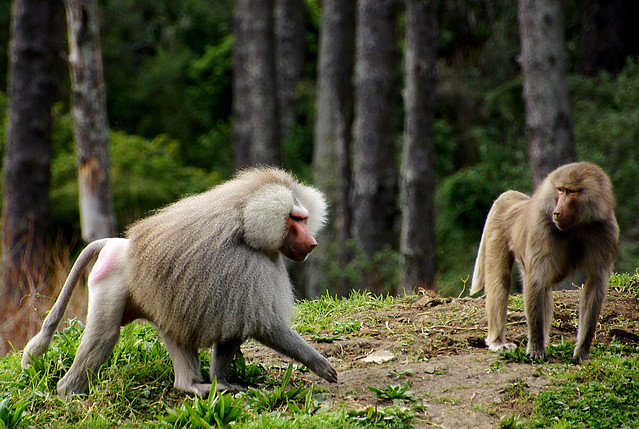
Baboons.

Embobiner means to get round (someone), to pull to wool over someone’s eyes, to bamboozle or to outfox. It can also mean to wind up, reel up/in or wrap up. It combines the same prefix and suffix as embabouiner with bobine (bobbin, reel, spool, drum), so you are winding someone on a bobbin when you bamboozle them [source].

Bobine probably comes from the Latin word balbus, (stammering, stuttering, lisping, fumbling) and is immitative of the noise of a bobbin [source].

The English word bamboozle comes from the 17th century slang word bam (to trick, to con), from the noun bam (fraudster, cheat), possibly from the French embobiner [source].

Polyglot Plans

Polyglot - definition

I just registered for the Polyglot Gathering in Bratislava at the end of May / beginning of June. This will be the fifth time I’ve been to the Gathering – the second in Bratislava, and I’m looking forward to it.

I’ll be staying in the same AirBnB as last time, which is close to the Gathering venue, and not too far from the centre of Bratislava. It’s easier that way as I already know my way around the area.

I haven’t decided if I’ll give a presentation or run a workshop at the Gathering. At previous polyglot events I’ve given talks on writing systems, the origins of languages, the origins of words, Manx, and language death and revival, and helped with a Welsh language workshop. Any suggestions for what I could talk about at this and future polyglot events?

At the end of January I’m going to Edinburgh for LingoFringo, a fringe event to the main polyglot conferences and gatherings with a focus on workshops, community and networking events. I’ll be running a workshop on traditional Scottish Gaelic songs there.

So this month I’ll be brushing up my Scottish Gaelic, preparing for the workshop, and continuing to work on other languages. The languages I’m focusing on currently are Swedish, Danish, Russian, Esperanto, Cornish and Scots. This year I also plan to learn some more British Sign Language and Slovak, and maybe some German, Czech and Spanish.

I don’t plan to start any new languages this year – we’ll see how that works out.

What are your language-related plans for this year?

Christmas

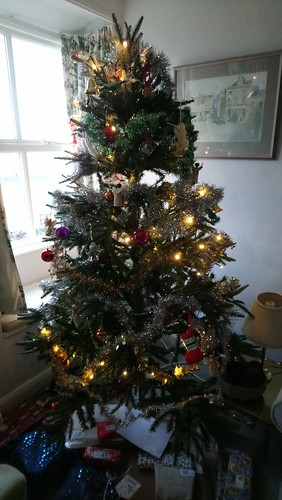
Christmas tree / Coeden nadolig

Did you get any language-related goodies for Christmas?

Are you planning to start learning any new languages next year?

I got a British Sign Language (BSL) course, The Accidental Dictionary by Paul Anthony, and a t-shirt with hello on it in many languages.

I plan to concentrate on improving my knowledge of the languages I already know, rather than starting any new ones. Whether I stick to this remains to be seen.

Oh and Merry Christmas
Nadolig Llawen
Joyeux Noël
Nedeleg Laouen
Frohe Weihnachten
Nadelik Lowen
聖誕快樂
Nollaig shona
メリークリスマス
Nollick Ghennal
¡Feliz Navidad!
Nollaig Chridheil
С Рождеством
God jul
Veselé vánoce
Glædelig jul
Ĝojan Kristnaskon

Can Hens Sing?

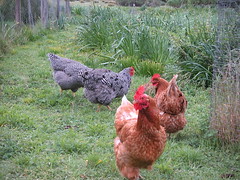
Four hens

What is the connection between singing and hens?

Hens don’t sing, but the words for to sing / speak in Celtic languages come from the same root as the English words hen and chant.

The root is the Proto-Indo-European *keh₂n- (to sing) [source].

This became *kan- (to sing) in Proto-Celtic, which became canaid (to sing) in Old Irish, and can (to chant, sing, speak, talk) in modern Irish. In Scottish Gaelic it became can (to sing, rehearse, say, name or call), and in Manx it became caayn (to bray, whine; song).

In Proto-Brythonic it became *kėnɨd (to sing), which became canam (to sing) in Old Welsh, canu (to sing, intone, chant, state, say) in modern Welsh, kana (to sing) in Cornish, canaff (to sing) in Middle Breton and kanañ (to sing) in Breton [source].

In Proto-Germanic *keh₂n- became *hanô (rooster), *hanjō (hen) and *hōnaz (fowl). The English word hen developed from *hanjō, via the Old English hænn / henn (hen). In other Germanic languages these words became: Huhn (hen, chicken) and Henne (hen) in German; hen (hen) in Dutch [source]; and höna (hen) in Swedish [source].

*keh₂n- is also the root of the Latin canō (I sing), from which words for to sing in Romance language developed, such as chanter (to sing) in French and cantar (to sing) in Spanish [source], and the English word chant [source].

See also the Celtiadur

500 days of Duolingo

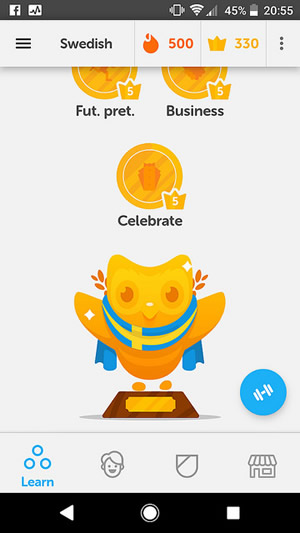
Duolingo screenshot

Today my streak on Duolingo reached 500 days. Before then I had a 96 day streak, but lost that one day when I didn’t quite get enough points. So for the past 596 days I have studied a bit of various languages every day. This is the longest continuous period of study I’ve managed, and I plan to maintain it for as long as possible.

Back in early 2017 I started studying Swedish and Russian on Duolingo. Later I added Romanian to the mix, and this year I added Danish and Esperanto. I’ve finished all the Swedish and Russian lessons, and am continuing to study them on Memrise. I decided to take a break from the Romanian last year, and am currently working on Danish and Esperanto. When I finish them I may add other languages I want to improve, such as Spanish, Italian, Portuguese and German.

I can’t say that I’ve become fluent in any of these languages, but my knowledge of them certainly has improved. I’ve made more progress with Swedish and Danish than with Russian or Romanian, which I find more challenging.

On Memrise I’m currently studying Swedish, Danish, Russian and Cornish, and have learnt bits of Icelandic, Slovak and Slovenian over the past year or so. I may start Slovak again in preparation for the Polyglot Gathering in Bratislava next year.

What’s your longest streak on Duolingo, or other language learning apps?

What do you think of this aspect of such apps?

Glass eyes

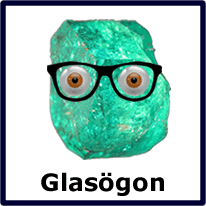
Glasögon

Recently I learnt an interesting word in Swedish – glasögon, which means glasses or spectacles, and literally means “glass eyes”.

Glas means glass, and comes from the Proto-Germanic *glasą (glass), from the Proto-Indo-European *ǵʰel- (to shine, shimmer, glow) [source].

Ögon is the plural of öga (eye), and comes from the Old Swedish ø̄gha (eye), from Old Norse auga (eye), from Proto-Germanic *augô (eye), from Proto-Indo-European *h₃ekʷ- (eye; to see) [source].

The Swedish word glas reminds me of the Russian word for eye, глаз (glaz), which I remember by thinking of a glass eye. Глаз comes from the Old East Slavic глазъ (glazŭ – ball, eye), from the Proto-Slavic *glazъ (ball), from Proto-Indo-European *g(ʰ)el- (round, spherical, stone) [source].

The Russian word for glasses is очки (ochki), which comes from очи (ochi), the plural of око (oko), the old Russian word for eye, which comes from the same Proto-Indo-European root as öga and eye [source].

In Danish and Norwegian, the word for glasses is briller, which means ‘a person wearing glasses’ in Dutch, and to shine or sparkle in French [source]. The German word for glasses is simliar – Brille, and the Dutch is bril [source].

Briller, Brille and bril come from the Middle High German berillus (beryl), from the Latin beryllus (beryl), probably from the Ancient Greek βήρυλλος (bḗrullos – beryl), from Sanskrit वैडूर्य (vaidurya – a cat’s eye gem; a jewel), from Dravidian. Probably named after the city Velur (modern day Belur / ಬೇಲೂರು) in Karnataka in southern India. The first glasses, made in about 1300 in Italy, were made from beryl [source].

Beryl is a mineral which comes from three forms: morganite (orange), aquamarine (blue-green – pictured top right) and heliodor (green-yellow).

The French word for glass, lunettes, means “little moons” [source].

Are there interesting words for glasses, spectacles, specs, or eyes in other languages?
Polyglot Conference – Day 1

The Polyglot Conference officially started today. There were talks and workshops all day on all sorts of interesting topics. I went to talks on Slovenian, linguistic relavtivity, Romani, the Cathars, and audiolinguistics. They were all interesting, especially the linguistic ones.

There was plenty of time between the talks to talk to other participants, and I managed to make some recordings in quite a variety of languages for the next episode of my podcast. I hope to make more recordings tomorrow.

I had conversations in English, Welsh, French, Irish, German, Russian, Mandarin, Japanese, and tried to speak a few other languages.

They are preparing Ljubljana for the Ljubljana Marathon tomorrow, and quite a few streets are being lined with barriers. I hope I’ll be able to get to the conference venue tomorrow.

Polyglotting in Ljubljana

After arriving in Ljubljana yesterday I found a bus into the city centre, then walked to the AirBnB I’m staying in, which is more or less in the centre of the old town. It doesn’t look like much from outside – the door is covered in graffiti, and the outside of the building is rather plain, but inside the flat I’m in is very nicely decorated.

Ljubljana

Last night I had dinner at a restaurant by the Ljubljanica, the river that flows through Ljubljana. I saw quite a few people I know from previous polyglot events going past, and met some of them afterwards in a tapas restaurant.

So far I’ve spoken a little Slovenian, quite a bit of German, French and Welsh, and odd bits of other languages.

We spent today talking about the best ways to learn languages. This was interesting and there was some useful advice that I might try.

I haven’t had a lot of time to explore the city yet. The centre is quite compact and mostly pedestranised, with lots of interesting and colourful buildings.

This evening there was a concert with songs in many languages, then I went for dinner with quite a few other polyglots.

Tykki Duw

Last week I learnt that a butterfly in Cornish is a tykki Duw [tɪkˑi’dyˑʊ / tɪkˑi’diˑʊ], or literally “God’s pretty thing”. A moth is a tykki Duw nos or “God’s pretty thing of the night”).

The word tykki comes from teg (pretty, attractive), and Duw comes from the Proto-Celtic *dēwos (god), from the Proto-Indo-European *deywós (god), from *dyew- (sky, heaven).

Butterfly

Names for butterflies are interesting in other languages as well:

  • Welsh: glöyn byw (glowing ember); iâr fach yr haf (little hen of the summer); pili-pala; plufyn bach yr haf (little feather of the summer), colomen fyw (lively pigeon); glöyn Duw (god’s ember/coal); eilir (spring).
  • Scottish Gaelic: féileagan; dealan-dé (god’s lightning); sglapaid; teine-dé (god’s fire); teillean-dé (god’s bee); tormachan-dé (god’s ptarmigan); dealman-dé; strainnsear (stranger); gogag
  • Manx: foillycan, follican
  • Irish: féileacán; guagóg; uallán
  • Breton: balafenn; barbellig; bobelan; aelig
  • Swedish: fjäril
  • Danish: sommerfugl (summer bird)
  • Spanish: mariposa
  • German: Schmetterling
  • French: papillon
  • Italian: farfalla
  • Russian: бабочка (babochka)

What about in other languages?

Sources: Gerlyver Kernewek, Wiktionary, Geiriadur Prifysgol Cymru, Geiriadur yr Academi, Am Faclair Beag On-line Manx Dictionary, Dictionnaire Favereau, bab.la

Speech recognition & pronunciation

Screen shot of Google Translate

Memrise language lessons sometimes test your pronunciation. You hear a phrase, then repeat it and record it. If your recording is close enough to the original, you move on to the next phrase. It’s actually a very useful exercise, and it’s interesting to compare you pronunication to that of native speakers.

It’s based on Google Translate’s voice function, and I thought I’d try that for other languages. Google Translate doesn’t record your voice, but you have to speak clearly for it to recognise the words. It doesn’t always recognise what I say to it in English, so getting it to recognise things I say in other languages is even more of a challenge.

I’ve tried it for all the languages I know that have the voice function. For most I can get it to recognise individual words and short phrases, though I find it easier for some languages than others. For French, Swedish, Russsian and German, for example, it’s usually fine. For Danish, however, it may recognise only a few words I say to it, even when I speak as clearly as I can. This suggests to me that my Danish pronunciation needs improving.

Have you used Google Translate or a simliar app in this way?

Did you find it useful?