Adventures in Etymology – Flowing Floods

What links the word flood with words for flow, river and high tide? Let’s find out in this Adventure in Etymology.
Flowing Floods

Meanings of flood [flʌd] include:

  • An overflow of a large amount of water (usually disastrous) from a lake or other body of water due to excessive rainfall or other input of water.
  • A large number or quantity of anything appearing more rapidly than can easily be dealt with (e.g. a flood of complaints).
  • The flowing in of the tide.

It comes from Middle English flod [floːd] (river, lake, ocean, flood), from Old English flōd / ᚠᛚᚩᛞᚢ [floːd] (flowing of the tide, river, stream, flood), from Proto-West Germanic *flōdu (river, flood), from Proto-Germanic *flōduz (river, flood), from PIE *plóh₃tus (overflow, deluge), from *pleh₃(w)- (to swim, to flow) [source].

Words from the same roots possibly include flow in English, flod [fluːd] (river, flood, high tide) in Swedish, vloeien [ˈvlui̯ə(n)] (to flow) in Dutch, плувам [ˈpɫuvɐm] (to swim, to float) in Bulgarian, and plauti [ˈpɫɐ̂ʊtʲɪ] (to wash, rinse) in Lithuanian [source].

In Old English, another word for river (and stream) was ēa [æɑː], which comes from Proto-West Germanic *ahu (river), from Proto-Germanic *ahwō (stream, river, water), from PIE *h₂ekʷeh₂ ([flowing] water) [source].

Words from the same roots include eddy and ewer in English, å [oː] (river, creek, big stream) in Swedish, ø [øˀ] (island) in Danish, á [auː] (river) in Icelandic, and agua [ˈa.ɣ̞wa] (water) in Spanish [source].

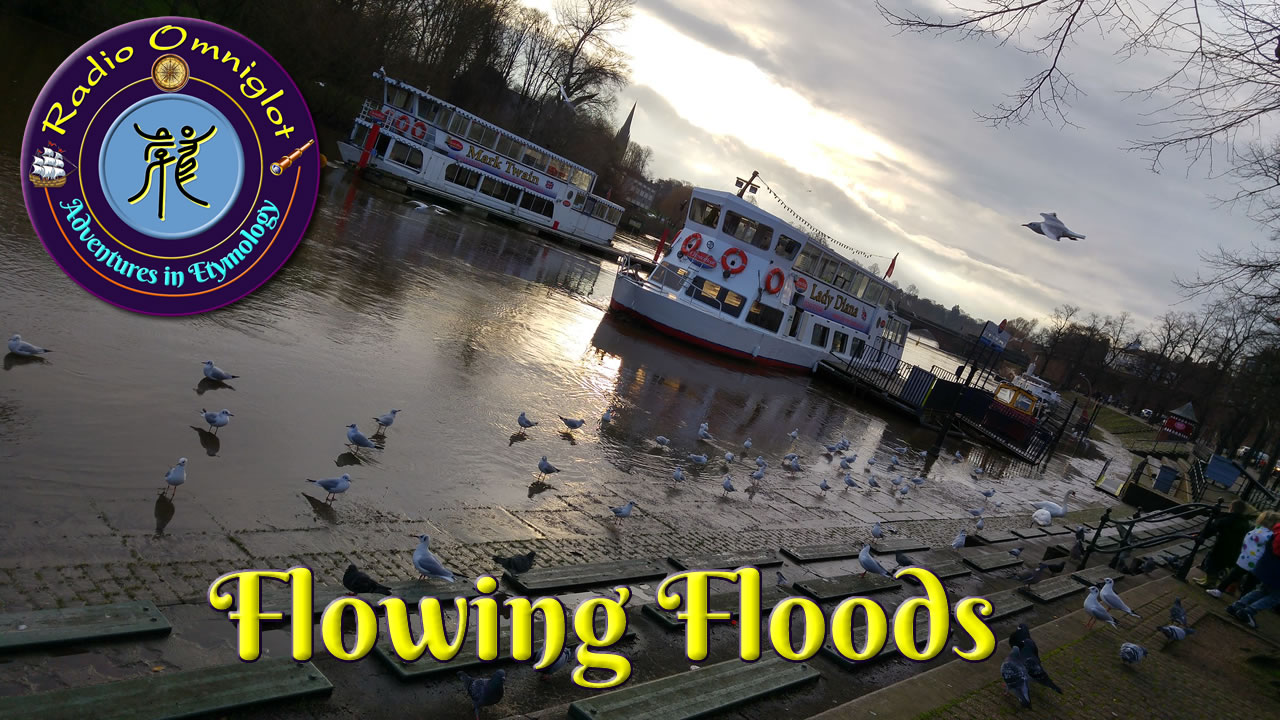
There was a lot of rain in the UK this week, and plenty of large puddles on the roads, but I didn’t see any major floods. I hope things were okay where you are.

If you would like to support this podcast, you can make a donation via PayPal or Patreon, or contribute to Omniglot in other ways.

Radio Omniglot podcasts are brought to you in association with Blubrry Podcast Hosting, a great place to host your podcasts. Get your first month free with the promo code omniglot.

The Fastest Way to Learn Japanese Guaranteed with JapanesePod101.com

I also write about words, etymology and other language-related topics on the Omniglot Blog, and I explore etymological connections between Celtic languages on the Celtiadur blog.


Adventures in Etymology – Flowing Rhythms

What does the word rhythm have to do with flowing? Let’s find out in this Adventure in Etymology.

bodhran by the window

Meanings of rhythm [ˈɹɪð.m̩] include:

  • The variation of strong and weak elements (such as duration, accent) of sounds, notably in speech or music, over time; a beat or meter.
  • A specifically defined pattern of such variation.
  • A flow, repetition or regularity

It comes from Latin rhythmus [ˈrʰytʰ.mʊs] (rhythm), from Ancient Greek ῥῠθμός [r̥ytʰ.mós] (vibration, rhythm, measure, order, form), from Proto-Hellenic *hrutʰmós, from PIE *sru-dʰ-mo-s from *srew- (to flow, stream) [source].

Words from the same roots include catarrh, stream, rheumatism and rhyme / rime in English, ρέω (réo – to flow, run) in Greek, ritmo (rhythm, pace) in Spanish, strøm ([electrical] current, flow, stream) in Danish, srūti (to flow, stream, run) in Lithuanian, and sruth (stream, current, flow) in Irish [source].

The word logorrhea (excessive talkativeness, the excessive use of words in writing; excessive and often uncontrollable speaking due to a mental disorder) also comes from the same roots. It’s made up of logo- (word speech) and -rrhea (flowing), and was possibly modelled on verbal diarrheadiarrhea also comes from the same roots [source].

Part of the word maelstrom (a large and violent whirlpool, a chaotic or turbulent situation) is also related. It comes from Dutch maelstrom (whirlpool), ultimately from PIE *melh₂- (to crush, grind) and *srew- (to flow, stream) [source].

If you would like to support this podcast, you can make a donation via PayPal or Patreon, or contribute to Omniglot in other ways.

Radio Omniglot podcasts are brought to you in association with Blubrry Podcast Hosting, a great place to host your podcasts. Get your first month free with the promo code omniglot.

The Fastest Way to Learn Japanese Guaranteed with JapanesePod101.com

I also write about words, etymology and other language-related topics on the Omniglot Blog, and I explore etymological connections between Celtic languages on the Celtiadur blog.