Spreading Sweetness

Foods, and the words that describe them, can travel around the world. For example, tea comes from China, and so do words for tea in many languages. Similarly, avocado, chocolate, tamale, tomato come from Mexico (both the words and the foods).

Those words came to Europe from other continents, and I recently discovered some words that travelled from Europe, or Western Asia, to many other parts of the world.

Honey

It started with the Proto-Indo-European word *médʰu (honey, mead), which spread throughout Europe and Asia, and possibly as far as China, Korea, Japan and Vietnam [source].

Descendants of *médʰu include:

  • մեղու [meʁú] = bee in Armenian
  • мед (med) = honey in Bulgarian
  • mõdu [mjøːd] = mead in Estonian
  • Met [meːt] = mead in German
  • μέθη (méthi) = drunkenness in Greek
  • מותק (mótek) = sweetness in Hebrew
  • मॊदुर / مۆدُر (modur) = sweet, tasty, delicious in Kashmiri
  • medus [mædus] = honey, mead in Latvian
  • މީރު [miː.ɾu] = pleasant, sweet, agreeable, savoury in Maldivian
  • medveď [ˈmɛdvɛc] = bear (“honey-eater”) in Slovak
  • mjöd [mjøːd] = mead in Swedish
  • மதுரம் [mɐd̪ʊɾɐm] = sweetness in Tamil
  • medd [meːð] = mead, and meddw [ˈmɛðu] = drunk in Welsh

The Irish name Méabh (Maeve) also comes from the same roots, via Middle Irish medb (intoxicating) [source]. For more details of related words in Celtic languages, see this Celtiadur post: Honey Wine

It also reached China, where it became mīt (honey) in Tocharian B, and was possibly borrowed into Old Chinese as *mit (honey), which became (mì – honey) in Mandarin, (mat6 [mɐt˨] – bee, honeybee) in Cantonese, (mitsu – honey, nectar, moasses, syrup) in Japanese, (mil – beeswax) in Korean, and mật (honey, molasses) and mứt (jam) in Vietnamese [source].

Evolution of the Chinese character for honey (蜜)

Evolution of the Chinese character for honey (蜜)

See also: https://hanziyuan.net/#蜜

The Fastest Way to Learn Japanese Guaranteed with JapanesePod101.com

Unlimited Web Hosting - Kualo

Super Brows

Someone who is supercilious is arrogantly superior, haughty or shows contemptuous indifference.

Finaly Raised Eyebrow.jpg

Supercilious comes from the Latin superciliōsus (haughty, supercilious) from supercilium (eyebrow, will, pride, haughtiness, arrogance, sterness, superciliousness) from super- (above, over) and‎ cilium ( eyelid), from Proto-Italic *keljom, from PIE *ḱel-yo-m, from *ḱel- (to cover) [source].

Equivalents of supercilious in other languages include:

  • hooghartig (“high-hearted”) = haughty, supercilious in Dutch
  • hochnäsig (“high-nosed”) = snooty, stuck-up, haughty, supercilious, arrogant in German
  • kione-ard (“high-head”) = arrogant, chieftain, haughty, presumptuous, supercilious in Manx
  • ffroenuchel (“high-nostril”) = haughty, disdainful, supercilious in Welsh

The word cilium also exists in English, and means:

  • A short microscopic hairlike organelle projecting from a eukaryotic cell, which serve either for propulsion by causing currents in the surrounding fluid or as sensors.
  • One of the fine hairs along an insect’s wing.
  • Hairs or similar protrusions along the margin of an organ.
  • An eyelash (plural cilia) [source].

Related words in other languages include: cil (eyelash), and sourcil (eyebrow) in French, ceja (eyebrow, rim, edge) in Spanish, and ciglio (eyelash, eyebrow, border, edge, side) in Italian [source].

Other (eye)brow-related words include:

  • highbrow = intellectually stimulating, highly cultured, sophisticated; a cultured or learned person or thing
  • middlebrow = neither highbrow or lowbrow, but somewhere in between; a person or thing that is neither highbrow nor lowbrow, but in between
  • lowbrow = unsophisticated, not intended for an audience of intelligence, education or culture; someone or something of low education or culture.

Highbrow first appeared in print in 1875, and originally referred to the ‘science’ of phrenology, which suggested that a person of intelligence and sophistication would possess a higher brow-line than someone of lesser intelligence and sophistication [source]. Lowbrow was also conntected to phrenology and first appeared in about 1902 [source]. Middlebrow first appeared in Punch magazine in 1925 and is based highbrow and lowbrow [source].

If something is completely devoid of cultural or educational value, it could be said to be no-brow / nobrow, a word popularized by John Seabrook in his book Nobrow: the culture of marketing, the marketing of culture (2000) [source].

Incidentally, raising or furrowing your eyebrows is used to show you are asking a question in British Sign Language (BSL). Do other sign languages do this?

Do you know of any other interesting brow-related expressions?

The Fastest Way to Learn Japanese Guaranteed with JapanesePod101.com

Unlimited Web Hosting - Kualo

Ruffled Rifles

The words rifle and ruffle sound similar, but are they related? Let’s find out.

A rifle is a firearm fired from the shoulder with a long, rifled barrel, which increases range and improves accuracy. It is short for “rifled gun”, referring to the spiral grooves inside the barrel (rifling).

Rifles

It comes from Middle English riflen (to rob, plunder, search through), from Old French rifler (to lightly scratch, scrape off, plunder), from Proto-Germanic *rīfaną (to tear, rend), from Proto-Indo-European *h₁reyp- (to tear) [source].

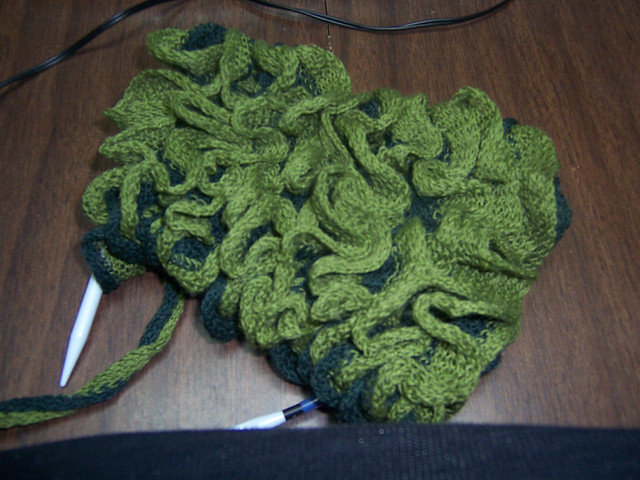
A ruffle is any gathered or curled strip of fabric added as trim or decoration; or a disturbance, agitation or commotion.

Ruffly Stuff

It comes from Middle English ruffelen, perhaps from Old Norse hrufla (to graze, scratch), or Middle Low German ruffelen (to wrinkle, curl). Beyond that, the etymology is not certain [source].

So it seems that rifle and ruffle are not related.

Words that do come from the same roots as rifle include rift, rip and rope in English; rive (bank [of a river]) in French, and arriba (above, over, up) in Spanish [source].

Words that do come from the same roots as ruffle include ruff in English, and hrufla (to graze, scratch) in Icelandic [source].

The English word riffle (a swift, shallow part of a stream causing broken water; a succession of small waves; a quick skim through the pages of a book; to ruffle with a rippling action, etc) is possibly an alteration of ruffle [source].

Riffles

Unlimited Web Hosting - Kualo

Madrugadores (Early Risers)

Are you a madrugador?

Madrugador...

I used to be, but now I’m more of a dormilón and a trasnochador.

Madrugador [ma.ð̞ɾu.ɣ̞aˈð̞oɾ] is a Spanish (and Portuguese) word that means an early riser, early bird or morning person, and as an adjective it means rising or waking early. [source].

Madrugador comes from madrugar (to get up early), from Vulgar Latin *mātūricāre (to wake up early), from Latin matūro (to ripen, mature, hasten, rush), from mātūrus (mature, ripe, early, soon), from Proto-Italic *mātus (ripeness) from the PIE *meh₂- (to ripen, to mature) [source].

Sometimes you can pack a lot of meaning into one word in Spanish, for example, madrugaba (I/he/she/it used to get up early) and madrugadores madrugaban (early risers used to rise early).

Related words include madrugada (dawn, early hours of the morning, before dawn) and madrugón (early riser, early bird, early start).

Words with similar meanings include tempranero (early, early-rising, early riser) [source] and mañanero (early rising, morning, early riser) [source].

How would you say early riser in other languages?

By the way, there’s a novel by Jasper Fforde called Early Riser that I would recommend.

If you’re a late riser, like me, then you’re a dormilón, which should not be confused with dormilona (reclining chair, nightgown), and if you stay up late, you could be described as a trasnochador (night owl, night bird) or a noctámbulo (active at night, sleepwalker, night owl) [source].

Are there interesting equivalents of late riser or night owl in other languages?

The English words mature and maturate (to ripen, bring to ripeness or maturity) come from the same Latin roots [source].

Apparently a quien madruga, Dios le ayuda (“God helps those who rise early”) or in other words the early bird gets the worm [source].

How would you say that in other languages?

Alternatively, you could say no por mucho madrugar, amanece más temprano (“getting up earlier won’t make the sun rise sooner”) or in other words things will happen at their own time, you can’t rush art [source].

Unlimited Web Hosting - Kualo

Fictile Dairymaids

I came across an interesting word yesterday that I hadn’t seen before: fictile. It means capable of being moulded into the shape of an artifact or art work; moulded clay or earth; relating to earthenware, or capable of being led or directed. Synonyms include pliable and moldable.

Hopi Tewa Pot

Fictile comes from Latin fictilus, from fictus (feigned, fictitious, false), from fingō (to shape, fashion, form, deceive, pretend), from Proto-Italic *fingō (to knead, form), from Proto-Indo-European *dʰeyǵʰ- (to knead, form, shape) [source].

Words for the same roots include: dairy, dough, feign, feint, fiction, figment and figure in English [source].

The word dairy comes from Middle English daierie (dairy, pantry, dairy farm), from daie/dey (dairymaid), from Old English dǣġe (maker of bread, baker, dairy-maid), from Proto-Germanic *daigijǭ (kneader of bread, maid), from Proto-Indo-European *dʰeyǵʰ- (to knead, form) [source].

The word lady has similar roots: from Middle English ladie (the mistress of servants; female head of a household, manor, etc), from Old English hlǣfdīġe (mistress of a household, wife of a lord, lady), from hlāf (bread, loaf) and dīġe (kneader), which is related to dǣġe (maker of dough/bread). So a lady was originally a “bread-kneader” [source].

Incidentally, dough is used as a slang term for money, as is bread . This is thought to have started during the 19th century. Bread was a traditional everyday necessity of life, and to earn one’s living was to earn one’s bread, or crust, so bread, and the dough it’s made from, became synonymous with money [source].

The use of bread as slang for money may also be linked to Cockney Rhyming Slang – bread and honey = money. This should not be confused with bread and butter = gutter, or bread and cheese = sneeze [source].

Ways to “to earn a living” or “to earn a crust” in Welsh include ennill eich bara menyn (to earn one’s bread and butter) and ennill eich bara a chaws (to earn one’s bread and cheese).

Are there interesting ways to say “to earn a living” in other languages?

Unlimited Web Hosting - Kualo

Mud Glorious Mud

If you live in a muddy place, or want to describe such a place, you could use the old word lutarious.

cute and muddy

It means “of, pertaining to, or like, mud; living in mud”, and comes from the Latin word lutarius (of or belonging to the mud, living in mud), from lutum (mud, soil, dirt, mire, loam, clay), from Proto-Indo-European *lew- (dirt, mud) [source].

A related word is lutulent [ˈlʌtjʊlənt], which means pertaining to mud, or muddy.

Words for the same roots include:

  • Albanian: llucë = thin or shallow mud, muddy place
  • Portuguese: lodoso = muddy
  • Romanian: lut = clay, loam, mud, dirt, lutos = clayey
  • Spanish: lodo = mud, muck, mire, lodoso = muddy, boddy

Lutetia, the Gallo-Roman town founded in 52 BC that became Paris, gets it’s name from the Gaulish word *lutos (swamp), from Proto-Celtic *lutā (dirt, mud), from PIE *lew- (dirt, mud). It was known as Lutetia Parisiorum by the Romans. The Parisiorum part comes from Parīsiī, the Latin name for the Gaulish tribe who lived in the area. The name Paris comes from the same roots.

You can find more details on Radio Omniglot.

Incidentally, the French word boue [bu] (mud, dirt), also has Celtic roots: it comes from the Gaulish *bawā (mud, dirt), from Proto-Celtic *bowā (dirt, filth, excrement), from Proto-Indo-European *gʷewh₁- (excrement, dung) [source].

The Galician word bosta (dung, manure) comes from the same Celtic roots, as do the Welsh words baw (mud) and budr (dirty, filthy, vile, foul) [source].

Gwineas buoy

The French word boue shouldn’t be confused with the Breton word boue [ˈbuː.e], which means buoy. It comes from Middle English boi(e) (buoy), from Middle Dutch boeye, from Old Dutch *bōcan, from Frankish *baukn (symbol, sign) from Proto-Germanic *baukną (sign, symbol), from PIE *bʰeh₂- (to glow, light, shine) [source].

By the way, do you pronounce buoy [bɔɪ] (boy) or [ˈbu.i] (boo-ee), or some other way?

Lost in the Geese

The French word oie means goose, but how do you pronounce it?

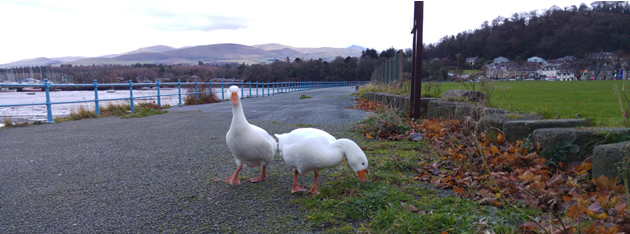
Geese

Last night at the French Conversation Group, we were talking about geese, as you do, and while I could remember how to write the word for goose in French, I wasn’t sure how to pronounce it. Then one of my friends suggested it was foie as in foie gras [fwa ɡʁa]. I knew this means “fat liver”, so foie must mean liver, and that oie probably sounds similar to foie.

My guess was right, oie is pronounced [wa] and rhymes with foie [fwa]. It comes from the Old French oie (goose), from Vulgar Latin auca (goose), a contraction of *avica, from Latin avis (bird), from Proto-Italic *awis (bird), from Proto-Indo-European *h₂éwis (bird). The Old French word was originally written oe or oue. The i was added by the end of the 12th century as analogy to oisel/oiseau (bird) [source].

Words from the same roots include հավ [hɑv] (hen, chicken) in Armenian, ave (bird) in Galician, Spanish and Portuguese, vista (chicken, hen) in Latvian, hwyad (duck) in Welsh, οἰωνός [i.oˈnos] (large bird, bird of prey, omen) in Greek [source].

The French word oiseau (bird) also comes from the same roots, via the Late Latin aucellus (little bird), as do uccello (bird) in Italian, and ocell (bird) in Catalan [source].

Incidentally, goose comes from Middle English go(o)s (goose, fool, idiot), from Old English gōs (goose), from Proto-West Germanic *gans (goose), from Proto-Germanic *gans (goose), from Proto-Indo-European *ǵʰh₂éns (goose), which is likely of imitative origin [source].

A French equivalent of to loose one’s marble (become crazy, loose one’s mind) is se perdre les oies (“to get lost in the geese”) [source].

Are there any interesting goose-related expressions in other languages?

Laxness

During the days between Christmas and New Year things may seem a bit more lax than usual, so I thought I’d look into the origins of the word.

lazy

Lax means lenient and allowing for deviation, not strict, loose, not tight or taut, lacking care, neglectful or negligent. It comes from the Latin laxus (wide, roomy, loose), from Proto-Indo-European *slǵ-so (weak, faint) [source].

The English word leash comes from the same roots, via the Middle English lesse (a leash for holding a coursing hound or watchdog) [source], the Old French lesse (leash, lead), and the Latin laxā (thong, a loose cord), from laxus [source].

The English word lease also comes from the same roots, at least partly: from Middle English *lesen, the Anglo-Norman lesser/lasier (to let, let go), from Latin laxō (to loose) from laxus, and partly from Old High German lāzan (to let, let go, release) [source].

Related words in other languages include laks (lax, slack) in Dutch, lâche (loose, slack, coward(ly), low, lazy) in French, lax (lax, easy, loose) in Geman, and llaes (loose, slack, free, trailing, flowing, low) in Welsh [source].

Losing the North

If you are lost, you might say in French “j’ai perdu le nord”. It means literally that you have lost the north, and can also be translated as to lose one’s way or one’s bearings, to become dazed and confused, or to lose one’s marbles, to lose one’s head or to lose contact.

Compass

Alternatively you could say “je suis à l’ouest” (“I am in the west”), which means to be spaced out, to not be with it, or to lose one’s bearings.

Other words for confused in French include confus, perplexe and désorienté.

Confus (confused, confusing, ashamed, embarrassed), comes from Latin cōnfusus (mixed, united, confounded, confused), from cōnfundō ( to pour together, mix), from con- (with, together) and fundō (to pour, shed).

English words from the same roots include confound, confuse, diffuse, found, fuse and profound.

Perplexe (puzzled, perplexed, confused) comes from Latin perplexus (entangled, involved, intricate, confused), from plectō (I weave, I twist), from Proto-Indo-European *pleḱ- (to fold, weave). The English word perplexed comes from the same roots, via Old French.

Désorienté (disorientated, bewildered, confused) comes from désorienter (to disorientate, confuse), from dés- (dis-/de-) and orienter (to orientate, set to north, guide), from Old French oriant (Orient, the East), from Latin oriens/orentem (rising, appearing, originating, daybreak, dawn, sunrise, east), from orior (I rise, get up, appear, originate), from PIE *h₃er- (to stir, rise, move).

The English words disorentated and orientated come from the same roots, as do such words as orient, origin, random and run.

So when you’re disorientated, you’re not sure where the east is. These days maps are generally orientated towards the north, or in other words, north is at the top. However, in Medieval times, maps made by European cartographers were orientated towards the orient or east in the direction of Jerusalem and the Holy Land. Other orientations were and are available.

Why is north usually up on maps? The Map Men explain in this video:

Do you have any other interesting ways to say you’re lost or confused?

Here’s a song called “Ai-je perdu le nord ?” (Have I lost the north?) by Clio, a French singer:

Sources:
https://dictionary.reverso.net/english-french/confused
https://en.wiktionary.org/wiki/confus#French
https://en.wiktionary.org/wiki/perplexe#French
https://en.wiktionary.org/wiki/désorienté
https://en.wiktionary.org/wiki/Category:English_terms_derived_from_the_Proto-Indo-European_root_*h₃er-

Just a Smidgen

How much is a smidgen? How about a tad, dash, drop or pinch?

Jot and Title

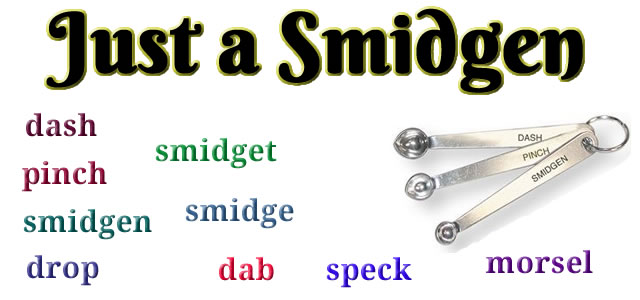
These are all terms that refer to small amounts of things. You might see them in a recipe, or use them to refer to other small quantities or amounts. You can even get measuring spoons for some of them.

Apparently a tad is ½ a teaspoon, a dash is ⅛ of a teaspoon. a pinch is 116 of a teaspoon, a smidgen is 132 of a teaspoon, and a drop is 164 of a teaspoon. Other amounts are available. A smidgen could be anything between 125 and 148, with 132 of a teaspoon being the most commonly used.

A tad is a small amount or a little bit, and used to mean a street boy or urchin in US slang. It probably comes from tadpole, which comes from Middle English taddepol, from tadde (toad) and pol(le) (scalp, pate).

A dash is a small quantity of a liquid and various other things. It comes from Middle English daschen/dassen (to hit with a weapon, to run, to break apart), from Old Danish daske (to slap, strike).

A smidgen is a very small quantity or amount. It is probably based on smeddum (fine powder, floor), from Old English sme(o)dma (fine flour, pollen meal, meal). Or it might be a diminutive of smitch (a tiny amount), or influenced by the Scots word smitch (stain, speck, small amount, trace). Alternative forms of smidgen include smidge, smidget, smidgeon and smidgin.

A pinch is a small amount of powder or granules, such that the amount could be held between fingertip and thumb tip, and has various other meanings. It comes from Middle English pinchen (to punch, nip, to be stingy), from Old Northern French *pinchier, possibly from Vulgar Latin *pinciāre (to puncture, pinch), from *punctiāre (to puncture, sting), from Latin punctiō (a puncture, prick) and *piccāre (to strike, sting).

A drop a very small quantity of liquid, or anything else. It comes from the Middle English drope (small quantity of liquid, small or least amount of something) from Old English dropa (a drop), from Proto-West Germanic *dropō (drop [of liquid]), from Proto-Germanic *drupô (drop [of liquid]),from Proto-Indo-European *dʰrewb- (to crumble, grind).

Do you know any other interesting words for small amounts or quantities?

Sources:
https://en.wiktionary.org/wiki/smidgen#English
https://practical-parsimony.blogspot.com/
https://en.wiktionary.org/wiki/tad#English
https://en.wiktionary.org/wiki/dash#English
https://en.wiktionary.org/wiki/pinch#English
https://quod.lib.umich.edu/m/middle-english-dictionary/dictionary/
https://en.wiktionary.org/wiki/smidgen#English
https://en.wiktionary.org/wiki/drop#English