Full

Words for full and related things in Celtic languages.

The Crowded Summit of Snowdon

Words marked with a * are reconstructions.

Proto-Celtic *ɸlānos = full
Old Irish (Goídelc) lán [l͈aːn] = full
láine = fullness
línad = filling
Middle Irish (Gaoidhealg) lán, lan = full, filled (with), whole, complete
Irish (Gaeilge) lán [l̪ˠɑːnˠ / l̪ˠæːnˠ] = full, pride, arrogance
lánaigh = to fill out, give volume to, mould
lánán = charge, filling
iomlán = all, the whole, total, aggregate, full, whole, complete
Scottish Gaelic (Gàidhlig) làn [l̪ˠaːn] = full, replete; complete; filled, sat(iat)ed, satisfied; fullness; high tide; complement, fill
lànach[l̪ˠaːnəx] = filling, fruitful
lànachadh [l̪ˠaːnəxəɣ] = fulness, plentitude, prime
lànmhòr [̪ˠaːn(v)ər] = full, complete, plentiful
làntachd [[l̪ˠaːn̪ˠdəxg] = plethora
iomlan [imil̪ˠan] = full, complete, whole, entire
Manx (Gaelg) lane [lɛdn] = full, replete, crowded, swelling, fully, total, gravid, lot, unexpurgated (edition), much, loaded, plenary, sound, full-blooded, at full strength
laneid = fullness, repletion, satiety
lhieeney = to fill (in/out), load, flow
lhieent = completed, filled, full, fullfilled, stuffed
Proto-Brythonic *lọn [ˈlɔːn] = full
Middle Welsh (Kymraec) llawn, llaunt = full
llewny, llaỽna, lleỽni, llewni = to full
llawnder = abundance, plenty, fullness
Welsh (Cymraeg) llawn [ɬau̯n] = full; covered, saturated; filled to capacity; teeming with, abounding in; charged with emotion
llawnaeth = fullness, plentitude, plenty, abundance
llawnaf, llewni, llawnu = to full, satiate, be filled
llawnder = abundance, plenty, fullness
llawnedig = filled
Middle Cornish (Cernewec) leun, luen, lên = full, replete, complete
Cornish (Kernewek) leun [lø:n / le:n] = full, complete, thorough, total
leun a dus = crowded
leun a styr = meaningful
leunder = fill, fullness
leunhe = to fill
Old Breton lon = full
Middle Breton leun = full
leunhat = to fill
leunyaff = to fill, complete
leunidigaez, leunydigaez = fullness, filling, supply
Breton (Brezhoneg) leun [ˈlœ̃ːn] = full, covered
leunaat = to fill
leunded = fullnes
leunder = entirety
leuniadur = to fill, complete
leuniañ [ˈlœ̃njã] = to fill, complete
leunidigezh = filling

Words marked with a * are reconstructions.

Etymology: from Proto-Indo-European *pl̥h₁nós (full), from *pleh₁- (to fill) [source]. Words from the same roots include complete, fill, full, plain and plenty in English, voll (full, filled, drunk) in German, lleno (full) in Spanish, plein (full, plenty, solid) in French [source].

The Fastest Way to Learn Japanese Guaranteed with JapanesePod101.com

Sources: Wiktionary, Am Faclair Beag, Online Manx Dictionary, Teanglann.ie, eDIL – Electronic Dictionary of the Irish Language, In Dúil Bélrai English – Old Irish glossary, Geiriadur Prifysgol Cymru, Gerlyver Kernewek, Dictionaire Favereau, TermOfis, English – ProtoCeltic WordList (PDF), Etymological Dictionary Of Proto Celtic

Unlimited Web Hosting - Kualo

Young

Words for young in Celtic languages.

Young

Words marked with a * are reconstructions.

Proto-Celtic *yowankos = young
Gaulish Iouinca = name (?)
Old Irish (Goídelc) óc [oːɡ] = young, young man, warrior
ócbad = young people, youths
óclach = young man, warrior, servant
Middle Irish (Gaoidhealg) óc = young, young man, warrior, poet
ócbad, ócbud = young folk, youths, youth
óclach, ócleach = young man, warrior, attendant, servant, vassal
Irish (Gaeilge) óg [oːɡ/ɔːɡ] = young (person, animal, bird), youth, junior, minor, new, fresh, early
ógánach = young man, youth, crafty person, boyo, trickster
óigeanta = youthful, youthful-looking
óigeantacht = youthfulness
óglach = young man, (young) warrior), attendant, servant, vassal, volunteer
óglachas = manhood, warriorship, armed service, vassalage
ógra = young people, youths
Scottish Gaelic (Gàidhlig) òg [ɔːg] = young, youthful
ògail [ɔːgal] = adolescent, youthful
ògalachd [ɔːgəl̪ˠəxg] = youthfulness, youth, youthful conduct
ògan [ɔːgan] = tendril, twig, seedling, lambkin
òganach [ɔːganəx] = youth, young man, bough
òganta [ɔːgən̪ˠdə] = juvenile
Manx (Gaelg) aeg [ɛːɡ] = young, adolescent, immature, juvenile
aegey = young, juvenile
aegid = adolescence, immaturity, young people, youth
aeglagh = adolescent, juvenile, young ones, youth
aegoil = youngish, youthful
Proto-Brythonic *jowank = young
Middle Welsh (Kymraec) ieuangc, yeueing, yeuejg, yefeink, ieuanc, ieueinc = young, juvenille, unmarried
ieu, iau = younger
yeuhaf, yeuaw, ieuhaf, ieuaf = (the) youngest
euectyt, euenctit, ieuegtit, ieuengtit = youth, adolescence
Welsh (Cymraeg) ifanc [ˈɪvaŋk / ˈiːvaŋk] = young, youthful, adolescent; inexperienced, immature; recent; unmarried, newly wed
iau, ieuach, ifach = younger, not as old
ieuaf, i(e)faf = (the) youngest, the younger (of two), junior
ieuant = young person, youth, adolescence
ieuenctid = youth, adolescence
Old Cornish iouenc, youonc = young
Middle Cornish yowync, iouenc, youonc = young, youthful
yonc = young, youthful, juvenile
yowyncneth = youth, youthfulness
Cornish (Kernewek) yowynk, yonk [‘jɔwɪŋk/jɔˑŋk] = juvenille, young, youthful
yowynka, yonka = younger
yonker, yonkores = youngster, youth
yowynkneth, yonkneth = youth
Middle Breton youanc, ioanc, iouanc = young
yaouancquat, youancat, youanchat = to rejuvenate
yaouanctet, iaouanctet = youth(fulness)
Breton (Brezhoneg) yaouank = young
yaouankaat = to rejunvenate
yaouankadur = rejunvenation
yaouank(t)iz = youth
yaouankted = youth(fulness)

Etymology: from the Proto-Indo-European *h₂yuh₁n̥ḱós (young), from *h₂yéwHō (young), from *h₂óyu (long time, lifetime) [source].

Words from the same roots include young and youth in English, jeudg (youth) in Dutch, Jugend (youth) in German, jeune (young) in French and joven (young(ster), youth(ful), young person) in Spanish [source].

The Fastest Way to Learn Japanese Guaranteed with JapanesePod101.com

Sources: Wiktionary, Am Faclair Beag, Online Manx Dictionary, Teanglann.ie, eDIL – Electronic Dictionary of the Irish Language, In Dúil Bélrai English – Old Irish glossary, Geiriadur Prifysgol Cymru, Gerlyver Kernewek, Lexicon Cornu-britannicum: A Dictionary of the Ancient Celtic Language of Cornwall, Dictionaire Favereau, TermOfis, Le dictionnaire diachronique du breton, Etymological Dictionary Of Proto Celtic

Bad

Words for bad and related things in Celtic languages.

Good

Words marked with a * are reconstructions.

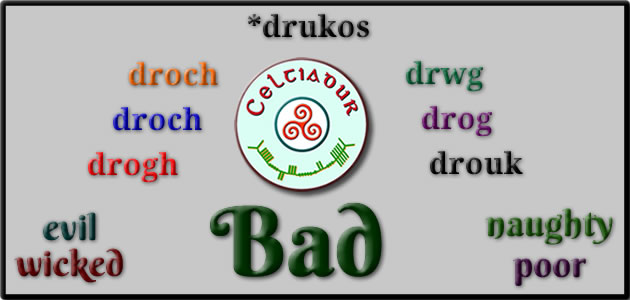
Proto-Celtic *drukos = bad
Gaulish druco- = bad
Old Irish (Goídelc) droch [drox] = bad, ill
Middle Irish (Gaoidhealg) droch = bad
Irish (Gaeilge) droch [drɔx] = bad, poor, evil, ill, un-
drochbhéas = vice, bad habit
drochmheas = contempt
drochobair = bad work, mischief
drochrath = ill luck, misfortune
drochrud = bad thing, inferior thing, bad/evil person, devil
drochrún = evil intention
drochuair = evil hour, unfortunate occasion
Scottish Gaelic (Gàidhlig) droch [drɔx] = bad, evil, wicked, mischievous, sad, calamitous, dark, obscure, secretive
droch-aigne = ill-will
droch-allaidh = libel
droch-chòrdadh = disagreement
droch-fhàistinneach = ominous
droch-mhèin = malice
droch-thuarach = sinister
Manx (Gaelg) drogh [drɔx] = evil, wicked, bad, abusive, unenviable, misfortune, badness, ill, sinister, vile
drogh aghtalys = misbehaviour, misconduct
drogh chaaynt = bad language, smut, swearing
drogh chonagh = misfortune
drogh hraghtey = to smuggle, smuggling
drogh oor = bad luck, ill-times, misfortune
Proto-Brythonic *drug = bad
Middle Welsh (Kymraec) druc, dryg, drỽc, drwc = bad
drycaruer , drygarver, drycarver = bad habit, abuse, misuse
drygdafod = scurrilous language, evil tongue
Welsh (Cymraeg) drwg [druːɡ] = bad, rotten, putrid; poor, piteous, wretched; sorry, grievous, sad; unfavourable, causing disquiet; injurious, harmful; unpleasant (taste); indecent, obscene (words); counterfeit, false; bad; harsh, cruel, severe, ruthless; corrupt, depraved, sinful, wicked, mischievous, naughty
strong>drwgabsen = malicious defamation, slander
drwgafer = bad habit, abuse, misuse
drwgdafod = scurrilous language, evil tongue
drwgenwog = infamous, notorious, disreputable
Middle Cornish (Cernewec) droc, drôg, drog = evil, wickedness, harm, injury, wrong, bad, wicked, hurtful, mischievous
droca, droga = worst
drocoleth = an evil deed, ill doing, injury, damage
droga, droaga = to do harm, hurt, injure
drogbrederys = evil-minded, malicious, envious
drogbres = ill will, spite, grudge
drogdavasec = ill-tongued, foul-mouthed, back-biting, reviling
drogger = ill report, infamy, reproach
droggeriit = infamous, reproachful
droggras = revenge, requital
drogober, drôk-ober = an evil deed, a crime
Cornish (Kernewek) drog [drɔ:g / dro:g] = bad, harm, hurt, ill, wrong, evil, invalid, nasty, naughty, wicked, wrong
drogdybi = to suspect
drogedh = vice
drogfara = to behave badly
drogga = wrong
droghandla = to abuse, mishandle
droglam = accident, crash, mishap
drogober = crime
drogboeror, drogoberores criminal, culprit
drogura = to smear
drokoleth = widkedness
drokter = wickedness
Middle Breton (Brezoneg) drouc = bad, illness, anger
drouc Ælez = the devil, bad angel
drouc auantur = misfortune, bad luck
droucyez, drouguyez = wickedness, malice, animosity
drouc =
drouc =
Breton (Brezhoneg) drouk [druːk] = bad, evil, naughty
droug [druːk] = bad, wickedness
drougiezh [druˈɡiːɛs] = wickedness, malice, animosity
droukrañsus [druˈɡrãsːys] = angry, resentful
droukaat = to become bad, make bad
drouziwezh [dru.ˈziː.wɛs] = defeat, disaster
dizrouk [ˈdi.zruk] = inoffensive, without anger

Etymology: possibly from the Proto-Indo-European *dʰrewgʰ- (to deceive) [source]. Word from the same roots include dream in English, droom (dream) and driegen (to deceive) in Dutch, Traum (dream) and trügen (to deceive, be deceptive) in German [source].

Proto-Celtic *dognawos = badly grown (?)
Old Irish (Goídelc) dona [ˈdona] = unlucky, unfortunate
Middle Irish (Gaoidhealg) dona = unfortunate, unlucky, wretched
donaide = ill-disposed, wretched
donán = miserable creature, wretch
donas = ill-luck, misfortune, calamity
donogad = act of making wretched
Irish (Gaeilge) dona [ˈd̪ˠɔn̪ˠə/ˈd̪ˠʌnˠə] = unfortunate, unlucky, bad, poor, wretched, ill
donacht = badness, wretchedmess, misfortune, illness
donagar = bad condition, misfortune
donaigh = to make worse, aggravate, become word, deteriorate, injure, maim
donaire = wretch
donaireacht = wretchedness
donaisín = little wretch, weakling
donas = ill-luck, misfortune, affliction, misery, mischief
Scottish Gaelic (Gàidhlig) dona [dɔnə] = bad, not well
donachas [dɔnəxəs] = mischief, harm, bad luck, mishap, devil
donachd [dɔnəxg] = mischief, harm, bad luck, mishap
donad [dɔnəd] = degree of badness, severity
donadas [dɔnədəs] = badness, evil
donas [dɔnəs] = mischief, harm, bad luck, devil
donasag [dɔnəsag] = imp
Manx (Gaelg) donney [ɔlk] = calamitous, ill-advised, inauspicious, unfortunate, unlucky, very ill, woeful, unhappy
donnan = dolt, dunce, stupid person, worse
donnys = affliction, bad luck, mischief, woe

Etymology: possibly from the Proto-Indo-European *ǵneh₃- (to recognise, know) [source]. Words from the same root include can, canny, gnome, ignore, know and quaint in English [source].

Proto-Celtic *ulkos = evil, bad
Old Irish (Goídelc) olc [olk] = bad, evil
olcas = badness
Middle Irish (Gaoidhealg) olc, olcc = evil, bad, wrong, misfortune
olcach = hurtful, injurious, harm, injury
olcas = badness
Irish (Gaeilge) olc [ɔl̪ˠk] = evil, harm, bad, harmful, poor, wretched, ill-disposed, hardly, scarcely
olcach = causing evil, harmful, injurious.
olcas = badness, evil, bad state, bad nature, spite
Scottish Gaelic (Gàidhlig) olc [ɔl̪ˠxg] = evil, wicked, bad, infamous, ill, iniquity
olcag [ɔl̪ˠxgag] = little brat (female)
olcair [ɔl̪ˠxgɛrʲ] = evildoer
olcas [ɔl̪ˠxgəs] = wickedness, badness
Manx (Gaelg) olk [ɔlk] = bad, evil, ill, injury, lousy, truculence, unfavourable, vicious, wicked, mischief, naughty, sinful
olkeyr = criminal, culprit, evil-doer, offender, mischief-maker
olkid = badness, evilness
olkys = badness, evilness, iniquity, mischief
olkyssagh = baleful, elfish, diabolical, iniquitous, malicious, malignant, mischievous, naughty, vicious, wicked

Etymology: from the Proto-Indo-European *h₁elḱ- (bad [?]) [source]. Words from the same root include ill and possibly ulcer in English, illa (badly, poorly, not well) in Swedish, and ilkeä (bad, mean, wicked, evil) in Finnish [source].

Sources: Wiktionary, Am Faclair Beag, Online Manx Dictionary, Teanglann.ie, eDIL – Electronic Dictionary of the Irish Language, In Dúil Bélrai English – Old Irish glossary, Geiriadur Prifysgol Cymru, Gerlyver Kernewek, Lexicon Cornu-britannicum: A Dictionary of the Ancient Celtic Language of Cornwall, Dictionaire Favereau, TermOfis, Le dictionnaire diachronique du breton, Etymological Dictionary Of Proto Celtic