Words for awl, bodkin and related things in Celtic languages.
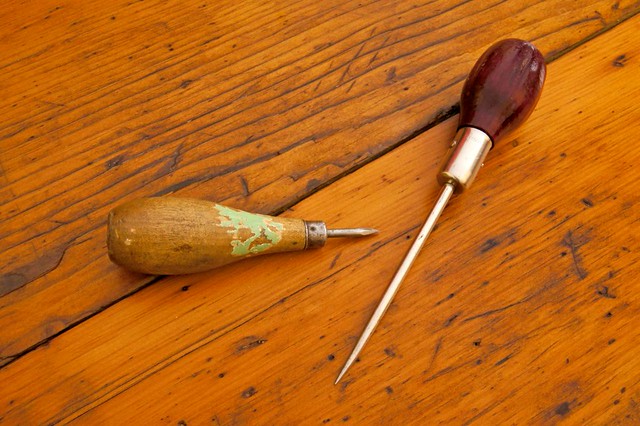
An awl [ɔːl/ɔl] is a pointed instrument for piercing small holes, as in leather or wood; used by shoemakers, saddlers, cabinetmakers, etc. The blade is differently shaped and pointed for different uses, as in the brad awl, saddler’s awl, shoemaker’s awl, etc. The word comes from Middle English a(u)l (awl), from Old English æl (awl, hook, fork), from Proto-West Germanic *al (awl), from Proto-Germanic *alaz (awl), from Proto-Indo-European *h₁ólos (awl) [source].

A bodkin [ˈbɒdkɪn] is a small sharp pointed tool for making holes in cloth or leather. A blunt needle used for threading ribbon or cord through a hem or casing. A hairpin. A dagger, or a sharp tool, like an awl, formerly used for pressing down individual type characters (e.g. letters) from a column or page in making corrections. It comes from Middle English boydekin (dagger) and possibly has Celtic roots [source].
Words marked with a * are reconstructions.
| Proto-Celtic | *minaweto- = awl |
|---|---|
| Old Irish (Goídelc) | menad = awl |
| Middle Irish (Gaoidhealg) | menad, menadh, menath, meanadh = awl, borer or pointed instrument used for drilling holes |
| Irish (Gaeilge) | meana [ˈmʲan̪ˠə] = awl, bradawl, bodkin |
| Scottish Gaelic (Gàidhlig) | minidh, meanaidh [minɪ] = shoemaker’s awl, small awl |
| Manx (Gaelg) | mennee = awl, bradawl, pricker, stiletto |
| Proto-Brythonic | *mɨnawed = awl (?) |
| Middle Welsh (Kymraec) | mynawyd, minawed = awl, bradawl, bodkin |
| Welsh (Cymraeg) | myn(i)awyd = awl, bradawl, bodkin (also written bin(i)ewid, binawad or byniawid) bwyta uwd â mynawyd = to attempt the impossible (“to eat porridge with an awl”) mynawydu, mynawydo = to pierce with an awl mynawydaidd = awl-shaped |
| Middle Cornish (Cernewec) | benewes = awl |
| Cornish (Kernewek) | menowes = awl |
| Middle Breton (Brezonec) | menauet = awl, bodkin, punch |
| Breton (Brezhoneg) | minaoued = awl, bodkin, punch minaoueder = maker of awls, bodkins or punches minaouediñ = to punch |
Etymology: unknown; possibly a substrate word [source].
| Proto-Celtic | *brazdos = thorn |
|---|---|
| Old Irish (Goídelc) | brot = goad |
| Middle Irish (Gaoidhealg) | brot, brud, brod = |
| Irish (Gaeilge) | brod [bˠɾˠod̪ˠ] = goad broideadh = to prod, nudge, bite |
| Scottish Gaelic (Gàidhlig) | brog [brog] = awl brogan [brogan] = small awl, probe, poker |
| Manx (Gaelg) | brod = goad, jab, nudge, prick, spur, stimulus, poker |
Etymology: from Proto-Indo-European *bʰresdʰ-, from *bʰers- (top, tip, point). Words from the same roots include barley, bristle and brush in English, barr (pine needles) in Icelandic, bara (bread) in Welsh, Cornish and Breton, farina (flour, meal) in Italian, and harina (flour) in Spanish [source].
Another word for bodkin in Manx is burkan. Not sure where it comes from. A bodkin in Welsh is also a bwytgyn or botgyn, which come from Middle English boytekyn / boydekin (dagger, bodkin).
Sources: Wiktionary, Etymological Dictionary Of Proto Celtic, In Dúil Bélrai English – Old Irish glossary, eDIL – Electronic Dictionary of the Irish Language, Teanglann.ie, Am Faclair Beag, An etymological dictionary of the Gaelic language, Fockleyreen: Manx – English Dictionary, Online Manx Dictionary, Gaelg Corpus, Geiriadur Prifysgol Cymru, Lexicon cornu-britannicum : a dictionary of the ancient Celtic language of Cornwall, Gerlyver Kernewek, Devri : Le dictionaire diachronique du breton, Geriafurch, TermOfis