Weathered pagodas and stretching times

Picture of a pagoda

The word for weather in Russian is погода (pogoda) [pɐˈɡodə], which sounds more or less like pagoda in English.

The English word pagoda, which refers to an Asian religious building, especially a multistory Buddhist tower, comes from Portuguese pagode, which comes via Tamil from the Sanskrit भगवती ‎(Bhagavatī, name of a goddess) or भागवत ‎(Bhāgavata, “follower of Bhagavatī”).

In French the words for weather, temps, also means time and tense, and comes from the Latin tempus (time, period, age, tense, weather), from the Proto-Indo-European *tempos ‎(stretch), from the root *temp- ‎(to stetch, string), which is also the root of the English word tempest, via the Latin tempestas ‎(storm), and the English word tense.

Breton also has one word for time and weather – amzer, which comes from the Proto-Celtic *amsterā ‎(time, moment), which is also the root of the Irish aimsir (weather, time and tense), the Manx emshir (weather, time and tense) and the Scottish Gaelic aimsir (climate, weather, season, era, time, reign), the Welsh amser (time, age, tense), and the Cornish amser (tense).

Sources: www.study-languages-online.com, Wiktionary

I’ve started putting together a new section on Omniglot featuring weather-related words and phrases. So far I have pages in Czech, Russian and Welsh.

In the UK we talk about the weather quite a bit. It’s (usually) a neutral and uncontroversial topic, and while some people are genuinely fascinated by it, for most of us it’s just a way to start a conversation. Do people do this is other countries? Or do you use of topics as conversation starters?

Ingenious genius

The word ingenious sounds like the antonym (opposite) of genius as in- is often used as a negative suffix (invisible, indivisible, etc). However they are not.

Ingenious means:

– displaying genius or brilliance
– tending to invent
– characterized by genius
– cleverly done or contrived; witty; original; shrewd; adroit; keen; sagacious.

It comes from:

– the Middle French ingénieux (ingenious)

– from the Old French engenious (ingenious)

– from the Latin ingeniōsus ‎(endowed with good natural capacity, gifted with genius), from ingenium ‎(innate or natural quality, natural capacity, genius), from in ‎(in) and gignere ‎(to produce)

– from the Old Latin genere, from genus (birth, origin)

– from the Proto-Italic *genos (lineage, origin)

– from the Proto-Indo-European *ǵénh₁os ‎(race), from *ǵenh₁- ‎(to produce, beget).

Genius means:

– someone possessing extraordinary intelligence or skill; especially somebody who has demonstrated this by a creative or original work in science, music, art etc.
– extraordinary mental capacity
– inspiration, a mental leap, an extraordinary creative process
– the guardian spirit of a place or person (in Roman mythology)
– a way of thinking, optimizing one’s capacity for learning and understanding

It comes from:

– the Latin genius ‎(the guardian spirit of a person, spirit, inclination, wit, genius, literally “inborn nature”), from gignō ‎(to beget, produce)

– from the Old Latin genō

– from the Proto-Indo-European root *ǵenh₁- (see above)

So ingenious and genius come from the same root, as do many other words, but took different paths to arrive at their modern forms.

In Proto-Celtic the PIE root *ǵenh₁- became *gniyeti (to make, to do), which became gníid / ·gní (to do, to work) in Old Irish, which, with a suffix became dogní (to do, to make), which became déan in Modern Irish, jean in Manx and dèan in Scottish Gaelic. This is possibly also the root of the Welsh gwneud, the Cornish gul and the Breton (g)ober). All these words mean to do or to make.

Sources: Wiktionary

The Salmon’s Daughter

Language quiz image

On Tuesday I saw a play in Bangor called Merch yr Eog / Merc’h an Eog (Daughter of the Salmon) in four different languages: Welsh, Breton, French and Guadeloupean Creole.

It was a co-production between Theatr Genedlaethol Cymru (Welsh National Theatre) and Teatr Piba from Brittany, and featured actors from Wales and Brittany. The lead role was played by Lleuwen Steffan, a Welsh singer-song writer who lives in Brittany and speaks Welsh, Breton, French, and English, fluently.

For me it was interesting to hear all the different languages, especially the Breton. I understood most of the Welsh and French, though I couldn’t always hear what they were saying clearly, and understood, or at least recognised, bits of the Breton.

There’s some discussion in the play about similarities between Welsh and Breton words, though I doubt very much if any of the Welsh speakers in the audience understood much of the Breton, unless they’d studied it. The languages have many similar words, but sound very different.

When one of the actors started speaking in Guadeloupean Creole I thought it was French at first with an unfamiliar accent, but when I listened more closely I thought is was probably a French-based Creole.

Translation was provided via an app called Sibrwd (Whisper) and was available in English, Welsh, French and Breton. However it was mainly a summary of what the actors were saying rather than a word-for-word translation, and wasn’t in time with the speech. Sometimes it was behind, sometimes ahead, so it was like watching a badly dubbed film, and made it tricky to follow the story.

There’s a review of the Bangor performance in the Daily Post.

Reflections on the Polyglot Gathering

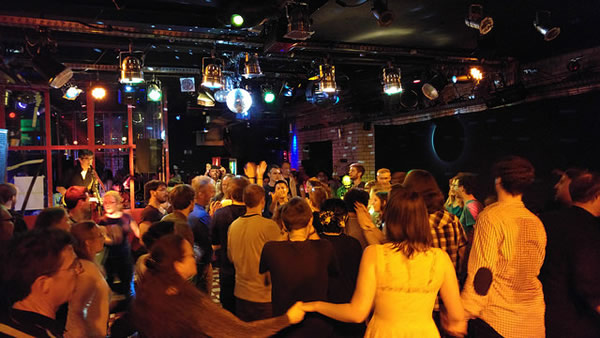
Polyglots dancing at the Slaughterhouse in Berlin

I got back from the Polyglot Gathering in Berlin late on Monday night. I travelled by train the whole way, which is a bit more expensive than the plane, and takes a few hours longer, but I prefer to travel this way, and you see more. The journey went smoothly, apart from the train from London, which was an hour late getting into Bangor. Fortunately I got a partial refund on my ticket. On the Eurostar I talked to a interesting lady from Vancouver, and on the train to Bangor I talked, mainly in Welsh, to a doctor from Felinheli.

This year’s Gathering was as much fun as previous years – it was my third. I arrived in Berlin quite late on Wednesday evening the day before it officially started, and missed out on most of the polyglot games that were going on in the afternoon and evening. Next year I might arrive a day or two before the start to give me a chance to explore more of Berlin – this year I spent most of my time in the venue and didn’t go exploring.

Over the next four days I learnt about many things, including Portuguese-based creoles, Greek, minimalism, Sardinian languages and dialects, why many language learners don’t acquire native-like accents, metaphors in native Canadian languages, language mentoring, how musical techniques can be applied to language learning, the stagecraft of multilingualism, and much more. I got to know old friends better, met lots of new ones, and I spoke lots of different languages. My talk on Manx went well, as did the introduction to Welsh that I helped with.

The talks were mainly in English, with some in French, Italian, German, Esperanto, Dutch, Spanish, Russian, Indonesian, and in various combinations of these.

Between us we polyglots speak quite a few different languages. The most common (i.e. those with quite a few speakers / learners) include English, French, Spanish, Italian, Portuguese, Catalan, Romanian, Esperanto, German, Dutch, Swedish, Norwegian, Danish, Russian, Czech, Slovak, Polish, Serbian, Greek, Finnish, Hungarian, Welsh, Irish, Mandarin, Cantonese, Japanese, Korean, Indonesian, Malay, Arabic, Persian, Hebrew and Swahili. There were also speakers and learners of Wolof, Punjabi, Hindi, Marathi, Romani, Tamil, Latin, Scottish Gaelic, Manx, Cornish, Breton, Sardinian, Luxembourgish, Latvian, Lithuanian, Macedonian, Bulgarian, Slovenian, Albanian, Basque, Tagalog, Turkish, Navajo, Toki Pona, Klingon, and probably other languages.

I’m looking forward to the next polyglot event – the North American Polyglot Symposium in Montreal in July. I’ll be doing a talk on the origins of language there, so should get working on it.

Some things I learnt from the Gathering

There are many ways to learn languages, and no single way will work for everyone. Some like to focus on one language at a time until they have reached a level they are happy with, then move on to the next language; others like to study many different languages at the same time. Some learn grammar and vocabulary first, then learn to speak; others start using their languages straight away, or soon after they start studying. Some like to study on their own; others like to study in a class and/or with a private tutor. Some combine many of the above and more, to varying degrees – I certainly do.

From Malachi Rempen’s talk on cartooning, minimalism and language learning (Less is More: What Silly Doodles Can Teach Us About Fluency), I learnt that you can do a lot with a little. He showed how he can make his Itchy Feet character express a wide variety of emotions with just a few lines, and suggested that the same can be applied to languages – you can communicate even if you know only a little of a language. He also argued that fluency means different things to different people, and might not be the best thing to aim for.

Tim Keeley, professor of Cross-Cultural Management at Kyushu Sangyo University in Fukuoka, explained that the idea that only children can acquire native-like accents in foreign languages is wrong – the brain is flexible throughout live and you can learn to perceive and produce foreign sounds. However there are emotional barriers which stop many people from sounding ‘native’. When learning another language you can also take on or create a new identity, and those who are willing and able to do this are most likely to sound more like native speakers. You also shouldn’t worry about mimicking people. In fact that is a good way to acquire native-like pronunciation.

Michael Levi Harris, an actor and polyglot from New York, talked about parallels between learning a part and learning a language. He explained that actors tend to exaggerate speech and physical mannerisms when learning a part, then make them more subtle, and that language learners can try the same things – exaggerate the pronunciation, gestures, etc. until they become second nature, then tone them down. He also talked about taking on different identities when speaking different languages and with different accents. If you can find a native speaker of a language whose voice and mannerisms appeal to you, then you can create your character in that language based on them.

The extend to which you take on a new identity in a new language depends on how much you want to integrate into a new culture. If you want to be taken for a native, then you need to sound and act like them. Alternatively you could try sounding like a native, perhaps with a bit of a foreign accent, but not worry so much about acting like them. If you spend a lot of time in a different county interacting and observing the natives, you’re likely to pick up at least some of their behaviour anyway.

Fiel Sahir, an Indonesian-American musician and polyglot who currently lives in Germany, talked about applying musical techniques to language learning. He explained how practice is the key to music and language, but it has to be intelligent practice that focuses on areas that you find difficult. This might be particular passages in a piece of music, or particular tenses or noun declensions in a language. By focusing like this, you can make a lot of progress.

Focus is something that I find difficult sometimes. I can and do focus, but often get distracted. I was thinking about how I’ve been dabbling with a variety of languages recently and not making a lot of progress in any of them. So my plan is to focus on one, or two, languages for the next year – Russian and Czech – and learn as much as I can in them. I will keep my other languages ticking over, but not spend much time on them.

Kernewek

I started learning Cornish yesterday. Mainly because it’s the only Celtic language I haven’t studied yet, and I’m curious about it.

I’m using the course SaySomethingin Cornish, and am finding it very good. I like the way the course is put together – you learn a small number of words and structures in each lesson and learn how to put them together in various ways. You are promoted to practice a lot during the lessons, and to come up with new combinations of the words that you haven’t heard before.

Quite a few of the words are similar to Welsh, but the grammar is different – more like Breton or older forms of Welsh in fact, so to my ears it sounds like I imagine Middle Welsh sounded. A bit like Middle English might sound to speakers of modern English.

At the moment I’m listening to a podcast in Cornish on Radyo An Gernewegva. If I listen carefully I can get the gist of some bits, and can understand other odd words, but it will be a while before I can understand it all.

Súilíní

Súilíní

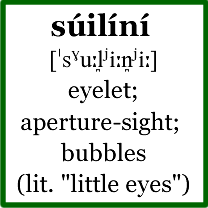
I discovered an interesting word in Irish yesterday – súilíní [ˈsˠuːl̪ʲiːn̪ʲiː] – which is a diminutive form of súil [sˠuːl̪ʲ] (eye) and means literally “small eyes”, and actually means eyelets, an aperture-sight, or bubbles. For example, uisce gan súilíní is still water (“water without bubbles”) [source].

More common Irish words for bubbles are bolgán and boilgeog.

The word súilíní is also used in Hiberno-English to mean “bubbles of fat floating on top of a stew or clear soup”, and is also written sooleens [source].

The word súil (eye) comes from *sūli, an alteration of the Proto-Celtic *sūle (suns), the dual of *sūlos, which is the genitive of *sāwol (sun), from the Proto-Indo-European *sóh₂wl̥ (sun). Apparently in Irish mythology the sun was seen as the “eye of the sky”, and the word for sun came to mean eye [source].

The words for sun in other European languages come from the same root, and most start with s, e.g. saũle (Latvian), sol (Swedish, Danish, Norwegian, Catalan, Spanish, Portuguese), Sonne (German), etc. There are some exceptions though, including haul (Welsh) heol (Breton), howl (Cornish) and ήλιος (ḗlios – Greek) [source].

Polyglot Gathering Berlin 2015

I got back from the Polyglot Gathering in Berlin about an hour ago. I took the train all the way from Berlin to Bangor, via Cologne, Brussels, London, Crewe and Chester, leaving Berlin just before 7am this morning, and arriving in Bangor just after 9pm this evening. On the way there I also travelled by train, though I had to stay in Brussels for one night, and continued the next day. It cost slightly more than flying (only about £20 more) and took a bit longer (about 2 hours – more on the way there), but I saw so much more, and went through parts of France and Germany I hadn’t been before, and visited Belgium for the first time. The engineers on German railways started a 5-day strike today, and I was worried that my trains might not be running. Fortunately they did run, and were more or less on time.

The gathering was bigger than last year with about 350 participants from many countries. There were many people there I knew from last year’s gathering, and from the Polyglot Conference in Novi Sad, and I met lots of new people. I had conversations in all the languages I know well, and most of the ones I know less well. There was a Breton speaker there, though I didn’t get to talk to him, as well as speakers of Welsh, Irish, Cornish and Scottish Gaelic. Like last year, there were plenty of Esperanto speakers, and I had quite a few conversations in Esperanto, which I brushed up a bit beforehand. There were a number of people who had studied sign languages there, including BSL, ASL, Dutch Sign Language (Nederlandse Gebarentaal / NGT) and Slovak Sign Language (Slovenský posunkový jazyk / SPJ), and the Slovak signer demonstrated how she interprets songs in SPJ, which was fascinating to watch.

The talks and lectures were really interesting, and I went to quite a few introductions to languages, including Northern Sami, Navajo, Arabic, Hebrew, Milanese, Gottlandic, Finnish, Greek and Basque. I don’t intend to learn any of these languages just yet, but it was fascinating to find out more about them. My own presentation, on the History of Writing, was well received, and I got lots of positive comments.

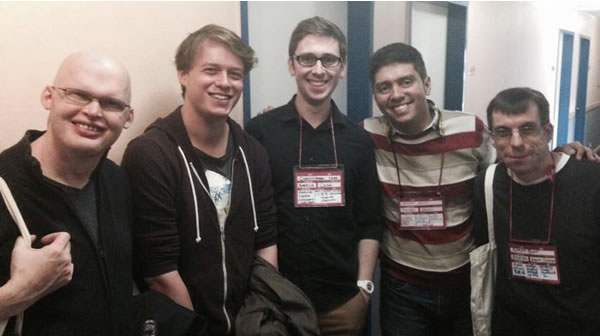
Some of the polyglots at the Polyglot Gathering in Berlin in May 2015
Some of the polyglots at the Polyglot Gathering – from right to left: Richard Simcott, Alex Rawlings, Christopher Huff, Jimmy Melo, and me – between us we speak at least 20 or 30 languages, to varying degrees.

The evening activities included a polyglot games evening, an international culinary festival – I took some Welsh cakes and bara brith, which were popular – a book fair, a polyglot game show, a concert with the multilingual French singer JoMo, who sang in 25 different languages, and an international cultural evening, at which I sang a Scottish Gaelic waulking song (Ceud soiridh soiridh bhuam) and one of my own songs – A Hen in My Hat (in 5 languages). After the cultural evening there was a little Irish and Scottish music session – I had a couple of tin whistles with me, and a few other people had instruments.

So now I’m back in Bangor and will start to catch up with the work I couldn’t do while away due to time constraints and internet connection issues.

Blwyddyn newydd dda!

Bloavezh mat / Šťastný nový rok / Blwyddyn newydd dda i chi i gyd / Einen guten Rutsch ins neue Jahr / Happy New Year to you all / Bonne année / Athbhliain faoi mhaise daoibh / Blein Vie Noa / Bliadhna mhath ùr / Blydhen Nowydh Da / С Новым Годом / Срећна Нова Година!

Happy New Year!

Bloavezh mat / 新年快樂 / Blydhen Nowydh Da / Šťastný nový rok / Gelukkig Nieuwjaar / Happy New Year / Bonne année / Einen guten Rutsch ins neue Jahr / Athbhliain faoi mhaise daoibh / Felice anno nuovo / 新年おめでとうございます / Blein Vie Noa / Feliz Ano Novo / С Новым Годом / Bliadhna mhath ùr / Срећна Нова Година / ¡Feliz Año Nuevo! / Gott nytt år / Blwyddyn newydd dda, and so on!

Da mad math

In Welsh and Cornish the usual word for good is da [daː], while in the other Celtic languages words for good are: Breton – mat [maːt˺], Irish – maith [mˠa(ɪ)(h)], Manx – mie [maɪ], and Scottish Gaelic – math [ma]. I’ve wondered for a while whether there were cognates in Welsh and Cornish for these words.

Last week I found that there are: mad in Welsh and mas in Cornish. The Welsh word, which means good, seemly, lucky, appears in the phrase: a wnêl mad, mad a ddyly (one good turn deserves another), but isn’t otherwise used, as far as I can discover. The Cornish word doesn’t appear in the Cornish dictionaries I’ve checked so I think it is probably not used any more.

These words all come from the Proto-Celtic *matis (measure), possibly from the Indo-European (measure, consider) [source], which is also the root of the Irish word meas (judgement, opinion, respect) [source], and possibly of the Welsh meddwl (to think), and the English mete (measure).