Mulling Mills

Mulled beverages, such as wine, seem to be quite popular at this time of year, at least in the UK. To mull wine, or other beverages, you add spices and maybe fruit, and heat it up. Is this a thing in other countries?

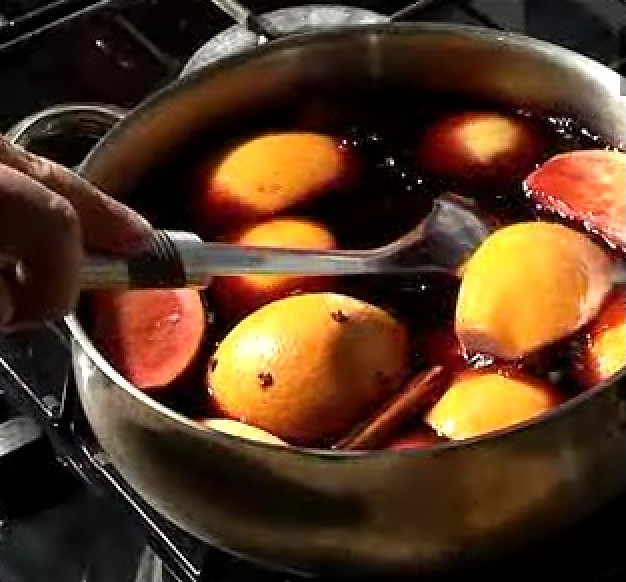
Navidad Irlanda - Mulled wine

According to The Online Etymology Dictionary, mull in the sense of mulled drinks was first used in writing in English in about 1600, and possibly comes from Dutch word mol – a kind of white, sweet beer, or from the Flemish molle – a kind of beer, and related to words for “to soften”.

The word mull, as is in to mull something over, is probably a version of mill (to grind), from the Old English mylen (a mill), from the Proto-Germanic *mulīnō / *mulīnaz (mill), from Late Latin molīnum / molīnus (mill), from molō (to grind, mill) [source].

A mull, as in the Mull of Kintyre, comes from the Scottish Gaelic word maol (bare, bald, rounded promontary), from the Old Irish máel (bald, hornless, blunt), from the Proto-Celtic *mailos (bald, bare) [source].

Mull of Kintyre

Knives and Cutlasses

Canif

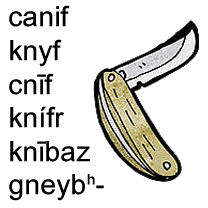
Yesterday I discovered that the French word for penknife is canif [ka.nif], which was borrowed from the Middle English knif / knyf [kniːf] (knife, dagger) [source]. The English word knife comes from the same root.

Knif comes from the Old English cnīf [kniːf] (knife), which was possibly borrowed or influenced by the Old Norse knífr (knife), which comes from the Proto-Germanic *knībaz [ˈkniː.βɑz] (pincers, shears, knife), from the Proto-Indo-European *gneybʰ- (to pinch, nip), from *gen- (to pinch, squeeze, bend, press) [source].

Cnīf was first used in writing in the 11th century. Before then, seax [sæɑ̯ks] was the word for a knife or dagger, which is related to the word Saxon [source].

The French word for knife is couteau [ku.to], which comes from the Old French coutel, from the Latin cultellus (small knife, dagger), a diminutive of culter [ˈkul.ter] (knife, razor) [source], which is also the root of words for knife in Romance languages, the English words cutlass and cutlery, and the Welsh word cyllell [ˈkəɬɛɬ].

Little Hillock of Glory

At the Welsh conversation group I went to tonight we had a quiz, part of which involved matching Welsh names for places in England to their English equivalents. I knew quite a few of them, but some were new to me.

My favourite was Twmpyn y Glori (“Little Hillock / Knoll of Glory”), which is apparently what you call Dewsbury in Welsh. I haven’t yet discovered why. Twmpyn is a diminutive of twmp, which means hillock, knoll, mound, pile or lump.

Northgate, Dewsbury

Dewsbury is a town in West Yorkshire in the north of England. The English name is thought to come from the Welsh name Dewi, an equivalent of David, and the Old English word burh (fort). The name was recorded as Deusberie, Deusberia, Deusbereia or Deubire in the Doomsday Book of 1086. Perhaps a better Welsh name for it would be Caerddewi (Dewi’s fort).

Nottingham

Another interesting name that came up was Tre’r Ogof (“Town of the Cave”), which is the Welsh for Nottingham. Apparently an old Brythonic name for that area was Tig Guocobauc, (Place of Caves). The name Nottingham comes from Snotingaham – Snot’s people’s (inga) homestead (ham). Snot was a Saxon chieftain.

Thatched Stegosauruses!

What do togas, stegosauruses and thatch have in common?

Stegasaurus

These words all come from the Proto-Indo-European root *(s)teg- (cover, roof) [source].

Toga comes from the Latin togategō (I clothe) , from the Proto-Indo-European *togéh₂ (cover), from *(s)teg- (to cover) [source].

Stegosaurus comes from the Ancient Greek words στέγος (stégos – roof) and σαῦρος (saûros – lizard) [source], and στέγος comes from the Proto-Indo-European root *(s)teg- (cover, roof) [source]. The origins of σαῦρος are uncertain. So a stegosaurus is a “roof lizard”.

Thatch comes from the Old English þæc (roof-covering), from the Proto-Germanic *þaką (covering), from the Proto-Indo-European *(s)teg- (to cover) [source].

Words for house in the Celtic languages also come ultimately from the same root – (Welsh) chi (Cornish), ti (Breton), teach (Irish), taigh (Scottish Gaelic) and thie (Manx). More details.

Just speirin

Last night I saw FARA, a brilliant group from Orkney, in our local arts centre. One of the songs they sang, Speir Thoo The Wast Wind, was in Orcadian dialect and based on a poem by Christina Costie from Orkney.

Orcadian dialect is a type of Insular Scots that combines elements of the extinct Norn language and Scots. There isn’t a lot of information available about Orcadian, but I will try to put together a page about it on Omniglot.

Each verse of the song and the poem finishes with the line “Speir thoo the wast wind, bit speir no me”, which means “Ask the west wind, and don’t ask me”, I think.

The word speir [spiːr], which is also written speer, means to enquire or ask, according to The Orkney Dictionary. When I heard it in the song, I thought I might be related to words for to ask in North Germanic languages, and it turns out that it is.

It comes from the Old English spyrian (to track, inquire, investigate, examine), from the Proto-Germanic *spurjaną (to search; to examine; to ask) [source], which is also the root of the Danish word spørge (to ask, inquire), Norwegian word spørre (to ask, inquire), and the word spyrja (to ask) in Icelandic and Faroese [source].

A few other words from Orkney dialect: hoodjiekapiv, hoodjiekapiffle, hoodjiekaboogle, which are all Orcadian equivalents of whatsit, thingy, doobry, thingamajig, whatjumacallit, thingamebob, etc [source]. What do you call something when you can’t remember it’s normal name?

You can hear the song here:

Can Hens Sing?

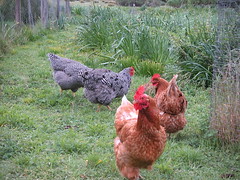
Four hens

What is the connection between singing and hens?

Hens don’t sing, but the words for to sing / speak in Celtic languages come from the same root as the English words hen and chant.

The root is the Proto-Indo-European *keh₂n- (to sing) [source].

This became *kan- (to sing) in Proto-Celtic, which became canaid (to sing) in Old Irish, and can (to chant, sing, speak, talk) in modern Irish. In Scottish Gaelic it became can (to sing, rehearse, say, name or call), and in Manx it became caayn (to bray, whine; song).

In Proto-Brythonic it became *kėnɨd (to sing), which became canam (to sing) in Old Welsh, canu (to sing, intone, chant, state, say) in modern Welsh, kana (to sing) in Cornish, canaff (to sing) in Middle Breton and kanañ (to sing) in Breton [source].

In Proto-Germanic *keh₂n- became *hanô (rooster), *hanjō (hen) and *hōnaz (fowl). The English word hen developed from *hanjō, via the Old English hænn / henn (hen). In other Germanic languages these words became: Huhn (hen, chicken) and Henne (hen) in German; hen (hen) in Dutch [source]; and höna (hen) in Swedish [source].

*keh₂n- is also the root of the Latin canō (I sing), from which words for to sing in Romance language developed, such as chanter (to sing) in French and cantar (to sing) in Spanish [source], and the English word chant [source].

See also the Celtiadur

When is the sky not the sky?

Useful phrase in Danish

In Danish, Norwegian and Swedish the word sky means cloud, as does ský in Icelandic. The word for sky in these languages is himmel (himinn in Icelandic), and in Swedish sky also means sky or gravy.

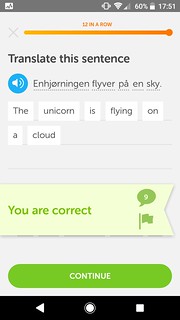
I learnt the Danish word sky the other day from the sentence: Enhjørningen flyver på en sky (The unicorn is flying on a cloud) – are very useful thing to be able to say.

Sky comes from the Old Norse ský (cloud), from Proto-Germanic *skiwją (cloud, cloud cover), from Proto-Indo-European *(s)kew- (to cover, conceal), which is also the root of the English word sky [source].

The English word cloud comes from the Old English clūd (mass of stone, rock, boulder, hill), from Proto-Germanic *klūtaz / *klutaz (lump, mass, conglomeration), from Proto-Indo-European *gel- (to ball up, clench), which is also the root of the English words chill, cold, congeal, cool, gel, gelatin and jelly [source].

In Old English there were different words for sky and cloud:

  • heofon was the sky or heaven [source], which survives in such modern English expressions as ‘the heavens opened’ (it started to rain heavily).
  • wolcen was cloud, and the plural, wolcnu was the sky or the heavens [source]. This became welkin in modern English, an archaic and poetic word for the sky, the upper air; aether; the heavens.

A sunny day in Bangor / Dydd heulog ym Mangor