Good

Words for good and related things in Celtic languages.
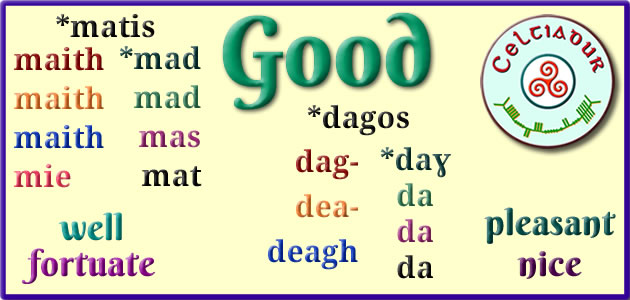
Good

Proto-Celtic *matis = good
Old Irish (Goídelc) maith [maθʲ] = good
maithe = goodness
Middle Irish (Gaoidhealg) maith, maid = good, profiable, excellent, fitness, proficiency, wealth
Irish (Gaeilge) maith [mˠa(h) / mˠaɪ(h)] = good; goodness, kindness; good things; fertility
maithe = goodness, good
maitheamh = forgiveness, pardon, abatement, remission
maitheas = goodness, good, good thing, kindness, gift
maitheasach = good, useful, kind, obliging
maitheasaí = good worker
maithiúnas = forgiveness, pardon
Scottish Gaelic (Gàidhlig) math [mah] = good, well
maitheadh = forgiving, pardoning
maitheas = goodness
maitheanas = forgiveness, pardon
maitheamhnas = forgiveness
Manx (Gaelg) mie [maɪ] = good, nice, moral, fair, pious, ready, goodness, favourable, virtuous, virtue, goodly
mienys = favourableness, good, goodness
Proto-Brythonic *mad = good
Middle Welsh (Kymraec) mad, mat [maːd] = fortunate, lucky, good, etc
matweith, madwaith = good work, goodness
Welsh (Cymraeg) mad [maːd] = fortunate, lucky, auspicious, happy, suitable, proper, good, beneficial, holy, fair, pleasant, beautiful, goodness, fairness, benefit, good deed, kindness
madedd = goodness, generosity, bounteousness
madog = good man, good, just, righteous
madol = fair, good, beneficial
madwaith = good work, goodness
madwr = benefactor, patron
Old Cornish mad = good
Middle Cornish (Cernewec) mas, mat, mâs, mâd = good, beneficial
Cornish (Kernewek) mas [ma:z / mæ:z] = good, respectable, moral, virtuous
maseth = morality
Old Breton mat = good
Middle Breton (Brezonec) mat, mad = good
Breton (Brezhoneg) mat, mad [mɑːt/maːd] = good, good product, moral, well (done), sweet
madek = wealthy, gentle, soft
madelezh = kindness, benevolence
madelezhus = beneficent, generous
madig = sweet, bonbon
madoberer = benefactor, patron
mataat = to improve, moralize
demat [deˈmɑːt] = hello, good day
demata = to greet, say hello
peurvat [ˈpør.vat] = perfect

Etymology: from Proto-Indo-European *meh₂tis (ripe, good), from *meh₂- (to ripen, to mature) [source].

Words from the same roots include demure and mature in English, matin (morning) and mûr (mature, ripe) in French, and , mañana (tomorrow, soon, morning) and maduro (mature, ripe) in Spanish [source].

Proto-Celtic *dagos = good
Gaulish dagos = good
Old Irish (Goídelc) dag- = good
Middle Irish (Gaoidhealg) dag = good, well
Irish (Gaeilge) dea- [dʲa/ dʲeː] = good, well
dea-bhéasach = well-mannered, well-behaved
dea-chruthach = well-shaped, shapely, handsome
dea-dhéanta = well-made, of good figure, physique
Scottish Gaelic (Gàidhlig) deagh [dʲoː] = good, fine, nice, pretty, rather well
deagh-rùn = good intention
deagh-aithnichte = well-known
deagh-chliù = good reputation, fame
deagh-spiorad = good spirit
deagh-ghean = goodwill, benevolence
Proto-Brythonic *daɣ = good
Middle Welsh (Kymraec) dá, da = good, beneficial, acceptable, suitable, useful
daeoni, dayoni, daioni = goodness, uprightness, graciousness, kindness, bravery
daionvs, daionus, dayonus = good, beneficial, bountiful, kind, loving, gracious
Welsh (Cymraeg) da [daː] = good, beneficial, acceptable, suitable, useful
daeder = goodness, quality, of goodness
daionedd = goodness, benefit
daioni = goodness, uprightness, graciousness, kindness, bravery
daionus = good, beneficial, bountiful, kind, loving, gracious
daionusrwydd = goodness
daionuster = goodness, beneficence, benefit
Middle Cornish (Cernewec) da = good
dader = goodness, excellence
Cornish (Kernewek) da [da:] = good
da lowr = alright, mediocre, OK, passable
da-ober = good deed
dader = goodness
mellyer/melyores dader = do-gooder
Old Breton da = good
Middle Breton (Brezonec) da = good
Breton (Brezhoneg) da [da] = pleasant, agreeable, satifactory; good (archaic)

Etymology: related to the Proto-Indo-European *déḱos (that which is proper), from *deḱ- (to take, perceive) [source].

Words from the same roots include dech (best) in Old Irish and dainty, decent, decor, dignity, docile doctor and dogma in English [source].

Words marked with a * are reconstructions.

Blubrry podcast hosting

Sources: Wiktionary, Am Faclair Beag, Online Manx Dictionary, Teanglann.ie, eDIL – Electronic Dictionary of the Irish Language, In Dúil Bélrai English – Old Irish glossary, Geiriadur Prifysgol Cymru, Gerlyver Kernewek, Gerlyvyr Cernewec, Lexicon Cornu-britannicum: A Dictionary of the Ancient Celtic Language of Cornwall, Dictionaire Favereau, TermOfis, Le dictionnaire diachronique du breton, Geriafurch, English – ProtoCeltic WordList (PDF), Etymological Dictionary Of Proto Celtic
Right & South

Words for right & south in Celtic languages.

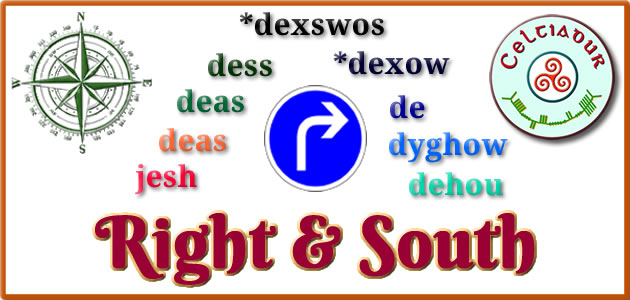
Right & South

Proto-Celtic *dexswos = right (side), south
Old Irish (Goídelc) dess = right (side), right-hand; south; right, just; convenient, agreeable
desse = right side, rightness
andess = (from the) south
Middle Irish (Gaoidhleag) dess = right, right hand (side), south, just, meet, well-arranged, neat, pretty, fine
desse = the right side, right hand, rightness, fairness
dessebar = the south, southern aspect
dessel = direction of the sun, right-hand course, sunwise
andess = from the right, from the south
Irish (Gaeilge) deas [dʲasˠ / dʲæsˠ] = south, southerly, to the south; right, right-hand
deasach = right-handed, suitable for use with right hand
deaslámh = right hand
deaslámhach = right-handed, dexterous, handy
deaslámhaí = handiness, dexterity
deasóg = right hand, right fist, right-handed punch
Scottish Gaelic (Gàidhlig) deas [dʲes] = south; southern; right (side); ready, finished; accomplished, expert, skilful; active, alert, quick, snappy; to hand, handy; clever, sharp; deft, dexterous
deasach [dʲesəx] = southerly, southern, southerner
deasag [dʲesag] = right hand
deasail [dʲesal] = clockwise
deasad [dʲesad]= neatness, readiness
deasalt [dʲesəl̪ˠd] = clockwise/sunwise turn
deasalachd [dʲesəl̪ˠəxg] = readiness, convenience, dexterity
Manx (Gaelg) jesh = rightwing, righthand, starboard, nice, smart, felicitous, elegant, ready, tidy, groomed, adept, neat, seemly, becoming, suitable, fancy, trim
jiass [d͡ʒas] = south, southern, southerly, southward
jeshag = righthander, right-handed blow
jeshagh = illumination, right-handed blow
jeshid = applicability, elegance, neatness, propriety, right-handedness, seemliness, smartness, suitability, tidiness
neearass = southwest
niar ass = southeast
niass = southerly
cheu-jiass = southward
Proto-Brythonic *dexow = right, southern
Middle Welsh (Kymraec) dehev, deheu, deau = right, south, southern, right (hand, side)
dehau ddwyrain = southeast
deau-’orllewyn, deheûorllewin = southwest
Dehaubarth = the medieval kingdom of South Wales
dehevbôl = south pole
deheuec = dexterous, skilful, adroit, right
dehevawl = south, southern, of the south, austral, facing southwards
Welsh (Cymraeg) deau = right, south, southern
de [deː] = south; dexterous, skilful, clever; ready; useful, handy; suitable, appropriate, proper, right, just; favourable, auspicious
de(au)-ddwyrain = southeast
de(au)-orllewin- = southwest
Dehaubarth = South Wales, the medieval kingdom of South Wales, southern part
Dehaubarth Cymru (Newydd) = (New) South Wales
deheubol = south pole
deheuder, deheudra = dexterity, adroitness, cleverness
deheueg = dexterous, skilful, adroit, right; South Welsh dialect
deheuol = south, southern, of the south, austral, facing southwards
Middle Cornish (Cernewec) dehou, dyhow, dyow = right, south
dehoules = southernwood
Cornish (Kernewek) dyghow [dɪ’hɔʊ / də’hɔʊ] = south, right-handed, southern, right
dyghow dhuryen = southeast
dyghow orlewin = southwest
dyghowbarth = south
Old Breton dehou, deou = right, south
Middle Breton (Brezonec) dehou, deho, dehaou = right, south
dehouyat, deouiad = right-handed
Breton (Brezhoneg) dehou [ˈde(h).u] = right, south
dehouiad = right-handed
dehoubarzh = southern zone
a-zehou = to the right

Etymology
From Proto-Indo-European *deḱswo-, from *deḱs- (right-hand side) [source].

Words from the same PIE root include dexterity, dextrose and (ambi)dextrous in English, diestro (right, right-handed, skillful, dextrous) in Spanish, and destro (clever, able, right, right-hand) in Italian [source].

Words marked with a * are reconstructions.
Blubrry podcast hosting

Sources: Wiktionary, Am Faclair Beag, Online Manx Dictionary, Teanglann.ie, eDIL – Electronic Dictionary of the Irish Language, In Dúil Bélrai English – Old Irish glossary, Geiriadur Prifysgol Cymru, Gerlyver Kernewek, Gerlyvyr Cernewec, Lexicon Cornu-britannicum: A Dictionary of the Ancient Celtic Language of Cornwall, Dictionaire Favereau, TermOfis, Le dictionnaire diachronique du breton, Geriafurch, English – ProtoCeltic WordList (PDF), Etymological Dictionary Of Proto Celtic

Small

Words for small, little and related words in Celtic languages.

Kittens

Words marked with a * are reconstructions.

Proto-Celtic *bikkos, *biggos, *bekkos, *beggos = small, little
Old Irish (Goídelc) bec(c) [ˈbʲeɡ] = small, little
becán = little
MIidle Irish (Gaoidhealg) bec, beg = small, little, a small amount
becaid = to make small, deplete
becaigid, begaigh = to lessen, diminish, reduce
becán, begán, beccan = a little, small quantity, a few, a small number, little one, child, humble, lowly one
becda = lowly, humble
Irish (Gaeilge) beag [bʲɔɡ / bʲɞɡ / bʲɛɡ] = little, small, small amount; few
beagadán = diminutive person, little one
beagaigh = to lesson, diminish
beagán = little, a few, a little, somewhat
beagchainteach = silent, taciturn
beagchéillí = senseless, foolish
Scottish Gaelic (Gàidhlig) beag [beg] = small, little, wee; minor; petty, puny, trifling; slight
beagadh [begəg] = to diminish, lessen, reduce
beagachadh [begəxəɣ] = diminishing, lessening, reducing
beagag [begag] = small thing, trifle
beagan [began] = a little, a few
beaganas [beganəs] = slight, snub
beagnachd [begnəxg] = parvity, smallness
Manx (Gaelg) beg = small, short, slight, few, poky, model, narrow, quiet, dwarf
beggan = somewhat, slightly, partly, faintly, a few, little, small piece
begganid = littleness, smallness, slightness
beggid = diminutive, diminutiveness, littleness, paltriness
Proto-Brythonic *bɨx = small
Middle Welsh (Kymraec) hach, bych, bâch, = small, little
baches, baçes = darling, little, little woman
bachken, bachcen = boy, lad, youngster, servant, son, child
bachcennes = young girl, maiden, damsel, lass, wench
Welsh (Cymraeg) bach [baːχ] = small, little, short; not fully grown or developed, young; insignificant, unimportant, humble; small (business); lower-case (letter); dear, beloved; poor
baches = darling, little, little woman
bachgen = boy, lad, youngster, servant, son, child
bachgennes = young girl, maiden, damsel, lass, wench
bachigol = diminutive, small, little
bychan [ˈbəχan] = little, small, minute, diminutive; inconspicuous, obscure, unimportant, petty; young inexperienced; little one, young child
bychanaf, bychanu = to abase, disparage, disregard, slight, minimize
bychander, bychandod = littleness, smallness, scarcity, contempt, pettiness
bychanig = very little/small, minute, diminutive, bit, piece
bychan bach very little
Middle Cornish (Cernewec) bechan, bian, bichan, bihan, bochan, byan, byhan = little, small
Cornish (Kernewek) byghan [‘bɪhan] = little, small
byghanhe = to reduce, make smaller
byghanna = smaller
Middle Breton (Brezonec) bihan, byhan = small
bihanaat, bihanhat, bihanat = to shrink, diminish
bihanaet, bihannaet = decrease
bihanded, bihandet, bihandætt = smallness
Breton (Brezhoneg) bihan = small, insufficient, modest, little
bihanaat = diminutive, pet name
bihanadur = miniature
bihanniver = minority

Etmology: possibly from the Proto-Indo-European *bʰég-ko-s, from *bʰeg- (to break) +‎ the suffix *-kos [source]. Words for small and little in Romance languages, such as petit in French, pequeno in Portuguese and pequeño in Spanish, possibly come from the same Proto-Celtic root, via the Latin word *pittus (small, little) [source].

Proto-Celtic *legus = small
Gaulish lau = small
Old Irish (Goídelc) lagu, lugu, laigiu = smaller
Middle Irish (Gaoidhealg) lagu = smaller
Irish (Gaeilge) laghad = smallness, fewness
laghadaigh = to lessen, decrease, diminish, reduce
laghadaitheach = lessening, decreasing
laghadú = decrease, diminuition, reduction
laghadúchán = (act of) diminution
níos lú = smaller
is lú = smallest, least
Scottish Gaelic (Gàidhlig) lugha = less, least, more or most disagreeable
nas lugha = smaller, less, shorter, minimum
as lugha = smallest, tiniest, shortest
laghad [̪l̪ˠɤɣəd] = smallness, littleness, minority
luighead = degree of smallness, littleness
laghdaich, lùghdaich = (to) decrease, diminsh, lessen, reduce, decline
Manx (Gaelg) loo = fewer, least, little(r), minimim
(ny) sloo = less, lesser, smaller, shorter
by loo = smallest, fewest, less
leodagh = decreasing, degrading, dreogatory
leodaghey = to decrease, minimize, reduce, diminish
Proto-Brythonic *llaɣw = small, bad
*llaɣü = smaller
Middle Welsh (Kymraec) llaw = small, little, low, mean, weak
llei, lley = smaller, less, fewer
leyhaf, lleyaf, lleiaf = least, smallest, lowest, fewest
leihaa, leihaei, lleihav, leihau = to become smaller or less
Welsh (Cymraeg) llaw = small, little, low, mean, weak
llai [ɬai̯] = smaller, less, fewer
lleia(f) = least, smallest, lowest, fewest
lleiafrif = minority
lleihad = a lessening, decrease, easing
lleihadog = belittling, diminutive, derogative
lleihau = to become smaller or less, to diminish, to shink, to decrease, to less, to shorten
Middle Cornish (Cernewec) le = less, smaller
leia = least, smallest
leyhy, lyha = to make smaller, diminish, lessen
Cornish (Kernewek) le = smaller, less, lesser, fewer, minor
lehe = to lessen, extenuate, mitigate, reduce, shrink, zoom out
leheans = reduction
Old Breton (Brethonoc) lau = less, fewer
Middle Breton (Brezonec) lau = less, fewer
Breton (Brezhoneg) lei = less, fewer
leiaat = to decrease, lower, attenuate

Etymology: from *h₁léngʰus (lightweight, easy, nimble), from *h₁lengʷʰ- (to move lightly or effortlessly; lightweight) [source]. Words from the same PIE roots include gelingen (to turn out well, go smoothly) in German, light and lever in English, licht (light, easy, mild) in Dutch, and léim (to jump, leap) in Irish [source].

The Fastest Way to Learn Japanese Guaranteed with JapanesePod101.com

Sources: Wiktionary, Etymological Dictionary Of Proto Celtic, In Dúil Bélrai English – Old Irish glossary, eDIL – Electronic Dictionary of the Irish Language, Teanglann.ie, Am Faclair Beag, An etymological dictionary of the Gaelic language, Fockleyreen: Manx – English Dictionary, Online Manx Dictionary, Gaelg Corpus, Geiriadur Prifysgol Cymru, Lexicon cornu-britannicum : a dictionary of the ancient Celtic language of Cornwall, Gerlyver Kernewek, Devri : Le dictionaire diachronique du breton, Geriafurch, TermOfis