Once in a Blue Moon

If something doesn’t happen very often, you might say that it happens once in a blue moon English. What about in other languages?

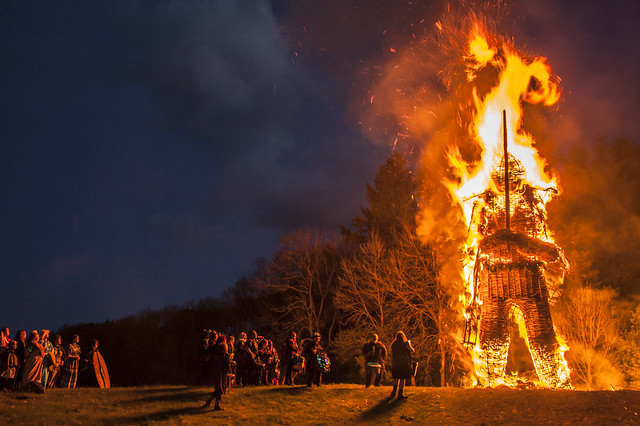
Blue Moon Daytime Moon

The phrase once in a blue moon first appeared in first around 1821 and refers to something that happens very rarely, very infrequently or almost never. An alternative version is apparently once in a purple moon [source].

A blue moon is a second full moon during a calendar month, which happens once every 32 months. A blue moon can also refer to a full moon that appears to be blue and bigger than usual [source].

In (Mandarin) Chinese, the equivalent is 千载难逢 [千載難逢] (qiān​zǎi​nán​féng), which means “an opportunity difficult to come by even in a thousand years”. This expression comes from folk tales, in which such rare opportunities might lead to success or life-changing events [source].

In Czech, the equivalent is jednou za uherský rok , which means ‘once in a Hungarian year’. Apparently this idiom dates from the Turkish wars, when Czech soldiers were hired in Hungary for a certain period of time, which was constantly extended [source]. The Slovak equivalent, raz za uhorský rok (“once a Hungarian year”), probably comes from the same roots.

In Polish, they say raz na ruski rok (“once in a Ruthenian year”), which refers to the fact that the Gregorian calendar used by East Slavs has longer months [source]. Alternatively, they say od wielkiego dzwonu (“from the big bell”), which refers to The Sigismund Bell, the largest of the five bells in the Sigismund Tower of Wawel Cathedral in Kraków, which is used only on special occasions [source].

In French, you might say tous les trente-six du mois (“every 36th of the month”) or une fois toutes les lunes (“once every moon”) [source].

In German, you could say alle Jubeljahre (“every jubilee year”), which refers to biblical jubliees that come round every 50 years [source].

In Russian, they say раз в сто лет (“once every hundred years”) [source].

In Spanish, they say cada muerte de obispo (“every death of a bishop”), or de Pascuas a Ramos (“from Easter (Day) til Palm Sunday”) – Palm Sunday comes before Easter Day [source].

In Welsh, one equivalent is unwaith yn y pedwar amser (“once in the four seasons”) and another is unwaith yn y pedwar gwynt (“once in the four winds”) [source].

Are there interesting similar idioms in other languages?

The Fastest Way to Learn Japanese Guaranteed with JapanesePod101.com


Burgling Burg(h)ers

Are the words (ham)burger, burgher and burglar related? Let’s find out.

Burghers of Calais

Burger [ˈbɜː(ɹ)ɡə(ɹ)] is a rebracketing of the word hamburger, which is:

  • A hot sandwich consisting of a patty of cooked ground beef or a meat substitute, in a sliced bun, usually also containing salad vegetables, condiments, or both.
  • The patty used in such a sandwich.

Hamburger is an abbreviation of Hamburger sandwich / steak, which comes from Hamburg steak, a patty of ground beef [source].

The idea of the Hamburg steak was brought to America by German immigrants in the 19th century, and is based on similar German dishes such as the Frikadelle, which have existed since the 17th century. It first appeared on menus in restaurants in New York in 1873. By the the 1930s, Hamburg steaks were being served as parts of sandwiches, and became known as (ham)burgers [source].

The name Hamburg comes from Old High German Hamme (bend, angle) and burg (castle, city), from Proto-West-Germanic *burg (fortification, (fortified) city), from Proto-Germanic *burgz (fortification, stronghold, (fortified) city), from Proto-Indo-European *bʰerǵʰ- (to rise up, to ascend, be elevated, to be up high) [source].

A burgher [ˈbɜː(ɹ)ɡə(ɹ)] is

  • A citizen of a borough or town, especially one belonging to the middle class.
    • A member of the medieval mercantile class.
    • A citizen of a medieval city.
  • A prosperous member of the community

It comes from Middle English burgher (a freeman of a borough, a burgess), likely merged with and reinforced by Middle Dutch burgher, from Middle High German burger, from Old High German burgāri (inhabitant of a fortress), from burg (fortress, citadel), from Proto-West-Germanic *burg (fortification, (fortified) city), etc. [source].

A burglar [ˈbɜːɡlə(ɹ) / ˈbɝɡlɚ] is

  • A person who breaks in to premises with the intent of committing theft.

It comes from Medieval Latin burglātor (a freeman of a borough, a burgess), from burgō (to commit burglary), from Latin Latin burgus (fortified town), probably from Frankish *burg (fortress), from Proto-Germanic *burgz (fortification, stronghold, (fortified) city), etc. It was possibly influence by the Latin word latro (thief) and/or the Old French word burgeor (burglar), which comes from Latin [source].

So, burger and burgher are related, and burglar is probably related to them.

Other words that share the same roots include: barrow, borough, burrow, comfort, force and fort in English, bourgeois in French, Burg (castle) in German, burcht (citadel, castle, borough, burrow) in Dutch, bwrw (to cast, throw, hit, precipiate) and brenin (king, monarch, sovereign) in Welsh, forte (fort(ress), strength, talent, strong, stressed) in Italian, fuerte (strong, loud, hard) in Spanish [source].

The Fastest Way to Learn Japanese Guaranteed with JapanesePod101.com


Sylvan Forests

When is a forest not a forest?

A view from the train

In modern English, the word forest [ˈfɒɹɪst / ˈfɔɹəst] means:

  • A dense uncultivated tract of trees and undergrowth, larger than woods.
  • Any dense collection or amount – e.g. a forest of criticism

Historically it referred to ‘defined area of land set aside in England as royal hunting ground or for other privileged use’, and didn’t necessarily contain trees.

It comes from Middle English forest (forest, wood, a preserve for hunting exclusive to royalty), from Old French forest (royal hunting ground, forest), from Early Medieval Latin forestis (a large area reserved for the use of the King or nobility, often a forest and often for hunting or fishing, forest), from Proto-West-Germanic *furhisti (forest), from *furhiþi (forest, woodland) and *hursti (thicket, wood, grove, nest) [source].

*furhiþi (forest) comes from *furhu (fir, pine), from Proto-Germanic *furhō (fir, pine, forest [of fir or pine trees]), from Proto-Indo-European *pérkus (oak), from *perkʷ- (oak) [source].

Words from the same roots include pērkons (thunder) in Latvian, perkūnas (sound of thunder, god of thunder) in Lithuanian, perth (bush, hedge) in Welsh, quercia (oak) in Italian, forêt (forest) in French, vorst (copse, grove, woodland) in Dutch, fjör (vitality, energy, fun, life) in Icelandic, and cork, fir and farm in English [source].

*hursti (thicket, wood, grove, nest) comes from Proto-Germanic *hurstiz, from Proto-Indo-European *kʷr̥s-ti-s, from *kʷres- [source].

Words from the same roots include hirst (a barren, unproductive piece of ground, usually a hillock, knoll or ridge) in Scots, horst (an elevated land overgrown with shrub) in Dutch, Horst (the nest of a bird of prey, eyrie, bush, thicket, small forest) in German, and hurst (wood, grove – found mainly in place names such as Sissinghurst) in English [source].

The Irish word crann (tree, mast), the Welsh word pren (timber, wood, tree), and related words in other Celtic languages also come from the same roots, via Proto-Celtic *kʷresnom (tree, wood) [source].

In Middle English, the word wode was used to refer to a living tree, a group of trees, a grove, a copse, a wood, a forest, wood, etc. As a verb, it meant to hunt, to take to the woods, or to hide oneself in the woods, and a wodeward was a forester or forest warden.

Wode comes from Old English wudu / ᚹᚢᛞᚢ (wood, forest, woods, tree), from Proto-Germanic *widuz (wood, tree, forest), from Proto-Indo-European *h₁widʰ-u-s [source].

Words from the same roots include wood in English, viður (trees or brambles, forest, wood, timber) in Icelandic, viita (a thicket of young deciduous trees) in Finnish, gwedhen (tree) in Cornish, gwezenn (tree) in Breton, and fiodh (wood, timber) in Scottish Gaelic [source].

Another forest-related word in English is sylvan, which means pertaining to the forest or woodlands, residing in a forest or wood, wooded, or covered in forest.

Related words include silviculture (forestry – the care and development of forests in order to obtain a product or provide a benefit), silvology (the scientific study of forests), and names such as Syliva, Transylvania (“across the forest”), Spotsylvania and Pennsylvania (“woodland of William Penn”).

It comes from Medieval Latin sylvanus, from Latin silvanus, from silva (forest), from Proto-Indo-European *s(w)el- (beam, board, frame, threshold) [source]. Words from the same roots include selva (forest, wood, mass, multitude) in Italian, selva (jungle, woods, forest) in Portuguese, and silva (bramble, blackberry bush) in Galician [source].

The Fastest Way to Learn Japanese Guaranteed with JapanesePod101.com


Gluten Glue

Did you know that the words glue and gluten are related to each other, and to the word clay?

Glue

Glue [ɡluː] is:

  • A hard gelatin made by boiling bones and hides, used in solution as an adhesive; or any sticky adhesive substance.
  • Anything that binds two things or people together.
  • A viscid secretion on the surface of certain plants.

It comes from Middle English glew [ɡliu̯] (glue, birdlime, tar, resin), from Old French glu (glue, birdlime), from Late Latin glūs, from Latin glūten (glue), from Proto-Italic *gloiten, from Proto-Indo-European *glóh₁ytn̥, from *gleyH- (to smear, to stick, glue, putty) [source].

Gluten [ˈɡluːtən / ˈɡluːtn̩] is:

  • The major protein in cereal grains, especially wheat; responsible for the elasticity in dough and the structure in baked bread.

It comes from Middle French gluten, from Latin glūten (glue), etc. [source].

Clay [kleɪ] is:

  • A mineral substance made up of small crystals of silica and alumina, that is ductile when moist; the material of pre-fired ceramics.

It comes from Middle English cley, from Old English clǣġ (clay), from Proto-West Germanic *klaij (clay), from Proto-Germanic *klajjaz (clay), from Proto-Indo-European *gloy-(y)ó-s, from *gleyH- (to smear, to stick, glue, putty) [source].

So they all come from the same PIE root. Other words from that root include glynu (to stick, adhere, settle) in Welsh, klína (to smear) in Icelandic, glina (clay, loam) in Polish, liiv (sand) in Estonian, klei (clay) in Dutch [source].

The Fastest Way to Learn Japanese Guaranteed with JapanesePod101.com


Shearing Scissors

Why does the word scissors have a silent c in it, and is it related to the word shears? Let’s find out.

scissors

Scissors [ˈsɪzəz / ˈsɪzɚz] are:

  • A tool used for cutting thin material, consisting of two crossing blades attached at a pivot point in such a way that the blades slide across each other when the handles are closed. [other meanings are available]

It comes from Middle English sisours (scissors, shears, [candle] snuffer), from Old French cusoirs (a cutting tool), from Late Latin cīsōria, from cīsōrium (a cutting tool), from Latin -cīsus or caesus (cut, hewn, felled, stuck, beaten), from *caedō (to cut, hew, fell, strike, beat), from Proto-Italic *kaidō (to cut, hew, fell), from Proto-Indo-European *kh₂eyd- (to cut, hew) [source].

The c was added to scissors during the 16th century due to the influence of the Medieval Latin word scissor (tailor, carver) and the Latin word scindō (to cut, tear, read, separate), which both come from Proto-Indo-European *skeyd- (to divide, split) [source].

Words from the same PIE root include cement, to excise, incision, precise and chisel in English, qeth (to cut) in Albanian, césped (lawn, grass, turf) in Spanish, précis (specific, explicit, sharp) in French [source].

In Old English, the word for scissors or shears was sċēar [ʃæ͜ɑːr], which comes from Proto-West Germanic *skāri, from Proto-Germanic *skēriz (cutting, cuttable), from *skeraną (to shear), from Proto-Indo-European *(s)ker- (to cut off, sever, separate, divide) [source].

Words from the same roots include shear(s), shred, share, scourge, sharp, scrotum, cortex and carnage in English, scheren (to shear) in German, skörd (harvest) in Swedish, ysgar (separation, split, divorce) in Welsh, cena (dinner) in Italian and Spanish, and harr (to weed, prune) in Albanian [source].

So, scissors and shears are not related.

Schist Outcrop

Another word with a silent / unnecessary c is schist [ʃɪst], which refers to any of a variety of coarse-grained crystalline metamorphic rocks with a foliated structure that allows easy division into slabs or slates.

It comes from French schiste [ʃist] (shale, schist), from Latin lapis schistos (“stone that is easy to split”), from Ancient Greek σχῐστός [skʰis.tós] (skhĭstós, cloven, divided, divisible), from σχῐ́ζω [skʰíz.dɔː] (skhĭ́zō, to split, cleave, divide), ultimately from Proto-Indo-European *skeyd- (to divide, split) [source].

Words from the same PIE root include schism (a split or separation within a group or organization, typically caused by discord) and schizophrenia in English, scindere (to split up, divide, cleave) in Italian, and scheef (crooked, weird) in Dutch [source].

The Fastest Way to Learn Japanese Guaranteed with JapanesePod101.com