Feverish

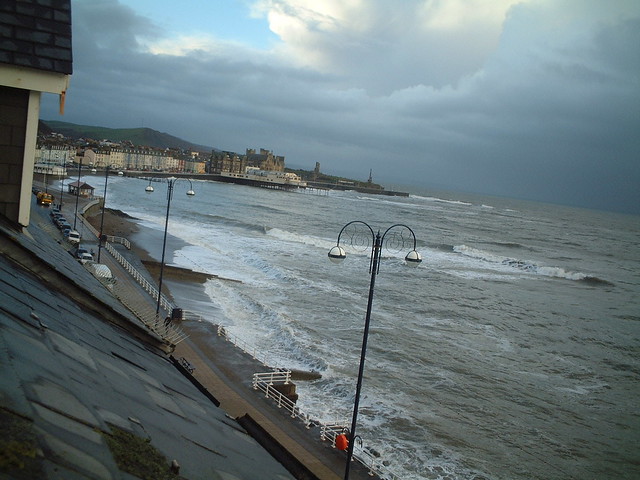
Last weekend I went to Aberystwyth to see a friend. I had a nice time, even though it was cloudy and rained a lot. This is one reason why I didn’t get round to making new episodes of the Celtic Pathways or Adventures in Etymology podcasts.

Aberystwyth

Unfortunately one souvenir I brought back was a dose of Covid. My friend wasn’t very well when I saw her, and later found out that she had the dreaded virus. I did a test today and found I have it too. It feels like a bad cold or maybe flu. I’ve been at times feverish, coughing, sneezing and lacking in energy and appetite. I hope I haven’t spread it to anyone else.

I hope you all are keeping well.

Kenning

If something is beyond your ken, it is beyond your knowledge or understanding. The word ken only really appears in this phrase, but in some dialects of English in northern England, and in Scots and Scottish English, ken is more commonly used.

Ken

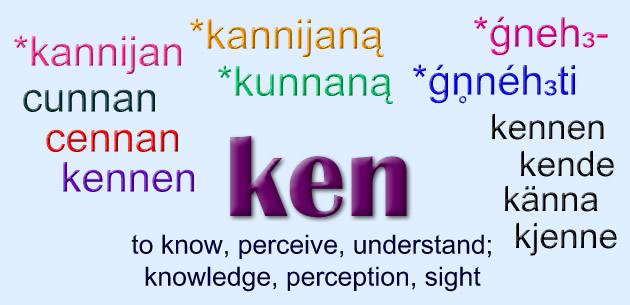
In English ken means to know, perceive, understand; knowledge, perception or sight. It comes from the Middle English kennen (to make known, tell, teach, proclaim, annouce, reveal), from the Old English cennan (to make known, declare, acknowledge), from cunnan (to become acquainted with, to know), from the Proto-West Germanic *kannijan (to know, to be aware of), from the Proto-Germanic *kannijaną (to make known), from *kunnaną (to be able), from the Proto-Indo-European *ǵn̥néh₃ti (to know, recognize) from *ǵneh₃- (to know) [source].

Some related words include:

  • beken = to make known, reveal, deliver, commit
  • foreken = to perceive, realise ahead of time, foreknow, preconceive
  • kenning = sight, view, a distant view at sea; range r extent of vision (esp. at sea), a small portion, as little as one can discrimminate or recognize
  • misken = to mistake one for another, fail to know, misunderstand, ignore, disregard, neglect
  • outken = to surpass or exceed in knowledge

These are no longer used, rarely used, or only used in some dialects of English.

Kenning also means “A metaphorical compound or phrase, used especially in Germanic poetry (Old English or Old Norse) whereby a simple thing is described in an allusive way.” It was borrowed from Old Norse [source].

Some examples of kenning in Old Norse and Old English include:

  • báru fákr (wave’s horse) = ship
  • gjálfr-marr (sea-steed) = ship
  • heofon-candel (sky-candle) = sun
  • grennir gunn-más (feeder of ravens) = warrior
  • winter-ġewǣde (winter-raiment) = snow
  • hilde-leoma (battle light) = sword
  • seġl-rād (sail-road) = sea
  • hwæl-weġ (whale-way) = sea
  • heofon-candel (sky-candle) = sun
  • ban-hus (bone-house) = body

Sources: https://en.wikipedia.org/wiki/Kenning, https://en.wikipedia.org/wiki/List_of_kennings, https://projects.iq.harvard.edu/cb45/kennings

There are cognates in other Germanic languages, including:

  • ken = to know (a person, a thing), be acquainted with in Afrikaans
  • kende = to know (be acquainted or familiar with) in Danish
  • kjenne = to know (be acquainted or familiar with), to feel or sense in Norwegian
  • känna = to feel or sense, or to know (a person) in Swedish
  • kennen = to know (a thing), be acquainted with in Dutch
  • kennen = to know, be acquainted with, be familiar with in German

In Scots ken means “To know, be aware of, apprehend, learn (a fact)”, and comes from the same roots as the English word [source]. Some related words include:

  • ken(n)ing = imparting, teaching, recognition, indentification, knowing
  • kenable = obvious, easily recognisable
  • kenmark = a distinguishing mark, mark of owenership on an animal, brand
  • kennage = knowledge, information
  • kenspeckle = easily recognisable, conspicuous, of familiar appearance

Tatami Swimming

If a Japanese person compared something to practising swimming on a tatmi mat, what would you think they meant?

畳

The idiomatic expression 畳の上の水練 (tatami no ue no suiren) means literally “swimming practise on tatami”, and refers to “useless book learning; knowing the theory but being unable to put it into practice”. It is also written 畳水練 (tatami suiren) .

Other tatami-related idioms include:

  • 畳の上で死ぬ (tatmi no ue de shinu) = to die a natural death, to die in one’s own bed​ (“to die on tatami”)
  • 畳み掛ける (tatmi o kakeru) = to press for an answer, to shower questions on someone​ (“to hang up tatami”)

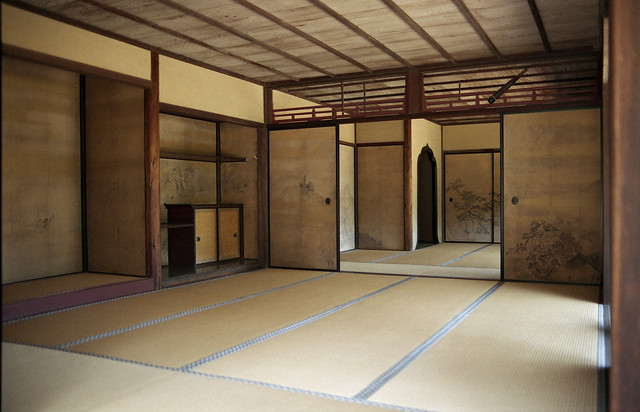
The character 畳 (tatami / jō) refers to the traditional Japanese straw floor coverings​, also known as tatami or tatami mats. The area of rooms in Japanese houses is measured by the number of tatami they contain or could contain. One tatami is 1.82 sqm or 1.54 sqm. An older version of the character is 疊. The same character means folding paper-case or kimono wrapping paper when pronounced tatō.

The verb 畳む (tatamu) means to fold (clothes, umbrellas, etc), to close (a shop or business) or to vacate. 畳み地図 (tatami chizu) is a folding map, 畳みじわ (tatamijiwa) is a crease, and 畳み椅子 (tatami isu) is a folding chair.

Source: jisho.org

League of the Lexicon

League of the Lexicon

I’ve been asked to let you know about a new language-based quiz game that is being launched today on Kickstarter. It’s called the League of the Lexicon and has two thousand questions related to words and language in five categories, such as etymology, trivia, definitions and usage. There are also two levels of difficulty so younger players can join in.

Linguists and lexicographers around the world have contributed questions to the game, including myself. My question involves mythical beings and Celtic languages.

If you back the game on Kickstarter, you can get hold of two sets of extra questions, or expansion packs – one on slang, cant and all things pertaining to the vulgar tongue, and the other on the world of language, from ancient to modern, Aramaic to Zulu.

Find out more at leagueofthelexicon.com and Kickstarter

Wurbling Wurblers

Wurble is a wonderful word that I learnt today. What do you think it means?

  1. to warble words in a waffly kind of way
  2. to wriggle like a worm
  3. to talk or sing with water in your mouth

Annelid
A wurble wurbling

Wurble [wʌrbl] is a Scots words that means:

1. To move forward in a twisting, sinuous manner like a worm, to wriggle, crawl; to walk with a knock-kneed gait.
2. To work hard, esp. on some finicky tedious job, to strive, struggle, contend with difficulties.
3. To join two threads by twisting and rubbing the ends together; to patch up a quarrel [source].

Wurble is also written warble or wirble. Related words are wurbler (worm), and wurdle, which means “to work hard with little prospect of success” [source]. As far as I know, the word game, Wordle has no connection to wurdle or wurble.

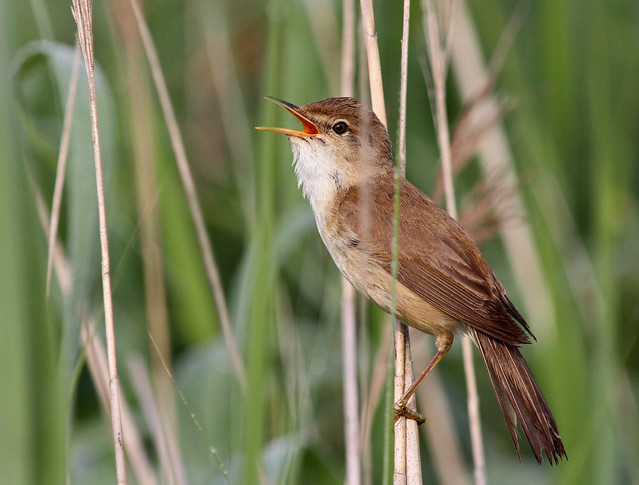
The English word warble [ˈwɔɹbl̩ / ˈwɔːbl̩] is not related to wurdle or wurble. It means to sing like a bird, to cause to quaver or vibrate, to modulate a tone’s frequency, to be modulated or to be uttered melodiously [source].

Reed Warbler, Acrocephalus scirpaceus

Warble comes from the Old North French werbler (to sing with trills and quavers, from the Frankish *werbilon, possibly from the Proto-Germanic *hwirbilaz (circle, ring, whirl) [source].

Dahu Hunting

If someone sent you to hunt for a dahu, would you go?
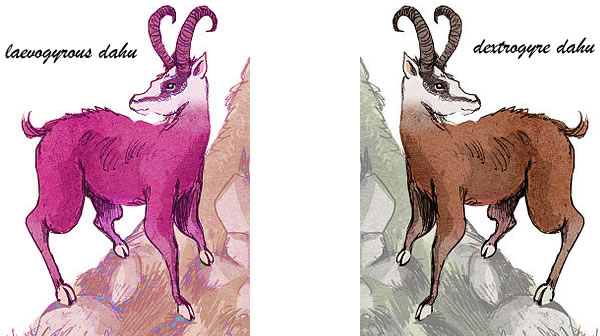
Dahu

In French the expression chasse au dahu (dahu hunt) is one equivalent of a wild goose chase, that is “a wild or absurd search for something nonexistent or unobtainable; any senseless pursuit of an object or end; a hopeless enterprise” [source].

The dahu [da.y], or dahut, is an imaginary creature that lives in mountainous areas of France and Switzerland. According to legend, the dahu looks a bit like a mountain goat or a chamois, and has legs shorter on one side than the other. This makes it easier for it to stay upright on step mountain sloops, but also means that it can only go around the mountain in one direction.

There are two varieties of dahu: the dahu lévogyre [da.y le.vo.ʒiʁ] or laevogyrous dahu, which has shorter legs on the left side, so goes around mountains in an anti-clockwise direction, and the dahu dextrogyre [da.y dɛks.tʁo.ʒiʁ] or dextrogyre dahu, which has shorter legs on the right side, and goes around mountains in the opposite direction. In some stories the dextrogyre dahu are the males and the laevogyrous dahu are the females.

If you want to catch a dahu there are apparently several methods. One involves two people, one with a big bag who waits at the bottom of a mountain, while the other sneaks up behind a dahu and makes a dahu-like sound. The dahu will turn around when it hears the sound, loose its balance and roll down the hill to be caught in the bag. Another method involves putting some pepper on a stone on the mountain. The when a dahu comes to see what’s on the stone, it sniffs the pepper, sneezes and knocks itself out on the stone. A dahu hunt is best undertaken at night and between November to February.

Dahu hunting became popular in mountainous parts of eastern France in the late 19th century, when tourists from urban areas with little knowledge of the countryside started visiting the mountains in large numbers. Local mountain guides would convince some of these guillable visitors to go hunting dahu, and tell them that to catch a rare and precious dahu, they would have to hide themselves on a mountain slope all night.

In Scotland the wild haggis (Haggis scoticus) is sometimes hunted, though rarely caught, and according to American folklore, the sidehill gouger is a beast somewhat like a dahu with legs shorter on one side than the other that lives in the hills of Wisconsin. Such creatures are also known as Sidehill Dodger, Sidehill Galoot, Wampus, Wampahoofus, Boofum, Hunkus, Rickaboo Racker, Prock, Gwinter or Cutter Cuss [source].

The expression wild goose chase first appeared in writing in 1593 in a book about horsemanship by Gervase Markham, an English poet. He describes a type of horse race in which riders try to follow a lead horse taking an erratic course, a bit like wild geese following their leader when flying.

Are there interesting equivalents of a dahu hunt or wild goose chase in other languages?

More information about the Dahu
https://mythus.fandom.com/wiki/Dahu
https://en.wiktionary.org/wiki/dahu
https://en.wikipedia.org/wiki/Dahu
https://fr.wiktionary.org/wiki/dahu
https://fr.wikipedia.org/wiki/Dahu
Distreetly Discrete

The words discrete and discreet are both pronounced in the same way – [dɪsˈkɹiːt] – but have different meanings, or in other words, are homophones. Until yesterday, I didn’t realise that they were discrete words.

Discretely Discreet

discrete means

1. apart or detached from others; separate; distinct
2. consisting of or characterized by distinct or individual parts; discontinuous. [source]

It also has specific meanings in mathematics that I won’t go into here.

discreet means

1. judicious in one’s conduct or speech, especially with regard to respecting privacy or maintaining silence about something of a delicate nature; prudent; circumspect.
2. showing prudence and circumspection; decorous
3. modestly unobtrusive; unostentatious [source]

discrete comes from the Old French discret (different), from the Latin discrētus (separate, differentiated), from discernō (I separate, set apart, divide, part), from dis- (asunder, in pieces, apart, in two) and cernō (I distinguish, divide, separate), from the Proto-Italic *krinō, from the Proto-Indo-European *krey- (to sieve) [source].

discreet comes from the same source, via the Middle English word discrete, which meant wise, morally discerning, prudent, polite, and also separate or distinct [source]. The two words separated during the Middle English period and acquired discrete meanings [source].

The word discern (to detect with the senses, perceive, distinguish) comes from the same roots [source].

Indiscrete and indiscreet are also discrete words. The former means not divided into discrete parts, while the latter means lacking prudence, revealing secrets, or tactless [source].

They both come from the Latin indiscretus (unseparated, undivided, indistinguisable), from in- (un-, non-, not) and discrētus (see above) [source].

So let’s not be indiscreet about discreetly keeping these words discrete.

Pseudonyms

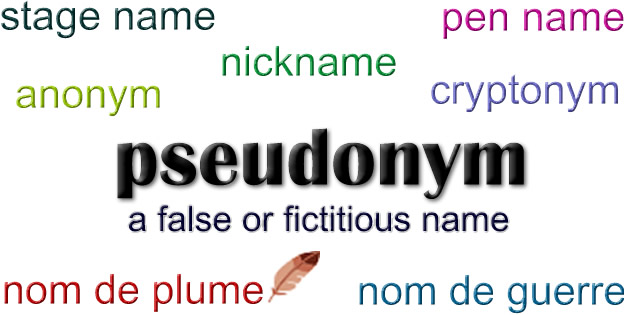
A pseudonym [ˈs(j)uː.də(ʊ).nɪm / ˈsu.də.nɪm] is a false or fictitious name, especially one used by an author. It comes from the Ancient Greek words ψευδής [pseu̯.dɛ̌ːs] (false, lying, untrue) and ὄνυμα [ó.ny.ma] (name) [source].

Pseudonym

Hyponyms* include:

  • stage name (used by actors)
  • pen name, pen-name, nom de plume (used by writers)
  • nom de guerre (used by military types)
  • allonym = another person’s actual name adopted as a pseudonym

* a term that denotes a subcategory of a more general class [source].

Related words include:

  • ananym = a pseudonym derived by spelling one’s name backwards
  • anonym = an anonymous person, or an assumed or false name
  • cryptonym = a secret name, or code name

An antonym of pseudonym is alethonym, which is the true name of an individual. From the Ancient Greek ἀλήθεια [aˈli.θi.a] (truth) and ὄνυμα [source].

I was inspired to write about pseudonyms today after seeing this joke on Facebook:

I used to go out with a girl called Sue Denim, until I found out that it wasn’t her real name.

It took me a while to get the joke, as I actually know someone called Sue Denim, a singer-songwriter who was part of the band Robots in Disguise. I always thought it was her real name, but now I realise that it’s actually an onomatopoeic pseudonym.

Do you have a pseudonym / nom de plume / stage name? If not, what pseudonym might you use?

I suppose the usernames I use online are kind of pseudonyms: Omniglot, Omniglossia and Ieithgi. Some variations of my name that I use, or friends use, include Sai, Simi and Saimundo.

Mountain Wind

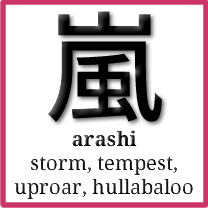
嵐 (arashi) - storm, tempest, uproar or hullabaloo

An interesting Japanese word I learnt recently is 嵐 (arashi), which means storm, tempest, uproar or hullabaloo [source].

It is made up of the kanji 山 (yama), which means mountain, hill, and various other things, and 風 (kaze), which means wind, breeze, manner, and various other things. So if when I first saw the kanji 嵐, I guessed that it was referred to some kind of wind from the mountains, or a wind that lives among the mountains.

嵐 appears in the following phrases:

  • 大嵐 (ō arashi) = raging storm
  • 砂塵嵐 (sajin arashi) = dust storm, sand storm
  • 嵐の前の静けさ (arashi no mae no shizukesa) = calm before the storm
  • 荒潮 (arashi o) = violent tide, fierce tidal current
  • 嵐を呼ぶ (arashi o yobu) = to cause a commotion, to create a big stir, to invoke a storm

Other stormy words in Japanese include:

  • 暴風 (bōfū) = storm, windstorm or gale, or literally “outburst (of) wind”.
  • 暴風雨 (bōfū’u), = rainstorm or storm, or literally “outburst (of) wind (and) rain”.
  • 吹雪 (fubuki) = snow torm or blizzard, or literally “blow snow”.
  • 颶 (gu) = storm – normally appears in the word 颶風 (gufū) = tornado, hurricane, typhoon
  • 猋 (hyū) = wind, storm, gale, dog moving (made up of three dog kanji – 犬 (inu))

暴風 and 暴風雨 can also be pronounced arashi [source].

The character 岚 [嵐] also exists in Chinese and is pronounced lán in Mandarin. It means mountain mist or haze, and is used mainly in place names, such as 岚山区 (Lanshan District), a part of Rizhao City (日照市) in Shandong Province in the northeast of China, and 岚皋县 (Langao County) in Shaanxi Province in central China.

There is also a district of Kyoto in Japan called 嵐山 (Arashiyama), and a nearby mountain with the same name. That area is famous for its bamboo forests.

Arashiyama Bamboo Grove

A good spot for a bit of 森林浴 (senrinyoku), that is forest bathing / therapy, or in other words, a peaceful walk through the woods for health benefits. This word was apparently coined in 1982 by Tomohide Akiyama (秋山智英), the head of the Japanese Ministry of Agriculture, Forestry and Fisheries, to encourage more visitors to forests​. Although it was a new word, the idea that spending time among trees in a forest is good for your health has been around for a long time in Japan [source]

While writing this, I realised that Omniglot doesn’t have a page about weather-related words in Japanese yet – I will put one together soon. If you know any interesting weather-related words and/or idioms in Japanese, do let me know.

Antidry

Recently I came across the French word antisèche [ɑ̃.ti.sɛʃ]. At first glance I would guess that it meant something like “anti-dry”, so maybe it’s a moisturiser or something similar that prevents dryness.

While that would be an accurate literal translation – it comes from anti- and sécher (to dry) – what it actually means is a cheat sheet or crib sheet. That is, a sheet of paper used to assist on a test [source].

antiseche

As well as meaning to dry, sécher also means to skip or miss (class), to dry out, to wither, to dry up or to be stumped. So an antisèche is something that prevents you from being stumped or drying up when asked difficult questions [source].

I have a number of antisèches, or maybe they’re more feuilles de référence, that summerise grammatical information for Irish and Russian. They’re very handy when I’m trying to write anything in these languages. You can find a variety of these for languages and other subjects on Amazon.

Are there interesting names for such things in other languages?