Jealous Envy

What is the difference between envy and jealousy?

A friend asked me this, so I thought I’d write a post about it.

Jealous!

Envy means:

  • a feeling of discontent or covetousness with regard to another’s advantages, success, possessions, etc
  • to regard (a person or thing) with envy [source]

In the past it meant:

  • hatred, enmity, ill-feeling
  • emulation; rivalry
  • public odium; ill repute.
  • to have envious feelings
  • to give (something) to (someone) grudgingly or reluctantly, to begrudge
  • to show malice or ill will, to rail
  • to do harm in, to injure, to disparage
  • to hate
  • to emulate

It comes from the Middle English envie (ill-will, hatred, enmity, spite, malice, envy, harm, eagerness), from the Old French envie, from the Latin invidia (envy, grudge, jealousy, prejudice, spite, odium), from invidus (envious, hostile, inimical), from invideō (I look askance or maliciously at, cast an evil eye upon), from in- (on, upon, after) and videō (see, observe, understand) [source].

Jealousy means:

  • jealous resentment against a rival, a person enjoying success or advantage, etc., or against another’s success or advantage itself
  • mental uneasiness from suspicion or fear of rivalry, unfaithfulness, etc., as in love or aims
  • vigilance in maintaining or guarding something.
  • a jealous feeling, disposition, state, or mood [source]

In the past it meant “A close concern for someone or something, solicitude, vigilance.” [source]

It comes from the Middle English jalousie (jealousness in a relationship, passion, desire, zealousness, devotion, belief), from the Old French jalousie, from jalous (eager, zealous, jealous), from the Late Latin zēlōsus (jealous, zealous), from the Latin zēlus (zeal, emulation, jealousy), from the Ancient Greek ζῆλος (zêlos – eager rivalry, zealous imitation, emulation, a noble passion) [source].

Other words from the same Ancient Greek root include zeal (diligent enthusiasm; powerful interest) and zealous (full of zeal; ardent, fervent; exhibiting enthusiasm or strong passion) [source].


Different Worlds

There’s a genre of Japanese stories known as 異世界 (isekai), which means “different world” or “otherworld”. They usually involve a person or people being transported from our world to a fantasy or virtual world, or to a parallel universe. Such stories appear in the form of novels, films, manga, anime and video games.

Hirael Bay in Bangor from a different perspective

There are two main types: one in which the main character is transported to another world by magic, divine intervention or other means, and another in which the character dies in our world and is reincarnated in another world. The former are known as 異世界転移 (isekai teni), or “transition into another world”, and the latter as 異世界転生 (isekai tensei), or “reincarnation into another world” [source].

Such stories, or similar ones, are also found in other languages, including English, and have been around for a long time. Recently I’ve been reading some of them, mainly in the form of web serials. In the descriptions of such serials, the term isekai often pops up, which is why I thought I’d look into it in this post.

As a linguist, one aspect of such stories that interests me is how the characters manage to communicate with people in the new world they find themselves in. Some writers just have everybody speaking English, or whatever language the main character speaks natively. In some case there are magical, technological or other ways that help the characters communicate, or the main character acquires a skill that helps them to learn the local language(s). Or, the main character finds someone to act as interpreter.

In The Wandering Inn, for example, the main character is magically transported to a different world where everybody speaks English, except the goblins and a few others. So she has no trouble communicating with most people. Some characters have their own writing systems though, which she can’t read.

In Cinnamon Bun the main character finds herself in a different world where people and other creatures speak all sorts of languages, and she is magically able to understand them all and to speak their languages. She can even communicate through dance with the giant bee characters.

In Quill & Still the main character is transported to another world where everybody speaks different languages. The magical system gives her the ability to speak some of them, but she still has to learn about the local culture.

In Beneath the Dragoneye Moons the main character is reincarnated in a different world, so grows up speaking the local language. When she finds herself many thousands of year in the future after spending time in the land of the fae, all the languages have changed and she has to learn new ones. She gains skills to help with this, and meets a character who can act as an interpreter as she speaks all languages, thanks to a skill granted to her by the gods.

Do you know of any other stories, in English or other languages, which are linguistically interesting and worth a read?

If you’re familiar with Japanese isekai, how do characters cope with different languages, or does everybody in the other worlds speak Japanese?

In real life we are unlikely to be transported into a completely different world. However, we can find ourselves in different linguistic and cultural environments by travelling to other countries, or by visiting other parts of our own countries. We have no magic to help us learn languages, but we do have books, courses, teachers, classes and technology.

The Fastest Way to Learn Japanese Guaranteed with JapanesePod101.com

Sake

Words for fish and other seafood seem to pop up quite often in the Japanese lessons on Duolingo. One such word is (sake), which means salmon, specifically chum salmon (Oncorhynchus keta), a species of salmon that lives in the North Pacific and the Beringian Arctic. It is also known as the dog salmon, Siberian salmon, keta salmon, or silverbrite salmon in North America [source].

chum salmon leaping

The word (sake), which is also written , サケ or さけ, comes from the Ainu word サㇰイベ (sak ibe – salmon), which literally means “summer eat”, as salmon as usually caught and eaten in the summer [source].

The chum of chum salmon comes from the Chinook Jargon word tzum (spotted, marked). The keta of keta salmon / Oncorhynchus keta comes from the Russian word кета (keta – chum/Siberian salmon), from the Nanai word кета (keta – fish) [source].

[sáꜜkè] should not be confused with [sàké] (alcohol, sake). In the former the first syllable has a high pitch and the second a low pitch, while in the latter, the first syllable has low pitch and the second a high pitch [source].

Other Japanese words borrowed from Ainu include [source]:

  • コタン / 古潭 (kotan) = village
  • トナカイ / 馴鹿 (tonakai) = reindeer
  • ラッコ / 海獺 (rakko) = sea otter
  • ルイベ (ruibe) = salmon, saffron cod, etc. cut into thin slices while frozen

The Fastest Way to Learn Japanese Guaranteed with JapanesePod101.com

Fangled

Things can be newfangled, but can they be oldfangled or just fangled?

fangled

Newfangled is used, often in derogatory, disapproving or humourous way, to refer to something that is new and often needlessly novel or gratuitously different. It may also refer to something that is recently devised or fashionable, especially when it’s not an improvement on existing things. It can also mean fond of novelty [source].

The word newfangle also exisits, although it’s obsolete. As a verb it means ‘to change by introducting novelties’, and as an adjective to means ‘eager for novelties’ or ‘desirous of changing’ [source]. It comes from the Middle English word neue-fangel, which meant fond of novelty, enamored of new love, inconstant, fickle, recent or fresh [source].

Things that are old-fashioned, antiquated, obsolete or unfashionable can be said to be oldfangled [source]. Things can also be fangled, that is, new-made, gaudy, showy or vainly decorated. Something that is fangled could be said to have fangleness [source].

The word fangle also exists, although it is no longer used, except possibly in some English dialects. It is a backformation from newfangled. As a verb it means to fashion, manufacture, invent, create, trim showily, entangle, hang about, waste time or to trifle. As a noun it means a prop, a new thing, something newly fashioned, a novelty, a new fancy, a foolish innovation, a gewgew, a trifling ornament, a conceit or a whim.

Fangle comes from the Middle English fangelen, from fangel (inclined to take), from the Old English *fangol/*fangel (inclinded to take), from fōn (to catch, caputure, seize, take (over), conquer) from the Proto-West Germanic *fą̄han (to take, seize), from the Proto-Germanic *fanhaną (to take, seize, capture, catch) [source].

Words from the same roots include fang (a long, pointed canine tooth used for biting and tearing flesh) in English, vangen (to catch) in Dutch, fangen (to catch, capture) in German, and (to get, receive, be allowed to) in Swedish [source].

Wanderwörter

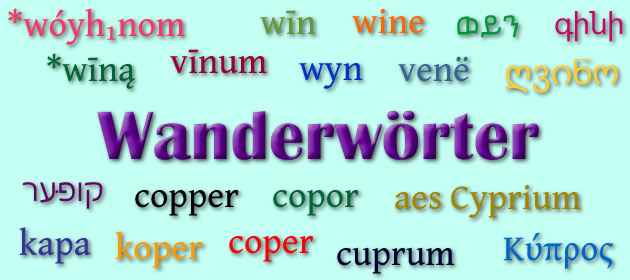
A Wanderwort is term used in linguistics to refer to a word that has spread to many different languages, often via trade. It was borrowed from German and comes from wandern (to wander) and Wort (word), so it’s a “wandering word”. The plural is Wanderwörter, Wanderworte or Wanderworts [source]. The origins of some such words goes back to ancient trade routes from the Bronze Age, and it can be difficult to trace which language they ultimately came from. Examples include copper, silver, mint and wine [source].

Wanderwörter

Another example of a Wanderwort is:

tea, which comes from the Dutch thee (tea), from (tê – tea) in the Amoy dialect of Southern Min (Min Nan), from the Old Chinese *l’aː (bitter plant), from the Proto-Sino-Tibetan *s-la (leaf, tea) [source].

There are similar words for tea in many other languages, including ᑎᕀ (tiy) in Cree, tae in Irish, in Maori and టీ (ṭī) in Telugu. These words arrived in Europe and elsewhere thanks to the Dutch East India Company, who brought tea by sea from Amoy [source].

The word chai which in English is short for masala chai, refers to a beverage made with black teas, steamed milk and sweet spices, based loosely on Indian recipes. It comes from from the Hindi-Urdu चाय / چائے‎ (cāy – tea), from the Persian چای‎ (čây – tea), from the Chinese (chá – tea) [source].

Languages that got their tea overland generally have a word for tea like chai or cha, including цай / ᠴᠠᠢ (tsay – tea) in Mongolian, चाय (cāy – tea) in Hindi, чай (čaj – tea) in Russian, ชา (chaa – tea) in Thai, and ca (tea) in Malay [source].

Sleep like a …

If you have slept well, you might say that you have slept like a baby, like a log, like a rock, like a top or like a lamb. Apparently in Chaucer’s time you might have said that you had slept like a swine, or whatever that was in Middle English [source].

Curled up sleeping cat

If you search for “sleeping” on Flickr, as I just did, you mainly get photos of sleeping cats and sleeping babys, so maybe you could also say that you slept like a cat. The cat in the photo above is my sister’s cat Fletcher, by the way.

In Welsh you might sleep like a hog / wild boar (cysgu fel twrch), or like a hedge (fel clawdd), like a sow (fel hwch), like a pig (fel mochyn), like a small rope/cord (fel cordyn), like a nail (fel hoelen), like a stone (fel carreg) or like a mole (fel gwadd) [source].

In Scottish Gaelic you could say bha cadal nam maigheach orm (I slept like a hare), and cadal nam maigheach ort!, or literally “sleep of the hare on you”, is how you say “sweet dreams, sleep tight!” or something similar [source].

In French you might sleep like a dormouse (dormir comme un loir), like a marmot (comme une marmotte), like a stump (comme une soche), like a baby (comme un bébé) or with closed fists (à poings fermés) [source].

What about in other languages?

Apologetic Thanks

The word 謝る (ayamaru – to apologise) has been popping up in my Japanese lessons on Duolingo recently, and I thought it would be interesting to look into the ways the character 謝 is used in Chinese and Japanese.

In Mandarin Chinese the usual way to say thank you is 谢谢 [謝謝] (xièxiè). If you want to say many thanks or thanks a lot you might say 多谢 [多謝] (duōxiè) or 感谢 [感謝] (gănxiè), or even 太感谢了 (tài gănxiè le). Other ways to express your thanks are available.

Apologetic Thanks

The character 谢 (xiè), in combination with other characters, can mean various other things:

  • 谢绝 (xièjué) = to decline
  • 谢客 (xièkè) = to decline to receive visitors
  • 谢幕 (xièmù) = to take a curtain call*
  • 谢罪 (xièzuì) = to offer an apology
  • 谢恩祈祷 (xiè’ēn qídǎo) = to say grace
  • 谢世 (xièshì) = to pass away, go to a better world, die

*the appearance of the performers at the conclusion of a theatrical or other performance in response to the applause of the audience [source].

The same character in Japanese means to apologise, and various other things. Here are some examples of how it’s used.

  • 謝る (ayamaru) = to apologise
  • 謝り (ayamari) = excuse, apology
  • 謝す / 謝する (shasu / shasuru) = to thank, apologise, say farewell, retreat, retire, refuse, pay back, settle old scores
  • 謝罪 (shazai) = apology
  • 謝礼 (sharei) = reward, remuneration
  • 謝意 (shai) = gratitude, thanks
  • 謝恩 (sha’on) = (expression of) gratitude
  • 謝恩会 (sha’onkai) = thank you party

In Cantonese there are several ways to say thank you, including:

  • 多謝 (do¹ ze⁶) = many thanks, thanks a lot (for something given)
  • 唔該 (m⁴ goi¹) = please, thanks (for services rendered), excuse me
  • 謝候 (ze⁶ hau⁶) = to thank sb for a favour or hospitality

Sources; LINE Dict Chinese-English, jisho, CC-Canto

Six Ways to Sunday

Six ways to Sunday is apparently an American expression that means ‘in every possible way, with every alternative examined’ or ‘in every possible direction’.

The first meaning can be found in “we checked him out six ways to Sunday before offering him that big loan.” while the second meaning is in “my necklace broke and the beads went six ways to Sunday”.

There are many variants on this phrase involving different numbers of ways ranging from two to a thousand. Some versions use different, both or many instead of numbers, and some replace to with from or for.

6 ways to Sunday

According to The Phrase Finder, the earliest known version of the phrase appeared in the American Turf Register and Sporting Magazine in July 1832:

“[The horse] Nullifier, led to the post by a small dry looking man, with a hat that stands nine ways for Sunday, and whose antagonists quake at the sight of that old slouched beaver, as do the Bourbons still at the cocked hat of Napoleon.”

Another example from the same year, which appears in the novel Westward Ho! by James Kirke Paulding goes:

“Look!; they were stitched with a compass that pointed nine ways from Sunday

The ‘six ways to Sunday’ version first appeared in The Chicago Tribune in November 1925.

World Wide Words quotes an earlier sighting of the phrase in Captain Francis Grose’s Dictionary of the Vulgar Tongue from 1785:

“SQUINT-A-PIPES. A squinting man or woman; said to be born in the middle of the week, and looking both ways for Sunday; or born in a hackney coach, and looking out of both windows; fit for a cook, one eye in the pot, and the other up the chimney; looking nine ways at once.”

According to The Free Dictionary, this phrase means ‘Thoroughly or completely; in every possible way; from every conceivable angle.’ and variants include six ways to Sunday, six ways from Sunday, eight ways to Sunday, eight ways from Sunday, forty ways to Sunday and forty ways from Sunday.

Other variants of the phrase on Wiktionary include every way to Sunday, six ways till Sunday, six ways for Sunday, six ways before Sunday, ten ways from Sunday and nine ways to Sunday.

Have you heard this phrase before? Do you use it? Do you know any similar phrases in English or other languages?

Before the Deluge

The word antediluvian means:

  • Ancient or antiquated
  • Extremely dated
  • Pertaining or belonging to the time period prior to a great or destructive flood or deluge.
  • (biblical) Pertaining or belonging to the time prior to Noah’s Flood.

It comes from the Latin ante- (before) and dīluvium (flood), which comes from dīluō (I wash away) and -ium (a suffix used to form abstract nouns), from dis- (apart, reversal) and‎ lavō (I wash) [source].

Afon Dyfrdwy / River Dee

The English word deluge (a great flood or rain), comes from the same Latin roots, via the Old French deluge (a large flood), as does the word diluvium (an inundation of flood, deluge; a deposit of sand, gravel, etc made by oceanic flooding) [source].

Other words from the same Latin roots include déluge (The Flood, deluge) in French, diluvio (deluge, downpour) in Spanish, díle (flood, deluge, torrent) in Irish, and dilyw (flood, deluge, destruction, ruin) in Welsh [source].

In Scottish Gaelic dìle [dʲiːlə] can refer to a deluge or flood. The phrase an dìle bhàite means heavy downpour or pouring rain, and the equivalent of it’s raining cats and dogs is tha an dìle ‘s an deàrrsach ann or tha an dìle bhàite ann an ceartair. As an adjective it means endless, for example gu dìlinn means “until the end of time” [source].

Another word for flood is inundation, which comes from the Old from inundacion (flood), from the Latin inundātiō (inuncation, overflowing, flood, crowd of people), from inundō (I overflow, inundate, flood) from in- (in, within, inside) and undō (I surge, flow), from unda (wave, billow) [source].

Undulate and undulation come from the same root, as does und, an obsolete word meaning wave, or in heraldry, a billow- or wave-like marking [source].

The word flood comes from the Middle English flod (river, lake, ocean, flood, rising tide), from the Old English flōd (flowing of the tide, river, stream, water, flood, deluge), from the Proto-Germanic *flōduz (river, flood), from the PIE *pléh₃tus (overflow, deluge), from *pleh₃(w)- (to flow, run) [source].

Cognates in other languages include flod (river, flood, high tide) in Danish, Norwegian and Swedish, Flut (flow, flood, hight tide) in German, and vloed (flood, current) in Dutch [source].

Essuie-tout

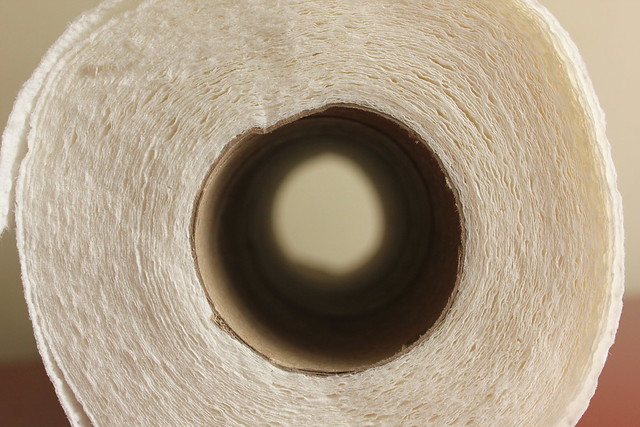
Essuie-tout [e.sɥi.tu] is what you might call paper towels in French. It literally means “wipe-all”, and comes from essuyer (to wipe, wipe down, soak up) and tout (whole, entirely, total, all) [source].

kitchen roll

Essuyer comes from the Old French essuier (to wipe), from the Latin exsūcāre from exsūcō (I juice, I dry), from ex- (out, away) and sūcus (juice, moisture) [source].

Such towels are also known as sopalin [sɔ.pa.lɛ̃] in French, which is a genericized trademark that was first registered in 1948 by the Société du papier linge (Linen Paper Company) and comes from the first syllables of the company name [source].

In English they are also known as kitchen towels, kitchen roll or kitchen paper. There may be other names for them as well. What do you call them?

Essuie also appears in essuie-glace (windscreen wiper), and essuie-mains (hand towel). Related words include; essuyer (to wipe, rub away, swab, suffer, experience), s’essuyer (to dry o.s.), ressuyer (to dry, dry out) [source].

You can essuyer une défaite (suffer a defeat), essuyer une rebuffade (suffer a rebuff), essuyer le feu (come under a fire), essuyer un refus (get a refusal), essuyer un revers (suffer a setback) or even essuyer la vaisselle (dry the dishes) [source].