World Endangered Writing Day

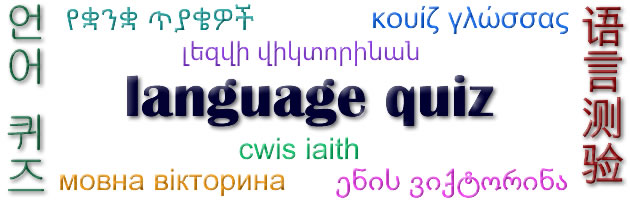
Today is World Endangered Writing Day, a day to celebrate the world’s minority and indigenous scripts and communities.
Logo of the World Endangered Writing Day

This is an initiative started this year by Tim Brookes, the founder of the Endangered Alphabets Project, who explains:

World Endangered Writing Day was born when I read that in traditional Balinese culture, one day a year was dedicated to respecting and venerating writing.

On the day dedicated to the goddess Saraswati, nothing written may be destroyed, or even a letter crossed out. All the lontar manuscripts—oblong pages of lontar palm leaf, written on with a stylus and then bound between wooden slats—in a household are gathered and act as the representation of the goddess, to whom eighteen offerings are made, one for each of the letters of the Balinese alphabet. Each offering contains the symbol of the supreme god, made of fried rice dough.

This shows a deep understanding of the value and importance of writing, beyond being a mere means of conveying information as quickly and clearly as possible.

World Endangered Writing Day, then, is a celebration of writing in all its varied and astonishing manifestations, especially those that see and use writing in far richer ways than we do.

[source]

Throughout the day there are online talks about writing, script extinction and revival, type design, and related topics. You can watch and listen to all the talks on the YouTube Channel: WEWD 2024.

More information about World Endangered Writing Day and about Tim Brookes’ Endangered Alphabets project:
https://www.endangeredwriting.world/
http://endangeredalphabets.com/
https://www.endangeredalphabets.net/

This is what the Balinese alphabet looks like, by the way:
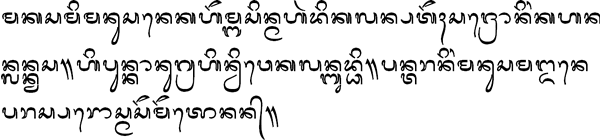
ᬫᬓᬲᬫᬶᬫᬦᬸᬲᬦᬾᬓᬳᭂᬫ᭄ᬩᬲᬶᬦ᭄ᬫᬳᬃᬤᬶᬓᬮᬦ᭄ᬧᬢᬾ᭪᭟ᬲᬚᬦᬶᬂᬓᬳᬦᬦ᭄ᬮᬦ᭄ᬓᬸᬲ᭟ᬳᬶᬧᬸᬦ᭄ᬓᬦᬸᬕ᭄ᬭᬳᬶᬦᬶᬯᬾᬓᬮᬦ᭄ᬩᬸᬤ᭄ᬥᬶ᭟ᬧᬦ᭄ᬢᬭᬦᬶᬂᬫᬦᬸᬲᬫᬂᬤᬦᬾᬧᬭᬲ᭄ᬧᬭᭀᬲ᭄ᬫᬲᬫᬾᬢᭀᬦᬦ᭄

If you want to know more about the world’s writing systems, there’s a little website you might find interesting: Omniglot – the online encyclopedia of writing systems and languages.

Lady Gunilda

When is a gun not a gun?

Ballista

The word gun nowadays refers to “A device for projecting a hard object very forcefully; a firearm or cannon, etc”. However, originally it wasn’t just used for firearms. The word possibly comes from the name of a ballista, a type of giant crossbow (see above), that was used at Windsor Castle in England in the 14th century – Domina Gunilda (Lady Gunilda).

An inventory of the munitions of Windsor Castle conducted in 1330-31 included the entry:

Una magna balista de cornu quæ vocatur Domina Gunilda.
(A great ballista of horn which is called Lady Gunilda.)

Not long after that, the word gonne starts to appear. It was also written gon, gonn, goone or gun, and referred to:

  1. A trebuchet or similar kind of pellet-firing siege engine.
  2. A cannon or other large firearm; a piece of artillery.
  3. A portable handheld firearm; a gun (i.e. a hand cannon).
  4. A projectile (rare).

Later, it began to be used specifically for firearms.

The name Gunilda comes from the Old Norse name Gunnhildr, from gunnr (war) and‎ hildr (battle). It’s a female name that’s poetically translated as “battle maid”. Other versions include Gunhilda, Gun(n)hild, Gunill(a), Gunnel, Hildur, Hilda and Hildegard.

Here’s a little song from Hildegard von Blingin’, because why not?

Other names from the same roots include Brunhild(a), Imelda and Matilda.

Sources: https://en.wiktionary.org/wiki/gun#English
https://en.wiktionary.org/wiki/gunne#Middle_English
https://www.wordorigins.org/big-list-entries/gun
https://en.wiktionary.org/wiki/Reconstruction:Proto-Germanic/hildiz

Interlinguistic Conflicts

Is it a good idea to study two or more closely related languages at the same time?

dominance

Perhaps. If you can devote more or less the same time to each one, and are able to keep them separate in your head, then there are certainly advantages to doing so. However, if you spend more time with one of them, it might interfere with the other(s), and they could end up fighting for dominance.

Many years ago, I started learning Irish and Scottish Gaelic. At first, I listened to songs in them which I tried to sing, even though I didn’t understand most of the words. Later, I started studying the languages, on my own at first, then I took some classes.

From 2005 to 2019, I spent a week or two every summer studying, speaking and singing in Irish in Donegal in the northwest of Ireland. I’ve also taken part in short courses in Scottish Gaelic songs at a college on the Isle of Skye in Scotland quite a few times between 2008 and 2022.

Until recently, I felt more fluent and confident in Irish, and it was my default Gaelic language. When I spoke Scottish Gaelic, I tended to fill in any gaps in my vocabulary and knowledge with Irish, which often works, as the two languages are closely related.

Over the past year though, I’ve been learning more Scottish Gaelic, and now feel a lot more confident with it. When I started brushing up my Irish this month, I realised that Scottish Gaelic is now the dominant form of Gaelic in my head, and Irish feels like a slightly deviant relative.

This happens with my other languages as well. Especially with closely related languages like German and Dutch (Dutch is currently winning), Swedish and Danish (Swedish is dominating at the moment), and French and Spanish (they’re fairly evenly balanced, although I feel more confident with French).

I studied (Mandarin) Chinese and Japanese at university, and became fluent in Chinese during the 5+ years I spent studying and working in Taiwan. However, I only spent one semester studying Japanese in Japan, and didn’t become as fluent in Japanese.

When I tried to read Japanese texts, I could recognise many of the kanji (Chinese characters) and knew what they meant and how to pronounce them in Mandarin, but not necessarily in Japanese. Recently I’ve been learning more Japanese and am getting better at reading it and speaking it. When I see kanji know, the Japanese pronunciation often comes first rather than the Mandarin pronunciation. I haven’t forgotten my Mandarin, but it is not as dominant as it was.

Are there interlinguistic conflicts in your head?

Lost in the Geese

The French word oie means goose, but how do you pronounce it?

Geese

Last night at the French Conversation Group, we were talking about geese, as you do, and while I could remember how to write the word for goose in French, I wasn’t sure how to pronounce it. Then one of my friends suggested it was foie as in foie gras [fwa ɡʁa]. I knew this means “fat liver”, so foie must mean liver, and that oie probably sounds similar to foie.

My guess was right, oie is pronounced [wa] and rhymes with foie [fwa]. It comes from the Old French oie (goose), from Vulgar Latin auca (goose), a contraction of *avica, from Latin avis (bird), from Proto-Italic *awis (bird), from Proto-Indo-European *h₂éwis (bird). The Old French word was originally written oe or oue. The i was added by the end of the 12th century as analogy to oisel/oiseau (bird) [source].

Words from the same roots include հավ [hɑv] (hen, chicken) in Armenian, ave (bird) in Galician, Spanish and Portuguese, vista (chicken, hen) in Latvian, hwyad (duck) in Welsh, οἰωνός [i.oˈnos] (large bird, bird of prey, omen) in Greek [source].

The French word oiseau (bird) also comes from the same roots, via the Late Latin aucellus (little bird), as do uccello (bird) in Italian, and ocell (bird) in Catalan [source].

Incidentally, goose comes from Middle English go(o)s (goose, fool, idiot), from Old English gōs (goose), from Proto-West Germanic *gans (goose), from Proto-Germanic *gans (goose), from Proto-Indo-European *ǵʰh₂éns (goose), which is likely of imitative origin [source].

A French equivalent of to loose one’s marble (become crazy, loose one’s mind) is se perdre les oies (“to get lost in the geese”) [source].

Are there any interesting goose-related expressions in other languages?

Laxness

During the days between Christmas and New Year things may seem a bit more lax than usual, so I thought I’d look into the origins of the word.

lazy

Lax means lenient and allowing for deviation, not strict, loose, not tight or taut, lacking care, neglectful or negligent. It comes from the Latin laxus (wide, roomy, loose), from Proto-Indo-European *slǵ-so (weak, faint) [source].

The English word leash comes from the same roots, via the Middle English lesse (a leash for holding a coursing hound or watchdog) [source], the Old French lesse (leash, lead), and the Latin laxā (thong, a loose cord), from laxus [source].

The English word lease also comes from the same roots, at least partly: from Middle English *lesen, the Anglo-Norman lesser/lasier (to let, let go), from Latin laxō (to loose) from laxus, and partly from Old High German lāzan (to let, let go, release) [source].

Related words in other languages include laks (lax, slack) in Dutch, lâche (loose, slack, coward(ly), low, lazy) in French, lax (lax, easy, loose) in Geman, and llaes (loose, slack, free, trailing, flowing, low) in Welsh [source].

Decals

Are you familiar with decals? Or maybe, like me, you call them stickers.

Sitckers / Decals
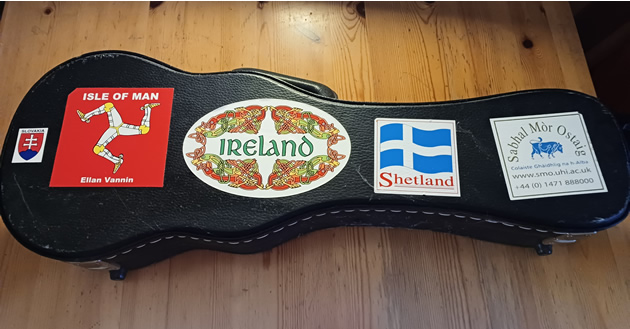
One of my ukulele cases with some stickers on it

Whatever you call them, they are “a design or picture produced in order to be transferred to another surface either permanently or temporarily.” or in other words, a decorative sticker. Apparently decal can be used as a verb as well, meaning to apply decals to (sth) [source].

I’ve come across the word decal in novels and other texts by American writers, but I hadn’t heard anybody use it in speech. Yesterday I watched a video made by a Canadian woman in Japan in which she talks about decals, and pronounces it [ˈdɛkəl] (deckle). This surprised me as I assumed it was pronounced more like [ˈdiː.kæl] (dee-cal).

Apparently, both pronunciations are used: [ˈdiː.kæl] in central Canada and Australia, and [ˈdɛkəl] in the USA, western Canada and Australia. If you use this word, how do you pronounce it, and where are you from?

Decal is an abbreviation of decalcomania (The process of transferring decorative designs onto surfaces using decals; a decal), from French décalcomanie (same meaning), décalquer (to trace, transfer [a design]), and -manie (a compulsion, obsession, a place where something can be found in great amounts).

A word that possibly comes from the same root is cockamamie, which means a foolish or ridiculous person; ridiculousness, folly or foolish nonsense; foolish, ill-considered, silly, unbelievable, triffling, and used to mean a decal [source].

Are there any words that aren’t pronounced as you’d expect based on their written forms?

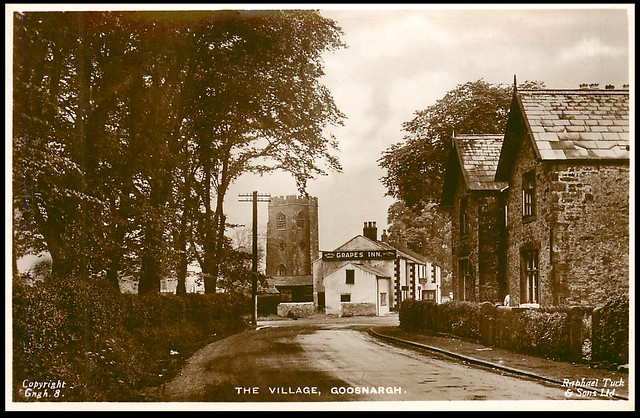
Goosnargh

What does the word goosnargh suggest to you?

Gertie and Bertie
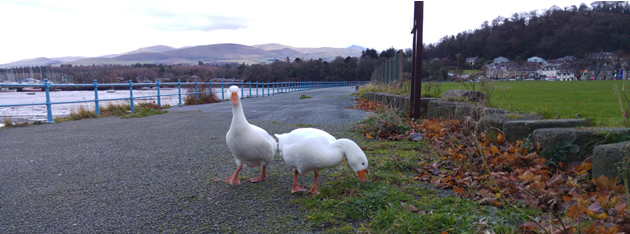
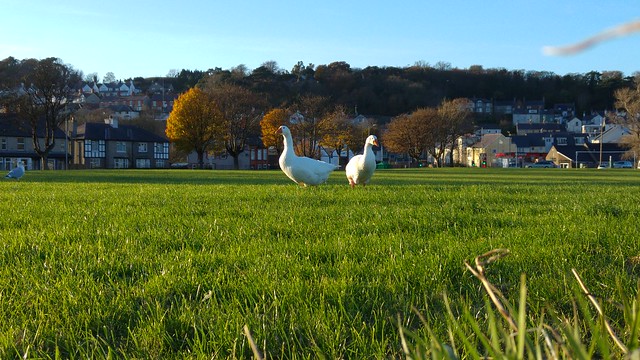
A couple of geese that I encountered unexpectedly when walking around Bangor.

When I first came across this word the other day, I guessed it might be an exclamation you make when encountering an unexpected goose. Goosnargh!

The Village, Goosnargh.

Somewhat disappointingly, Goosnargh [ˈɡuːznər] is in fact a village between Broughton and Longridge in the City of Preston district of Lancashire in the northwest of England, not far from where I grew up. It’s apparently famous for its Goosnargh cakes, a type of caraway seed shortcake biscuit traditionally sold at Whitsun (the seventh Sunday after Easter).

Here’s a recipe: https://bakingforbritain.blogspot.com/2005/09/goosnargh-cakes-from-lancashire.html

The name comes the Old Irish name Gosan or Gusan and the Old Norse word erg (hill pasture), which is thought to come from the Old Irish áirge (a place for milking cows). Alternatively, it might come from the Old Norse gudhsins hörgi (“at the idol’s (god’s) temple”). Goosnargh appears in the Domesday Book as Gusansarghe, and by 1212 it had changed to Gosenargh.

Áirge became áirí (milking-place, herd (of cows), ground manured in previous year; ground from which potatoes have been cropped) in Irish, àirigh [aːrʲɪ] (hill pasture, bothy, sheiling, pastoral summer residence, sheiling (knitting pattern)) in Scottish Gaelic, and eairee (hill pasture, shieling) in Manx. The Faorese word ærgi [ˈaɹt͡ʃɪ] (a pasture for cattle to graze over the summer with a hut where the people tending them live meanwhile; a shieling, saeter) also come from the same roots.

According to Douglas Adams in his novel In So Long, and Thanks For All the Fish, goosnargh is a Betelgeusian word used by Ford Prefect “when he knew he should say something but didn’t know what it should be.”

However, in The Meaning of Liff, in which Douglas Adams’ gives comic meanings to British place names, goosnargh is defined as “Something left over from preparing or eating a meal, which you store in the fridge despite the fact that you know full well you will never ever use it.”

I certainly have a few goosnarghs (leftovers) in my fridge. How about you?

Sources: https://en.wikipedia.org/wiki/Goosnargh
https://en.wiktionary.org/wiki/Goosnargh
https://www.teanglann.ie/en/fgb/áirí
https://www.faclair.com/

Shopping for Grasshoppers

Have you ever been grassed up or grassed on?

In the UK, to grass someone up or to grass on someone means to betray them to the police or other authorities, and a grass is an informer who betrays a group (of criminals or other ne’er-do-wells) to the police. It’s also used to mean telling on someone to a figure of authority, such as a boss, teacher or parent [source].

Grasshoppers

Grass in these senses is probably a shortening of grasshopper, which is rhyming slang for copper (police officer), as in someone who will inform on you to the police, and/or rhyming slang for shopper, i.e. one who ‘shops’ you to the authorities [source].

A grasshopper is also:

  • a mostly herbivorous insect of the order Orthoptera.
  • A cocktail made with crème de menthe and optionally with crème de cacao.
  • A young student in initial stages of training who has been chosen on account of their obvious talent. [source]

Other words for an informant apparently include: bigmouth, canary, fink, gossip, leak, mole, nark, quisling, sneak, snitch, snout, squealer, stooge, stool pigeon, stoolie, tattler, tattletale, telltale tit, telltale, tout and whistleblower [source].

Do you use any of these, or are there others you know/use?

Are there interesting words for informants in other languages?

Titles

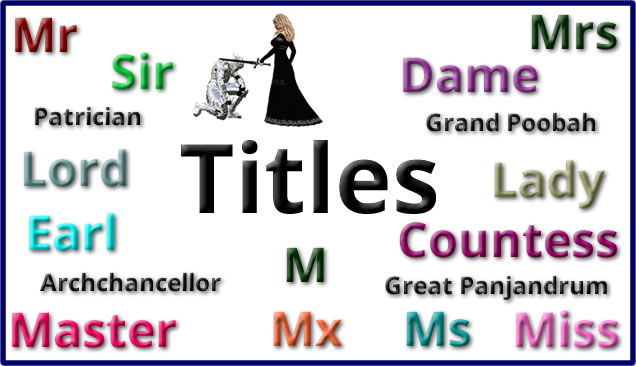
Titles like Mr, Mrs, Ms, Dr, etc are commonly and widely used, but have you heard of Mx?

Saturday

I hadn’t heard of it until yesterday when I listened to an episode of the Subtitle podcast all about it.

Mx [mɪks/məks] is a gender-neutral alternative to Mr, Mrs and Ms. The x was chosen as a “wildcard” character, and it was first used in print in 1977 in Single Parent, and American magazine. It is usually written Mx. in the USA and Mx in the UK. It was added to the Merriam-Webster Unabridged Dictionary in 2016, although is not widely used in the USA. [source].

The first major organisation to acccept its use in documents was the UK Post Office in 2009. Since then many other companies and organisations have accepted it, at least in the UK [source].

More details: https://en.wikipedia.org/wiki/Mx_(title)

An alternative gender-neutral title is apparently M. [ɛm], although it is rarely used [source]. Several other alternative gender-neutral titles are discussed on https://nonbinary.wiki/wiki/Gender_neutral_titles – apparently Mx is the most widely used.

The title Ms(.) has been around since the 17th century as an abbreviation of mistress, which does not indicate marital status. It was revived in 1901, based on Southern dialects of English in the USA which pronounced both Mrs and Miss as [mɪz]. Ms started to become popular in the 1970s after Ms. magazine was founded [source].

More details: https://en.wikipedia.org/wiki/Ms.

I generally avoid using titles or even names when talking to people, unless they ask me to do so, and prefer to be addressed simply as Simon. If I had a fancy title like Dr, Professor or Sir, I might ask people to use them, at least sometimes. Sir Simon has a nice ring to it. I also rather like Japanese titles like san and chan.

How about you?