
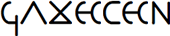
The Elbasan alphabet was invented around the middle of the 18th century and named after the city of Elbasan in central Albania. It was used mainly in a document called the Elbasan Gospel Manuscript, or Anonimi i Elbasanit (The Anonymous of Elbasan) in Albanian, which was created at St Jovan Vladimir's Church, published in 1761, and can now be found in the National Archives of Albania in Tiranë.
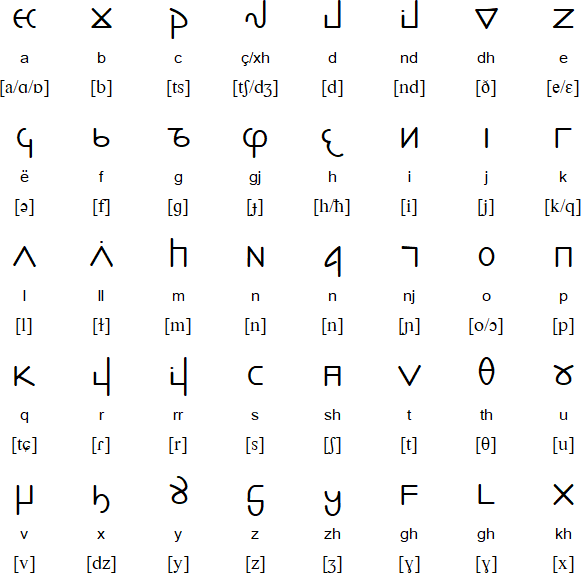
Download an alphabet chart for Elbasan (Excel)

Të gjithë njerëzit lindin të lirë dhe të barabartë në dinjitet dhe në të drejta. Ata kanë arsye dhe ndërgjegje dhe duhet të sillen ndaj njëri tjetrit me frymë vëllazërimi.
All human beings are born free and equal in dignity and rights. They are endowed with reason and conscience and should act towards one another in a spirit of brotherhood.
(Article 1 of the Universal Declaration of Human Rights)
Information about Albanian | Phrases (Gheg) | Phrases (Tosk) | Numbers (Gheg) | Numbers (Tosk) | Family words (Gheg & Tosk) | Tongue twisters | Tower of Babel | Beitha Kukju alphabet | Elbasan alphabet | Todhri alphabet | Vellara alphabet | Veso Bey alphabet | Berati alphabet
Albanian courses on: Amazon.com and Amazon.co.uk [affilate links]
Information about the Elbasan alphabet
http://en.wikipedia.org/wiki/Elbasan_alphabet
http://www.elsie.de/pdf/articles/A1995ElbasanMs_Fig.pdf
http://std.dkuug.dk/jtc1/sc2/wg2/docs/n3856.pdf
Transliterate between the Latin and Elbansan scripts
https://shqip.ee/
A-chik Tokbirim, Adinkra, ADLaM, Armenian, Avestan, Avoiuli, Bactrian, Bassa (Vah), Beitha Kukju, Berati, Beria (Zaghawa), Borama / Gadabuursi, Carian, Carpathian Basin Rovas, Chinuk pipa, Chisoi, Coorgi-Cox, Coptic, Cyrillic, Dalecarlian runes, Elbasan, Etruscan, Faliscan, Fox, Galik, Georgian (Asomtavruli), Georgian (Nuskhuri), Georgian (Mkhedruli), Glagolitic, Global Alphabet, Gothic, Greek, Hurûf-ı munfasıla, Irish (Uncial), Kaddare, Kayah Li, Khatt-i-Badíʼ, Khazarian Rovas, Koch, Korean, Latin, Lepontic, Luo Lakeside Script, Lycian, Lydian, Manchu, Mandaic, Mandombe, Marsiliana, Medefaidrin, Messapic, Mongolian, Mro, Mundari Bani, Nag Chiki, Naasioi Otomaung, N'Ko, North Picene, Novo Tupi, Nyiakeng Puachue Hmong, Odùduwà, Ogham, Old Church Slavonic, Oirat Clear Script, Ol Chiki (Ol Cemet' / Santali), Old Italic, Old Nubian, Old Permic, Ol Onal, Orkhon, Osage, Oscan, Osmanya (Somali), Pau Cin Hau, Phrygian, Pollard script, Quốc âm tân tự, Runic, Székely-Hungarian Rovás (Hungarian Runes), South Picene, Sutton SignWriting, Sunuwar, Tai Viet, Tangsa, Todhri, Toto, Umbrian, (Old) Uyghur, Vellara, Veso Bey, Wancho, Yezidi, Zoulai
Page last modified: 02.02.26
[top]

You can support this site by Buying Me A Coffee, via PayPal or Patreon, or by contributing in other ways.
If you find all the adverts annoying, there is now an Ad-free version of Omniglot which you can access for a small monthly or annual donation.

Note: all links on this site to Amazon.com



[top]


