Language Puzzles

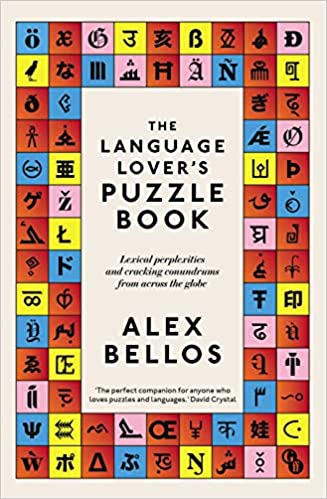
The Language Lover's Puzzle Book

Recently I was sent a copy of a new book by Alex Bellos – The Language Lover’s Puzzle Book: Lexical complexities and cracking conundrums from across the globe, and agreed to write a review of it.

According to the blurb:

Crossing continents and borders, bestselling puzzle author Alex Bellos has gathered more than one hundred of the world’s best conundrums that test your deduction, intuition and street smarts.

The first chapter focuses on computer-related puzzles, including a regex-based crossword, soundex codes and a bad translation puzzle. To find out what these things are, you could buy the book. I had to read the explanations several times to understand them.

Other chapters contain puzzles based various languages, writing systems and counting systems from around the world. Some give you some examples words or phrases in a particular language, and then challenge you to work out how to write other words or phrases, or to identify aspects of the grammar of that language. There are also number-based puzzles using a variety of number systems.

Ancient, modern and constructed languages and writing systems are included, such as Welsh, Irish, Esperanto, Toki Pona, Javanese, Inuktitut, Egyptian Hieroglyphs, Phoenician, Khipu, Ogham, Linear B, Old Norse, Korean, Chinese, Japanese, Georgian, Greek and Cherokee.

Some of the puzzles look relatively easy to me as they involve languages and writing systems I’m familiar with. Others look quite difficult. Fortunately there are answers and explanations for all the puzzles at the back of the book. In fact the answer section takes up almost a third of the whole book.

I think I’ll have fun trying to solve them, and anybody reading this with an interesting in languages and writing might do as well.

You can also find a language quiz every Sunday on this blog, of course, and occasional writing-based puzzles on my Instgram.

In Hot Water

While making the lastest episode of the Radio Omniglot Podcast this week, I noticed that there are several words for water in Japanese – something I knew but had forgotten.

  • 水 (mizu/sui) = water (esp. cool, fresh water, e.g. drinking water)​, fluid, liquid, flood(waters)
  • 湯 (yu/tō) = hot water, bath, hot spring
  • 潮 (shio/ushio/chyō) = tide, salt water, opportunity
  • ウォーター (wātā) = used in foreign placenames

If you count the different ways to pronounce the kanji as separate words, you could say that there are eight different words for water in Japanese. Mizu, yu, shio and ushio are native Japanese words, sui, tō and chyō were borrowed from Chinese, and wātā might possibly come from English.

仁王尊プラザ温泉

Here are some examples of how they’re used.

  • 水曜日 (suiyōbi) = Wednesday (“water day”)
  • 水素 (suitso) = hydrogen
  • 水族館 (suizokukan) = aquarium
  • 水路 (suiro) = waterway, canal, channel, aqueduct
  • 水切り (mizukiri) = straining, draining; strainer, colander
  • 水車 (suishō) = water wheel, hydraulic turbine
  • 水辺 (mizube) = waterside, waterfront
  • 湯気 (yuge) = steam, vapour
  • 湯沸かし (yuwakashi) = kettle
  • 湯船 (yubune) = bathtube (“hot water boat”)
  • 湯水 (yumizu) = hot and cold water​; abundant / plentiful item
  • 潮流 (chōryū) = tide, tidal current​, tendency, drift, trend​
  • 潮水 (shiomizu) = seawater
  • 潮力 (chōryoku) = tidal energy

I suppose it makes sense that in a land where hot water is readily available from the many hot springs, that hot water is be seen as something different to cold water.

In Mandarin Chinese 水 (shuĭ) means water or liquid, and 汤 [湯] (tāng) means soup or hot water.

Do any other languages have separate words for cold water and hot water, or other types of water?

You could say that there quite a few words for water in various states: ice, rain, snow, sleet, hail, mist, fog, clouds, water vapour, and so on.

Source: Jisho.org

Earth Apples & Ground Pears

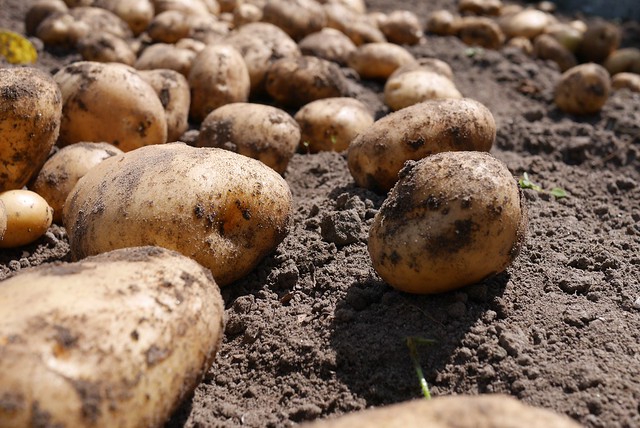
One of the Dutch words I learnt recently is aardappel [ˈaːr.dɑ.pəl], which means potato, or literally “earthapple”. This is cognate with one of the German words for potato – Erdapfel [ˈeːɐ̯tˌʔa.p͡fl̩/], which is used mainly in southern Germany, Switzerland and Austria. Apparently earthapple also exists in English, although it’s rare, The Sinhala word අර්‍තාපල් [art̪aːpal] was apparently borrowed from Dutch [source].

One French word for potato, pomme de terre, means “apple of the earth”, though comes from different roots.

Untitled

Related words include:

  • aardappelpuree = mashed potato(es)
  • aardappelschilmesje = potato peeler
  • aardappel in de schil = baked potato, jacket potato, potato skins
  • aardappelsoep = potato soup
  • aardappelknödel = potato dumplings
  • aardappelsalade = potato salad
  • aardappeloogst = potato harvest
  • De aardappeleters = The Potato Eaters (a painting by Van Gogh – see below)

In case you’re feeling hungry now, here are a few receipes for potato-based dishes (in Dutch). I might even try some of these myself. It would be a fun way to practise using my Dutch.

De aardappeleters

Another Dutch word for potato is patat [paːˈtɑt], borrowed from the French patate (potato), which is used mainly in Canada and Louisiana, and comes from the Spanish patata (potato), from the Taíno batata (sweet potato) and/or the the Quechua papa (potato). This is also the root of the English word potato, and similar words in other languages [source].

Another German word for potato is Grundbirne [ˈɡʁʊntˌbɪʁ.nə] (ground pear), which is used in Austria. It’s cognate with the Luxembourgish Gromper [ˈɡʀompeʀ] (potato), the Slovenian krompir [krɔmpìːr] (potato), the Macedonian компир (potato) [source].

The Dutch word aardpeer means “earthpear”, and refers to the Jerusalem artichoke (Helianthus tuberosus), a kind of sunflower native to North America [source].

The more common German word for potato, Kartoffel [kaʁˈtɔfəl], and related words in other languages, comes from the Italian tartufolo, a diminutive of tartufo (truffle), from the Medieval Latin *territūberum or the Latin terrae tūber (tuber of the earth) [source].

In Mandarin Chinese, a potato is a 土豆 (tǔdòu) or “earth bean”, at least in Mainland China. In Taiwan this means peanut [source] – a potato is a 馬鈴薯 (mǎlíngshǔ), or “horse bell potato / yam”, probably because potatoes look like the bells used on horses [source].

Edinburgh

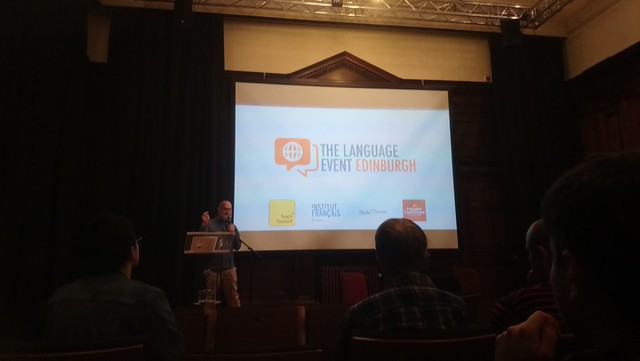
I am currently in Edinburgh for the Edinburgh Language Event, brought to you by the people behind the Polyglot Conference. It’s a smaller than other polyglot events I’ve been to, with only 100 or participants, and the main focus is languages of the Isles, or the British Isles and Ireland, if you prefer.

The Language Event, Edinburgh

I arrived earlier this evening, and eventually found the AirBnB I’m staying in after a few wrong turns. Then I discovered that my phone charger was no longer in my bag – it must have dropped out somewhere, probably on the train. So by the time I found my accommodation, it had only 3% charge. I hope to borrow someone’s charger tomorrow, or I might have to buy a new one.

I met up with some of the other participants at a large bar in the centre of Edinburgh. Some I know already from previous such events, and others I didn’t know before. Most of the conversations were in English, but I also spoke some Welsh, Russian, Swedish, Mandarin and Japanese.

The event starts tomorrow morning, and I’ll be giving a talk about connections between Celtic languages tomorrow afternoon. I know there are speakers of Welsh, Irish, Manx and Scottish Gaelic here, and there may even be some Cornish and Breton speakers.

More photos from Edinburgh:

Edinburgh / Dùn Èideann

Bratislava

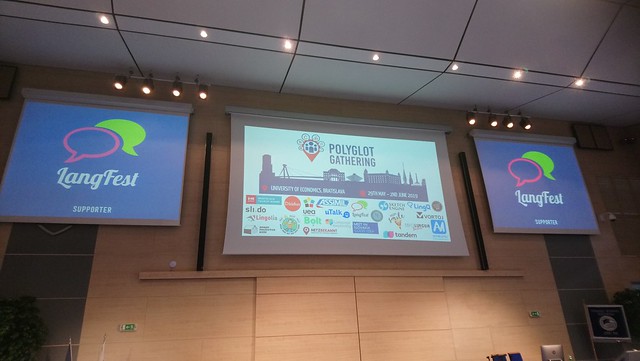
I’m currently in Bratislava in Slovakia for the 2019 Polyglot Gathering, which starts tomorrow, although there was an opening ceremony this evening.

The Polyglot Gathering 2019 begins

Today I went on a tour taking in three countries – Slovakia, Hungary and Austria. I had conversations in English, French, German, Mandarin, Spanish and Irish, and spoke odd bits of Czech, Slovak, Russian, Scots, Hungarian, Portuguese, Welsh, Esperanto and Swedish.

Hainburg Castle

I probably won’t have much time for blogging with all the intensive polylgotting that’s going on. Normal service will be resumed next week.

Flying Deer and Kites

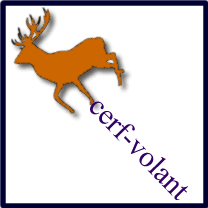
Cerf-volant / Kite

Last night I learnt that the French word for kite is cerf-volant [sɛʁ.vɔ.lɑ̃], or “flying deer/stag”. Cerf-volant also means stag beetle.

Cerf (stag, hart) comes from the Old French cerf (deer), from Latin cervus (deer, stag), from Proto-Indo-European *ḱr̥h₂wós, from *ḱerh₂- (horn) [source].

Actually the cerf in cerf-volant comes from a different root to the cerf meaning stag – from the Occitan sèrp-volanta (flying serpent) [source].

Kites were possibly invented in China in the 6th century BC. They in first appeared in Europe during the 15th century and were in the form of serpents or dragons, which is perhaps why there were called sèrp-volanta [source].

In Chinese a kite is 风筝 [風箏] (fēngzheng): 风 [風] (fēng) = wind, and 箏 (zhēng) is a kind of musical instrument similar to a zither [source], so you could translate that word as “wind zither”.

Do kites have interesting names in other languages?

Christmas

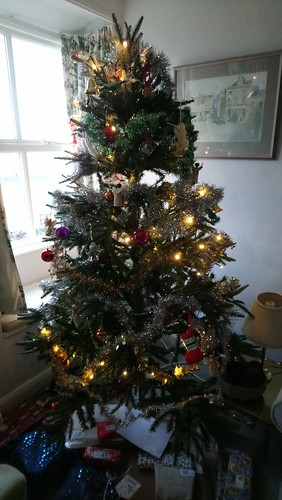
Christmas tree / Coeden nadolig

Did you get any language-related goodies for Christmas?

Are you planning to start learning any new languages next year?

I got a British Sign Language (BSL) course, The Accidental Dictionary by Paul Anthony, and a t-shirt with hello on it in many languages.

I plan to concentrate on improving my knowledge of the languages I already know, rather than starting any new ones. Whether I stick to this remains to be seen.

Oh and Merry Christmas
Nadolig Llawen
Joyeux Noël
Nedeleg Laouen
Frohe Weihnachten
Nadelik Lowen
聖誕快樂
Nollaig shona
メリークリスマス
Nollick Ghennal
¡Feliz Navidad!
Nollaig Chridheil
С Рождеством
God jul
Veselé vánoce
Glædelig jul
Ĝojan Kristnaskon

Polyglot Conference – Day 1

The Polyglot Conference officially started today. There were talks and workshops all day on all sorts of interesting topics. I went to talks on Slovenian, linguistic relavtivity, Romani, the Cathars, and audiolinguistics. They were all interesting, especially the linguistic ones.

There was plenty of time between the talks to talk to other participants, and I managed to make some recordings in quite a variety of languages for the next episode of my podcast. I hope to make more recordings tomorrow.

I had conversations in English, Welsh, French, Irish, German, Russian, Mandarin, Japanese, and tried to speak a few other languages.

They are preparing Ljubljana for the Ljubljana Marathon tomorrow, and quite a few streets are being lined with barriers. I hope I’ll be able to get to the conference venue tomorrow.

Buying and Selling

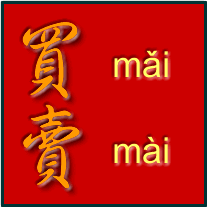
買賣 - Buy and sell in Chinese

The words for to buy and to sell are very similar in Mandarin: 買 [买] (mǎi) [maɪ˦˩˧] = buy and 賣 [卖] (mài) [maɪ˥˩] = to sell. In Cantonese the characters are the same, but are pronounced maai5 [maːi˩˧] (buy) and maai6 [maːi˨] (sell) [source]. The only difference between them is in the tones, and they are easily confused by learners. Do native speakers ever mix them up?

The character 買 combines 网 (wǎng – net) and 貝 (bèi – shell, cowrie) [source], and 賣 combines those elements plus 出 (chū – go out), which became reduced to 士 (shì – soldier) over time [source].

If you put these two characters together: 買賣 [买卖] (mǎimài) it means business, shop, store or deal [source].

Do any other languages have words for buy and sell that are so similar?

Buying and selling both involve an exchange of goods or services. The only difference is in the direction of the exchange. I might sell something to you, or buy something from you, while you might sell something to me, or buy something from me.

The same is true of other pairs of words such as borrow and lend. The one you use depends on the direction of the exchange: I borrow from you, and you lend to me. Teach and learn are also similar: You teach me, and I learn from you, or I teach you, and you learn from me. Although in some varieties of English learn is used to mean learn and teach.

In Welsh the word dysgu means to learn and to teach, and benthyca means to borrow and to lend. The word addysgu, means to teach, but it isn’t used much in colloquial Welsh [source].

Are there any other languages that don’t make a distinctions like this?

Is there a linguistic term for word pairs like this?

Cake on Cake and Gilded Lilies

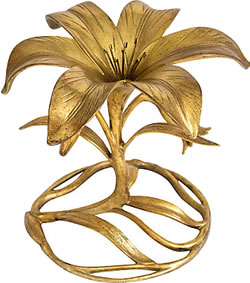
A gilded lily

When you have to much of a good thing, or are repeating things superfluously, you’re putting cake on cake – tårta på tårta or kaka på kaka, at least in Swedish [source].

For example:

– Det är tårta på tårta = That would be too much [source]
– Det är lite tårta på tårta att tala om ”ISBN-nummer” = It is a bit superfluous to talk about “ISBN number”

The English phrase “too much of a good thing” first appeared in writing in Shakespeare’s play As You Like It in 1600 [source].

A similar idiom is “to gild the lily“, meaning to embellish or improve something unnecessarily. Or to add superfluous attributes to something. It is apparently a misquote from Shakespeare’s play King John (1595):

“To gild refined gold, to paint the lily, to throw a perfume on the violet, to smooth the ice, or add another hue unto the rainbow, or with taper-light to seek the beauteous eye of heaven to garnish, is wasteful and ridiculous excess.”

Other related idioms include “to go overboard” and “to over-egg the pudding” [source].

In Chinese an equivalent idiom is 畫蛇添足 [画蛇添足] (huàshétiānzú) = “to draw a snake and add legs” [source].

Are there other idioms in English or other languages with a similar meaning?

Photo from: http://www.janneyscollection.com/product/arthur-court-gilded-lily-side-table/