Stanzas, Cameras and Salons

The Italian word stanza [ˈstan.tsa] means room or bedroom. I noticed it recently in my Italian lessons, and wondered where it came from. Today I realised that it’s related to the English word stanza (a part of a poem equivalent to a verse), and also has that meaning in Italian.

Villa Panza - Robert Wilson, Ivory. Black Panther, 2007

It comes from Vulgar Latin *stantia (standing, stopping-place), from Latin stantem (standing, staying, remaining), from stō (to stand, stay, remain), from Proto-Italic *staēō (to stand), from Proto-Indo-European *steh₂- (to stand) [source].

The English word stanza [ˈstænzə], which was borrowed from Italian, can also refer to:

  • An apartment or division in a building (architecture)
  • A segment or portion of a broadcast devoted to a particular topic (broadcasting)
  • A period or interval into which a sporting event is divided (sports)

It is also used in computing.

Words from the same roots include stance, stand, distant, estate, stable, stage, state, station, status and store in English, sawdl (heel) in Welsh, Staat (country, state) in German, and stam (tree trunk, stem, tribe, clan) in Dutch [source].

Other words for room in Italian include sala and camera.

Sala can also refer to a hall, living room or cinema (movie theatre), and was borrowed from French salle (hall, room), which ultimately comes from PIE *sel- (human settlement, village, dwelling), via Middle and Old French, Frankish and Proto-Germanic. The English words salon and saloon come from the same roots [source].

Camera is a room, chamber, bedroom, assembly, parliament or camera. It comes from Latin camera (chamber, room, vault), from Ancient Greek καμάρα (kamára – a vaulted chamber, vault), from Proto-Iranian *kamarā- (something curved), from *kamárati, ultimately from PIE *kh₂em- (to bend, curve) [source].

Words from the same roots include camera, cabaret and chamber in English, قَمَرَة (qamara – berth, bunk, cabin) in Arabic, καμάρα (kamára – arch, instep) in Greek, chambre (room, chamber, bedroom) and cabaret (pub, tavern, cabaret) in French, and câmara (chamber, council, camera) in Portuguese [source].

IMG_4321

Camera, as in a device for taking photos and/or videos, is an abbreviation of camera obscura (A darkened room in which the image of an outside object is projected and focused onto a surface – see above) from New Latin camera obscūra (“dark chamber”) [source].

In English, camera can also mean a vaulted room or a judge’s private chamber, where cases may be heard in camera (in secret, in private).

The Fastest Way to Learn Japanese Guaranteed with JapanesePod101.com

Forest Cities

What is a forest, and can cities such as London and Berlin by classified as forests?

Forest

There are hundreds of definitions of what constitutes a forest involving things like the number of trees, the height of trees, the land use, legal standings and ecological function.

According to the United Nations’ Food and Agriculture Organization (FAO), a forest is

“Land spanning more than 0.5 hectares with trees higher than 5 meters and a canopy cover of more than 10 percent, or trees able to reach these thresholds in situ. It does not include land that is predominantly under agricultural or urban use.”

Richmond Park London

Some people say that by this definition, cities like London and Berlin are technically forests as they have 20% or more of tree cover. However, as the land is predominantly under urban use, such claims do not really hold water. There are apparently almost as many trees as people in London, by the way, and over 40% of the city is made up of green spaces (see above), and about a third of Berlin is composed of forests, parks and gardens, rivers, canals, and lakes (see below).

Berlin - Tiergarten

Other definitions of forest include:

  • A dense uncultivated tract of trees and undergrowth, larger than woods [source].
  • A complex ecological system and natural resource in which trees are the dominant life-form [source].
  • A dense growth of trees and underbrush covering a large tract; a tract of wooded land in England formerly owned by the sovereign and used for game [source].
  • An extensive wood; a large tract of land covered with trees; in the United States, a wood of native growth, or a tract of woodland which has never been cultivated [source].

Historical, a forest in England was an area of land set aside as royal hunting ground or for other privileged use.

The word forest comes from Middle English forest (a forest, a wood, a preserve for hunting exclusive to royalty), from Old French forest (royal hunting ground, forest), from Early Medieval Latin forestis (a large area reserved for the use of the King or nobility, often a forest and often for hunting or fishing), possibly from Proto-West Germanic *furhisti (forest), from *furhiþi (forest) +‎ *hursti (thicket, grove) [source].

Proto-West Germanic *hursti is also the root of horst (an elevated land overgrown with shrub) in Dutch, Horst (the nest of a bird of prey, an eyrie; bush, thicket, small forest [literary]) in German, and hurst (a wood or grove) in English, which appears mainly in placenames such as, Hurstpierpoint, Lyndhurst, Sissinghurst and Woodhurst [source].

Incidentally, in Middle English wode referred to forests and woods, as well as wood (material), and it also meant to hunt, to take to the woods, or to hide oneself in the woods. A forester or forest warden was a wodeward [source].

Sources and further information:
https://en.wiktionary.org/wiki/forest#English
https://en.wikipedia.org/wiki/Forest
https://www.timeout.com/london/things-to-do/did-you-know-that-london-is-the-worlds-largest-urban-forest
https://en.wikipedia.org/wiki/Berlin

The Fastest Way to Learn Japanese Guaranteed with JapanesePod101.com

Unlimited Web Hosting - Kualo

Muchedumbre

In one of the Spanish lessons I did on Duolingo this morning, I came across the interesting word muchedumbre, and thought I’d write a post about it.

Muchedumbre cantando en contra de los Mossos

Muchedumbre [mutʃeˈðumbɾe] means crowd, throng, multitude, mob, herd, or flock (of birds). It comes from Old Spanish muchedumne, muchidumne, from Latin multitūdinem (a great number [of people], multitude, numerousness, crowd, mob, throng), from multus (much, many), from Proto-Italic *moltos (much, many), from Proto-Indo-European *ml̥tós (crumbled, crumpled), from *mel- (to worry, be late, hesitate) [source].

Words from the same roots possibly include mejor (better, best), muy (very), mucho (much, a lot of, many) and multitud (multitude, crowd, a lot, loads) in Spanish, multitude in English, and mieux (better, best) in French [source].

Incidentally, if you’re keen on crowds, you might like to darse un baño de multitudes (to mingle with the crowd) [source], or darse un baño de masas (to go on a walkabout) [source]. Un baño de masas can also mean ‘to walk into the crowd (by a famous person)’ [source]. This might attract una muchedumbre de admiradores (a crowd of admirers).

I tend to avoid crowds, which isn’t difficult living in a small city in the wilds of north Wales. How about you?

The Fastest Way to Learn Japanese Guaranteed with JapanesePod101.com

Unlimited Web Hosting - Kualo

Buckling Swashes

Have you a swashed any buckles or buckled any swashes recently? Do you known the differences between a pirate, a privateer and a buccaneer? What about a freebooter or a corsair?

Pirate Ship, Key West, Florida.

A swashbuckler is a swordsman or fencer who engages in showy or extravagant swordplay, a daring adventurer or a kind of period adventure story with flashy action and a lighthearted tone [source].

A swashbuckler likes to swashbuckle, that is, take part in exciting romantic adventures [source].

Swash as a noun has a variety of meanings, including:

  • The water that washes up on shore after an incoming wave has broken.
  • A narrow sound or channel of water lying within a sand bank, or between a sand bank and the shore, or a bar over which the sea washes.
  • A wet splashing sound.
  • A smooth stroke; a swish.
  • A swishing noise.
  • A long, protruding ornamental line or pen stroke found in some typefaces and styles of calligraphy.
  • A streak or patch.

As a verb, to swash means:

  • To swagger; to act with boldness or bluster (toward).
  • To dash or flow noisily; to splash.
  • To swirl through liquid; to swish.
  • To wade forcefully through liquid.
  • To swipe.
  • To fall violently or noisily.
  • To streak, to color in a swash. [source].

Swash also appears in swash letter (an italic capital letter with top and bottom flourishes, intended to fill an unsightly gap.) [source]; and swish-swash (a repeated swishing action or sound, going back and forth) [source].

Sword & Buckler

A buckler is “a kind of shield, of various shapes and sizes, held in the hand or worn on the arm (usually the left), for protecting the front of the body. In the Middle Ages in England, the buckler was a small shield, used not to cover the body but to stop or parry blows.” [source].

A pirate is “a criminal who plunders at sea; commonly attacking merchant vessels, though often pillaging port towns.” It comes from Old French pirate (pirate), from Latin pīrāta (pirate), from Ancient Greek πειρατής (peiratḗs – brigand, robber), from πεῖρα (peîra – trial, attempt, plot). It replaced the Old English word wīċing, which could refer to a pirate or a viking [source], although vikings were more commonly called Norþmenn (north people), hǣþene (pagans) or Dene (Danes) [source].

A privateer was historically a privately owned warship that acted under a letter of marque to attack enemy merchant ships and take possession of their cargo. An officer or any other member of the crew of such a ship, or in other words, a government-sanctioned pirate [source].

Buccaneer is another word for pirate, and specifically refers to pirates who preyed on the ships of other nations on the Spanish Main and in the Pacific in the 17th century. It comes from French boucanier (buccaneer), from boucaner (to smoke or broil meat and fish, to hunt wild beasts for their skins), from boucan ([Tupi-style] grill), from Old Tupi m(b)oka’ẽ (wooden grill) [source].

A freebooter refers to an adventurer who pillages, plunders or wages ad-hoc war on other nations. It comes from Dutch vrijbuiter (freebooter, pirate), from vrijbuit (plunder, spoils) [source]. The old word flibustier (a French pirate in the Americas) comes from the same roots [source], as does filibuster [source].

Incidentally, the Dutch word buit (spoil, booty, loot, prey, gains), and the English word booty, might ultimately come from the Proto-Celtic word *boudi (victory, booty, spoils), as does the name Boudica [source].

Saint-Malo corsair ship

A corsair refers specifically to French privateers, especially from the port of Saint-Malo, and the ships they sail. It can also refer to privateers and pirates in general.

It comes from French corsaire (privateer, corsair, pirate), from Italian corsaro (privateer, corsair, pirate), from Medieval Latin cursārius (pirate, sea-raider), from Latin cursus (course, running, race, way, passage, journey, voyage) [source].

Are there any other words for pirate that I’ve missed?

For more seafaring-related words, see this podcast, which inspired this post:

The Fastest Way to Learn Japanese Guaranteed with JapanesePod101.com

Unlimited Web Hosting - Kualo

Ruffled Rifles

The words rifle and ruffle sound similar, but are they related? Let’s find out.

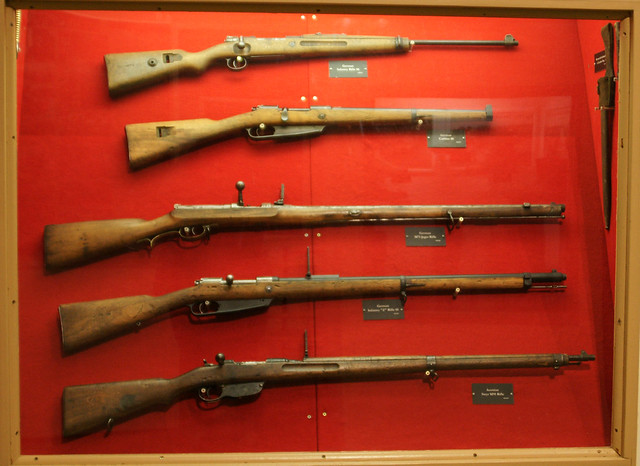
A rifle is a firearm fired from the shoulder with a long, rifled barrel, which increases range and improves accuracy. It is short for “rifled gun”, referring to the spiral grooves inside the barrel (rifling).

Rifles

It comes from Middle English riflen (to rob, plunder, search through), from Old French rifler (to lightly scratch, scrape off, plunder), from Proto-Germanic *rīfaną (to tear, rend), from Proto-Indo-European *h₁reyp- (to tear) [source].

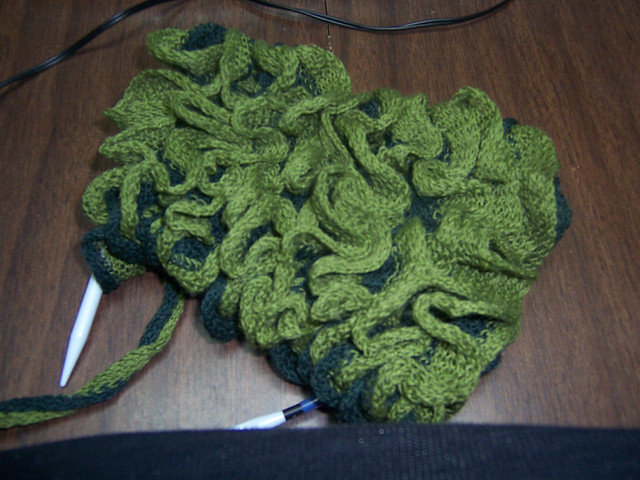
A ruffle is any gathered or curled strip of fabric added as trim or decoration; or a disturbance, agitation or commotion.

Ruffly Stuff

It comes from Middle English ruffelen, perhaps from Old Norse hrufla (to graze, scratch), or Middle Low German ruffelen (to wrinkle, curl). Beyond that, the etymology is not certain [source].

So it seems that rifle and ruffle are not related.

Words that do come from the same roots as rifle include rift, rip and rope in English; rive (bank [of a river]) in French, and arriba (above, over, up) in Spanish [source].

Words that do come from the same roots as ruffle include ruff in English, and hrufla (to graze, scratch) in Icelandic [source].

The English word riffle (a swift, shallow part of a stream causing broken water; a succession of small waves; a quick skim through the pages of a book; to ruffle with a rippling action, etc) is possibly an alteration of ruffle [source].

Riffles

Unlimited Web Hosting - Kualo

Lost in the Geese

The French word oie means goose, but how do you pronounce it?

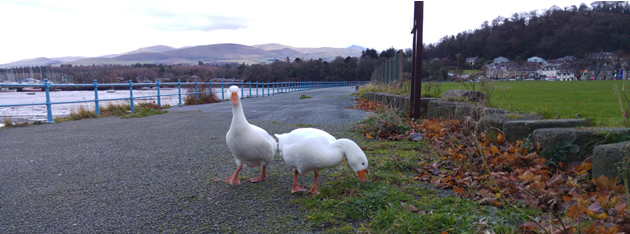
Geese

Last night at the French Conversation Group, we were talking about geese, as you do, and while I could remember how to write the word for goose in French, I wasn’t sure how to pronounce it. Then one of my friends suggested it was foie as in foie gras [fwa ɡʁa]. I knew this means “fat liver”, so foie must mean liver, and that oie probably sounds similar to foie.

My guess was right, oie is pronounced [wa] and rhymes with foie [fwa]. It comes from the Old French oie (goose), from Vulgar Latin auca (goose), a contraction of *avica, from Latin avis (bird), from Proto-Italic *awis (bird), from Proto-Indo-European *h₂éwis (bird). The Old French word was originally written oe or oue. The i was added by the end of the 12th century as analogy to oisel/oiseau (bird) [source].

Words from the same roots include հավ [hɑv] (hen, chicken) in Armenian, ave (bird) in Galician, Spanish and Portuguese, vista (chicken, hen) in Latvian, hwyad (duck) in Welsh, οἰωνός [i.oˈnos] (large bird, bird of prey, omen) in Greek [source].

The French word oiseau (bird) also comes from the same roots, via the Late Latin aucellus (little bird), as do uccello (bird) in Italian, and ocell (bird) in Catalan [source].

Incidentally, goose comes from Middle English go(o)s (goose, fool, idiot), from Old English gōs (goose), from Proto-West Germanic *gans (goose), from Proto-Germanic *gans (goose), from Proto-Indo-European *ǵʰh₂éns (goose), which is likely of imitative origin [source].

A French equivalent of to loose one’s marble (become crazy, loose one’s mind) is se perdre les oies (“to get lost in the geese”) [source].

Are there any interesting goose-related expressions in other languages?

Laxness

During the days between Christmas and New Year things may seem a bit more lax than usual, so I thought I’d look into the origins of the word.

lazy

Lax means lenient and allowing for deviation, not strict, loose, not tight or taut, lacking care, neglectful or negligent. It comes from the Latin laxus (wide, roomy, loose), from Proto-Indo-European *slǵ-so (weak, faint) [source].

The English word leash comes from the same roots, via the Middle English lesse (a leash for holding a coursing hound or watchdog) [source], the Old French lesse (leash, lead), and the Latin laxā (thong, a loose cord), from laxus [source].

The English word lease also comes from the same roots, at least partly: from Middle English *lesen, the Anglo-Norman lesser/lasier (to let, let go), from Latin laxō (to loose) from laxus, and partly from Old High German lāzan (to let, let go, release) [source].

Related words in other languages include laks (lax, slack) in Dutch, lâche (loose, slack, coward(ly), low, lazy) in French, lax (lax, easy, loose) in Geman, and llaes (loose, slack, free, trailing, flowing, low) in Welsh [source].

Losing the North

If you are lost, you might say in French “j’ai perdu le nord”. It means literally that you have lost the north, and can also be translated as to lose one’s way or one’s bearings, to become dazed and confused, or to lose one’s marbles, to lose one’s head or to lose contact.

Compass

Alternatively you could say “je suis à l’ouest” (“I am in the west”), which means to be spaced out, to not be with it, or to lose one’s bearings.

Other words for confused in French include confus, perplexe and désorienté.

Confus (confused, confusing, ashamed, embarrassed), comes from Latin cōnfusus (mixed, united, confounded, confused), from cōnfundō ( to pour together, mix), from con- (with, together) and fundō (to pour, shed).

English words from the same roots include confound, confuse, diffuse, found, fuse and profound.

Perplexe (puzzled, perplexed, confused) comes from Latin perplexus (entangled, involved, intricate, confused), from plectō (I weave, I twist), from Proto-Indo-European *pleḱ- (to fold, weave). The English word perplexed comes from the same roots, via Old French.

Désorienté (disorientated, bewildered, confused) comes from désorienter (to disorientate, confuse), from dés- (dis-/de-) and orienter (to orientate, set to north, guide), from Old French oriant (Orient, the East), from Latin oriens/orentem (rising, appearing, originating, daybreak, dawn, sunrise, east), from orior (I rise, get up, appear, originate), from PIE *h₃er- (to stir, rise, move).

The English words disorentated and orientated come from the same roots, as do such words as orient, origin, random and run.

So when you’re disorientated, you’re not sure where the east is. These days maps are generally orientated towards the north, or in other words, north is at the top. However, in Medieval times, maps made by European cartographers were orientated towards the orient or east in the direction of Jerusalem and the Holy Land. Other orientations were and are available.

Why is north usually up on maps? The Map Men explain in this video:

Do you have any other interesting ways to say you’re lost or confused?

Here’s a song called “Ai-je perdu le nord ?” (Have I lost the north?) by Clio, a French singer:

Sources:
https://dictionary.reverso.net/english-french/confused
https://en.wiktionary.org/wiki/confus#French
https://en.wiktionary.org/wiki/perplexe#French
https://en.wiktionary.org/wiki/désorienté
https://en.wiktionary.org/wiki/Category:English_terms_derived_from_the_Proto-Indo-European_root_*h₃er-

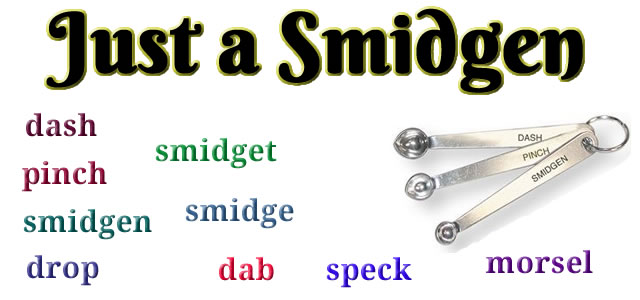
Just a Smidgen

How much is a smidgen? How about a tad, dash, drop or pinch?

Jot and Title

These are all terms that refer to small amounts of things. You might see them in a recipe, or use them to refer to other small quantities or amounts. You can even get measuring spoons for some of them.

Apparently a tad is ½ a teaspoon, a dash is ⅛ of a teaspoon. a pinch is 116 of a teaspoon, a smidgen is 132 of a teaspoon, and a drop is 164 of a teaspoon. Other amounts are available. A smidgen could be anything between 125 and 148, with 132 of a teaspoon being the most commonly used.

A tad is a small amount or a little bit, and used to mean a street boy or urchin in US slang. It probably comes from tadpole, which comes from Middle English taddepol, from tadde (toad) and pol(le) (scalp, pate).

A dash is a small quantity of a liquid and various other things. It comes from Middle English daschen/dassen (to hit with a weapon, to run, to break apart), from Old Danish daske (to slap, strike).

A smidgen is a very small quantity or amount. It is probably based on smeddum (fine powder, floor), from Old English sme(o)dma (fine flour, pollen meal, meal). Or it might be a diminutive of smitch (a tiny amount), or influenced by the Scots word smitch (stain, speck, small amount, trace). Alternative forms of smidgen include smidge, smidget, smidgeon and smidgin.

A pinch is a small amount of powder or granules, such that the amount could be held between fingertip and thumb tip, and has various other meanings. It comes from Middle English pinchen (to punch, nip, to be stingy), from Old Northern French *pinchier, possibly from Vulgar Latin *pinciāre (to puncture, pinch), from *punctiāre (to puncture, sting), from Latin punctiō (a puncture, prick) and *piccāre (to strike, sting).

A drop a very small quantity of liquid, or anything else. It comes from the Middle English drope (small quantity of liquid, small or least amount of something) from Old English dropa (a drop), from Proto-West Germanic *dropō (drop [of liquid]), from Proto-Germanic *drupô (drop [of liquid]),from Proto-Indo-European *dʰrewb- (to crumble, grind).

Do you know any other interesting words for small amounts or quantities?

Sources:
https://en.wiktionary.org/wiki/smidgen#English
https://practical-parsimony.blogspot.com/
https://en.wiktionary.org/wiki/tad#English
https://en.wiktionary.org/wiki/dash#English
https://en.wiktionary.org/wiki/pinch#English
https://quod.lib.umich.edu/m/middle-english-dictionary/dictionary/
https://en.wiktionary.org/wiki/smidgen#English
https://en.wiktionary.org/wiki/drop#English

Tents and Tenants

Are the words tent and tenant related? Let’s find out.

MM07302011_21

A tent is a portable shelter made of fabric or other material stretched over a supporting framework of poles and usually stabilized or secured to the ground with cords and stakes [source].

It comes from the Middle English tente (tent, abode, dwelling place, pavilion) [source, from the Old French tente (tent, temporary hut or other similar building), from Vulgar Latin *tenta (tent), from tentus (stretched, extended, distended), from tendō (to stretch, distend, extend), from Proto-Italic *tendō (I stretch), from the Proto-Indo-European *ten- (to stretch, extend) [source].

A tenant is one that pays rent to use or occupy land, a building, or other property owned by another; a dweller in a place; an occupant [source].

It comes from the Middle English tenaunt (tenant – one who holds real property from another by feudal obligation or payment of rent) [source], from Anglo-Norman tenaunt (tenant), from Old French tenant (holder, possessor [of land or property], tenant, owner), from tenir (to hold), from Latin teneō (I hold, have, grasp), from Proto-Italic *tenēō (I hold), from the Proto-Indo-European *ten- (to stretch, extend) [source].

So they do come from the same PIE root, via different routes. Other words from the same PIE root include tenor, tone, tonic, tune, sustain and content [source].

Incidentally, in Old English the word for tent was teld, from the Proto-Germanic *teldą (tent, drape), which became teld (tent, castle, fort, hut) in Middle English, and teld (tent, to lodge in a tent, to pitch a tent), and tilt (a canvas covering for carts, boats, etc, tent) in Modern English, although these words are no longer used [source].

Jousting

Tilt, which means to slope or incline (smth), to slant, to be at an angle, to charge (at sb) with a lance, to joust, etc, comes from different roots. Apparently it came to be associated with jousting as the cloth barrier that separated combantants in a joust is called a tilt [source].