Sailing Away

While putting together a post on my Celtiadur blog about words for ships and boats in Celtic languages, I realised that words for boats, ships and other nautical things in English come from many different languages. So I thought I’d write a blog post about them.
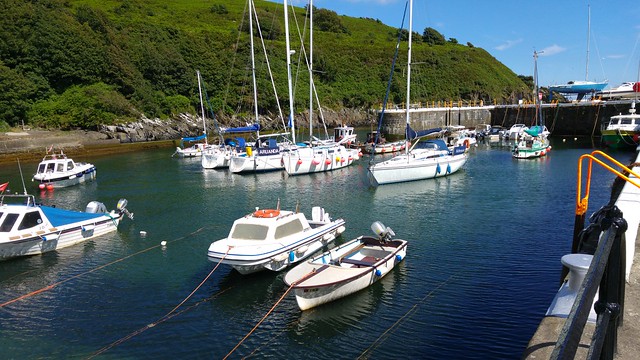
Laxey / Laksaa

The word boat comes from Middle English bot (boat, the path or course of one’s life), from Old English bāt (boat), from Proto-West Germanic *bait, from Proto-Germanic *baitaz (boat, small ship), from Proto-Indo-European *bʰeyd- (to break, split) [source].

The French word bateau (ship, boat), the Dutch word boot (boat), and the German word Boot (boat) were all borrowed from Middle or Old English.

Words for boat in North Germanic languages, such as Swedish (båt), Danish (båd) and Icelandic (bátur), were borrowed from Old Norse bátr, which was borrowed from Old English bāt (boat) [source].

Some words for boat in Irish (bád), Scottish Gaelic (bàta), Manx (baatey) and Welsh (bad) were also borrowed from Old English or Old Norse [source].

ship-13

The word ship comes from Middle English schip (ship, boat), from Old English scip (ship), from Proto-West Germanic *ship (ship), from Proto-Germanic *skipą (ship), from unknown origins [source].

Ship can be used to refer to a water-borne vessel generally larger than a boat, while boat usually refers to vessels smaller than a ship but larger than a dinghy. Boat also refers to submarines of any size, and lakers (ships used in the Great Lakes trade in North America).

Dinghy Sailing

A dinghy is a small open boat, propelled by oars or paddles, carried as a tender, lifeboat, or pleasure craft on a ship; a sailing dinghy, or an inflatable rubber life raft. It comes from Bengali ডিঙি (ḍiṅi – canoe), probably from Sanskrit द्रोण (droṇa – wooden vessel, bucket, trough), Proto-Indo-Iranian *dráwnam (wooden object), from Proto-Indo-European *dréw-no-m, from *dóru (tree, wood) [source].

Untitled

A yacht is a sailing boat larger than a dinghy but smaller than a sailing ship, often with a cabin. It can also be a motor-powered private boat. It comes from yeaghe (light, fast sailing ship) from Dutch jacht (yacht, hunt), from jaghtschip (light sailing vessel, fast pirate ship: lit. “pursuit ship”).

Apparently the original Dutch jaghtschip were built to chase pirates and smugglers from the coast. In 1660 the Dutch East India Company presented one to King Charles II, who used it as a pleasure boat. It was then copied by British shipbuilders as a pleasure craft for wealthy gentlemen [source].
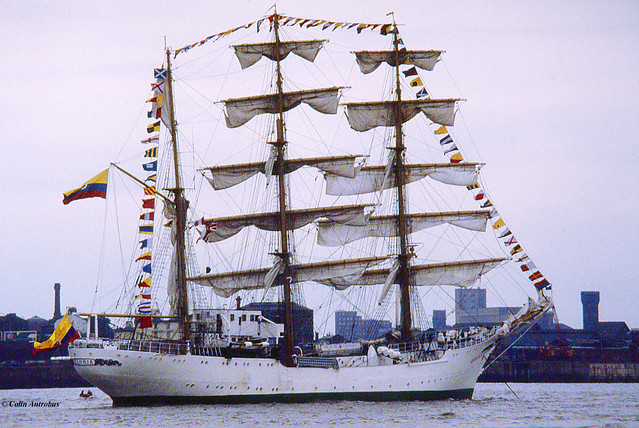
Tall Ships 015 Gloriaa_C

Another type of boat is a barque, which is a sailing vessel with three or more masts, with all masts but the sternmost square-rigged. It comes from Middle English barke (boat), from Middle French barque, from Latin barca (baris – a type of flat-bottomed freighter used on the Nile in Ancient Egypt), from Ancient Greek βᾶρις (bâris – Egyptian boat), from Coptic ⲃⲁⲁⲣⲉ (baare – small boat), from Demotic br, from Ancient Egyptian bꜣjr (transport ship, type of fish) [source].
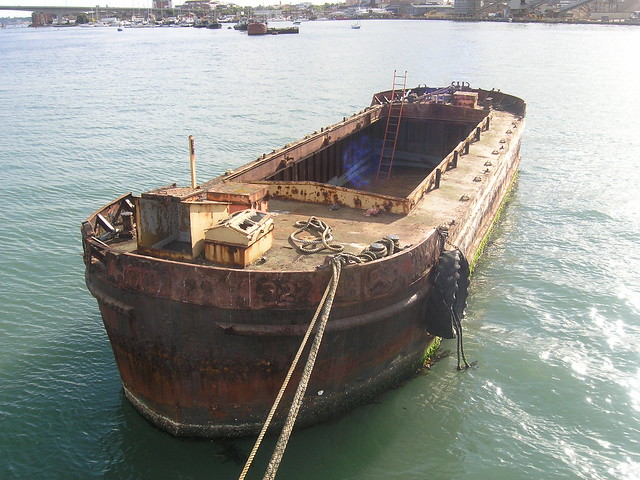
Barge

The word barge (A large flat-bottomed towed or self-propelled boat used mainly for river and canal transport of heavy goods or bulk cargo), comes from the same roots, as does the Spanish barco (boat), the Galician barco (ship, boat, barge) and the Portuguese barco (boat) [source].

Green Canoe

The word canoe (a small long and narrow boat, propelled by one or more people) comes from Spanish canoa (canoe), probably from Taino *kanowa (canoe), from Proto-Arawak *kanawa (caone) [source].
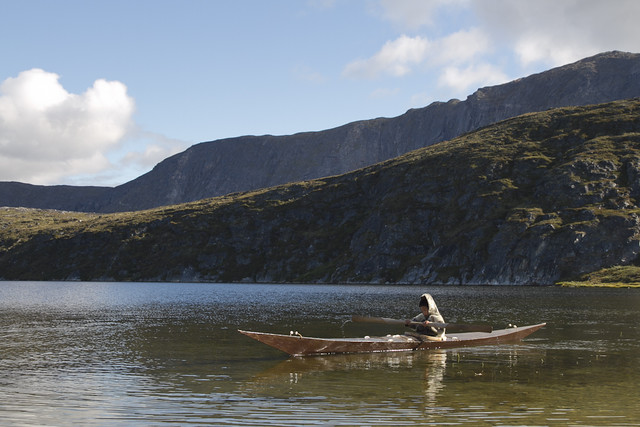
Inuit kayak

Canoes are generally open on top, while kayaks are covered over except for the cockpit where the paddler sits. Kayak comes from Inuktitut ᖃᔭᖅ (qayaq – kayak, man’s boat), from Proto-Eskimo *qayaʁ (kayak) [source].
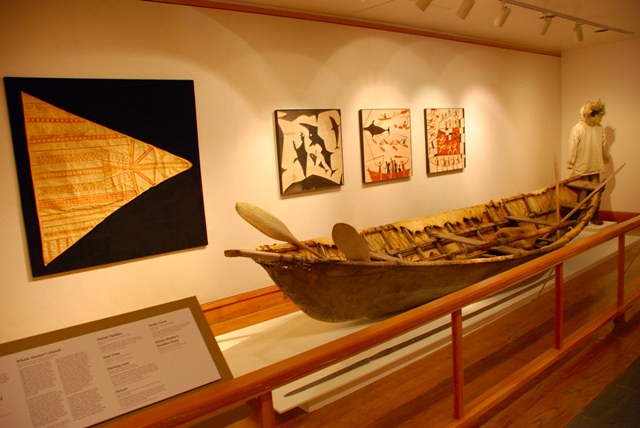
Umiak

If kayaks are men’s boats, are there women’s boats as well? There are – they are the umiak (a large, open boat made of skins stretched over a wooden frame that is propelled by paddles), from Inuvialuktun ᐅᒥᐊᖅ (umiaq – women’s boat) [source].

Incidentally, navy (a country’s entire sea force, including ships and personnel) comes from Middle English nave (navy), navye, from Old French navie (navy), from Latin nāvigia, from nāvigium (vessel, ship boat, from nāvis (ship, boat, vessel), from Proto-Indo-European *néh₂us (boat). In Old English navy was sciphere (“ship army”) [source].

English words from the same roots include navigate, nave, nautical and astronaut (lit. “star sailor”) [source].

Gadding About

In this post we explore the various meanings and origins of the word gad.

Gadfly

As an exclamation, gad! is a euphemistic alteration of the word God, and is the roughly equivalent of by God!, goodness gracious! and similar exclamations. It also appears in such exclamations as egad!, egads!, gadzooks!, gadsbobs!, gadsbudlikins! and gadsnouns!.

As a verb, to gad means:

  • to move from one location to another in an apparently random and frivolous manner
  • (of cattle) to run with the tail in the air, bent over the back, usually in an attempt to escape the warble fly

This comes from Middle English gadden (to go quickly, hurry, rush about), possibly from gadde. Related words include gadabout (a person who restlessly moves from place to place, seeking amusement or the companionship of others) and gaddish (inclined to gad, or move from place to place frivolously).

As a noun, gad means one who roams about idly, or a gadabout. This version comes from Middle English gade (a fool, simpleton), from Old English gāda (comrade, companion), from Proto-West Germanic *gadō, from Proto-Germanic *gadô/*gagadô (companion, associate), from Proto-Indo-European *gʰedʰ- (to join, unite).

The obsolete English word gadling (a companion in arms, fellow, comrade, a roving vagabond) comes from the same roots, as does the Dutch word gade (spouse), and the German word Gatte (spouse).

In Northern England and Scotland, gad is apparently used to mean a greedy and/or stupid person.

Finally, gad can mean:

  • a goad, a sharp-pointed rod for driving cattle, horses, etc, or one with a whip or thong on the end for the same purpose
  • a rod or stick, such as a fishing rod or a measuring rod
  • a pointed metal tool for breaking or chiselling rock
  • a spike on a gauntlet.

This comes from Middle English gad(de), from Old Norse gaddr (goad, spike), from Proto-Germanic *gazdaz (spike, rod, stake).

Words from the same roots include yard (a unit of length equal to 3 feet, a spar on a sail) in English, and gadd (stinger, sting, tooth) in Swedish.

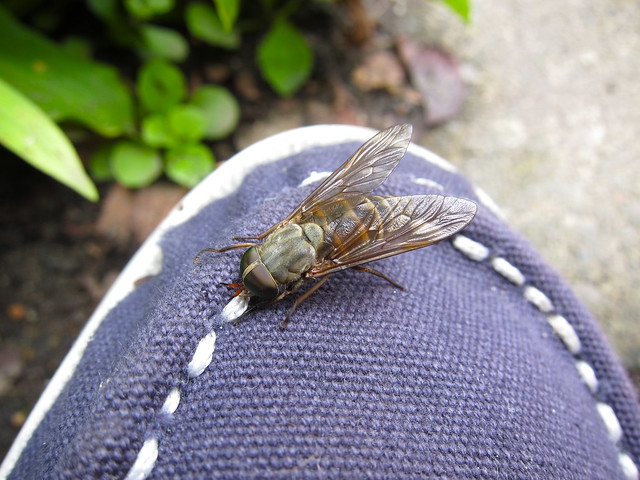
Also from the same root in the English word gadfly, which refers to certain types of flies that irritate animals by buzzing around them and biting them to suck their blood, and by extension, a person of thing that irritates or instigates, or a person who takes without giving back. It is also a synonym of gadabout.

Sources: https://en.wiktionary.org/wiki/gad#English
https://en.wiktionary.org/wiki/gadfly#English
https://quod.lib.umich.edu/m/middle-english-dictionary/dictionary
https://www.etymonline.com/search?q=gad

Attics

The attic in my house is currently being converted into a usable space, so I thought I’d look into the origins of the word attic and related ones.

Attic

An attic is:

  • The space, often unfinished and with sloped walls, directly below the roof in the uppermost part of a house or other building, generally used for storage or habitation.
  • A person’s head or brain (slang)

It comes from the French attique (penthouse flat/apartment; Attic, delicate, elegant), from the Latin atticus (Attic – relating to Athenian culture or architecture), from the Ancient Greek Ἀττικός [at.ti.kós] (Attic, Athenian). Apparently the name is related to the practice of decorating the top storey of building facades in the Attic architectural style [source].

Another word for attic is loft, which used to mean air, sky or the heavens. It comes from the Middle English lofte (air, sky, loft), from the Old English loft, a version of lyft (air, atmosphere, sky), from the Proto-West-Germanic *luftu (roof, air). from the Proto-Germanic *luftuz (roof, firmament, heavens, sky, air) [source].

Words from the same roots include lift and aloft in English, lucht (air) in Dutch and Luft (air) in German.

Attics might also be known as garrets, which comes from the Middle English garett (watchtower, turret, attic), from the Old French garite (watchtower), from guarir (to protect, save, cure, heal), from the Frankish *warjan (to ward off) , from the Proto-West Germanic *warjan (to ward off, defend against), from the Proto-Germanic *warjaną (to ward off, defend against, thwart, stop) from the PIE *wer- (to heed) [source].

Words from the same roots include weir in English, weren (to hold back, keep out, defend oneself) in Dutch, wehren (to fight, defend) in German, guérir (to cure, heal) in French [source].

Are there interesting words for attics in other languages?

Desks, Discs and Discos

What links the words desk, dais, disc, disco, dish and discus?

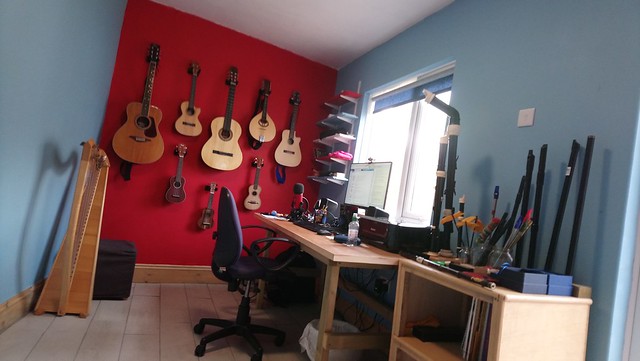
My studio / office
My desk in my office/studio

The answer is, they share the same roots: the Latin word discus (a discus, quoit, dish-shaped object, disc of a sundial), but arrived in English via different routes [source].

Desk comes from the Middle English deske (a reading desk or lecturn), from the Medieval Latin desca, from the Latin discus [source].

Dais (a raised platform in a room for a high table, a seat of honour, a throne, or other dignified occupancy) comes from the Middle English deis (podium, dais, high table), from the Anglo-Norman deis (dais, high seat/table, table of honour), from the Old French deis/dois, from the Latin discum, the accusative singular of discus [source].

Disc (a thin, flat, circular plate or similar object; a gramophone record) comes from the French disque (disc, discus, record, disk), from the Latin discus [source].

Disco, is an abbreviation of discoteque, which was borrowed from the French discothèque (discotheque, nightclub), from disque (disc, record) and bibliothèque, (library). It originally it meant “a library of discs/records”. Disque comes from the Latin discus [source].

Dish comes from the Middle English disch (dish, plate, bowl, discus), from the Old English disċ (plate, dish), from the Proto-West Germanic *disk (dish) from the Latin discus [source].

Discus comes directly from the Latin discus, from the Ancient Greek δίσκος (dískos – disc, dish, round mirror), the origins of which are uncertain [source].

Disk is used interchangeably with disc, and means more or less the same things. However, it comes straight from the Ancient Greek δίσκος [source].

The Fastest Way to Learn Japanese Guaranteed with JapanesePod101.com

Fangled

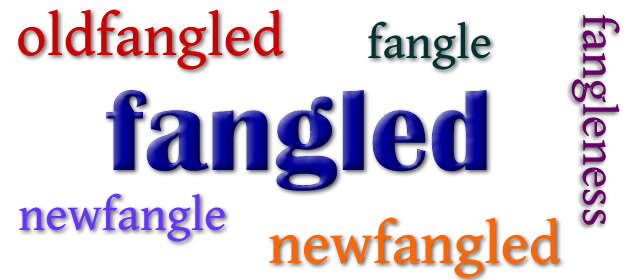
Things can be newfangled, but can they be oldfangled or just fangled?

fangled

Newfangled is used, often in derogatory, disapproving or humourous way, to refer to something that is new and often needlessly novel or gratuitously different. It may also refer to something that is recently devised or fashionable, especially when it’s not an improvement on existing things. It can also mean fond of novelty [source].

The word newfangle also exisits, although it’s obsolete. As a verb it means ‘to change by introducting novelties’, and as an adjective to means ‘eager for novelties’ or ‘desirous of changing’ [source]. It comes from the Middle English word neue-fangel, which meant fond of novelty, enamored of new love, inconstant, fickle, recent or fresh [source].

Things that are old-fashioned, antiquated, obsolete or unfashionable can be said to be oldfangled [source]. Things can also be fangled, that is, new-made, gaudy, showy or vainly decorated. Something that is fangled could be said to have fangleness [source].

The word fangle also exists, although it is no longer used, except possibly in some English dialects. It is a backformation from newfangled. As a verb it means to fashion, manufacture, invent, create, trim showily, entangle, hang about, waste time or to trifle. As a noun it means a prop, a new thing, something newly fashioned, a novelty, a new fancy, a foolish innovation, a gewgew, a trifling ornament, a conceit or a whim.

Fangle comes from the Middle English fangelen, from fangel (inclined to take), from the Old English *fangol/*fangel (inclinded to take), from fōn (to catch, caputure, seize, take (over), conquer) from the Proto-West Germanic *fą̄han (to take, seize), from the Proto-Germanic *fanhaną (to take, seize, capture, catch) [source].

Words from the same roots include fang (a long, pointed canine tooth used for biting and tearing flesh) in English, vangen (to catch) in Dutch, fangen (to catch, capture) in German, and (to get, receive, be allowed to) in Swedish [source].

Kenning

If something is beyond your ken, it is beyond your knowledge or understanding. The word ken only really appears in this phrase, but in some dialects of English in northern England, and in Scots and Scottish English, ken is more commonly used.

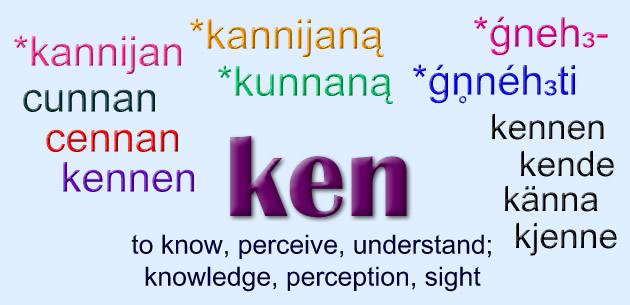
Ken

In English ken means to know, perceive, understand; knowledge, perception or sight. It comes from the Middle English kennen (to make known, tell, teach, proclaim, annouce, reveal), from the Old English cennan (to make known, declare, acknowledge), from cunnan (to become acquainted with, to know), from the Proto-West Germanic *kannijan (to know, to be aware of), from the Proto-Germanic *kannijaną (to make known), from *kunnaną (to be able), from the Proto-Indo-European *ǵn̥néh₃ti (to know, recognize) from *ǵneh₃- (to know) [source].

Some related words include:

  • beken = to make known, reveal, deliver, commit
  • foreken = to perceive, realise ahead of time, foreknow, preconceive
  • kenning = sight, view, a distant view at sea; range r extent of vision (esp. at sea), a small portion, as little as one can discrimminate or recognize
  • misken = to mistake one for another, fail to know, misunderstand, ignore, disregard, neglect
  • outken = to surpass or exceed in knowledge

These are no longer used, rarely used, or only used in some dialects of English.

Kenning also means “A metaphorical compound or phrase, used especially in Germanic poetry (Old English or Old Norse) whereby a simple thing is described in an allusive way.” It was borrowed from Old Norse [source].

Some examples of kenning in Old Norse and Old English include:

  • báru fákr (wave’s horse) = ship
  • gjálfr-marr (sea-steed) = ship
  • heofon-candel (sky-candle) = sun
  • grennir gunn-más (feeder of ravens) = warrior
  • winter-ġewǣde (winter-raiment) = snow
  • hilde-leoma (battle light) = sword
  • seġl-rād (sail-road) = sea
  • hwæl-weġ (whale-way) = sea
  • heofon-candel (sky-candle) = sun
  • ban-hus (bone-house) = body

Sources: https://en.wikipedia.org/wiki/Kenning, https://en.wikipedia.org/wiki/List_of_kennings, https://projects.iq.harvard.edu/cb45/kennings

There are cognates in other Germanic languages, including:

  • ken = to know (a person, a thing), be acquainted with in Afrikaans
  • kende = to know (be acquainted or familiar with) in Danish
  • kjenne = to know (be acquainted or familiar with), to feel or sense in Norwegian
  • känna = to feel or sense, or to know (a person) in Swedish
  • kennen = to know (a thing), be acquainted with in Dutch
  • kennen = to know, be acquainted with, be familiar with in German

In Scots ken means “To know, be aware of, apprehend, learn (a fact)”, and comes from the same roots as the English word [source]. Some related words include:

  • ken(n)ing = imparting, teaching, recognition, indentification, knowing
  • kenable = obvious, easily recognisable
  • kenmark = a distinguishing mark, mark of owenership on an animal, brand
  • kennage = knowledge, information
  • kenspeckle = easily recognisable, conspicuous, of familiar appearance

Together Living

A Dutch word I learnt recently is samenleving [‘samənlevɪŋ], which means society or community. It comes from samenleven (to live together, co-exist), from samen (together) and leven (to live), and could be literally translated as “together-living” [source].

Wonder All Around

Some related words include:

  • anderhalvemetersamenleving = ‘one and a half meter society’, in which (almost) everyone keeps a distance of one and a half meters where possible to prevent the spread of an infectious disease (especially Covid-19)’ [source]
  • wegwerpsamenleving = ‘throw away society’, in which using things once then throwing them away is normal [source]

The English word society comes from the Middle French societé (society), from the Old French societé (association, council, group, society, club), from the Latin societās (fellowship, association, alliance, union, community), from socius (associated, allied, partner, companion, ally), from the Proto-Indo-European *sokʷ-yo- (companion), from *sekʷ- (to follow) [source].

English words from the same PIE root include associate, consequence, obsequious, persue and sequel [source].

The English word community comes from the Old French comunité (community), from the Latin commūnitās (community; public spirit), from commūnis (common, ordinary, universal, public, democratic) [source].

In Old English a community was a gemænscipe [ˈjeˌmæːnˌʃi.pe], which is cognate with the Dutch word gemeenschap (community, society, fellowship) and the German word Gemeinschaft (community, group, company, sense of community). These come from the Proto-West Germanic *gamainiskapi (community), from *gamainī (common, shared, communal) and *-skapi (forms nouns denoting state) [source].

Gadwaddicking Gads

If someone told you they were going to gadwaddick, what do you think they meant?

jaunting cars

Here are a few possible meanings of to gadwaddick:

  1. to drag or tail along, to walk draggingly
  2. to go on a pleasure trip, to jaunt, to gad about
  3. to saunter, to walk slowly and clumsily

It is in fact the second, and is used in Norfolk dialect in the east of England. The first definition is for the word to drail, which is used in Gloucestershire, Wiltshire, Dorest, Somerset in the the southwest of English, and the third definition is for the word to dadge, which comes from the dialects of Northumbria and Cumbria in the north of England.

These words all come from The English dialect dictionary by Joseph Wright, which was published in 1900.

A gadabout is someone who restlessly moves from place to place, seeking amusement or the companionship of others, or in other words, someone who gads about [source], or gadwaddick about in Norfolk.

The verb to gad means “to move from one location to another in an apparently random and frivolous manner”. It comes from the Middle English word gadden (to hurry, to rush about) [source].

A gad is a greedy and/or stupid person, at least in northern England and Scotland, and comes from the Middle English gade (a fool, simpleton, rascal, scoundrel), from the Old English gada (fellow, companion, comrade, associate), from the Proto-West Germanic *gadō, from the Proto-Germanic *gadô/*gagadô (companion, associate), from the Proto-Indo-European *gʰedʰ- (to join, unite) [source].

Carefully Garrulous

What do the words care and garrulous have in common?

Well, care comes from the Middle English care (grief, sorrow), from the Old English caru/ċearu (worry, anxiety, care, sorrow, grief), from the Proto-West-Germanic *karu (care, worry), from the Proto-Germanic *karō (complaint, lament, grievance, moan, worry, sorrow, care, concern), from the Proto-Indo-European *ǵeh₂r- (to shout, call, cry; voice) [source].

Careful now

Garrulous (excessively or tiresomely talkative) comes from the Latin garrulus (talkative), from garriō (I chatter, prattle), from the Proto-Indo-European *ǵeh₂r- (to call, cry), which is apparently of imitative origin [source].

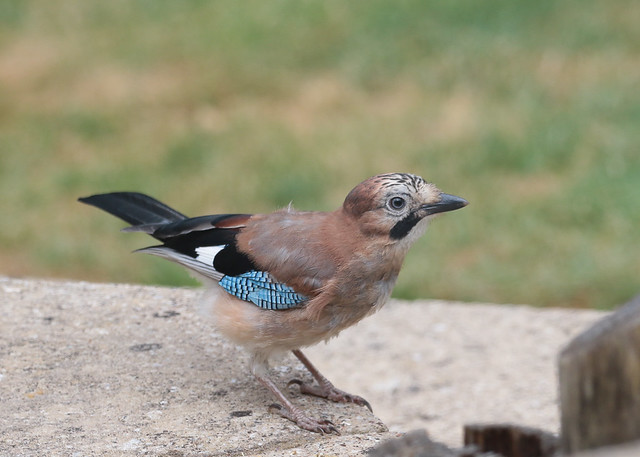
JAY (Garrulous glandarius)
Pictured above is a Eurasian Jay, also known as Garrulus glandarius – the garrulus part means chattering/noisy and the glandarius part means “of acorns”.

So, they come from the same PIE root, via different paths. Other words from the same root include [source]:

  • Italian: garrire [ɡarˈrire] = to chirp (of birds); to flutter, flap, wave (of flag)
  • Portuguese: garrir [ɡɐˈʁiɾ] = to resound, gossip, shine
  • Irish: gair [ɡaɾʲ] = to call, summon, invoke, name, proclaim, inaugurate, acclaim; and gáir [ɡɑːɾʲ/ɡæːɾʲ] = cry, shout, report, fame, notoriety; to shout, laugh
  • Scottish Gaelic: gàir [ɡaːrʲ] = laugh, cry, shout; outcry, clamour;
    and gairm [ɡɤrʲɤm] = call, cry, declare, announce
  • Manx: gerr = crow, shout
  • Welsh: gair [ɡai̯r] = word, speech, phrase, greeting, salutation
  • Cornish: ger = word
  • Breton: ger = word, speech, question

The English word slogan also comes from the same root, or at least part of it does. It comes from sloggorne/slughorn(e) (battle cry), from the Scottish Gaelic sluagh-ghairm [ˈsl̪ˠuəɣərəm] (slogan, war cry), from the Old Irish slúag/slóg (army, assembly, crowd) and gairm (call, cry).

Fighting Combs

The Scots word fecht [fɛçt / feːçt / faeçt] means to fight, or to struggle in the battle of life against misfortune, poverty, etc. It comes from the Middle English fighten (to fight, battle, quarrel), from the Old English feohtan (to fight), from the Proto-West Germanic *fehtan (to fight), from the Proto-Germanic *fehtaną (to comb, detangle, struggle (with), fight, shear) from the Proto-Indo-European *peḱ- (to pluck, ruffle, tousle, shear) [source].

Related words include:

  • fecht, feicht = a fight
  • fechtand, feghtand = fighting
  • fechtar, fechter = one who fights (in battle or in brawls)
  • fechting, fechtine = engaging in fight or battle

Source: DSL Dictionaries of the Scots Language / Dictionars o the Scots Leid

I learnt about this word on a video on Tiktok by @misspunnypennie – part of her Scots word of the day series. This particular video is about the word ilka, which means each or every. The example she gives includes fecht and fechter:

Agin ilka sair fecht there’s a bonnie fechter
(Against every hard fight there’s a fearless fighter)

By the way, if you prefer to avoid Tiktok, you can find compilations of the Scots Word of Day videos, and Scots-related videos by Miss Punny Pennie (a.k.a. Len Pennie) on Twitter and YouTube. Here’s Len talking about Scots:

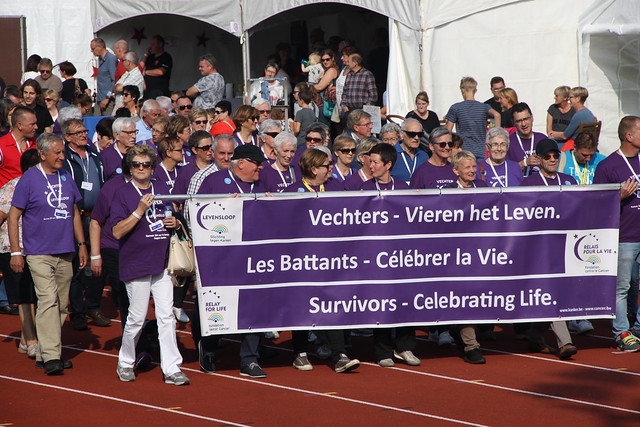
When I heard the words fecht and fechter, I thought they must be related to the Dutch words vechten [ˈvɛxtə(n] (to fight, fighting) and vechter (fighter, warrior), which I learnt recently – they are indeed related and come from the same Proto-West-Germanic root [source].

20170924-153745LC

Other words from the same Proto-West-Germanic root (*fehtan) include: fight in English, fäkta (to fence, fight) in Swedish, fechten (to fence, fight) in German, and фехтовать [fʲɪxtɐˈvatʲ] (to fence) in Russian, which was borrowed from German. To fence here means to fight with swords rather than to make a fence [source]

There is also a Dutch word related to ilkaelk, which means each or every [source].