Neither fur nor feather

Ни пуха, ни пера

Today I came across an interesting Russian idiom in the book I’m reading (Moon Seed, by Stephen Baxter): Ни пуха, ни пера (Ni púkha, ni perá). It means literally “neither fur nor feather” and is used to wish someone good luck.

The phrase was originally used by Russian hunters in a sarcastic/ironic way. The feathers referred to birds, and the fur to animals, so they were saying that they hoped that the other hunters wouldn’t catch any birds or animals.

The usually reply to this phrase is К чёрту (K chëtu), which means “to the devil” or “go to hell”, and is saying “the hell I won’t”.

Source: http://www.linguajunkie.com/learning/russian-proverbs-sayings

An equivalent of this phrase in English is “break a leg”, which is traditionally said to actors to wish them luck before they go on stage, especially on the opening night. According to theatrical superstition it’s bad luck to wish someone good luck.

This phrase first appeared in writing in May 1948 in the The Charleston Gazette as:

“Another [superstition] is that one actor should not wish another good luck before a performance but say instead ‘I hope you break a leg.”

There is a similar phrase in German, Hals und Beinbruch (break your neck and leg), which was apparently used by the Luftwaffe during WWII. This might come from the Hebrew blessing hatzlakha u-brakha‘ (success and blessing), which might have made it’s way into English via German and Yiddish.

Source: http://www.phrases.org.uk/meanings/break-a-leg.html

Are there idiomatic ways to wish people luck in other languages?

Have you got your snap?

A snap tin make be Acme

On an episode of Uncle Mort’s North Country, a comedy drama on Radio 4 Extra that I listened to today, I heard the word snap used for a packed lunch. I’e heard it before, but wasn’t sure where it came from. The drama features two characters from Yorkshire: Uncle Mort and his nephew, Carter Brandon, who both speak with strong Yorkshire accents, so I thought snap might be a Yorkshire word.

I found it in a Yorkshire Dialect Dictionary defined as ‘a light meal’, and Wiktionary defines it as ‘a small meal, a snack; lunch’.

According to the The Oxford Guide to Etymology, lunch boxes were once called snap-tins in parts of the UK, and the word snap came to mean a a light meal or quick bite by metaphorical extension.

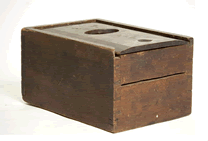
In A History of the Word on the BBC website it says that miners used snap tins to carry their lunch down the pits – the photo is an example of a miner’s snap tin.

The word snap comes from the Dutch / Low German snappen ‎(to bite; seize), from the Proto-Germanic *snappōną ‎(to snap; snatch; chatter), from the Proto-Indo-European *ksnew- ‎(to scrape; scratch; grate; rub) [source].

What do you call a container you put your lunch in?

Please alight

I received an email yesterday asking about the Swiss German equivalent of Bitte verlassen Sie den Zug (Please alight from the train). Does anybody know?

Are announcements on Swiss trains in Swiss German or Standard German (Hochdeutsch)? What other languages are they in? Or does it depend on where you are in Switzerland?

This got me thinking about some of the words that are used in announcements on trains and stations. On trains in the UK there are endless announcements which tell you what stations, stops or station stops are coming up next, where the train is going, where it’s come from, what is available in the buffet / shop. You are reminded to keep a close eye on your luggage and personal belongings, to dispose of rubbish in the bins provided, not to smoke – not even in the vestibule areas or toilets, and not not to leave anything on the train and to mind the gap when you alight.

Some of the expressions are rarely heard elsewhere. e.g. alight, vestibule and station stop. Trains are referred to as services, and they call at station stops. Passengers are often referred to as customers.

In parts of Wales announcements are in Welsh and English, though not in the parts where Welsh is most-spoken.

You can hear recordings of some announcements from UK trains and stations here:

Are there particular terms used in announcements on trains and other public transport in other countries?

Joskins, bumpkins and yokels

Last week a friend asked me about the origins of the word joskin [ˈdʒɒskɪn], which I hadn’t come across before. According to the Urban Dictionary it is defined as follows:

North-Walian term used in both English and Welsh to describe anyone from a rural or farming background. It is used both affectionately and in a derogatory way depending on the audience.

Example: He’s a right joskin – he’s got a tractor and everything.

According to the Collins English Dictionary joskin is a slang word meaning “a country bumpkin; hick”.

Wiktionary suggests that is comes from the dialect word joss (bump) and (bump)kin. Alternatively it comes from the name Joseph + (bump)kin [source].

Bumpkin, a clumsy, unsophisticated person or a yokel, apparently comes from the Dutch boomken ‎(shrub, little tree) [source]. Or it might come from the Dutch bommekijn (small cask), from the Middle Dutch bomme (cask) [source], and was also used as a derogatory reference to short and dumpy Dutch people [source].

Yokel possibly comes from German dialect word Jokel, a diminutive of Jakob, or an English dialect word meaning woodpecker [source].

What other words are there for joskins?

Les chuchoteuses

Lindsay et les chuchoteuses

On Rue Staint-Paul in Vieux Montréal there’s a statue of three women having a gossip. It’s known as Les chuchoteuses or ‘The whisperers’. It’s also known as the “fat ladies talking statue”. It’s by Rose-Aimée Bélanger, a sculptor from Ontario, and was installed as part of a 2006 initiative to highlight some of Old Montreal’s forgotten spaces.

The word chuchoteuses [ʃyʃɔtø:z] comes from chuchoter [ʃy.ʃɔ.te] (to whisper; to rustle), which is of imitative origin. Related words include chuchoterie (whispering), chuchotis (faint whispering), chuchotement (a whisper / murmur, rustling).

I like the sound of this word, and of the words for whisper in other languages:

– Italian / Portuguese / Spanish: sussurro, from Latin susurrus ‎(a humming, whispering)
– German: Flüstern
– Dutch: fluistering
– Welsh: sibrwd

What about in other languages?

The photo is one I took while exploring Montréal with Linsday Dow of Linsday Does Languages, who features in it.

Sources: Wiktionary and Reverso

Multilingual Manchester

Part of the Manchester Day Parade 2016

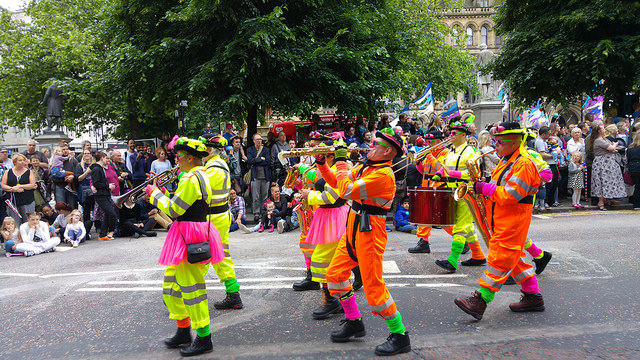
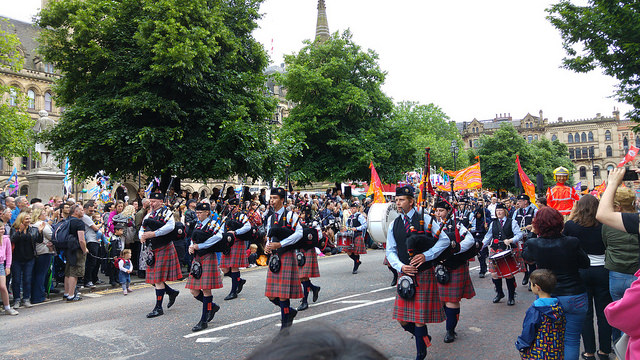
I had a multilingual day in Manchester today – I spent part of it listening to choirs and other groups performing as part of the Manchester Day celebrations. They sang in English, Irish, Scottish Gaelic, Maori, Hebrew and Yiddish, and I also watched the Manchester Day parade.

Part of the Manchester Day Parade 2016

I also went to the Polyglot Pub, a meet-up arranged by Kerstin Cable of Fluent Language. The seven of us who turned up spoke in English, French, German, Spanish, Portuguese, Italian, Russian and Swedish, plus odd bits of Welsh, Irish, Scottish Gaelic, Japanese, Finnish and Estonian. This was the first Polyglot Pub in Manchester, and hopefully won’t be the last.

Greater Manchester Fire & Rescue Service Pipe Band

You can see more photos on Flickr

There will be a language quiz tomorrow, by the way.

Reflections on the Polyglot Gathering

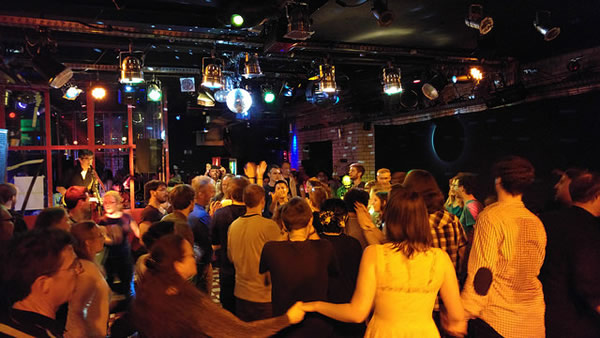
Polyglots dancing at the Slaughterhouse in Berlin

I got back from the Polyglot Gathering in Berlin late on Monday night. I travelled by train the whole way, which is a bit more expensive than the plane, and takes a few hours longer, but I prefer to travel this way, and you see more. The journey went smoothly, apart from the train from London, which was an hour late getting into Bangor. Fortunately I got a partial refund on my ticket. On the Eurostar I talked to a interesting lady from Vancouver, and on the train to Bangor I talked, mainly in Welsh, to a doctor from Felinheli.

This year’s Gathering was as much fun as previous years – it was my third. I arrived in Berlin quite late on Wednesday evening the day before it officially started, and missed out on most of the polyglot games that were going on in the afternoon and evening. Next year I might arrive a day or two before the start to give me a chance to explore more of Berlin – this year I spent most of my time in the venue and didn’t go exploring.

Over the next four days I learnt about many things, including Portuguese-based creoles, Greek, minimalism, Sardinian languages and dialects, why many language learners don’t acquire native-like accents, metaphors in native Canadian languages, language mentoring, how musical techniques can be applied to language learning, the stagecraft of multilingualism, and much more. I got to know old friends better, met lots of new ones, and I spoke lots of different languages. My talk on Manx went well, as did the introduction to Welsh that I helped with.

The talks were mainly in English, with some in French, Italian, German, Esperanto, Dutch, Spanish, Russian, Indonesian, and in various combinations of these.

Between us we polyglots speak quite a few different languages. The most common (i.e. those with quite a few speakers / learners) include English, French, Spanish, Italian, Portuguese, Catalan, Romanian, Esperanto, German, Dutch, Swedish, Norwegian, Danish, Russian, Czech, Slovak, Polish, Serbian, Greek, Finnish, Hungarian, Welsh, Irish, Mandarin, Cantonese, Japanese, Korean, Indonesian, Malay, Arabic, Persian, Hebrew and Swahili. There were also speakers and learners of Wolof, Punjabi, Hindi, Marathi, Romani, Tamil, Latin, Scottish Gaelic, Manx, Cornish, Breton, Sardinian, Luxembourgish, Latvian, Lithuanian, Macedonian, Bulgarian, Slovenian, Albanian, Basque, Tagalog, Turkish, Navajo, Toki Pona, Klingon, and probably other languages.

I’m looking forward to the next polyglot event – the North American Polyglot Symposium in Montreal in July. I’ll be doing a talk on the origins of language there, so should get working on it.

Some things I learnt from the Gathering

There are many ways to learn languages, and no single way will work for everyone. Some like to focus on one language at a time until they have reached a level they are happy with, then move on to the next language; others like to study many different languages at the same time. Some learn grammar and vocabulary first, then learn to speak; others start using their languages straight away, or soon after they start studying. Some like to study on their own; others like to study in a class and/or with a private tutor. Some combine many of the above and more, to varying degrees – I certainly do.

From Malachi Rempen’s talk on cartooning, minimalism and language learning (Less is More: What Silly Doodles Can Teach Us About Fluency), I learnt that you can do a lot with a little. He showed how he can make his Itchy Feet character express a wide variety of emotions with just a few lines, and suggested that the same can be applied to languages – you can communicate even if you know only a little of a language. He also argued that fluency means different things to different people, and might not be the best thing to aim for.

Tim Keeley, professor of Cross-Cultural Management at Kyushu Sangyo University in Fukuoka, explained that the idea that only children can acquire native-like accents in foreign languages is wrong – the brain is flexible throughout live and you can learn to perceive and produce foreign sounds. However there are emotional barriers which stop many people from sounding ‘native’. When learning another language you can also take on or create a new identity, and those who are willing and able to do this are most likely to sound more like native speakers. You also shouldn’t worry about mimicking people. In fact that is a good way to acquire native-like pronunciation.

Michael Levi Harris, an actor and polyglot from New York, talked about parallels between learning a part and learning a language. He explained that actors tend to exaggerate speech and physical mannerisms when learning a part, then make them more subtle, and that language learners can try the same things – exaggerate the pronunciation, gestures, etc. until they become second nature, then tone them down. He also talked about taking on different identities when speaking different languages and with different accents. If you can find a native speaker of a language whose voice and mannerisms appeal to you, then you can create your character in that language based on them.

The extend to which you take on a new identity in a new language depends on how much you want to integrate into a new culture. If you want to be taken for a native, then you need to sound and act like them. Alternatively you could try sounding like a native, perhaps with a bit of a foreign accent, but not worry so much about acting like them. If you spend a lot of time in a different county interacting and observing the natives, you’re likely to pick up at least some of their behaviour anyway.

Fiel Sahir, an Indonesian-American musician and polyglot who currently lives in Germany, talked about applying musical techniques to language learning. He explained how practice is the key to music and language, but it has to be intelligent practice that focuses on areas that you find difficult. This might be particular passages in a piece of music, or particular tenses or noun declensions in a language. By focusing like this, you can make a lot of progress.

Focus is something that I find difficult sometimes. I can and do focus, but often get distracted. I was thinking about how I’ve been dabbling with a variety of languages recently and not making a lot of progress in any of them. So my plan is to focus on one, or two, languages for the next year – Russian and Czech – and learn as much as I can in them. I will keep my other languages ticking over, but not spend much time on them.

Polyglot Gathering 2016

I’m currently at the Polyglot Gathering in Berlin. I arrived here on Wednesday evening and have been speaking and hearing lots of different languages. So far I’ve had conversations in English, French, Welsh, German, Irish and Mandarin, and spoken bits and pieces of Spanish, Italian, Russian, Czech, Portuguese, Toki Pona and Esperanto. I’ve also heard some Finnish, Punjabi, Korean, Japanese, Polish, Slovak, Sardinian, Dutch, Hebrew, Indonesian, Norwegian, Swedish and other languages that I didn’t recognise.

Yesterday I went to talks on Portuguese Creole languages, Greek, language learning and linguistics, how to achieve advanced language competence, and on connections between cartoons and language learning. This morning I’ve been to talks on teaching multiple languages simultaneously, and languages and dialects of Sardinia. All the talks I’ve been to so far have been in English, apart from the Sardinian one, which was in Italian.

I’ve met lots of people I know from previous polyglot events, and lots of new people too. I might try to explore a bit more of Berlin at some point as well.

Snollygoster

I came across the wonderful word snollygoster [ˈsnɒlɪˌɡɒstə] today. It is defined as follows:

– One, especially a politician, who is guided by personal advantage rather than by consistent, respectable principles.
– A politician who cares more for personal gain than serving the people (Slang, USA)

From: The Free Dictionary.

– A shrewd person not guided by principles, especially a politician

Etymology: from 19th-century American English. Possibly from snallygaster, a mythical beast that preys on poultry and children, possibly from the Pennsylvania German schnelle geeschter, from the German schnell (quick) and geist (spirit).

From: Wiktionary.

– a fellow who wants office, regardless of party, platform or principles, and who, whenever he wins, gets there by the sheer force of monumental talknophical assumnacy.
Columbus Dispatch, Ohio, 28 Oct. 1895

From: World Wide Words

It doesn’t seem to be used much any more, perhaps because it isn’t needed as there isn’t anybody who behaves like this, especially not politicians.

Here’s an interesting TED talk about this and other political vocabulary:

Are there any similar words in other languages?

Sabhal Mòr Ostaig

This week I am doing a course in Scottish Gaelic songs at Sabhal Mòr Ostaig, the Gaelic college on the Isle of Skye. While all the songs I’m learning are in Gaelic, the class it taught mainly in English, so I don’t get to speak much Gaelic in class. Outside class there are plenty of opportunities to speak Gaelic with college staff and other students, who are doing courses in language, fiddle or step dancing.

This is my fifth visit to the college, and each time my Gaelic gets a bit better. I rarely speak it at home, apart from to myself, but do listen to online Gaelic radio and occasionally read things in Gaelic. I tend to mix Irish and Scottish Gaelic a bit as I know a lot more Irish, and if I don’t know how to say something in Scottish Gaelic I try it in Irish. Sometimes it works.

On the way here and in the college I’ve heard and/or spoken quite a few different languages – plenty of English and Gaelic, and also Spanish, Italian, French, Irish, Welsh, Mandarin, Japanese, Russian and German. So this is a good place to practice a variety of languages.