Stellar Stars

Stars

Here’s an interesting question that I was sent to me by email:
—————————–
I am curious as to why some of the languages that developed from Latin had to put an extra ‘e’ at the start of some of their words.

Here are some examples:

Latin Italian French Spanish English
stēlla stella étoile estrella star
status stato état estado state
spero speranza espère esperanza hope
spōnsa sposa épouse esposa wife

It looks as if the Gauls, and the people living in the Iberian peninsula, couldn’t cope with the st- and sp- beginnings, and had to stick an ‘e’ on the front. Is this because words in the Celtic languages they spoke didn’t have such beginnings? I can’t find any similar words in modern Welsh.
—————————–

Incidentally, the words for hope have a cognate in English – esperance, which is a old word for hope or expectation [source], and the ones for wife have a cognate in spouse (husband, wife).

Let’s look at the origins of some of these words to see how they have changed over time.

The Latin word stēlla (star), comes from the Proto-Italic *stērolā (star), from Proto-Indo-European *h₂stḗr (star). This became estoile/esteile/estelle in Old French, and estoile in Middle French. It was (e)strela in Old Portuguese and estrella in Old Spanish So the extra e has been there for a while [source].

In Proto-Celtic the word for star was *sterā, from the same PIE root as the Latin stēlla. This became *ster in Proto-Brythonic, Old Breton and Old Cornish, and ster in modern Breton and Cornish. So at least some speakers of Celtic languages could cope with the initial st-. In Old Welsh it was *ser, in Middle Welsh it was ser / syr, and in modern Welsh it’s sêr. It was also borrowed into Old Irish as ser [source].

The Latin word status means state, status, condition, position, place or rank. It became estat in Old French, from which we get the English word estate. Meanwhile in Old Spanish it was (e)strela, and in Old Portuguese it was estado [source].

It was borrowed into Old Irish as stad (stop, stay, delay), which is the same in modern Irish [source]. Proto-Brythonic borrowed it as *ɨstad from the Vulgar Latin *istatus, this became (y)stad / (y)stât in Middle Welsh and ystad (state, condition, situation) in modern Welsh [source].

Do any of you have any thoughts on this question?

Lillilu

This week I wrote a new song – a lullaby inspired by learning that a Scots word for lullaby is lillilu. This is also written lilly-loo or lilli-lu, and an extended version is lillila-baloo [source].

baby sleep

Here’s a recording of the song:

This got me wondering about whether there are interesting words meaning lullaby in other languages. Here are some I found:

  • French: berceuse – from bercer (to craddle, rock), from the Old French bercier (to rock), from Vulgar Latin *bertiāre, from Gaulish, from Proto-Celtic *berta- (to shake)
  • Irish: suantraí – from suan (sleep) and -traí (type of music)
  • Italian: ninnananna (onomatopoetic)
  • Portuguese: canção de ninar (sleep song) – ninar = to sing to sleep, canção de embalar (rocking song)
  • Spanish: canción de cuna (cradle song), nana (lullaby, wet nurse, nursemaid), arrurrú – from arrullo (cooing, murmur, lullaby)
  • Welsh: hun-gân (sleep song), (si-)lwli (onomatopoetic), su(o)-gân (lulling song), hwian-gân (murmur song)

Do you know of any other interesting ones?

Gadwaddicking Gads

If someone told you they were going to gadwaddick, what do you think they meant?

jaunting cars

Here are a few possible meanings of to gadwaddick:

  1. to drag or tail along, to walk draggingly
  2. to go on a pleasure trip, to jaunt, to gad about
  3. to saunter, to walk slowly and clumsily

It is in fact the second, and is used in Norfolk dialect in the east of England. The first definition is for the word to drail, which is used in Gloucestershire, Wiltshire, Dorest, Somerset in the the southwest of English, and the third definition is for the word to dadge, which comes from the dialects of Northumbria and Cumbria in the north of England.

These words all come from The English dialect dictionary by Joseph Wright, which was published in 1900.

A gadabout is someone who restlessly moves from place to place, seeking amusement or the companionship of others, or in other words, someone who gads about [source], or gadwaddick about in Norfolk.

The verb to gad means “to move from one location to another in an apparently random and frivolous manner”. It comes from the Middle English word gadden (to hurry, to rush about) [source].

A gad is a greedy and/or stupid person, at least in northern England and Scotland, and comes from the Middle English gade (a fool, simpleton, rascal, scoundrel), from the Old English gada (fellow, companion, comrade, associate), from the Proto-West Germanic *gadō, from the Proto-Germanic *gadô/*gagadô (companion, associate), from the Proto-Indo-European *gʰedʰ- (to join, unite) [source].

Language Politics

Part of the process of learning a new language involves learning about the people who speak it, and about their culture(s), history and so on. You might also find yourself involved in the politics of when and how the language is used, especially if you’re learning a minority / endangered / revived language, or a non-standard version of a major language. This is certainly the case for the Celtic languages I’ve studied.

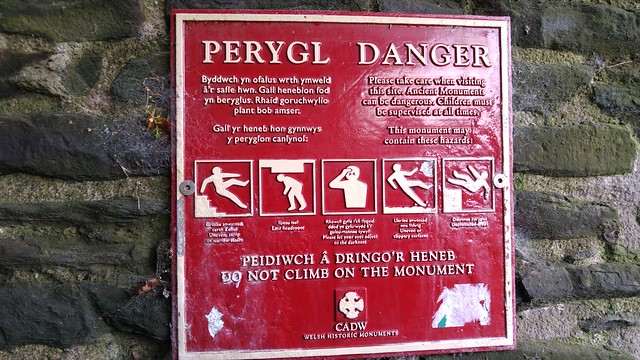
Sign on the walls of Conwy

You might be told that there’s no point in learning a Celtic language as everybody who speaks them also speaks English, or in the case of Breton, French. This is not in fact true – there are people in Patagonia in Argentina who speak Welsh and Spanish, but not English, and there are some people who have learnt a Celtic language who don’t speak English or French.

People may object to children being ‘forced’ to learn such ‘useless’ languages in school, or they may complain that they had to learn them in school. Well, education usually involves learning things that you might have little or no interest in, but you never know, maybe it will be useful to know them one day.

Critics of minority languages might come from the country or region where they are spoken, but not feel part of the local culture as they don’t speak the local language. In Wales, for example, non-Welsh-speaking people are sometimes told by Welsh speakers that they are less Welsh or basically English. Fortunately this is not a common view among Welsh speakers. Also, people who don’t speak such languages could learn them, and will find that most native speakers will be support their efforts.

Also, why are they spending our taxes to support those useless languages? That’s a comment that often crops up whenever there’s discussion of bilingual or minority language education, bilingual signage and other material, and any other initiatives to support minority languages. Speakers of minority languages also pay taxes, you know.

Have you encountered any such linguistic politics?

Here’s an example of an article that discusses some of these issues.

What the Deuce‽

The expression “What the deuce‽” can be used to express surprise, shock or bafflement. It’s an example of a minced oath in which deuce is used in place of devil [source].

If you run like the deuce, you are running very quickly and wildly, or like the devil, or maybe like you’re being pursued by the devil.

Apparently deuce was first used in the 17th century exclamations and was associated with bad luck or mischief, because when playing dice, deuce (two) is the lowest and most unlucky throw. The connection with the devil developed later [source].

306

Deuce also appears in the phrase there will be the deuce to pay (there will be a huge amount of trouble).

In card games deuce refers to a card with two pips. In baseball a deuce is a curveball. In tennis it refers to a tied game where either player can win by scoring two consecutive points, and in Canadian slang it refers to a two-year prison sentence.

It comes from the Middle English dewes (two), via Anglo-Norman from the Old French deus (two), from the Latin duo, from the Proto-Italic *duō (two), from the Proto-Indo-European *dwóh₁ (two) [source].

Deuce might also be linked to or come from the Late Latin dusius (phantom, specter), which comes from the Gaulish *dusios (incubus, monster), probably from Proto-Indo-European *dʰeus- (spirit) [source].

Alternatively it might be linked to the Old French deus (God), from the Latin deus (god, deity), from the Old Latin deivos, from the Proto-Italic *deiwos, from Proto-Indo-European *deywós, from *dyew- (sky, heaven) [source].

Other Anglo-Norman numbers that are/were used in cards, dice and other games include ace (one), trey (three), cater (four), cinque (five), sice (six) [source].

Year of the Tiger

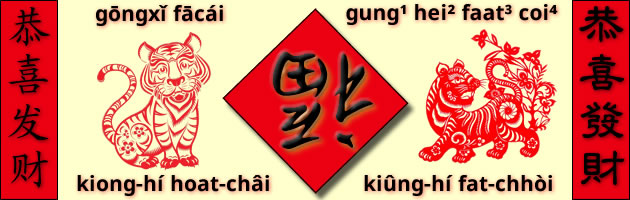
Today is the first day of the Year of the Tiger 🐅, according to the Chinese Lunar calendar, so to anybody who celebrates this:

恭喜發財 / 恭喜發財 (Chinese New Year wishes)

The Chinese character for tiger is 虎, which is pronounced hǔ [hu˦˩˧] in Mandarin, fu² [fuː˧˥] in Cantonese. It also means brave, fierce or vigorous, and is used as a surname. The usual word for tiger is in fact 老虎 (lǎohǔ / lou5 fu²) – the first character means old or venerable and shows respect for this dangerous animal.

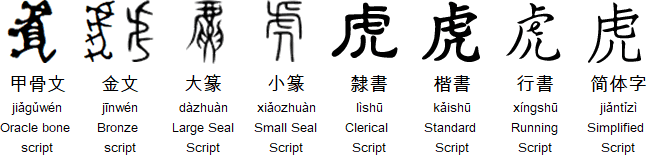
Here’s how the character 虎 has changed over the past 3,500 years or so:

Evolution of the Chinese character for tiger (虎)

The phrase 恭喜发财 [恭喜發財], which means literally “congratulations, make a fortune”, is the most common way to wish someone a Happy (Lunar) New Year in Chinese. It can be followed by the phrase 红包拿来 [紅包拿來] (hóngbāo ná lái), which means “bring out the red packet”, and refers to the red envelopes containing money that are traditionally given as gifts at Lunar New Year. It was apparently first used among Cantonese speakers in the mid-19th century, and is now used by speakers of other varieties of Chinese [source].

Last night I was invited to celebrate Chinese New Year by my neighbours, one of whom is Chinese. We had a very enjoyable evening and some rather tasty Chinese food.

Sources: LINE Dict Chinese-English, mdbg.net, Wiktionary

Britland

The word Britain is used to refer to the island of Great Britain, and is also to the United Kingdom of Great Britain and Northern Ireland, or UK. As it’s the place I’ve lived most of my life, I thought I’d look into the origins of this word.

SS Great Britain

Britain comes from the Middle English Breteyn (Britain, Brittany), from the Old English Bryten/Breoton (Britain), from the Latin Britannia (the British Isles, Great Britain, the Roman province of Britain) – the land of the Britanni (Britons), from the Proto-Brythonic *Prɨdėn (Britain), from *Pritanī, which is possibly related to *Prɨdɨn (Picts), and the Ancient Greek Πρεττανική (Prettanikḗ – British Isles). The name Brittany comes from the same root [source].

Until the 1st century BC Britain was known as Albion in Latin, which comes from the Proto-Celtic *Albiū (luminous world, upper world, high mountain, alp, alpine pasture, Britain), from the Proto-Indo-European *albʰós (white) – possibly refering to the white chalk cliffs along the south coast of Britian [source].

After the Roman conquest of Britain in 43 AD, the name Britannia was used to refer to the Roman province of Britain, which consisted of what is now England and Wales and part of southern Scotland [source].

In Welsh, Britian is referred to as Ynys Prydain (The Island of Britain) or Prydain Fawr (Great Britian). These words, along with Prydyn (Scotland, (land of the) Picts), come from the same Proto-Brythonic root as Britain [source].

In Cornish, Britain is Breten and Great Britain is Breten Veur [source].

In Breton, Great Britain is Breizh-Veur and Brittany is Breizh.

The Irish name for Wales is An Bhreatain Bheag (“Little Britain”), while Great Britain is An Bhreatain Mhór, and Brittany is An Bhriotáin [source].

In Scottish Gaelic, A’ Bhreatainn Bheag is Brittany, Wales is a’ Chuimrigh, which comes from the Welsh name for Wales, Cymru and Great Britain is A’ Bhreatainn Mhór [source].

Oak Knowers

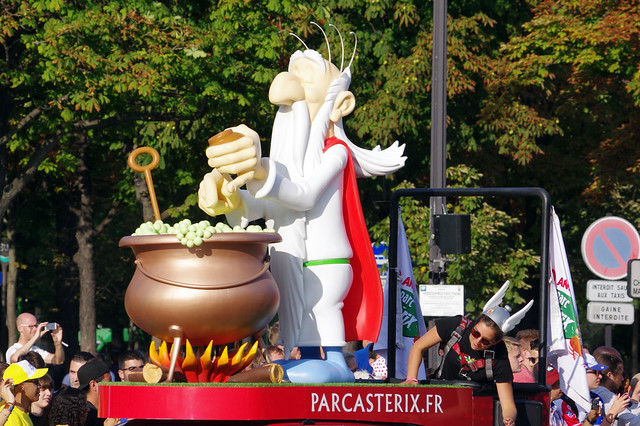
To me the word druid makes me think of Getafix, the druid in the Asterix comics – an old man with a long white beard who brews magic potions in a big cauldron. He has other names, such as Panoramix in many other European languages, and Kensawthetrix (“knows all the tricks”) in Scots [More details].

IMGR6414-ed

According to TheFreeDictionary, a druid is:

  1. a member of an ancient order of priests in Gaul, Britain, and Ireland in the pre-Christian era
  2. a member of any of several modern movements attempting to revive druidism

It comes from the French druide (druid), from the Old French druide (druid), from the Latin Druidae (the Druids), from the Gaulish *druwits (druid), from the Proto-Celtic *druwits (druid), from *daru (oak) amd *wid/*windeti (to know, to see), so a druid is an “oak knower/seer”, from the Proto-Indo-European *dóru (tree) and *weyd- (to see) [Source].

In Proto-Brythonic a druid or seer was a *drüw, which became dryw [drɨu̯/drɪu̯] (druid, seer) and derwydd (prophet, wise man, druid) in Welsh, drewydh (druid) in Cornish and drouiz (druid) in Breton [source]. It was also borrowed into Old English as drȳ (sorcerer, magician), which became drī(mann)/driʒ(mann) (sorcerer, magician) in Middle English [source]. A few modern druids use the word drymann, or something similiar, to refer to themselves.

Here’s a traditional Welsh folk tune called Y Derwydd (The Druid):

There is sheet music for several versions of this tune on The Session.

Playing Around

In English then word play has a variety of meanings. You can play a role in a play or drama, play a game or sport, play an instrument, play with toys or other things, or just play in general.

Playing

In Portuguese, however, there are several different words that can be translated as to play, such as:

  • jogar – to play (a game, a sport), gamble, throw, drop
  • brincar – to play (with toys), to joke
  • representar – to play (a role), to represent, put on, act, make a complaint
  • pregar (uma peça em alguém) – to play (a trick on sb)
  • bancar (o idiota) – to play (the fool)

According to Carlos Carrion, who sent me this information, these words are translated as to play or the equivalent in most of the languages in Google Translate.

There are several ways to translate to play in Welsh, including:

  • chwarae = to play (a game, sport, instrument), amuse oneself, compete, frolic
  • canu = to play (piano, harp, organ), to sing, intone, chant
  • seinio = to play (a musical instrument), make noise/sound, ring
  • piltran = to play at (doing something), potter about, fiddle
  • actio / perfformio = to play (a role), to act, perform

Are there different words for different kinds of play in other languages?

Sources: ReversoDictionary, Geiriadur Prifysgol Cymru, Geiriadur yr Academi

Jargon

When I come across an unfamiliar word, I usually find it interesting and intriguing, and try to find out what it means and where it comes from. I also do this when I hear words being used in ways that are unfamiliar to me.

For example, the builder who is currently working on the new studio in my garden often shares building jargon with me. I find this interesting as I can see examples of what he means. The latest term was snots, which refers to drops of cement that fall off while it’s being applied to walls. [More details].

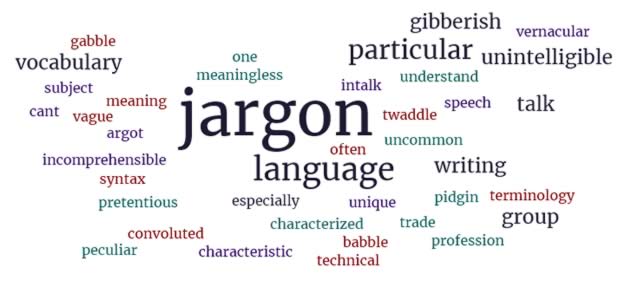
Jargon image

Sometimes, though, I find new words annoying, especially when a lot of them appear together. For example, I often receive emails from companies who are keen to advertise on Omniglot, who want to managing the ads on my site, or who want to redesign the site. These emails include lots of specialist vocabulary and abbreviations that I only partially understand. If I think they have something to offer that might benefit the site, I will try to decipher the jargon. Otherwise I don’t bother.

According to Dictionary.com, jargon [ˈdʒɑː.ɡən/ˈdʒɑɹ.ɡən] is:

  • the language, especially the vocabulary, peculiar to a particular trade, profession, or group: medical jargon.
  • unintelligible or meaningless talk or writing; gibberish.
  • any talk or writing that one does not understand.
  • pidgin.
  • language that is characterized by uncommon or pretentious vocabulary and convoluted syntax and is often vague in meaning.

It comes from the Middle English jargo(u)n (the sound of conversation, talking), from the Old French jargon (talk, chatter, conversation, talking), a variant of gargon/gargun (chatter, talk, language) [source].

When people mention things like header bidding, operational yield management, proprietary stacks, display inventory, RPMs and CPMs (all from one email), I tend to switch off. Perhaps it would be useful and lucrative for me to know about such things, but I’d rather not. I might also find myself becoming a little irritated with people who use such terms, and wondering why they can’t just use more transparent language.

How do you feel about jargon and other unfamiliar forms of language?