Reflections on the Polyglot Gathering

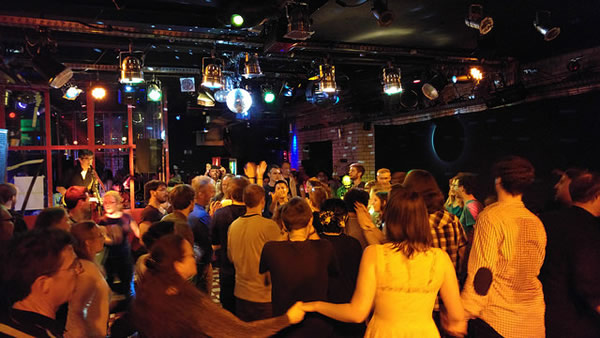
Polyglots dancing at the Slaughterhouse in Berlin

I got back from the Polyglot Gathering in Berlin late on Monday night. I travelled by train the whole way, which is a bit more expensive than the plane, and takes a few hours longer, but I prefer to travel this way, and you see more. The journey went smoothly, apart from the train from London, which was an hour late getting into Bangor. Fortunately I got a partial refund on my ticket. On the Eurostar I talked to a interesting lady from Vancouver, and on the train to Bangor I talked, mainly in Welsh, to a doctor from Felinheli.

This year’s Gathering was as much fun as previous years – it was my third. I arrived in Berlin quite late on Wednesday evening the day before it officially started, and missed out on most of the polyglot games that were going on in the afternoon and evening. Next year I might arrive a day or two before the start to give me a chance to explore more of Berlin – this year I spent most of my time in the venue and didn’t go exploring.

Over the next four days I learnt about many things, including Portuguese-based creoles, Greek, minimalism, Sardinian languages and dialects, why many language learners don’t acquire native-like accents, metaphors in native Canadian languages, language mentoring, how musical techniques can be applied to language learning, the stagecraft of multilingualism, and much more. I got to know old friends better, met lots of new ones, and I spoke lots of different languages. My talk on Manx went well, as did the introduction to Welsh that I helped with.

The talks were mainly in English, with some in French, Italian, German, Esperanto, Dutch, Spanish, Russian, Indonesian, and in various combinations of these.

Between us we polyglots speak quite a few different languages. The most common (i.e. those with quite a few speakers / learners) include English, French, Spanish, Italian, Portuguese, Catalan, Romanian, Esperanto, German, Dutch, Swedish, Norwegian, Danish, Russian, Czech, Slovak, Polish, Serbian, Greek, Finnish, Hungarian, Welsh, Irish, Mandarin, Cantonese, Japanese, Korean, Indonesian, Malay, Arabic, Persian, Hebrew and Swahili. There were also speakers and learners of Wolof, Punjabi, Hindi, Marathi, Romani, Tamil, Latin, Scottish Gaelic, Manx, Cornish, Breton, Sardinian, Luxembourgish, Latvian, Lithuanian, Macedonian, Bulgarian, Slovenian, Albanian, Basque, Tagalog, Turkish, Navajo, Toki Pona, Klingon, and probably other languages.

I’m looking forward to the next polyglot event – the North American Polyglot Symposium in Montreal in July. I’ll be doing a talk on the origins of language there, so should get working on it.

Some things I learnt from the Gathering

There are many ways to learn languages, and no single way will work for everyone. Some like to focus on one language at a time until they have reached a level they are happy with, then move on to the next language; others like to study many different languages at the same time. Some learn grammar and vocabulary first, then learn to speak; others start using their languages straight away, or soon after they start studying. Some like to study on their own; others like to study in a class and/or with a private tutor. Some combine many of the above and more, to varying degrees – I certainly do.

From Malachi Rempen’s talk on cartooning, minimalism and language learning (Less is More: What Silly Doodles Can Teach Us About Fluency), I learnt that you can do a lot with a little. He showed how he can make his Itchy Feet character express a wide variety of emotions with just a few lines, and suggested that the same can be applied to languages – you can communicate even if you know only a little of a language. He also argued that fluency means different things to different people, and might not be the best thing to aim for.

Tim Keeley, professor of Cross-Cultural Management at Kyushu Sangyo University in Fukuoka, explained that the idea that only children can acquire native-like accents in foreign languages is wrong – the brain is flexible throughout live and you can learn to perceive and produce foreign sounds. However there are emotional barriers which stop many people from sounding ‘native’. When learning another language you can also take on or create a new identity, and those who are willing and able to do this are most likely to sound more like native speakers. You also shouldn’t worry about mimicking people. In fact that is a good way to acquire native-like pronunciation.

Michael Levi Harris, an actor and polyglot from New York, talked about parallels between learning a part and learning a language. He explained that actors tend to exaggerate speech and physical mannerisms when learning a part, then make them more subtle, and that language learners can try the same things – exaggerate the pronunciation, gestures, etc. until they become second nature, then tone them down. He also talked about taking on different identities when speaking different languages and with different accents. If you can find a native speaker of a language whose voice and mannerisms appeal to you, then you can create your character in that language based on them.

The extend to which you take on a new identity in a new language depends on how much you want to integrate into a new culture. If you want to be taken for a native, then you need to sound and act like them. Alternatively you could try sounding like a native, perhaps with a bit of a foreign accent, but not worry so much about acting like them. If you spend a lot of time in a different county interacting and observing the natives, you’re likely to pick up at least some of their behaviour anyway.

Fiel Sahir, an Indonesian-American musician and polyglot who currently lives in Germany, talked about applying musical techniques to language learning. He explained how practice is the key to music and language, but it has to be intelligent practice that focuses on areas that you find difficult. This might be particular passages in a piece of music, or particular tenses or noun declensions in a language. By focusing like this, you can make a lot of progress.

Focus is something that I find difficult sometimes. I can and do focus, but often get distracted. I was thinking about how I’ve been dabbling with a variety of languages recently and not making a lot of progress in any of them. So my plan is to focus on one, or two, languages for the next year – Russian and Czech – and learn as much as I can in them. I will keep my other languages ticking over, but not spend much time on them.
Polyglot Gathering 2016

I’m currently at the Polyglot Gathering in Berlin. I arrived here on Wednesday evening and have been speaking and hearing lots of different languages. So far I’ve had conversations in English, French, Welsh, German, Irish and Mandarin, and spoken bits and pieces of Spanish, Italian, Russian, Czech, Portuguese, Toki Pona and Esperanto. I’ve also heard some Finnish, Punjabi, Korean, Japanese, Polish, Slovak, Sardinian, Dutch, Hebrew, Indonesian, Norwegian, Swedish and other languages that I didn’t recognise.

Yesterday I went to talks on Portuguese Creole languages, Greek, language learning and linguistics, how to achieve advanced language competence, and on connections between cartoons and language learning. This morning I’ve been to talks on teaching multiple languages simultaneously, and languages and dialects of Sardinia. All the talks I’ve been to so far have been in English, apart from the Sardinian one, which was in Italian.

I’ve met lots of people I know from previous polyglot events, and lots of new people too. I might try to explore a bit more of Berlin at some point as well.

Polyglot Gathering Berlin 2015

I got back from the Polyglot Gathering in Berlin about an hour ago. I took the train all the way from Berlin to Bangor, via Cologne, Brussels, London, Crewe and Chester, leaving Berlin just before 7am this morning, and arriving in Bangor just after 9pm this evening. On the way there I also travelled by train, though I had to stay in Brussels for one night, and continued the next day. It cost slightly more than flying (only about £20 more) and took a bit longer (about 2 hours – more on the way there), but I saw so much more, and went through parts of France and Germany I hadn’t been before, and visited Belgium for the first time. The engineers on German railways started a 5-day strike today, and I was worried that my trains might not be running. Fortunately they did run, and were more or less on time.

The gathering was bigger than last year with about 350 participants from many countries. There were many people there I knew from last year’s gathering, and from the Polyglot Conference in Novi Sad, and I met lots of new people. I had conversations in all the languages I know well, and most of the ones I know less well. There was a Breton speaker there, though I didn’t get to talk to him, as well as speakers of Welsh, Irish, Cornish and Scottish Gaelic. Like last year, there were plenty of Esperanto speakers, and I had quite a few conversations in Esperanto, which I brushed up a bit beforehand. There were a number of people who had studied sign languages there, including BSL, ASL, Dutch Sign Language (Nederlandse Gebarentaal / NGT) and Slovak Sign Language (Slovenský posunkový jazyk / SPJ), and the Slovak signer demonstrated how she interprets songs in SPJ, which was fascinating to watch.

The talks and lectures were really interesting, and I went to quite a few introductions to languages, including Northern Sami, Navajo, Arabic, Hebrew, Milanese, Gottlandic, Finnish, Greek and Basque. I don’t intend to learn any of these languages just yet, but it was fascinating to find out more about them. My own presentation, on the History of Writing, was well received, and I got lots of positive comments.

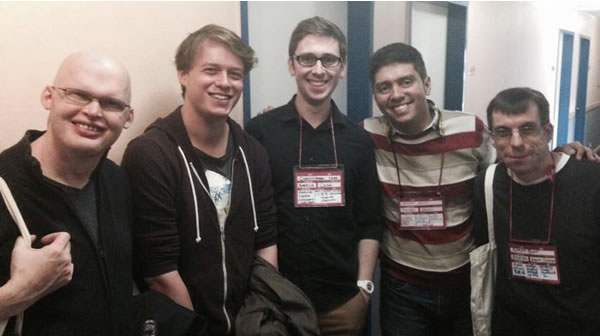
Some of the polyglots at the Polyglot Gathering in Berlin in May 2015
Some of the polyglots at the Polyglot Gathering – from right to left: Richard Simcott, Alex Rawlings, Christopher Huff, Jimmy Melo, and me – between us we speak at least 20 or 30 languages, to varying degrees.

The evening activities included a polyglot games evening, an international culinary festival – I took some Welsh cakes and bara brith, which were popular – a book fair, a polyglot game show, a concert with the multilingual French singer JoMo, who sang in 25 different languages, and an international cultural evening, at which I sang a Scottish Gaelic waulking song (Ceud soiridh soiridh bhuam) and one of my own songs – A Hen in My Hat (in 5 languages). After the cultural evening there was a little Irish and Scottish music session – I had a couple of tin whistles with me, and a few other people had instruments.

So now I’m back in Bangor and will start to catch up with the work I couldn’t do while away due to time constraints and internet connection issues.

Mutual intelligibility

This week I heard an interesting conversation about the mutual intelligibility between Czech and Slovak friends. They were talking in English, but said that when they can talk to each other in their own languages they’re able to understand everything. The Slovak lass said that she finds it strange for Czechs to speak Slovak to her as if they speak Czech she understand them without difficulty, though if people from other countries speak Slovak, that’s fine. I use what little Slovak I know with her, for example. The Czech lass said more or less the same thing about Slovaks – she doesn’t expect them to speak Czech, though if they do, that’s fine by her.

If you are a native speaker of Czech or Slovak, what’s your take on this?

What about other languages that as mutually intelligible as Czech and Slovak?

I understand that Swedes and Norwegians can talk to one another in their own languages, for example. Would it be strange for a Norwegian to speak Swedish or vice versa?

Polyglottery

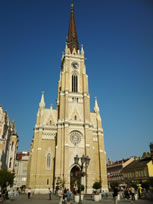
Novi Sad Catholic Cathedral

Yesterday morning I met up with other conference participants and after a bit of a wander around the city, we had lunch then went to the opening ceremony a reception. In the after we had a little guided tour of Novi Sad seeing some interesting buildings, including the Catholic or Orthodox Cathedrals, and the fortress. There are some rather attractive buildings here, wide, pedestrianised café-lined streets, some nice parks and generally a relaxed kind of atmosphere.

In the evening we all went to a restaurant about 4 or 5km from the city centre for dinner. I walked there with a few others, and the rest went by bus or taxi. We had a nice dinner with lots of polyglot chat, then some people started dancing, and others carried on chatting.

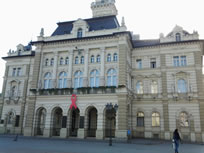
Novi Sad town hall

Today there were lectures and talks on a variety of topics including sound symbolism, the magic of metaphors, language coaching, and acting and humour in a foreign language.

So far I’ve had conversations in about 10 languages and spoken bits and pieces of maybe 10 others. In some cases this was only a few words (all I know), in others it was a bit more. There are even two guys here who are learning Scottish Gaelic, one of whom also speaks a bit of Manx, and another who is learning Irish.

Voices and calls

After writing yesterday’s post I was thinking about the Czech word hlas [ɦɫas] (voice, vote) and realised that it is quite similar to the Welsh word for voice, llais [ɬais]. I wondered it they share the same root.

Hlas comes from the Proto-Slavic *golsъ (voice), from the Proto-Balto-Slavic *galsas (voice), from the Proto-Indo-European *golHsos, from *gels- (to call)

The words for voice in other Slavic languages come from the same root: Old East Slavic: голосъ (golosŭ); Belarusian: голас (hólas); Russian: голос (gólos) and глас (glas – archaic/poetic); Ukrainian: голос (hólos); Old Church Slavonic: гласъ (glasŭ); Bulgarian: глас (glas); Macedonian: глас (glas); Serbo-Croatian: гла̑с; Slovene: glas; Kashubian: głos; Polish: głos; Slovak: hlas; Lower Sorbian: głos; Upper Sorban: hłós.

Also from the same root are the Latin gallas (cockrel); Romani glaso (voice); Romanian glas (voice, vote); Old Norse kalla (to call); English call, Dutch kallen (to chat, talk); German kallen (to scream, talk loudly, talk too much); Lithuanian galsas (sound, echo); Welsh galw (to call) and llais (voice); and possibly the Irish and Scottish Gaelic glaodh (to cry, shout).

Sources: Wiktionary

Thumbs and inches

I discovered today that the French word for thumb, pouce, also means inch, which makes sense as the length of the inch is apparently based on the width of a man’s thumb.

Related expressions include:

– se tourner les pouces, se rouler les pouces = to twiddle one’s thumbs
– manger sur le pouce = to grab a quick bite to eat (“to eat on the thumb”)
– déjeuner/dîner sur le pouce = to have a quick lunch/dinner (“to lunch/dine on the thumb”)
– donner un coup de pouce à quelqu’un = to help someone out (“to give a blow of the thumb to sb”)
– mettre les pouces = to throw in the towel; to give in; to give up (“to put the thumbs”)

The word inch comes from the Latin word uncia (a twelfth; ouce; inch), as does the word ounce, which is a twelfth of a troy pound [source]

The word for inch is the same as the word for thumb in Italian (pollice), Dutch and Afrikaans (duim), and Czech and Slovak (palec). How about in other languages?