Exploring Bratislava

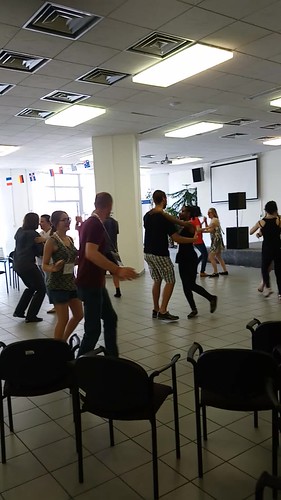
Yesterday was the last day of the #PolyglotGathering. I spent the morning learning how to tell stories through dance. We improvised one dance, then learnt some hula dances. It was a lot of fun, and a nice change from the usual talks.

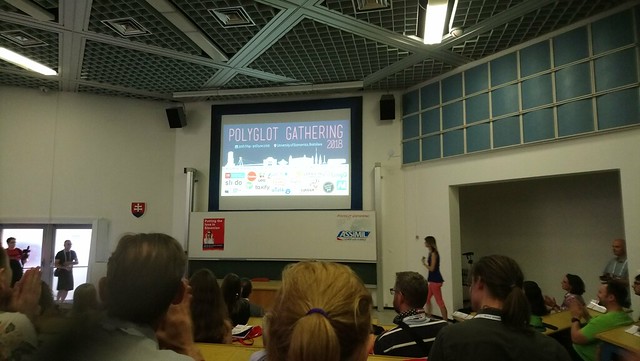
Here are some photos of the Gathering, and from previous polyglot events:
Polyglottery

In the afternoon I went to a talk about podcasting, which was interesting. I’ve been considering starting my own podcast for a while, but haven’t actually got round to it yet. I have a name for it – Radio Omniglot, and some ideas about what I would talk about, and now know more about how to set one up and publicize it.

After dinner – chicken and rice, again, I went with some others to a bar in the Old Town. It was the first time I’d been that side of the river, and had a nice evening there. I didn’t stay out too late, as I was rather tired, and managed to find my way home on foot.

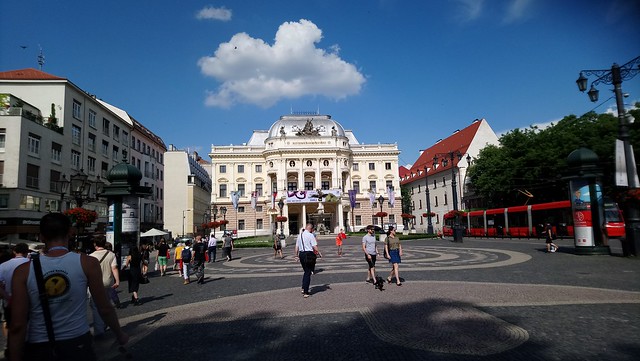
This morning there was a polygot picinc in the Medická záhrada (Medical Gardens), a nice little park not far from the centre of Bratislava. It was quite hot, so most of us sat under a tree, and talked and ate for a while. In the afternoon I went on a walking tour of Bratislava’s old town, which is rather fine, and we had a funny and informative guide. After that some of us went to a Vietnamese restaurant for dinner. Then I come back to my temporary home by tram and on foot.

Here are some photos of Bratislava:
Bratislava

During the Gathering, and today, we got free travel on trams and buses in Bratislava by showing our name badges, although there rarely seem to be ticket inspections. I only took advantage of this last night and today, as the place I’m staying is only a ten minute walk from the Gathering venue. Others stayed further away and used the buses a lot.

I’m flying to Birmingham from Bratislava tomorrow afternoon, and should be back in Bangor tomorrow night.
Language quiz

This week the quiz is a bit different. As I’m currently at the #PolyglotGathering, I thought I’d come up with a question related to the event.

So, the question is, can you guess which of these languages has not been talked about here (in one of the talks or lectures): Ukrainian, Warlpiri, Rapa Nui, Southern Sami, Manx, Tunica, or Shanghainese.

No cheating by looking at the program now 🙂

Yesterday was a good day with some interesting talks and conversations. At the International Culutural Evening I sang a Welsh folk song (Gwcw Fach) on my own, and two songs with a few others – one in Spanish (Cielito Lindo), and one in Māori (Ngā iwi e).

It’s not just about languages

Dance workshop at the Polyglot Gathering

As well as talks about language learning, languages and related topics, this year’s #PoylgotGathering includes workshops in singing songs in various languages, calligraphy, knitting and dancing. Yesterday I caught the end of a dancing workshop, and learnt a bit of belly dancing, and a folk dance from Brittany. It was a lot of fun.

I also did a bit of juggling and poi spinning with a few other polyglots yesterday, and there was a musical jam session with a few people who had instruments with them. I don’t have any instruments with me this year as I’m travelling light with only one small bag.

Tonight there’s an international cultural evening, and I plan to sing a Welsh folk song (Gwcw Fach), and maybe a Scottish Gaelic song (Illean Bithibh Sunndach). Some of us who took part in the singing workshop on Thursday with be singing songs in Maori and Spanish.

Languages I spoke yesteday – English, French, German, Spanish, Welsh, Irish, Swedish, Slovak, Mandarin, Dutch, Esperanto, Portuguese.

Polyglotting

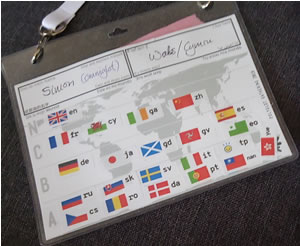
My name tag for the 2018 Polyglot Gathering

Today is the second full day of the #PolyglotGathering. It’s been a lot of fun, with some very interesting talks, and I’ve met a lot of people I know from previous polyglot events, and many new people too.

So far I’ve had conversations in English, French, German, Spanish, Welsh, Irish, Mandarin, Swedish, Russian and Esperanto, and have spoken odd bits of Manx, Danish, Icelandic, Czech, Italian, Portuguese and Slovak. I’ve learnt about Warlpiri, Bengali and Ukrainian, and have sung songs in Spanish, Italian, Serbian and Maori.

This morning I’ll be giving my presentation on Deconstructing Language. My original plan was to talk mainly about how grammar works and how it develops, but What I’ll actually talk about is where words come from and how and why they change over time.

Polyglot Gathering

This afternoon I’m off to Bratislava for the #PolyglotGathering – 5 days of talking and learning about languages, meeting other language enthusiasts, and having fun.

This will be my first trip to Bratislava, though I have been through it before when travelling between Vienna and Budapest. I was going to go to the Bratislava at this time last year for the Gathering, but decided to cancel that trip, unfortunately, after breaking my ankle.

I’ll be doing a talk on ‘Deconstructing Language’ on Friday morning. It will look mainly at where words come from, and how and why they change over time. I will also talk a bit about how grammar develops.

For the past few months I’ve been learning some Slovak, mainly with the 50 languages app and Memrise. I already know some Czech, so can understand some Slovak as well, but can’t say much yet.

Blundering about, eyes closed

Wink emoji

I learnt today that the Swedish word blunda means to shut one’s eyes, to keep one’s eyes shut, to refuse to see something; to pretend not to know about, or to ignore. It comes from the Old Norse word blunda (to shut the eyes, to doze) [source].

Related words include blund (good sleep, wink), blund for (to wink at, turn a blind eye to), and Jon/John Blund, a character from folklore who brings good sleep and dreams to children, known as the sandman in English.

In Icelandic blunda means to doze.

Wink is also linked to sleep in English – you might take forty winks, or not sleep a wink, which might make you blunder about.

The English word blunder comes from the same root, via the Middle English blunder, blonder (disturbance, strife), and blonden, blanden (to mix; mix up); and blunden (to stagger; stumble), from the Old Norse blunda [source].

Blunder is also a Swedish word meaning blooper, gaffe, trip, bloomer and blunder.

Cows, beef and shepherds

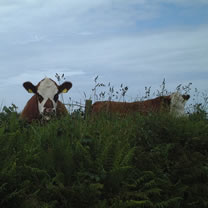
Cows among the heather in Cregneash, Isle of Man

Yesterday I learnt the Russian word for beef, говядина [ɡɐˈvʲædʲɪnə], and the promotely forgot it. So I thought I’d investigate its etymology to help me remember it.

говядина comes from говядо [ɡɐˈvʲadə] and old word for cattle. This comes from the Proto-Slavic *govędo (head of cattle, bull, ox), from the Proto-Indo-European *gʷew-n̥d-, from *gʷṓws (cattle) [source].

The usual Russian word for cow is корова [source], which comes from the Proto-Slavic *kőrva (cow), from the Proto-Indo-European *ḱerh₂- (horn) [source].

*gʷṓws is also the root of:

  • gak = boar (Albanian)
  • govs = cattle, cow (Latvian)
  • говядо = beef (Ukrainian)
  • говедо = cattle (Bulgarian, Macedonian & Serbian)
  • govedo = cattle (Croatian & Slovenian)
  • hovado = brute (Czech & Slovak)
  • gowjedo = cow (Lower Sorbian)
  • *kūz = cow (Proto-Germanic)
  • Kuh = cow (German)
  • koe = cow (Dutch)
  • ku = cow (Norwegian)
  • ko = cow (Swedish, Danish, North Frisian)
  • coo, kye = cow (Scots)
  • βοῦς = cow (Ancient Greek)
  • bōs = cow, bull, ox (Latin)
  • bou = ox (Catalan)
  • bue = ox, beef (Italian)
  • bife = steak (Portuguese)
  • bou= ox, idiot (Romanian)
  • buey= ox. steer (Spanish)
  • bœuf = cow, ox, beef, jam session (French)
  • *bāus = cow (Proto-Celtic)
  • *bōws = ox (Proto-Celtic)
  • bu, buw = cow, bullock, head of cattle (Middle Welsh)
  • buwch = cow (Welsh)
  • bugh = cow (Cornish)
  • bu, buoc’h = cow (Breton)
  • bó = cow (Irish)
  • booa = cow (Manx)
  • bò = cow (Scottish Gaelic)

The English words beef and bovine come ultimately from the same root. Beef comes from the Middle English beef, bef, beof, from the Anglo-Norman beof, from the Old French buef, boef (ox). from Latin bōs (“ox”)

The Proto-Indo-European word *gʷowkólos, from *gʷṓws (cow) & *kʷel- (to revolve, move around, sojourn) gives us the following words in the Celtic languages [Source].

  • *boukolyos = herdsman (Proto-Celtic)
  • *bʉgöl = herdsman (Proto-Brythonic
  • bugail = shepherd, pastor (Welsh)
  • bugel = child, shepherd (Cornish)
  • bugel = child (Breton)
  • búachaill = cowherd (Old Irish)
  • buachaill = boy, herdsman, servant, boyfriend (Irish)
  • bochilley = shepherd, herdsman (Manx)
  • buachaill, buachaille = cowherd, herdsman, shepherd, youth (Scottish Gaelic)

Oină

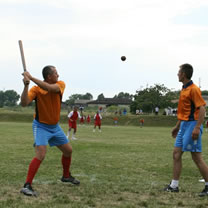
People playing oină

I came across the oină in one of the Romanian lessons I did today. It’s translated as ‘oina’ without any explanation of what it means. As the lesson was about sport and oină is something you play, I guessed that it’s some kind of sport.

According to Wikpedia, oină [ˈoj.nə] is a traditional Romanian sport similar to baseball and lapta (a similar Russian sport).

The word oină was originally hoina, and is comes from the Cuman word oyn (game), which is cognate with the Turkish oyun). The game was first mention in writing in 1364. Cuman is an extinct Turkish language that was spoken in Hungary until the 18th century.