Fourfold

Words for four and related things in Celtic languages:
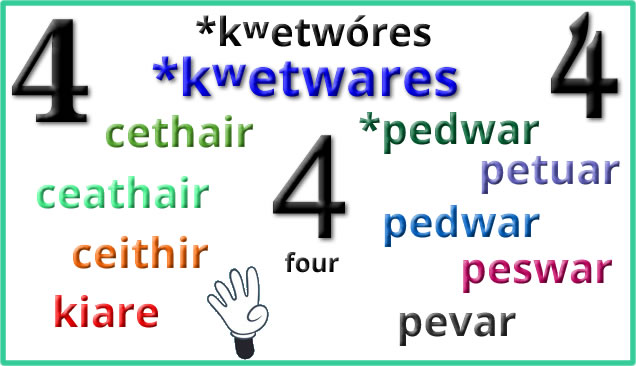
four

Proto-Celtic *kʷetwares = four
*kʷetwariyos = fourth
Gaulish petru, petuar = four
petuarios = fourth
Old Irish (Goídelc) cethair [ˈkʲeθirʲ] = four
cethramad [ˈkʲeθraṽað] = fourth
cethracha = forty
cethrar = four people
cethardúil = four elements
Middle Irish (Gaoidhealg) cethair = four
cethramad = fourth
cethrar = four people
cethracha = forty
cetharchair = four-sided, square, rectangular
cethairríad = four-wheeled chariot or carriage
cethardenus = space of four days
cethardóit = group of four
cetharaird = the four points of the compass, the four quarters, the world, universe
Irish (Gaeilge) ceathair [ˈcahəɾʲ/ˈcæɾʲ] = four, quadruped
ceithre [ˈcɛɾʲə/ˈçɛɾʲə] = four
ceathrar [ˈcahɾˠəɾˠ/cæːɾˠ] = four people
ceathracha = forty
ceathrú [cahˈɾˠuː] = quarter, thigh, quatrain
ceathrúnach = quartermaster
ceathairbhliantúil = quadrennial
ceathairchodach = fourfold, quadruple
ceathairchosach = fourfooted, quadruped
ceathairéad = quartet
ceathairfhillte = quarto, fourfold
Scottish Gaelic (Gàidhlig) ceithir [kʲehɪrʲ] = four
ceathramh [kʲɛrəv] (4mh) fourth (4th)
ceathrar [kʲɛrər] = four (people)
ceathrad [kʲɛrəd] = forty
cairteal [kar̪ˠʃdʲal] = quarter; quarters, lodgings
ceithir-chasach = quadruped, four-legged animal
ceithir-cheàrnach = quadrilateral
ceithir-fillte = quadruple, fourfold, four-ply
Manx (Gaelg) kiare [kʲeːə(r)] = four, foursome, quartet
kiarroo, (yn) chiarroo = (the) fourth
kerroo = fourth, quarter, quatrain
kiarad = forty
kiare-fillagh, kiare-filley = fourfold, quadruple
kiare-lhiatteeagh, kiare-lhiatteean = four-sided, quadrilateral
kiare-chassagh = four-footed, four-legged, quadruped
Proto-Brythonic *pedwar [pɛdˈwaːr] = four
*pėdwėrɨð [pe̝dwe̝ˈrˑɨːð] = fourth
Old Welsh petguar = four
petguaret = fourth
Middle Welsh (Kymraec) pedwar, peduar = four (m)
pedeyr, pedair, pedeir = four (f)
pedweryd = fourth (m)
pedwyred = fourth (m)
pedwar deg, pedeir deg = fourteen
pedwar/pedeir ar bymthec = nineteen
pedwar ugein(t) = eighty
Welsh (Cymraeg) pedwar [ˈpɛdwar] = four (m)
pedair [ˈpɛdai̯r/ˈpeːdai̯r] = four (f)
pedwerydd [pɛdˈwɛrɨ̞ð] (4ydd) = fourth (m)
pedwaredd [pɛdˈwarɛð] (4edd) = fourth (f)
pedwarplyg = quadruple
pedwaraf, pedwaru = to divide into four, quarter
pedwaraid = set of four, foursome
pedwar ar ddeg = fourteen
pedwar ar bymtheg = nineteen
pedwar deg = forty
pedwar ugain = eighty
Middle Cornish (Cernewec) peswar = four (m)
pedar = four (f)
peswere, pyswere = fourth
peswardhec, pazawardhak = fourteen
padzhar iganz = eighty
padzhar iganz ha deg = ninety
Cornish (Kernewek) peswar, pajar = four (m)
peder = four (f)
peswora, pajwora = fourth
peswartrosek = fourfooted
peswardhek = fourteen
peswar ugens = eighty
Old Breton petguar = four
petguare = fourth
Middle Breton (Brezonec) peuar, puar = four
peuare, pevare = fourth
peuarzec, pévarzecq, piarzeg = fourteen
peuaruguent, pêver huguent, pévar uguent = eighty
pevar-benveg = quartet
pevarc’hartier = to cut in quarters
pévar c’hemend = quadruple
pevar(-)c’hementi(ñ) = to quadruple
Breton (Brezhoneg) pevar = four (m)
peder = four (f)
pevare = fourth
pevarved = fourth (m)
pedervet = fourth (f)
pevarzek = fourteen
pevar-ugent = eighty
pevarad = quartet
pevarzuek = quadrilatéral

Etymology: from Proto-Indo-European *kʷetwóres (four) and *kʷetwr̥yós (fourth) [source].

English words from the same roots include four, quarter, quart, quartet, quaruple, and words beginning with tetra-, such as tetradecimal (a 14-base counting system) [source].

Sources: Wiktionary, Am Faclair Beag, Online Manx Dictionary, Teanglann.ie, eDIL – Electronic Dictionary of the Irish Language, In Dúil Bélrai English – Old Irish glossary, Geiriadur Prifysgol Cymru, Gerlyver Kernewek, Gerlyvyr Cernewec, Dictionaire Favereau, TermOfis, Le dictionnaire diachronique du breton, Geriafurch, English – ProtoCeltic WordList (PDF), Etymological Dictionary Of Proto Celtic
Threesome

Words for three and related things in Celtic languages:

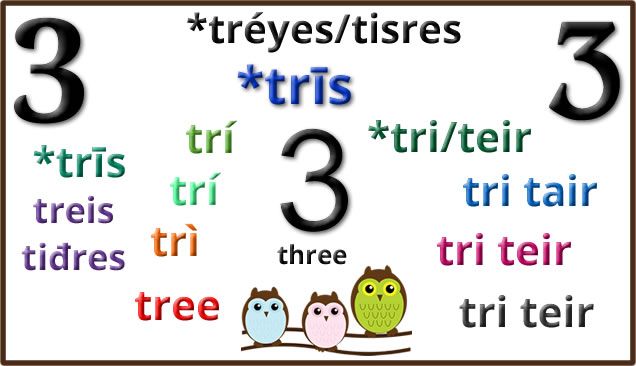
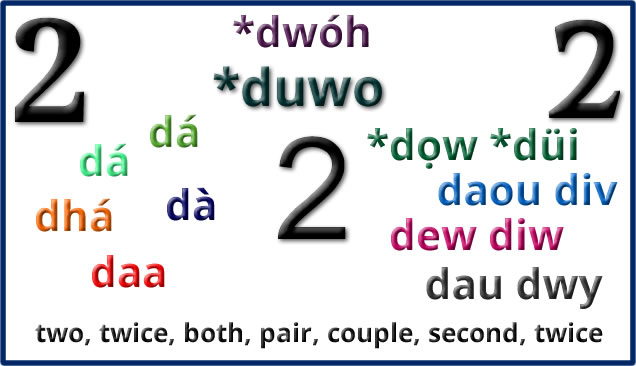
three

Proto-Celtic *trīs = three
*tritiyos = third (in a sequence)
*trisano- = third (fraction)
Celtiberian Tiriś = three
Gaulish treis = three (m)
tiđres = three (f)
Lusitanian *trīs = three
Old Irish (Goídelc) tri, trí [tʲrʲiː] = three
tress = third (in a sequence)
trían = third (fraction)
tríar = three (people)
tréide = three things
trédenus = three days
tréimse = three months
Middle Irish (Gaoidhealg) trí = three
tress = third (in a sequence), one of three
trímad = third (in a sequence)
trían = third (fraction)
tríar = three persons, trio, three things
tréimse = three months, a quarter (of a year)
Irish (Gaeilge) trí [tʲɾʲiː] = three
tríú [tʲɾʲiːuː] = third (in a sequence), third part
triúr [tʲɾʲuːɾˠ] = three (people)
triantán = triangle
triantánacht = trigonometry
triantánaigh = to triangulate
tríoiseach = three-dimensional
Scottish Gaelic (Gàidhlig) trì [triː] = three
treas [tres] (3ˢ) third (3ʳᵈ)
treasamh (3ᵐʰ) third (3ʳᵈ)
triùir [truːrʲ] = three (people)
trì-fillte = triple, threefold, three-ply
trian [triən] = third (part)
triantan [triəndan] = triangle
iantanachd [iantanachd] = trigonometry
Manx (Gaelg) tree [t̪riː] = three
troor = three (people), threesome, triad, Trinity, trio, trinity
treeoo, trass = third
trooane, troorane = triangle
Proto-Brythonic *tri [triː] = three (m)
*teir = three (f)
*trɨdɨð [trɨˈdɨːð] = third (m)
*trɨdeð = third (f)
Old Welsh *tri [triː] = three (m)
*teir = three (f)
tritid = third (in a sequence)
trean = third (fraction)
Middle Welsh (Kymraec) tri = three (m)
teir, tair = three (f)
trited, trydet, trydyd = third
teir coglaỼc, trichonglaỼc, trichongloc = triangular, three-cornered
trydeblyc, tridyblic = three times, threefold, triple
Welsh (Cymraeg) tri [triː] = three (m),
tair [tai̯r] = three (f)
triawd = trio, threesome, triology, triple
trichorn = three-horned, three-cornered, tricorn hat
tric(h)onglog = triangular, three-cornered
tri deg = thirty
tridyblyg = three times, threefold, triple, triplicate
trionglyn = triangle
trydydd (3ydd) = third (m)
trydedd (3edd) = third (f)
teirgwaith = three times, thrice, on three occasions
Middle Cornish (Cernewec) tri, trei = three (m)
teir, teyr = three (f)
triddydh = the space of three days
tridzha = third
trihans = three hundred
trindas, trinsys = Trinity
triugans = three score, sixty
trivorh = three-pronged
Cornish (Kernewek) tri, trei = three (m)
trei = three (f)
tredhek, terdhek = thirteen
tressa, tryja = third
triasen = triplet
trihorn = triangle
tryflek = threefold, triple
teyrgweyth = three times
Old Breton tri = three
Middle Breton (Brezonec) tri, try = three (m)
teir, teyr = three (m)
tri-c’hard = three quarters
tri-ugent = sixty
tri-chant = three hundred
triad = trio, group of three
tric’hogn, tricoign, tric’horn = triangle
Breton (Brezhoneg) tri = three (m)
teir [ˈte.iʁ] = three (f)
trived (m) teirved (f) = third
trizek = thirteen
tri-ugent = sixty
trifarzh = three quarters
tric’horn, tric’hogn = triangle

Etymology: from Proto-Indo-European *tréyes (three – m) and *tisres (three – f) [source].

English words from the same roots include tertiary, three, thrice, three, triad, tripod, triple and triplex [source].

Sources: Wiktionary, Am Faclair Beag, Online Manx Dictionary, Teanglann.ie, eDIL – Electronic Dictionary of the Irish Language, In Dúil Bélrai English – Old Irish glossary, Geiriadur Prifysgol Cymru, Gerlyver Kernewek, Gerlyvyr Cernewec, Dictionaire Favereau, TermOfis, Le dictionnaire diachronique du breton, Geriafurch, English – ProtoCeltic WordList (PDF), Etymological Dictionary Of Proto Celtic
A Pair of Twos

Words for two and related things in Celtic languages:

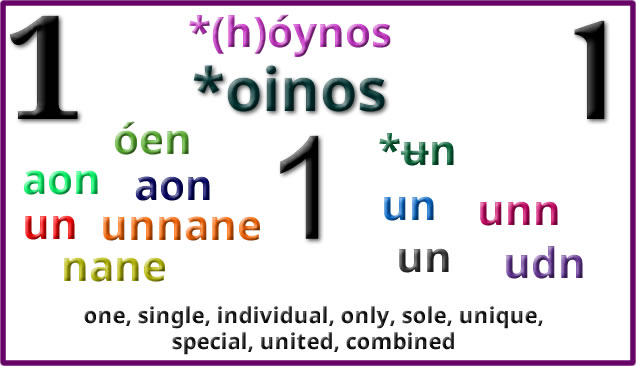
two

Proto-Celtic *duwo = two
*dwau = two (masculine)
*dwī = two (feminine)
Old Irish (Goídelc) [daː] = two
dechenc = two people
déide = two things
Middle Irish (Gaoidhealg) = two, twice
dechenc = a pair of persons
déide = double, consisting of two, two things, a pair
Irish (Gaeilge) dhá [ɣɑː/ɣaː] = two
[d̪ˠɑː/d̪ˠaː] = two (used after an (the), aon (any) and céad (first))
= two (used when counting, e.g. a dó)
dháréag = twelve
daichead = forty
déidhe = two persons or things, two, pair
dís = two, pair, couple
Scottish Gaelic (Gàidhlig) [daː] = two
dà reug = twelve
dà fhichead = forty
dà-fhillte = double, twice over, two-way, twofold
dà-chànanach = bilingual
dà-chomhaireach = bidirectional
dà-bheathach = amphibian
dà-bheulach = duplicitous, two-faced
Manx (Gaelg) daa [d̪eː/d̪ɛː] = two, both
daa cheayrt = doubly, twice, twice over, double
daa-hengagh, daa-hengoil = bilingual
daa hroagh = two-way
daa laare = double-decker
daa lout = two-storey
daa yeig = twelve
daeed = forty
Proto-Brythonic *dọw = two (masculine)
*düi = two (feminine)
Middle Welsh (Kymraec) dau, dou, deu, dev = two (masculine)
dwy = two (feminine)
dau dafodioc = double-tongued, two-tongued, bilingual
deu dyblyc, deudeblyg, deudyblyc, deudyblic = twofold, double, duplicate
deu eiryawc = deceitful, double-tongued
doudec, deudec, deudeg = twelve, dozen
deuckeyn, deugeint, deu vgein, deugein = forty
duyweith, dwyweith, dwyweyth = twice, doubly
Welsh (Cymraeg) dau [daɨ̯/dai̯] = two (masculine), both, pair, couple, second, twice
dwy [duːɨ̯/dʊi̯] = two (feminine)
daudafodiog = double-tongued, two-tongued, bilingual
dauddeall = equivocal, ambiguous
dauddyblaf, dauddyblu = to (re)double
dauddyblyg, deuddyblyg = twofold, double, duplicate
daueiriog, deueiriog = deceitful, double-tongued, prevaricating, false, equivocal
deuddeg = twelve, dozen
deugain = forty
dwywaith = twice, doubly
Middle Cornish (Cernewec) dew = two (masculine), pair, couple
dui, dyw = two (feminine)
dewdhec = twelve
dewugens = two score, forty
deweth, dewyth = twice
Cornish (Kernewek) dew = two (masculine)
diw = two (feminine)
dewdhek = dozen, twelve
dew ugens = forty
dewblek = double, twofold
dewbries = married couple
dewdhen = couple, pair
dewek = binary
diwweyth = twice
Old Breton (Brethonoc) dou = two
Middle Breton (Brezonec) daou, dou, deü = two
div = two (feminine)
doudec, douzec, daoudec, daouzek = twelve
dou vguent, daouuguent, daou-ugent = forty
daouad = duo
daudroadecq, daoudriadeg, daou-droadek = biped
daougementiñ = to double
Breton (Brezhoneg) daou [dɔw] = two (masculine), double, couple
div [diw] = two (feminine)
daouzek = twelve
daou-ugent = forty
daouad = binomial, duo
daouhanteriñ = to cut in two
di(v) wezh = twice

Etymology: possibly from Proto-Indo-European *dwóh₁ (two) [source]. English words from the same roots include binary, double, duo, duplex, twig, twin and two [source].

Sources: Wiktionary, Am Faclair Beag, Online Manx Dictionary, Teanglann.ie, eDIL – Electronic Dictionary of the Irish Language, In Dúil Bélrai English – Old Irish glossary, Geiriadur Prifysgol Cymru, Gerlyver Kernewek, Gerlyvyr Cernewec, Dictionaire Favereau, TermOfis, Le dictionnaire diachronique du breton, Geriafurch, English – ProtoCeltic WordList (PDF), Etymological Dictionary Of Proto Celtic

One Alone

Words for one and related things in Celtic languages:

One

Proto-Celtic *oinos/*oyno- = one
*oynānos = alone, personally
Old Irish (Goídelc) oen [oːi̯n] = one
oenar [ˈoːi̯nər] = one person, alone, by oneself
oentu [ˈoːi̯n͈tu] = oneness, unity
oínḟer [oːi̯nʲer] = one person
Middle Irish (Gaoidhealg) óen = one, the same, single, only, unique
oenar = a single individual, one alone, one person
oentu = oneness, unity, association, fellowship, alliance
Irish (Gaeilge) aon [eːn̪ˠ/iːnˠ] = one, any, same, only
aonad = unit
aonadach = unitary
aonán = individual
aonar = one, lone, person, single, solitary
aonarach = single, solitary, lone
aonaracht = singularity, solitude
aonarán = single, solitary person
aontaigh = to unite
aonú = first
Scottish Gaelic (Gàidhlig) aon [ɯ̃ːn] = one, same, sole, approximately, about
aonachd = unity, union
aonaich = to combine, coalesce, unite, intergrate
aonaichte = united, integrated
aonan = one item/thing/person
aonar = one (person), (state of being) alone
aonanag = onesie
aonaranach = alone, desolate, deserted, lone, solitary
aonrachd = solitude, solitariness
Manx (Gaelg) un [eːn/ɯːn/uːn] = one
unnane = one, identical, ace (in cards)
nane = one
unnaneagh = particular, singular, unanimous
unnaneysee, unnaneysey = to unite
unnaneysit = united
Proto-Brythonic *ʉn [ʉːn] = one
Old Welsh un = one
ungueid = once
Middle Welsh (Kymraec) un, vn [ʉn] = one, single, individual
unbin, vnbenn, unbyn = dictator, monarch, tyrant, despot, chief
unkyrn, vncorn, ynkorn = unicorn, one-horned
unweith, vn weith, vnwaith = once
Welsh (Cymraeg) un [ɨːn/iːn] = one, single, individual, only, sole, unique, special, united, combined
unaf, uno = to unite, unify, coalesce, amalgamate, combine, join, connect, agree, be reconciled
unaidd = united, unary
unawd = solo (music/dance)
unawdr, unawdydd = soloist
unben = dictator, monarch, tyrant, despot, chief
unbriodas = monogamy
uncorn, ungorn = unicorn, one-horned, chimney-stack
unwaith = once, (on) one occasion, (at) one or any time, sometime
Middle Cornish (Cernewec) un = one, individual
uncorn = unicorn
unsel = only, alone
unver = of one mind, unanimous, agreed
unya = to make one, unite, join
unwyth = once
Cornish (Kernewek) unn, udn [ˈʏn/ˈɪᵈn] = one, only, single, sole
unnik = individual, only, single, sole, unique
unplek = singular
unran = one-piece
unsel = only
unses = unit, unity
untu = one-sided, unilateral
unver = agreed, in agreement, unanimous
unweyth = incidentally, once, only
unya = to unite
Old Breton (Brethonoc) un = one
Middle Breton (Brezonec) un, unn, unan, vnan, en, eun, oun = one
unanaat = to unify
unanadur = unification
unanded = uniqueness
unander = singular
unanelezh = unit, unity
Breton (Brezhoneg) un, unan = one, someone, unit, unity
unvanadur = unification
unander = singular
unvaniñ = to unify
unanelezh = uniqueness

Etymology: possibly from Proto-Indo-European *(h₁)óynos (one, single) [source].

English words from the same roots include one, a, an and oenology (the study of wines and winemaking) [source].

Sources: Wiktionary, Am Faclair Beag, Online Manx Dictionary, Teanglann.ie, eDIL – Electronic Dictionary of the Irish Language, In Dúil Bélrai English – Old Irish glossary, Geiriadur Prifysgol Cymru, Gerlyver Kernewek, Gerlyvyr Cernewec, Dictionaire Favereau, TermOfis, Le dictionnaire diachronique du breton, Geriafurch, English – ProtoCeltic WordList (PDF), Etymological Dictionary Of Proto Celtic