
Here’s a recording in a mystery language.
Do you know or can you guess the language, and do you know where it’s spoken?
Here’s a recording in a mystery language.
Do you know or can you guess the language, and do you know where it’s spoken?
What would you buy in a ferretería?

When I first saw this (Spanish) word, I thought it was a shop that sells ferrets. I was slightly disappointed to discover that it actually means hardware, or hardware store or ironmongers. Or in other words, a place selling things made of ferrous metal (iron).
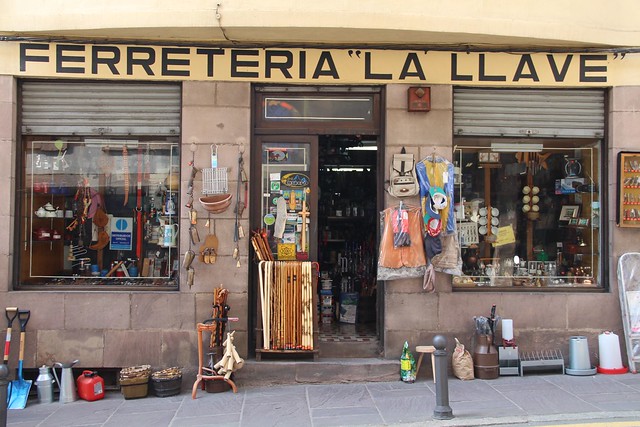
It comes from ferrete (branding iron), from the Old French ferret (branding iron), a diminutive of fer (iron), from the Latin ferrum (iron); and -ería (a suffix that turns a noun into a store or restaurant that sells such an item; characteristic of) [source].
A shop selling ferrets (hurones) would be a huronería, and the Spanish word for ferret, hurón, comes from the Latin fūr (thief), which is also the root of the English word ferret [source]. More about ferrets.
Other words for hardware store in Spanish include:
Other words ending in -ería include [source]:
Recently I was sent details of a image-based communication system that is being developed by some friends of mine at KomunIKON. It’s known as IKON, and according to their website:
IKON is an easy, intuitive, international and transcultural visual language. It is a structured system of graphical communication that combines icons and linguistics.
By being fun and creative, IKON has applications in different fields, from communication technology to graphic design, education, product merchandise and humanitarian crisis support.
Here are some examples – see if you can work out what they mean:



All the examples on the KomunIKON website, and the ones they sent to me, include English labels under each image. The word order for each one is based on English, but apparently “the IKON language is very flexible, so the grammatical explanations that we offer here are meant to show some ideas behind our icons, but they are not rigid rules to be learnt, anyone can use the language as they prefer, as far as the receiver understands.”
So we have a visual communication system without grammatical conventions. That doesn’t sound like a language to me. What do you think?
Here’s a recording in a mystery language.
Do you know or can you guess the language, and do you know where it’s spoken?
I am currently (re)learning Japanese, and am noticing some differences between the meanings of characters in Japanese (漢字 – kanji) and in Chinese (汉字 [漢字] hànzì). In some cases the meanings are similar but subtly different, in other cases they’re completely different.

For example, in Mandarin Chinese 高 (gāo) means tall or high (高的 gāode), or senior (高级的 gāojíde), while in Japanese 高 (taka), means quantity, amount (of money), volume or number, 高い (takai) means high, tall, expensive, above average or loud, and 高 (kō) means high (school).
The Chinese word for expensive is 贵 [貴] (guì), which also means valuble. In Japanese this character, 貴 (ki), means your, and indicates high rank, status, love or respect. Or when it’s pronounced mochi it means lord, god, goddess, and is used in honorific title for deities and high-ranking people. One Japanese word for you is あなた (anata), which is usually written in hiragana, but can be written with the kanji 貴方. In very formal written Chinese 贵方 [貴方] (guìfāng) can be used to mean you.
The Japanese word for cheap is 安い (yasui), while the same character in Chinese, 安 (ān), means quiet or safe. The Chinese word for cheap is 便宜 (piányi), which in Japanese is pronounced bengi and means convenience, accommodation, advantage, benefit or expediency.
The character 便 is also pronouned biàn in Mandarin, and means convenient, convenience and to excrete. It appears in the word 便利 (biànlì) = convenient, to faciliate, which also exists in Japanese as 便利 (benri) meaning convenient, handy or useful.
The character 利 (lì) means sharp, advantageous, interest or to profit in Mandarin. In Japanese it’s pronounced ri and means advantage, benefit, profit or interest. It appears in the word 利益 (lìyì / rieki), which means benefit in Mandarin, and profit or gains in Japanese, and also in 利害 (lìhai / rigai) which means terrible in Mandarin, and advantages and disadvantages in Japanese. Which should not be confused with 厉害 [厲害] (lìhai), which means terrbile, terribly or awesome, and is used as a general intensifier in Mandarin. The equivalent in Japanese is 素晴らしい (subarashī).
There are many more. Have you noticed any?
Sources: LINE Dict Chinese-English, jisho.org
The other day I came across an interesting Dutch word – klimop [‘klɪ.mɔp], which means ivy (Hedera helix).

It comes from opklimmen (to climb up, become greater, become larger), and literally means “climb-up”, which seems like a good name for a plant the climbs up walls and other things [source].
Klimop also features in Afrikaans, and similar words are used in Low German (Klimmop) and Papiamentu (klemòk) [source].
Klimmen (to climb, go up) comes from the Middle Dutch climmen (to climb, rise, to go up, increase), from the Old Dutch *climban (to climb), from the Proto-Germanic *klimbaną (to climb) [source].
The English word climb comes from the same root, via the Middle English climben [ˈkliːmbən/ˈklimbən] (to climb, scale, ascend, soar), and the Old English climban [ˈklim.bɑn] (to climb). In Late Middle English the b was no longer pronounced, so climben became [ˈkliːmən/ˈklimən]. Then the i became a diphthong and the -en ending fell off, resulting in the pronunciation [klaɪm] [source].
The English word ivy comes from the Middle English ivi (ivy), from the Old English īfiġ [ˈiː.vij] (ivy), from the Proto-Germanic *ibahs (ivy), from the Proto-Indo-European *(h₁)ebʰ- [source].
From the same root we get words for ivy in Danish (efeu), German (Efeu) and Norwegian (eføy) [source], and words for yew (trees) in Celtic languages, including iúr in Irish and iubhar in Scottish Gaelic [more details]

Here’s a recording in a mystery language.
Do you know or can you guess the language, and do you know where it’s spoken?
Yesterday I discovered that a French word for skip is benne [bɛn], which also means cable car, cable way, dumpster, bucket, bin, barrow or dump truck [source].
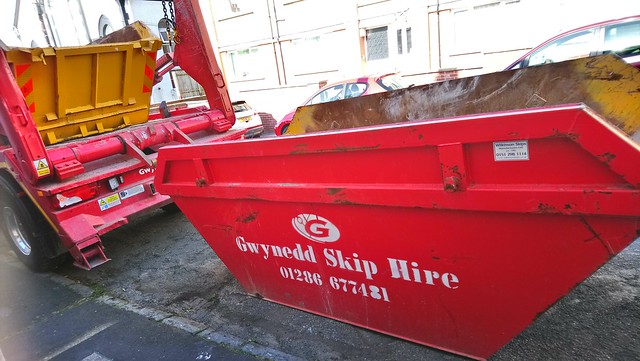
It comes from the Latin word benna (a wagon of wicker or basket-work – see below), which comes from the Gaulish word bennā [benːaː] (carriage), from the Proto-Indo-European word *bʰendʰ- (to bind, bond), which is also the root of English words such as band, bandage, bend, bin, bind, bond and bundle, and also the Welsh word ben (cart, wagon, carriage), and the Italian word benna (bucket, grab) [source].
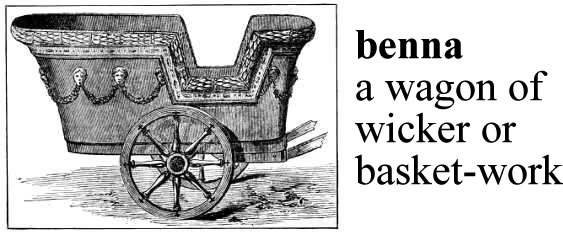
Similar wagons are still used in parts of Italy, Germany, Switzerland and Belgium. In Beligum they are known as banne, and they are benne in Switzerland. Sources: gutenberg.org and perseus.tufts.edu
Some related words in French include:
Incidentally, after I booked a skip the other day, my builder called to tell me that I didn’t need one after all. They will use a truck to take away all the detritus from the work in my garden. Fortunately I was able to cancel the booking and get a refund. Unfortuantely I can’t a refund on the skip permit, which the skip hire people applied for on my behalf.
The hedge in my garden was cut down yesterday, and soon work will start clearing the end of the garden where my new studio will be built. Now I need to hire a skip for all the stuff that needs to be taken away.

This is how my garden looks at the moment. The shed and the mound next to it will be removed next. The wooden fence on the left belongs to my neighbours, and hopefully they’ll fix it or replace it soon.
A skip in this sense is “a large open-topped container for waste, designed to be lifted onto the back of a truck to remove it along with its contents” (see below). It can also refer to a transportation container in a mine, usually for ore or mullock (waste material from a mine), a wheeled basket used in cotton factories, a charge of syrup in the pans (in sugar manufacture), or a beehive.

It comes from the Middle English word skep(pe) (basket, beehive made of straw or wicker), from the Old English sceppe, from Old Norse skeppa (basket), which is of unknown origin [source].
From the same Old Norse root we get the Swedish word skeppa [ɧɛpʰa] (to ship; to transport by ship or boat) [source].
Apparently the word skip is mainly used in the UK, and the equivalent in North America is a dumpster. Is that right? What about in other places?
The word dumpster comes from dump and Dempster, a brand name for such things that became generic [source].
Here’s a recording in a mystery language.
Do you know or can you guess the language, and do you know where it’s spoken?