Underthrowing

The other day the word onderwerp [ˈɔndərwɛrp] came up in one of my Dutch lessons. It means subject, topic or issue, and to help me remember it, I decided to look into its etymology.

SUBJECT

It comes from onder (under, among) and werpen (to throw, shed, cast), and is a calque of the Latin word subiectum (that which is spoken of, the foundation or subject of a proposition) [source].

Related expressions include onderwerpen (to subject), onderwerping (submission, subjugation, subjection), onderwerpszin (subject clause), gespreksonderwerp (topic of conversation, talk, conversation piece), nieuwsonderwerp (news item)

Subiectum comes from subiciō (throw under or near; supply; forge; subject; propose), from sub- (under) and‎ iaciō (throw, hurl). The English word subject comes from the same root, as do related words in other languages, such as sujet (subject, cause, reason) in French, and soggetto (subject, dependent) in Italian [source].

So an onderwerp and a subject is something that is thrown under.

A related Dutch word is voorwerp [ˈvoːrˌʋɛrp], which means object or item, and comes from voor (for, before, in front of) and werpen (to throw, shed, cast), and is a calque of the Latin word obiectum (a charge, accusation), which is the root of object comes from the same root, as do related words in other languages, from obiciō (throw to; offer, present) [source]

Bonnets

What would you call a knitted woolen hat with a bobble on top?

Lost: red bobble hat

I would call it a bobble hat, and I discovered yesterday that in French such a hat is called un bonnet à pompons or un chapeau à pompons or simply un bonnet. What about in other languages?

Bonnet [bɔ.nɛ] also means hat, cap, beanie, knit cap, skully, stocking cap or (bra) cup. Other types of bonnet include:

  • bonnet d’âne = dunce’s cap
  • bonnet de bain = bathing cap, swimming hat
  • bonnet de nuit = nightcap
  • bonnet de police = forage cap
  • bonnet de douche = shower cap

A bigwig, or “person of consequence”, is un gros bonnet, and the French equivalent of six of one, half a dozen of the other is bonnet blanc, blanc bonnet.

Bonnet comes from the Middle French bonet, from the Old French bonet (material from which hats are made), from the Frankish *bunni (that which is bound), from the Proto-Germanic *bundiją (bundle), from the Proto-Indo-European *bʰendʰ- (to tie).

The English word bonnet comes from the same root, and can refer to various types of headgear, particularly a type of hat usually framing the face and tied with ribbons under the chin and worn mainly by females.

baby bonnets

In Scots a bonnet/bunnet refers to “A head covering for men or boys, including all kinds of caps, but not hats”.

Sources: ReversoDictionary, Wiktionary, Dictionaries of the Scots Language / Dictionars o the Scots Leid

Knickknacks

An interesting Dutch word I learnt yesterday is liflafjes [ˈlɪf.lɑf.jəs], which
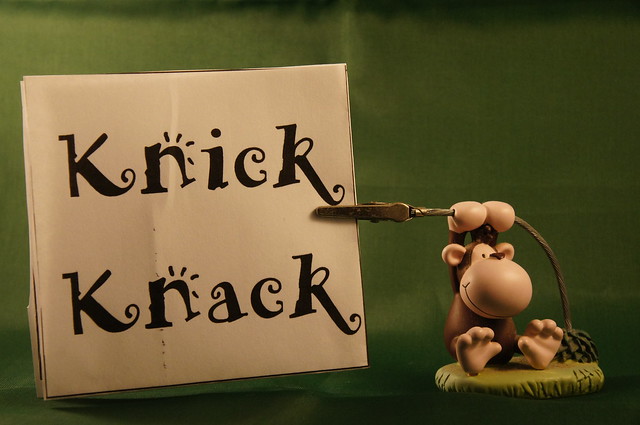
means scraps, trimmings, leftovers or knickknacks [source]. The singular version, liflafje, apparently means “a small meal that fails to fill” or “a trifle” and is a diminutive of liflaf, which means insipid food, insipid text(s) or bland writing, and used to mean insipid or tasteless [source].

Knick-Knack

According to webwoordenboek.nl, liflaf means “een smakelijk maar weinig voedzaam gerechtje” (a tasty but not very nutritious dish), or “een aardig maar overbodig iets” (a nice but unnecessary thing).

These words come from liflaffen, a dated word that’s used mainly in Belgium to mean to grovel, fawn, flatter, caress or fondle. A related word is liflafferij [ˌlɪf.lɑ.fəˈrɛi̯], which means flattery or sweet-talking [source].

A knick(-)knack is a small ornament of minor value, a trinket or bauble. It is a reduplication of knack (aptness, petty contrivance, trick), which possibly comes from the Middle English krak (a sharp blow). An equivalent in Dutch is snuisterij [source].

A mishmash is a collection containing a variety of miscellaneous things. It is a reduplication of mash. Some synonyms include hodgepodge, melange, mingle-mangle, oddments and odds and ends. Do you have any others? An equivalent in Dutch is mikmak [source].

Snoring Fits

I came across an interesting Dutch word today – snorfiets [snɔrfits], which sounds like ‘snore fits’, and means a moped or scooter, particularly one limited to a maximum speed of 25 km/h (15.5 mph) [source].

Jawa Snorfiets

Snor [snɔr] on its own means mustache or whiskers, and when I saw snorfiets I thought it maybe referred to a bicycle with mustache-shaped handlebars, or some other mustache-shaped parts. In fact it comes from snorren (to hum, roar, purr, whirr).

Fiets [fits] means bicycle, and its origins are uncertain. It may be named after Elie Cornelis Viets, a wheelwright from Wageningen who made and repaired bicycles from 1880. It may be an abbreviation of a Dutch version of the French word velocipède, or it might come from vietse/fiette, Limburg and East Brabant dialect words meaning ‘to run fast or move quickly’, or from the older dialect word vietsen (to move quickly). The last exclamation is thought to be the most likely [source].

Bicycles, or fietsen, are quite popular in the Netherlands, so much so that there are more bikes than people there. According to an article in The Brussels Times, in 2018 there were an estimated 22.9 million bicycles in the Netherlands, and just 17.2 million people, or 1.3 bicycles per person.

Other types of fiets include:

  • bakfiets = cargo bike, freight bike
  • bierfiets = a party bike, beer bike – a pedal-powered road vehicle with a bar counter, multiple seats and a beer tap, so that the riders can drink while riding
  • bromfiets = moped
  • ligfiets = recumbent bike
  • motorfiets = motorbike
  • omafiets = roadster bike (“grandma bike”)
  • racefiets = racing/road bike

Pling!

I discovered the other day the the exclamation mark (!), which is apparently known as an exclamation point in American English, has a number of other names. When it was first introduced by printers in the 15th century, it was known as a sign of admiration or exclamation or the note of admiration in English.

In the early 20th century it was known as an ecphoneme [source]. A related word is eroteme, which is another name for the question mark (?), and comes from the Ancient Greek ἐρώτημα (erṓtēma – question), from ερωτώ (erotó – to ask) [source].

In 1950s American typesetting manuals it was referred to as a bang. Related punctuation marks are the interrobang (‽), a combination of an exclamation mark and question mark that was invented in 1962 by Martin K. Speckter, an American advertising executive [source], and the gnaborretni (⸘), an inverted interrobang [source].

Printers might call it a screamer, gasper, slammer or startler.

British hackers apparently call it, or called it, a shriek or pling, which is my favourite name for this punctuation mark.

In Welsh the exclamation mark is known as a ebychnod, from ebychu (to exclaim) and nod (mark), or rhyfeddnod, from rhyfedd (strange, odd) and nod.

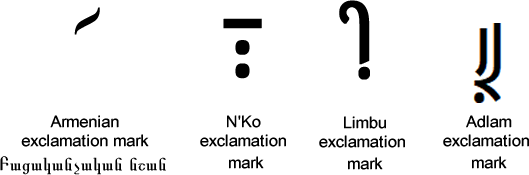
In Armenian the equivalent of the exclamation mark (see below) is known as a Բացականչական նշան (Bats’akanch’akan nshan) or “exclamatory mark/sign” or “screamer”.

Here are some exclamation marks in other alphabets:

Exclamation marks in various alphabets

What is the exclamation mark called in other languages?

Here’s a video I made last week about the word exclamation:

¡Guácala!

One of the Spanish words I learnt today was ¡guácala! [ˈɡwa.ka.la], which means yuck! ew! gross! it’s disgusting! and similar exclamations of disgust. It’s used in El Salvador, Honduras, Mexico and the Dominican Republic to indicate dislike, disgust, or rejection [source].

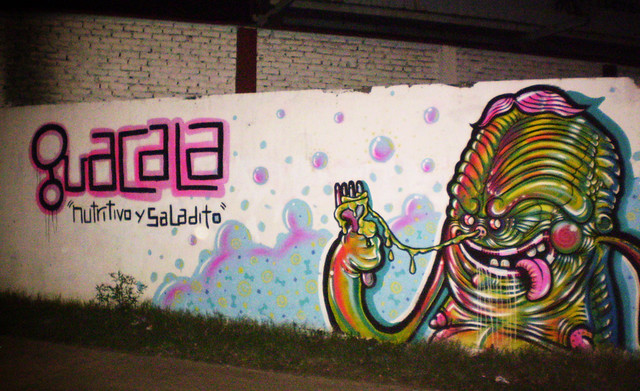
*****GUACALA**** golosina visual ***nutritiva y saladita

It comes from guacal (wooden crate, tub, calabash tree), from the Classical Nahuatl huacalli [kwaˈkalːi] (wooden crate) [source]. Why a word for a wooden crate became an exclamation of disgust is not clear.

Here are some examples of how it’s used (from ReversoContext and Duolingo):

  • ¡Guácala! ¡Sabe horrible! = Yuck! It tastes horrible!
  • ¡Guácala, casi lo pisé! = Ew, I almost stepped in it.
  • ¡No, guácala! = No, it’s disgusting!
  • ¡Guácala, mal postre = Euhhh… bad pie

Related words include:

  • guácara = vomit
  • guacarear = to vomit

Both of which are used in Mexico.

Other Spanish words with a similar meaning include:

  • ¡Qué asco! = Yuck! How revolting! How disgusting!
  • ¡Puaj! = Ew! Yeech! Blecchh! Yuk! Phooey! Gross!
  • ¡Uf! = Phew! Ugh!
  • ¡Puf! = Yuck!

Are there other words in Spanish with a similar meaning?

What about equivalent words in other languages?

One of my favourite expressions in Welsh is ych a fi! [əx ə viː], which means yuck! [source].

The word ych, pronounced [ɨːχ/iːχ], also means ox.

Longhaired Kites

An interesting Spanish word I learnt today is cometa [koˈmeta], which means both kite and comet. It comes from the Latin word comēta, an alternative version of comētēs (comet, meteor, shooting star; portent of disaster), from the Ancient Greek κομήτης (komḗtēs, – longhaired, comet), which refers to the tail of a comet, from κομᾰ́ω (komáō – let the hair grow long) and -της (-tēs – a suffix that forms nouns) [source].

Cometas

Related words and expressions include:

  • cometa voladora = hang gilder
  • hacer volar una cometa = to fly a kite

Other words for kite in Spanish include [source]:

  • papalote in Cuba, Honduras, Mexico, from the Classical Nahuatl pāpalōtl (butterfly) [source]
  • barrilete in Argentina, Nicaragua, a diminutive of barril (barrel) [source]
  • piscucha or papalota in El Salvador – the former of unknown origin. The latter from Classical Nahuatl like papalote
  • volantín in Peru, Chile, Argentina, probably from volar (to fly)
  • chiringa in Puerto Rico, probably a version of chiringo which means small in Puerto Rico and Cuba [source]

Are there any other words for kite in other Spanish-speaking countries?

Red Kites - Gigrin Farm Wales

Kite, as in the bird of prey of the subfamily Milvinae, is milano in Spanish, which also means the down of a thistle and flying gurnard (Dactylopteridae) – a type of fish. This comes from the Vulgar Latin *milānus, from the Latin milvus (kite, gurnard) [source].

Neshness

If someone told you they were feeling a bit nesh, would you know what they meant?

Nesh [nɛʃ] means “sensitive to the cold” and “timid or cowardly”, according to Dictionary.com, and is apparently used in in northern and Midlands English dialects. Although I grew up in the northwest of England, I’d never heard it before a friend mentioned it yesterday.

According to Wiktionary it means:

  • Soft, tender, sensitive, yielding
  • Delicate, weak, poor-spirited, susceptible to cold weather, harsh conditions etc
  • Soft, friable, crumbly

As a verb it means “to make soft, tender or weak”, or “to act timidly”.

It comes from the Middle English nesh/nesch/nesche, from the Old English hnesċe/ hnysċe/hnæsċe (soft, tender, mild; weak, delicate; slack, negligent; effeminate, wanton), from the Proto-West Germanic *hnaskwī (soft), from the Proto-Germanic *hnaskuz (soft, tender), from the Proto-Indo-European *knēs-/*kenes- (to scratch, scrape, rub).

Related words include:

  • neshen = to make tender or soft, to mollify
  • neshness = the condition of being nesh

Chocolate Beetroot Brownies

From the same roots we get the German word naschen (to nibble, to eat sweets on the sly), and the English word nosh (food, a light meal or snack, to eat), via the Yiddish word נאַשן‎ (nashn – to snack, eat) [source].

Flaming Llamas!

In Spanish the word llama has several different meanings. As well as being a domesticated South American camelid of the genus Lama glama, it also a flame, and means “he/she/it calls”, or in other words the third person singular present tense form of the verb llamar (to summon, call, knock, ring). Each version of llama comes from a different root [source].

The animal llama [ˈʎama] comes from the the Quechua word llama. Other members of the genus lama include:

  • alpaca [alˈpaka] (Vicugna pacos) comes from the Aymara word allpaqa
  • guanaco [ɡwaˈnako] (Lama guanicoe) comes from the Quechua word wanaku
  • vicuña [biˈkuɲa] (Lama vicugna / Vicugna vicugna) comes from wik’uña

llama_1

The flaming version of llama, which is pronounced [ˈʝama/ˈɟ͡ʝa.ma], is an alternative version of flama (flame), and comes from the Latin flamma (flame, fire), from the Proto-Italic *flagmā, from Proto-Indo-European *bʰlē- (to shimmer, gleam, shine) [source].

Junior Jarl squad

Some English words from the same root include flame, flambé and flagrant.

Llamar [ʝaˈmaɾ/ɟ͡ʝaˈmaɾ] (to summon, call, etc) comes from the Old Spanish lamar, from the Latin clāmāre, from clamō (cry out, clamer, yell, shout), from the Proto-Indo-European *kelh₁- (to shout) [source].

Words from the same root include acclaim, claim, clamour, council and haul [source].

When I see words beginning with a double l, which are quite common in Spanish, I have to stop myself giving them a Welsh pronounciation [ɬ]. There is in fact a Welsh word which resembles llamallamu, which means to jump, leap, bound, spring. It comes from the Proto-Celtic word *lanxsman (jump), from the Proto-Indo-European *h₁lengʷʰ- (light; move lightly) [source]. The Welsh for llama is lama, by the way.

Cow Throwing

Yesterday I had my second dose of the Covid-19 vaccine (AstraZeneca), and feel just fine. So I thought I’d look at the origins of vaccine and related words.

Vaccine

Vaccine comes from the Latin word vaccīnus (of or derived from a cow), from vacca (cow), from the Proto-Indo-European *woḱéh₂ (cow) [source]. Why cows? Well, from 1796 to 1840, people were vaccinated against smallpox by being infect with cowpox (variola vaccīna), a much less serious virus – a procedure developed by Edward Jenner [source].

Some related words include:

immunisation / immunization = the process by which an individual is safely exposed in a controlled manner to a material that is designed to prime their immune system against that material. From the French immunisation. Coined by Albert Calmette (1863-1933), a French physician, bacteriologist and immunologist, who developed a vaccine against tuberculosis, and the first antivenom for snake venom [source]

inoculation = the introduction of an antigenic substance or vaccine into the body to produce immunity to a specific disease. From the Latin inoculātio (inoculation, ingrafting), from inoculō (I ingraft an eye or bud of one tree into another, inoculate, graft by budding, implant), from in- (in, within, inside) and oculus (eye) [source]

injection = the act of injecting, or something that is injected. From the Middle French injection, from Latin iniectio/injectiō (injection, inspiration, instillation), from iniciō (I throw, cast, hurl or place in), from in- (in, within, inside) and iaciō (throw, hurl) [source]