Is VR ready for language learning?

Today we have a guest post by Ramon Brena of Avalinguo

When we see the acronym “VR”, we immediately think of headsets and gaming, as well as of fantasy dystopian worlds like in Spielberg’s Ready Player One, where everything, I mean everything, is done in VR.

Well, perhaps not everything in the real world, but could we learn to speak languages in VR? Now that travel is not possible because of COVID-19, could we engage in lively conversations with Parisians in a VR Montmartre pub?

Put like this, we have to answer “No”. To begin with, Paris is one of the worst places to practice French with the locals (as it was commented by Benny Lewis in the Language Hacking Podcast): if you want to speak French with the locals, you better go to a small town in France. Believe me on this, I lived for 6 years in France.

Then, a more basic question, Who are we going to talk to in VR? There are two broad answers to this question, and each of them takes a completely different approach to interaction in VR.

We call the first approach “simulation-based”. As you know, VR has been applied for educational purposes using the VR capabilities for simulating a world, could it be the bloodstream inside arteries in the body, or the working of complex mechanical contraptions, or… the situation inside a taxi in a foreign city.

The cab example was taken from the Mondly-VR app (headset plug-in for the Mondly app), which I bought for my Oculus. They use the synthetic worlds construction capabilities of VR to show you very compelling city views taken from inside the cab. The cab driver turns to you like expecting to have your instructions.

After that, things become a bit awkward. You have to interact with the driver using one of the options written for you on-screen and… Wait a moment, do you have to answer using predefined scripts? Here the magic starts to vanish. Dialogs are not natural, speech recognition leaves a lot to desire, and in general, the interaction doesn’t feel at all like a human conversation where only you know what you want to talk about.

To be fair, Mondly does a good job at the virtual scenario construction, but the interaction engagement wears off very quickly as the novelty fades out. Mondly-VR is available for several VR headsets and builds on top of its popular smartphone app. You can learn the language lessons on the smartphone alone, but of course, in the little cellphone screen, Mondly graphics look far less impressive than with the headset.

We call the second approach for language practice with VR “interaction-based” and it consists of putting in a virtual world the avatars of several humans. In this case, the language practice aspect is taken care of completely by those humans, who converse as they want. In this approach, the interaction is, of course, more natural just because it is done by humans, but then other less obvious problems arise.

There are several general VR platforms that can be used to have language practice conversations, like Mozilla Hubs (web browser-based), High Fidelity (audio only, I have used it for Meetup language gatherings), AltspaceVR (acquired by Microsoft some years ago), and others, which are not specifically intended to be used for language learning, but to some extent could.

I’m rather going to take as an example of this second approach the app Avalinguo, which is specifically intended for language learning (disclaimer: I’m the CEO of Avalinguo). I know, you are going to ask: In which headsets can I run Avalinguo? Right now in none. Avalinguo is a cellphone app.
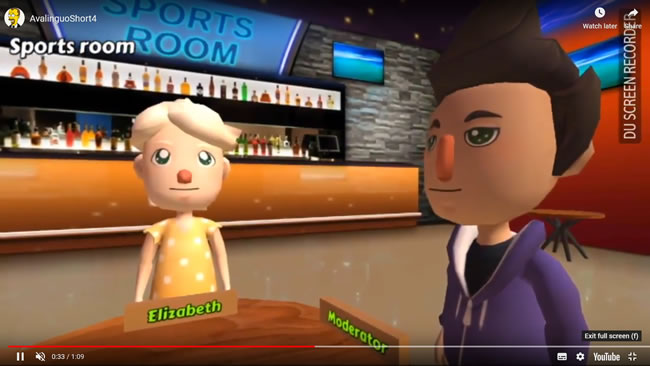
Screenshot of the Avalinguo app

The value of VR in Avalinguo is, first of all, to replace the face and body of the participants by avatars in order to give privacy. You know, talking is the most stressful language learning activity, and research studies have found that many self-conscious or shy people find it difficult to deal with. Some beginners feel judged or stupid when babbling in the language they are starting to learn. Linguists such as Luca Lampariello have proposed to change the attitude and embrace making mistakes, which is a good idea, but we propose to reduce the stress of the situation in the first place, by using avatars instead of showing your babbling face.

Another advantage of VR in Avalinguo (not yet currently released) is that role-playing games, which is one of the best language-learning practice activities, is greatly enhanced by the use of avatars already using a costume like a nurse, travel agent, bell boy, you name it. Other mini-game props such as roulette can be easily implemented, and there are hundreds of ready-to-use graphic resources to plugin.

Now, the distinction between the “simulation” approach and the “interaction” one is not clear cut, because, for instance, the use of costumed-avatars and props is a form of simulation. There is plenty of room for “simulation-interactive” hybrid approaches. The tricky aspect is to build it in such a way that it makes sense from an educational point of view, while at the same time making it entertaining and coherent.

So, in the end, the question is not if VR is ready for language-learning, but rather if language-learning is ready for VR, isn’t it?


Elephants and Molehills

If you like to make a fuss about things, to make a big deal out of things, or to make a song and dance about things, you could be said to be making a mountain out of a molehill.

DSC08542

This phrase first appeared in writing in 1548 in Nicholas Udall’s translation of The firſt tome or volume of the Paraphraſe of Eraſmus vpon the newe teſtamente as “The Lacos could abide no length, the Sophistes of grece coulde through their copiousnes make an Elephaunt of a lye, and a mountayne of a molle hill”. It is based on the Latin proverb “elephantem ex musca facere” (to make an elephant from a fly). It is possible that Udall coined the phrase, or that someone else did so around that time [source].

The word mole (as in the animal) comes from the Middle English mold(e)warp (“earth-thrower”). This became molle, and later mole. In Old English a mole was a wand, which became want, and a molehill was a wantitump.

In Dutch the equivalent of to make a mountain out of molehill is van een mug een olifant maken (“to make an elephant from a fly”).

Are there similar sayings in other languages?

Lollygagging Elephants

Do you lollygag?

As a verb it means to dawdle, be lazy or idle, to avoid necessary work or effort. As a noun lollygag means silliness or nonsense [source].

I have been known to dawdle on occasion, and to loiter, tarry, dilly-dally, shilly-shally and even to procrastinate, but I rarely lollygag.

A nice equivalent of these words in Dutch is lanterfanten (to loiter, loaf/sit around, lollygag), which can be used in sentences like:

  • Er is geen tijd om te lanterfanten, slaapkop = There’s no time to dillydally, sleepyhead
  • Ik betaal ke niet om te lanterfanten = I don’t pay you to lounge about
  • De olifanten lanterfanten zoals gewoonlijk = The elephants are lounging around as usual

A lanterfanter is a slacker or good-for-nothing
and lanterfanteren means to waste one’s time or be lazy.

Lanterfanten comes from lanterfant (slacker, good-for-nothing, vagabond), from landtrouwandt (vagabond), from land (country) and trouwant (vagabond, beggar), from the Old French truant (vagabound, beggar, rogue) [source], which possibly comes from the Gaulish *trugan, or from the Breton truan (wretched) [source].

A related word is treuzelen (to dawdle, dilly-dally, stall).

Elephants Kaudulla National Park

Rare Words

There’s a rare word in Dutch – raar [raːr] – which is cognate with the English word rare, but means weird, strange, funny, odd or unusual.

It comes from the Middle Dutch rare (rare, unusual), from the Latin rārus (scattered, seldom, few, uncommon, thin, loose), from the Proto-Indo-European *h₁r̥h₁rós, from *h₁reh₁- (to separate) [source].

Here are some examples of how it’s used:

  • Ik heb een raar telefoontje gehad = I got a weird phone call
  • Want je doet een beetje raar = Because you’ve been acting a little weird
  • Dit is vast gewoon een raar misverstand = I’m sure it’s just a weird misunderstanding
  • M’n leven is nu nogal raar = My life is kind of, like, a little weird right now
  • Luister, dit gaat raar klinken … = Look, this is going to sound strange …

Source: Reverso Context

The Dutch words for rare include zeldzaam [ˈzɛlt.saːm] (rare, scarce), which is cognate with the Engish words seldom and seldsome (rare, uncommon), and schaars [sxaːrs] (scarce, rare, sparse), which is cognate with the Engish word scarce [source].

The English word rare comes from the same root, via the Middle English rare [ˈraːr(ə)/ˈrɛːr(ə)] (airy, vacuous, porous, breathable, sparsely spread, uncommon, scare, small, little), and the Old French rare/rere (rare, uncommon) [source].

Other descendants of the Latin word rārus include:

  • Albanian: rrallë [raːɫ] = sparse, infrequent, rare, outstanding
  • Catalan: rar [ˈrar] = rare, strange, odd, thin (of a gas)
  • Danish: rar [ʁɑːˀ] = pleasant, kind, nice
  • Dutch: raar [raːr] = weird, strange, funny, odd, unusual
  • French: rare [ʁɑʁ] = rare, sparse, scarce
  • German: rar [ʁaːʁ] = rare, scarce
  • Spanish: raro [ˈraɾo] = strange, odd, rare
  • Swedish: rar = cute, sweet, loveable, rare

So rare, and its relatives, are strangely funny, wiredly unusual, outstandingly odd, loveably cute, nicely sweet, sparsely scarce and oddly rare words, it seems.

Now here’s a rare bird, a little bittern or Ixobrychus minutus:

Little Bittern

Boring Cloaks

The Dutch word saai [saːi] means boring, tedious or dull. It originally meant woven woollen cloth. By the 19th century it was being used to mean annoying, and also came to mean boring, because cloth was thought to be dull and uninteresting apparently [source].

Saai comes from the Middle Dutch saye / saey, from the Old French saie [sɛ] (a short garment worn by ancient Persians, Romans, and Gauls in combat), from the Latin sagum [ˈsa.ɡʊ̃ˑ/ˈsaː.ɡum] (a military cloak), from the Ancient Greek σάγος [ˈsa.ɣos] (cloak, coat, habit), [source] from the Gaulish *sagos [source], from the Proto-Celtic word *sago- (a coarse woollen blanket or mantle) [source] (PDF), from the Proto-Indo-European *sagom (mantle) [source]

The word sagum also exists in English, and refers to a cloak, worn in ancient times by the Gauls, early Germans, and Roman soldiers, made of a rectangular piece of (usually red) coarse cloth and fastened on the right shoulder (see the photo below).

Words that come from the Latin sagum include the Spanish saya [ˈsaʝa] (skirt, petticoat, dress, woman), the Portuguese saia [ˈsajɐ/ˈsaja] (skirt, woman), and the obsolete French word sayon [sɛ.jɔ̃] (cassock, jacket) [source].

Romans

Orbiting Ruts

One of the expressions that came up in the French conversation group yesterday was (être) coincé dans une ornière, which means (to be) stuck in a rut.

Coincé [kwɛ̃.se] means stuck, jammed,wedged, stranded, uptight, stuck up or close-minded. It appears in expressions like:

  • etre coincé = to be stuck (fast), to get stuck
  • etre coincé dans = to be marooned in
  • etre coincé entre = to be wedged between
  • etre coincé avec qn = to be stuck with sb
  • etre coincé avec qch = to be stuck with sth
  • rester coincé = to get stuck
  • La clé est coincée dans la serrure = The key is stuck in the lock
  • La porte est coincée = The door’s jammed
  • Il est un peu coincé = He’s a bit uptight

It comes from coincer (to jam, catch (out), nab, stick), which comes from coin (wedge, cornerpiece, corner, area, part, place, spot), from the Old French coin, from the Latin cuneus (wedge, wedge shape, troops in a wedge formation, an army), from the Proto-Indo-European *h₂ḱū (sting), which is also the root of such words as the English coin and cuneiform, the Irish cúinne (angle, corner, nook), the Welsh cŷn (chisel) and the Albanian kunj (peg, spike).

Ornière [ɔʁ.njɛʁ] is a rut, habit, routine or cart track, and appears in such expressions as;

  • suivre l’ornière = to be in a rut
  • sortir de l’ornière = to get out of a rut / spot
  • dans l’ornière = in a rut
  • dans une ornière = cornered
  • avec ornière = potholed

It comes from the Old French ordiere, from the Vulgar Latin *orbitaria, from the Latin orbita (a track or rut made by a wheel, path, track, circuit, orbit, impression, mark), form orbis (rind, circle, orbit).

ruts

Another way to say you’re stuck in a rut in French is s’encroûter, to get into a rut, to get set in one’s ways, to become encrusted (“to encrust onself”).

Sources: Reverso, Wiktionary

Grassduning

An interesting Dutch word I learnt yesterday was grasduinen [ˈɣrɑsˌdœy̯.nə(n)], which means to do something with relish, to enjoy working (on something), to enjoy searching (through, in), to delve (into something), to dabble or to browse (the internet) [source].

Grasduinen comes from grasduin (grassy dune) from and gras (grass) and duin (dune). So it literally means “to grassdune”, and grassy dunes were historically considered a delightful place, apparently. It is in fact a contraction of the phrase in grasduinen gaan (to go in the grassy dunes).

More about this expression (in Dutch).

Words with similar meanings to grasduinen include:

  • snuffelen = to snuffle, to sniff (around), to poke around, to search for something haphazardly [source]
  • rondsnuffelen = to sniff, snoop, poke around [source]
  • neuzen = to browse, peruse, snoop, peek, peep [source]
  • rondneuzen = to poke, snoop nose around, to look for something special [source]

Are there interesting words for browsing, snooping, sniffing around, etc in other languages?

Duinen bij Hargen

Endearing Bids

An interesting French word I learnt yesterday was enchère [ɑ̃.ʃɛʁ], which means a bid in an auction or sale, or in bridge (the card game) [source].

Enchère comes from enchérir, which means to make more expensive, to bid; to outbid, to make a bid (at auction); to go up (in price), to become more expensive.

Enchérir comes from cher (dear, dearly) plus a couple of affixes [source].

Cher means dear both in the sense of expensive, and in the sense of beloved, and dearly, as in payer cher (to pay dearly). It is also used to start letters.

Related words and expressions include:

  • faire une enchère = to (make a) bid
  • mettre aux enchères = to put up for auction
  • vente aux enchères = auction
  • enchère publique = public auction
  • renchérir sur = to add something to, to become more expensive
  • surenchéir = to outbid, to bid higher, to raise one’s bid, to try and outbid each other
  • enchérisseur, enchérisseuse = bidder
  • enchérissement = rise in cost, price surcharge

Encheres Voxan 100505 188

If you translate enchérir literally into English, you get to endear, which means to attach, attract, bind, captivate, charm, engage, win. Back in the 16th century, however, it meant to make (something) more precious or valuable, and then it came to mean to make (something) more expensive; to increase the cost of, or to stress (something) as important; to exaggerate [source].

The English word bid comes from the Middle English bidden (to ask, beseech, demand, comand), from the Old English biddan (to ask, demand), from the Proto-Germanic *bidjaną (to ask), from the Proto-Indo-European *gʷʰedʰ- (to request, pray, ask for) [source], which is also the root of the Welsh words gwaedd (to shout, cry), gweiddi (prayer) and gweiddïo (to pray).

Auction comes from the Latin auctiō (an increase, auction), from augere (to increase) [source]

What do you do?

What do you do?

Language courses usually have lessons that explain how to talk about your job / profession / work. The examples they give might include jobs like doctor, nurse, teacher, secretary, engineer, architect, writer, ninja, etc. These are all mentioned in lessons I’ve done on Duolingo (and other apps).

If you tell someone you’re a teacher or a doctor, they probably have at least some idea of what that entails. However, there are many jobs and other ways to make a living that are more difficult to define and explain, even in your native language. I’ve never come across a language lesson that includes unusual or difficult-to-define jobs like influencer, game tester, snuggler, bounty hunter or youtuber, for example.

Yesterday I was talking to a friend and he asked how my business is doing. I’ve told him what I do before, and have shown him Omniglot and explained what the site is about, but he thinks that it involves translation in some way. He’s not the only one to think this.

I wouldn’t usually call myself a translator or interpreter, although I did do a bit of translating and interpreting many years ago, mainly between Mandarin and English. These days I sometimes translate mysterious inscriptions and other bits of writing sent to me by Omniglot visitors, and occasionally help friends with translations, mainly between English and Welsh.

Sometimes I say that I’m a linguist. This usually leads to questions about which languages I speak and/or teach. I might try to explain what linguistics is all about and what I mean by linguist, but often I don’t bother. It depends on the situation.

I did teach English for a short while in Taiwan, and occasionally I teach people juggling and other circus skills. Does that make me a teacher? I don’t think so – I have no teaching qualifications, and only limited experience.

Sometimes I say that I’m a writer, and when they hear this, people assume that I write books and ask where they can find them. Maybe one day I will write books, but in the meantime I have written about more than 1,800 languages and writing systems, over 3,500 blog posts, and some silly dialogues and a short story that I’ve made into videos.

I could call myself a musician, singer-songwriter, composer and/or arranger as I have written 80+ songs and tunes. I do this because I enjoy it, and don’t earn anything from it. I share my songs and tunes online and with my friends, and occasionally perform in public.

Sometimes I say that I run my own company, or that I run a language-related business. This is true, but the company consists of just me. I am the director, secretary, marketing and sales department, and everything else.

On Twitter I call myself a Wordherder, Tunesmith and Gravityweaver.

When trying to explain this in other languages, I might just say that I’m a linguist, writer, translator, depending on which of these words I know in the relevant language. If I’m asked for more details, I direct people to Omniglot.

In case you’re not sure what I do, and how I make a living from it, you can read about it here, and/or listen to my podcast about it.

Do you have a difficult-to-define or unusual job or way to make a living?

Slurping Snorkels

I learnt today that an elephant’s trunk in Dutch is a slurf [slʏrf], not to be confused with a smurf. As I like the sound of it, I thought I’d write about it.

Slurf also means proboscis, or jetbridge – the long, flexible tube thing through which you board a plane – also known as a vliegtuigslurf (“aeroplane trunk”). It has another slangy meaning, but I won’t go into that here [source].

It comes from slurven, a variant of slurpen (to slurp) from the Middle Dutch slorpen/slurpen (to slurp), from the Old Dutch *slurpen, from the Proto-Germanic *slarpaną (to sip, slurp), from the Proto-Indo-European *srebʰ-/*srobʰ- (to sip, slurp, gulp). The English word slurp comes from the same root, via the Middle Dutch [source], as does the word absorb, via the Latin absorbeō (swallow up) [source].

Elephants are good swimmers and use their trunks as snorkels, a word that comes from the German Schnorchel, which is related to schnarchen (to snore). It refers both to snorkels used by swimmers to breath under water, and exhaust tubes on diesel submarines. The Dutch word for snorkel is snorkel, and was borrowed from English [source].

The English words snort and snark come from the same root as the German schnarchen: the Proto-Germanic *snarkōną (to snore, snort), from the Proto-Indo-European *(s)nerg- (to sound, murmur, growl) [source].

However, snore comes from the Middle English snoren/fnoren (to snore loudly; snort), from snore/*fnore (snore; snort), from the Old English fnora (snort; sneezing), from the Proto-Germanic *fnuzô, from the Proto-Indo-European *pnew- (to breathe; snort; sneeze) [source]. Sneeze comes from the same root, as do pneumatic, pneumonia and related words [source].

Slurf