Worthless Slabs

Recently I discovered that the slate fences that are common in this part of Wales are known as crawiau in Welsh. I had thought they were something like ffensys llechi or ffensiau llechi, but according to one of the guys who is working on my garden at the moment, a native Welsh speaker, they’re called crawiau.

My garden / Fy ngardd

Such fences were made of pieces of slate from the local slate quarries that were no use for anything else, such as roof tiles. The Welsh word for this kind of slate is craw, which the Geiriadur Priysgol Cymru defines as “piece of slate which has been rejected, worthless slab”. So a slate fence made up of these worthless slabs, which are partially buried in the ground and wired together, is called a crawiau (the plural of craw).

The slate fence on one side of my garden have now been removed and is being replaced with a wooden one, which will stop my neighbour’s dog (Hector – see below) from getting in my garden all the time. My slate fences probably date back to when the houses on my street were built back in 1910 for local quarry workers.
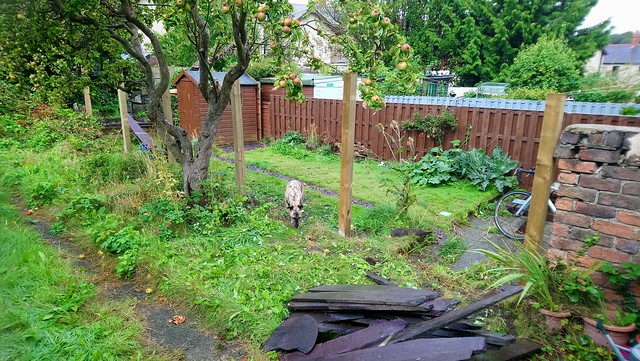
Hector the dog

On the other side of the garden there’s a privet hedge, a slate fence and a wooden fence. I’m having the hedge removed to make more room in the garden, and then a garden studio will be built. I’ll use that for practising and recording music and songs, and maybe making podcasts and videos as well.

Here’s a tune I wrote a few months ago called “Hector Got Through the Fence Again” played on the cavaquinho. It’s one of the videos I’ve posted on Tiktok – yes, I am now on Tiktok as @ieithgi (same as Instagram). Incidentally, iethigi is a “term for one who is interested in the study of language (rather than of literature), philologist” or literally “languages-dog” [source]. Hector apparently responds best to commands in German, so he’s a bit of a ieithgi as well.

Steering Club

The other day I came across the Dutch word stuurknuppel [ˈstyːrˌknʏ.pəl] and had to find out where it comes from. I also rather like the sound of it.

Competition Pro

Stuurknuppel means joystick, stick or controls, particularly in an aeroplane. It comes from sturen [ˈstyːrə(n)] (to steer, guide, send), and knuppel [ˈknʏpəl], which means a club, cudgel or other blunt instrument, and also a clown, lout or awkward individual [source].

Sturen comes from the Middle Dutch sturen (to steer, direct, lead), from the Old Dutch stiuren, from the Proto-Germanic *stiurijaną (to direct, steer). The English word steer comes from the same root, as do related words in other Germanic languages [source].

Some related words include:

  • fietsstuur = handlebars
  • stuurhuis = wheelhouse, pilothouse
  • stuurhut = wheelhouse, cockpit, flight deck
  • stuurstang = handlebar, steering rod
  • stuurwiel = steering wheel
  • gummiknuppel = truncheon, baton
  • honkbalknuppel = baseball bat

Unreliable Wool

If your thinking is woolly, it is unclear, fuzzy, hazy, confused, vague, cloudy and/or confused and irrational, and you base it more on emotions rather than logic. You might be said to be woolly-headed or woolly-minded. For those of you who use American English, just ignore the second l in woolly [source].

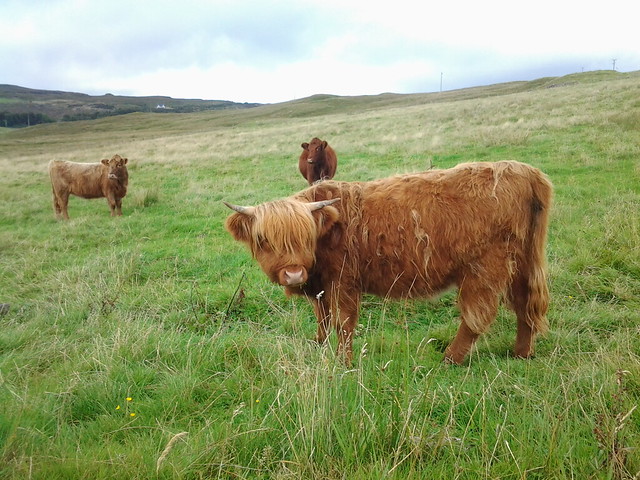
Highland cows / Bò Ghàidhealach / Hielan coo

If you like to do a bit of woolgathering, then you either gather tufts of wool caught on bushes, are absentminded, or like to indulge in idle fancies and daydreams [source].

In Dutch the word wollig [ˈʋɔ.ləx] means woolly, fluffy, fuzzy, and also vague, unclear or muddy (tone) [source].

In Welsh, one word for woolly is gwlanog [ˈɡwlanɔɡ], which also means fleecy, unshorn, downy, woollen, and a well-off or well-to-do person. There are more sheep than people in Wales and owning a lot of them was probably a sign of prosperity in the past.

A related Welsh word gwlanen [ˈɡwlanɛn], which means a flannel or face-cloth, and also a man of weak character, one who lacks backbone, and a spineless or unreliable person, gwlanennog means flannel-like, soft and also weak-willed, without backbone, unreliable or spineless [source].

So a well-off person who is spineless would be a gwlanog gwlanennog.

You can find more woolly words in Celtic languages in today’s Celtiadur post.

Incidentally, the English word flannel comes ultimately from *wlanā, a Gaulish word meaning wool, via Old French and Norman [source].

Are there any interesting wool-related expressions in other languages?

Funny Grips

One of the Dutch words I learnt recently is grappig [ˈɣrɑ.pəx], which means funny or amusing. It comes from grap [ɣrɑp] (a joke or prank), and is related to grijpen [ˈɣrɛi̯pə(n)] (to grap, seize, intervene), which comes from the Middle Dutch gripen (to grab, attack, overwhelm, understand), from the Old Dutch grīpan (to seize, grasp), from the Proto-West Germanic *grīpan (to grab, to grasp), from the Proto-Germanic *grīpaną (to grab, grasp), from the Proto-Indo-European *gʰreyb- (to grab, grasp) [source].

The Hague Street Art in Het Achterom.

The English words grip and gripe come from the same Proto-Germanic root, as do words such as the German greifen (to grab, grasp, grip, seize, snatch, reach), the Danish gribe (to catch, seize, grab, grasp, grip), the Swedish gripa (to catch hold of, seize, detain), and the French griffer (to scratch) and gripper (to grab, grasp) [source].

Some related words and expressions include:

  • grapje = joke, kidding, joking
  • grappigheid = humour, funniness, comicality, liveliness, succulence
  • grappenmaker = joker, prankster, funny man, comic
  • grappen maken = to joke, make jokes, make fun

Do you know any good Dutch jokes?

Do you find jokes in languages you’re learning / have learnt funny? If you do, that is a sign that you really understand a language well.

The Pull of Pandas

An interesting Japanese expression I came across today is 客寄せパンダ (kyakuyose panda), which means a star attraction, draw card or crowd puller, or literally “visitor-gathering-panda” [source]. Originally it referred to pandas, which tend to be popular attractions in zoos and pull in many visitors, and came to refer to other crowd pulling attractions [source].

パンダ

客寄せパンダ is made up of words of Chinese, Japanese and English origin and is an example of 混種語 (konshugo), or a hybrid word that combines elements from several languages.

  • (kyaku) was borrowed from Chinese and means guest, visitor or customer.
  • 寄せ (yose) is a native Japanese word and means gathering, collection, coming together, or the last moves or endgame in chess, go or other games.
  • パンダ (panda) comes from English.

The English word panda was borrowed from French, which possibly comes from nigálya-pónya, a name for the red panda used in Nepal and Sikkim, which may come from the Nepali निँगाले (nĩgāle – a species of bamboo), and the Tibetan name for the same animal: ཕོ་ཉ (pho nya, or literally “messenger”) – quite a hyrid word [source].

panda

Chaise longues

When is a chaise longue not a chaise longue?

CHAISE_LONGUE_Customer_Own_Fabric_Romo

Well, in English the word chaise longue [ˌʃeɪz ˈlɒŋ(ɡ)/ˌʃeɪz ˈlɔŋ] refers to a long kind of seat, like the one pictured above, designed for reclining on. The word chaise longue was borrowed from French and literally means “long chair” [source].

In French the word chaise longue [ʃɛz lɔ̃ɡ] refers to deckchair, sunlounger, lounge chair or chaise longue (in the English sense) [source].

Deckchairs

Other kinds of chaise include:

  • chaise haute / chaise de bébé = highchair
  • chaise pliante = folding chair
  • chaise berçante = rocking chair
  • chaise roulante = wheelchair
  • chaise à porteurs = sedan chair

The word chaise longue appears in quite a few other languages, such as Italian and Portuguese, with the same spelling and the same meaning as in English and French. Another word for this type of chair in Italian is agrippina, named after Agrippina the Elder, the daughter of Marcus Agrippa [source].

Some other ways it’s written include:

  • Belarusian: шэзлонг (šezlonh)
  • Czech: šezlong
  • Georgian: შეზლონგი (šezlongi)
  • Japanese: シェーズ・ロング (shēzu-rongu)
  • Norwegian: sjeselong
  • Polish: szezlong
  • Romanian: șezlong
  • Russian: шезлонг (šezlong)
  • Swedish: schäslong
  • Yiddish: שעזלאָנג‎ (shezlong)

By the way, what is the plural of chaise longue?

The Most Popular Languages to Learn

Today we have a guest post by Taylor Tomita

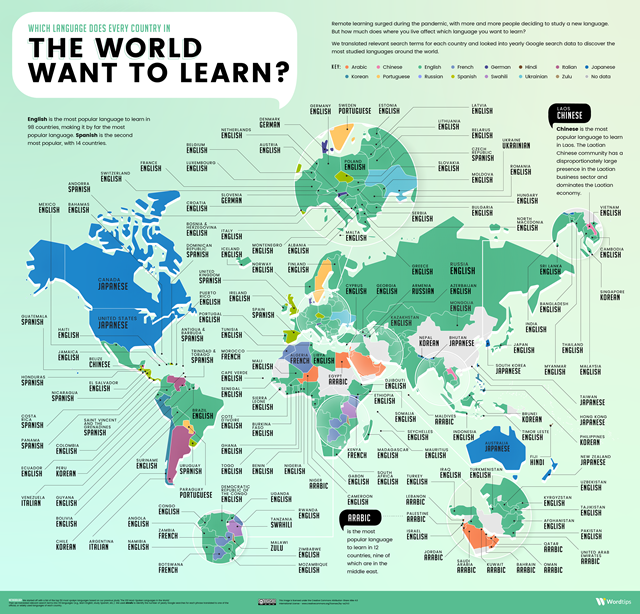
Every year millions of people decide to learn a new language. Some do it as a hobby, while others brush up on their language skills before setting off on a travel adventure. And for many, learning a second tongue is the first step toward a brighter economic future.

So what are the most popular languages to learn? WordTips decided to find out. Its researchers created a map of the languages people are learning in every country across the globe. Here’s a closer look at their findings.

The most popular languages to learn around the world

You can find a large version of this map, and maps for each continent at: https://word.tips/multilingual-world/

North America
English and Spanish are among the most popular choices for second language learners in the USA. This is due to the USA’s large migrant population and its proximity to South America, where Spanish is widely spoken. But Japanese is the top choice for US and Canadian language learners. Japan has long-standing economic and cultural ties with both countries. North Americans account for 2.5% of all foreigners currently living in Japan.

South America
English is the top language to learn for people in six South American countries, including Brazil, Ecuador, and Columbia. People in Peru are more interested in learning Korean. It’s a strange choice, given the geographical distance and cultural disparities. But young Peruvians are crazy for K-Pop! Concert tours sell out within hours, and Korea’s biggest pop stars are welcomed by huge crowds whenever they step foot in the country.

Europe
English is the number one language to learn in over 30 European countries. In fact, it’s the top choice in all but seven European countries. The nations bucking the trend include Denmark and Slovenia, where German comes out on top. Portugal is a popular retirement destination for wealthy Scandinavians, explaining why so many Swedish people are learning to speak Portuguese.

Middle East and Central Asia
Learning English is especially popular among unemployed or poorly paid workers living in Middle Eastern and Central Asian countries. Speaking English proficiently is often a ticket to higher-paid jobs in the tourism industry. It’s also a vital skill for those who want to work in education, finance, or government. A recent survey found that English speakers from Iraq earn up to 200% more than those with no English language skills.

Asia and Oceania
English is the second language of choice for people living in Asian countries that attract a large number of western tourists, including Thailand and Vietnam. Oceania’s English-speaking countries (New Zealand and Australia) are interested in learning the native tongue of their closest neighbor, Japan.

Africa
Millions of Africans are increasing their economic opportunities by learning two of the world’s most important lingua francas, English and French. These languages are important for Africans who want to work in travel, tourism, or the booming tech sectors driving economic growth across the continent. The widespread adoption of European languages is a sign of Africa’s troubled colonial past. Thankfully, many Africans are ensuring their native languages are never forgotten. Zulu is the most popular language to learn in Malawi, while Swahili is the number choice for those living in Tanzania.

Learning a new language is fun and empowering. It also helps create a greater sense of global community. And that only can lead to better things for everyone.

Font Police

What do the words font and police have in common?

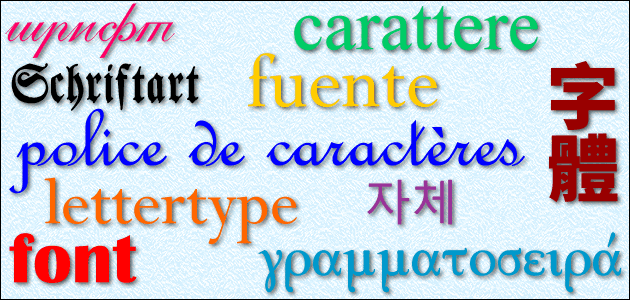
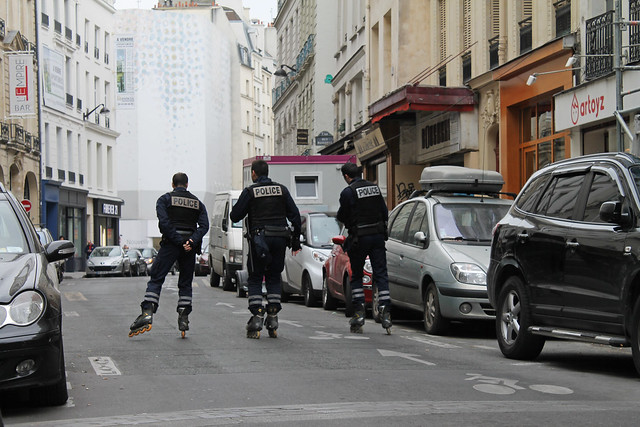
Well, a font or typeface as used in computers and other electronic devices is called a police [pɔ.lis] or police de caractères in French.

Words for font in various languages and fonts

As well as meaning font, police also means policy, branch or department. It comes from the Italian word polizza (policy, bill, voucher), from the Medieval Latin apodissa (receipt for money), from the Byzantine Greek *ἀπόδειξα (*apódeixa), from Ancient Greek ἀπόδειξις (apódeixis – proof, publication, demonstration). The English word policy comes from the same root [source].

The word police, as in the forces of law enforcement, comes from the Middle French police (governance; management), from Latin polītīa (state, government), from Ancient Greek πολιτεία (politeía – citizenship, government, adminstration), from πολῑ́της (polī́tēs – citizen) [source].

la police

Another French word for font, and also melting, smelting, thawing and
cast iron, is fonte [fɔ̃t]. This probably comes from fondre (to melt (down), smelt, dwindle), from the Old French fondre, from the Latin fundere (to melt), from fundō (I melt), from the Proto-Italic *hundō (pour out), from the Proto-Indo-European *ǵʰewd- (to pour) [source].

The word font, as in “a receptacle in a church for holy water, especially one used in baptism”, comes from the Latin fōns/fontis (fountain), possibly from the Proto-Indo-European *dʰenh₂- (to flow) [source]. The name of the River Danube comes from the same root, via the Latin Dānubius, from the Proto-Celtic *Dānowyos, from *Dānu, from the Proto-Indo-European *déh₂nu (river goddess) [source].

Danube in Bratislava

What are your favourite fonts?

Underthrowing

The other day the word onderwerp [ˈɔndərwɛrp] came up in one of my Dutch lessons. It means subject, topic or issue, and to help me remember it, I decided to look into its etymology.

SUBJECT

It comes from onder (under, among) and werpen (to throw, shed, cast), and is a calque of the Latin word subiectum (that which is spoken of, the foundation or subject of a proposition) [source].

Related expressions include onderwerpen (to subject), onderwerping (submission, subjugation, subjection), onderwerpszin (subject clause), gespreksonderwerp (topic of conversation, talk, conversation piece), nieuwsonderwerp (news item)

Subiectum comes from subiciō (throw under or near; supply; forge; subject; propose), from sub- (under) and‎ iaciō (throw, hurl). The English word subject comes from the same root, as do related words in other languages, such as sujet (subject, cause, reason) in French, and soggetto (subject, dependent) in Italian [source].

So an onderwerp and a subject is something that is thrown under.

A related Dutch word is voorwerp [ˈvoːrˌʋɛrp], which means object or item, and comes from voor (for, before, in front of) and werpen (to throw, shed, cast), and is a calque of the Latin word obiectum (a charge, accusation), which is the root of object comes from the same root, as do related words in other languages, from obiciō (throw to; offer, present) [source]

Bonnets

What would you call a knitted woolen hat with a bobble on top?

Lost: red bobble hat

I would call it a bobble hat, and I discovered yesterday that in French such a hat is called un bonnet à pompons or un chapeau à pompons or simply un bonnet. What about in other languages?

Bonnet [bɔ.nɛ] also means hat, cap, beanie, knit cap, skully, stocking cap or (bra) cup. Other types of bonnet include:

  • bonnet d’âne = dunce’s cap
  • bonnet de bain = bathing cap, swimming hat
  • bonnet de nuit = nightcap
  • bonnet de police = forage cap
  • bonnet de douche = shower cap

A bigwig, or “person of consequence”, is un gros bonnet, and the French equivalent of six of one, half a dozen of the other is bonnet blanc, blanc bonnet.

Bonnet comes from the Middle French bonet, from the Old French bonet (material from which hats are made), from the Frankish *bunni (that which is bound), from the Proto-Germanic *bundiją (bundle), from the Proto-Indo-European *bʰendʰ- (to tie).

The English word bonnet comes from the same root, and can refer to various types of headgear, particularly a type of hat usually framing the face and tied with ribbons under the chin and worn mainly by females.

baby bonnets

In Scots a bonnet/bunnet refers to “A head covering for men or boys, including all kinds of caps, but not hats”.

Sources: ReversoDictionary, Wiktionary, Dictionaries of the Scots Language / Dictionars o the Scots Leid