Here’s a recording in a mystery language.
Can you identify the language, and do you know where it’s spoken?
Here’s a recording in a mystery language.
Can you identify the language, and do you know where it’s spoken?

The Swedish word klok [kluːk] means wise, sensible or intelligent. It doesn’t sound quite like the English word clock, but looks like it should. In fact it sounds more like cluck.
Some examples of how it’s used, and of related words:
Owls are also seen as wise in English, and although we don’t say ‘as wise as a book’, reading books can help on the road to wisdom. Poodles are not usually associated with wisdom in English, as far as I know, but it seems they are in Swedish.
In other languages, what is the equivalent of the phrase ‘as wise as an owl’?
Klok comes from the Old Norse klókr (arch, cunning, clever), from Middle Low German klôk.
The Swedish word for clock is klocka [klɔkːa], which comes from the Old Swedish klockæ, from Old Norse klokka (bell, clock), from Late Latin clocca (o’clock), probably from the Proto-Celtic *klokkos (bell), from the Proto-Indo-European *klēg-/*klōg- (onomatopoeia).
Sources: bab.la, Linguee, Ord.se, Svenska Akademiens Ordböcker, DinOrdbok, Wiktionary

In my Czech lessons this week I learnt two words that can mean face – obličej [ˈoblɪt͡ʃɛj] and tvář [tvaːr̝̊], which also means cheek. I couldn’t work out why one was used to mean face in some contexts, and the other in other contexts. Can any of you enlighten me?
Obličej comes from the Proto-Slavic ob + lice (face, cheek), which is also the root of the Czech líc (front, face, right side, face side) and líce (cheeks).
Cognates in other Slavic languages include: Polish oblicze (face, character), Russian обличье (image, character, look), and Ukrainian обли́ччя (face, character) [source].
Tvář comes from the Proto-Slavic *tvarь (creation, creature) [source]. Cognates in other Slavic languages include: Polish twarz (face), Russian тварь (creature, being, animal, beast, monster; mean, vile, worthless), and Croatian tvar (substance, material) [source].
Another Czech word for face is ksicht, from the German Gesicht (face).
Here’s a recording in a mystery language.
Can you identify the language, and do you know where it’s spoken?
One of the Swedish phrases I learnt this week was Det knallar!, which means “it’s okay; it’s business as usual” [source] or literally “it bangs / crashes / pops”. I like the sound of it, so thought I’d write about it.
The verb knalla means to bang, crash or pop [source], and knall means bang, crash, pop [source]
Related words and expressions include:
Is it used in any other interesting expressions?
Some words that came up this week in the French conversation group I go to.
| français | English |
|---|---|
| travailler | to work (on) to practise (a musical instrument, tune, song) |
| travailler son piano | to do one’s piano practice |
| Je devrais m’exercer davantage | I ought to practise more |
| pratiquer | to practise (a language) to play / do (a sport) to apply (a method, theory) to carry out (an intervention, operation) |
| Je dois pratiquer mon espagnol | I need to practise my Spanish |
| s’entraîner | to practise (sport) |
| L’équipe s’entraîne le jeudi | The team practises on Thursdays |
| excercer | to practise (as a doctor, dentist, lawyer) |
Have you ever wonder why the names of the Gauls in the Asterix books all end in -ix?


There were genuine Gauls with names ending in -ix, or rather rix, which means king in Gaulish. They include Vercingetorix (see photo), Dumnorix, Albiorix, Adgennorix and Dagorix [source]. Asterix and friends have joke names with the -ix suffix to make them sound Gaulish.
The word rix comes from the Proto-Celtic *rīxs (king), from Proto-Indo-European *h₃rḗǵs (ruler, king). Words for king in Irish (rí), Scottish Gaelic (rìgh), Manx (ree) and Welsh (rhi) come from this root [source].
The Welsh one is in fact rarely used – the usual Welsh word for king is brenin, which comes from the Proto-Celtic *brigantīnos ((someone) pre-eminent, outstanding), from the Proto-Indo-European *bʰerǵʰ- (to rise, high, lofty, hill, mountain) [source], which is also the root of such English words as barrow, burrow, bury, borough, burgher and fort [source].
Words for realm or kingdom in Germanic languages come from this root, including Reich (empire, realm) in German, rike (realm, kingdom, empire, nation) in Swedish, and rik (realm, kingdom) and kinrick / kin(g)rik (kingdom) in Scots.
We also get the English suffix -ric from this root – as in bishopric (a diocese or region of a church which a bishop governs), and in the obsolete English word for kingdom – kingric, which means “king king” [source].
The words for king in the Romance languages also come from *h₃rḗǵs, via the Latin rēx (king, ruler) [source].
Here’s a recording in a mystery language.
Can you identify the language, and do you know where it’s spoken?
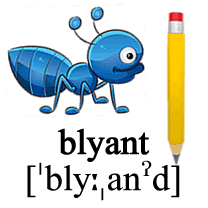
In Danish the word for pencil is blyant [ˈblyːˌanˀd], which sort of sounds like blue ant. When I learnt this, I wondered where this word comes from, and I thought I’d share what I found with you.
The word blyant, which is also used in Norwegian, combines bly (lead) with the French suffix -ant. It is an abbreviation of blyertspen [source], which comes from blyert (black lead, graphite), from the German Bleiertz (lead ore – lit. “lead earth”) and pen [source].
Related words include:
Source: Den Danske Ordbog
The words for pencil in Swedish (blyertspenna), Faroese and Icelandic (blýantur) come from the same roots [source].
The German word for pencil, Bleistift [ˈblaɪ̯ʃtɪft] comes from a similar root: Blei (lead) and Stift (pen) [source].
There is in fact a creature called a blue ant (Diamma bicolor) – it is blue, but is a species of wasp rather than an ant, and lives in parts of Australia [source].

Yesterday I saw a post on Facebook saying that some polyglots “are just jumping from one language to another, only reaching beginner or at most intermediate level” and “They’re learning bits of many languages but mastering none of them.”
The person who wrote this states that he would prefer to focus on one or two languages and become really competent, learn them in depth, and learn about the culture, literature, poetry, and so.
If you learn many languages at a lower level, “[…] your language efforts make you nothing more than a glorified party trick. You can make people smile at a party when you can introduce yourself in 5 languages. But your language skills have no depth or breadth.”
There are as many ways to learn languages as there are language learners. Some prefer to focus on one or two languages and learn them to a high level, others prefer to learn more languages to a lower level. Some combine both approaches – they may learn some languages to a high level, and others to a lower level.
I can focus on one language or other interest, at least for a while, but usually have several projects on the go at the same time. As a result, it takes me quite a while to learn and improve my skills and knowledge, and I accept that I’m unlikely to become fluent in all my languages, or a virtuoso on any of my instruments, or a great singer or composer, or an amazing juggler / circus performer.
Are you a specialist, able to focus on one language, or other project / interest / hobby?
Or are you more of a generalist, flitting between different languages and interests?