| français | English | Cymraeg |
|---|---|---|
| instable | precarious (ladder) | simsan; sigledig; siglog |
| précarie | precarious (situation; existence) | ansicr |
| périlleuse | precarious | simsan; sigledig; siglog |
| le navet | turnip | meipen; erfinan |
| le rutabaga | swede | swedsen; rwden |
| le potiron; la citrouille | pumpkin | pwmpen; pompiwn |
| chirurgien | surgeon | llawfeddyg |
| la (veste à) capuche | hoodie | hwdî |
| bouder; faire la tête | to sulk | sorri; pwdu; mulo |
| la bouderie | sulks | pwd; soriant; sorri |
| elle boude; elle fait la tête | she’s sulking / she’s in the sulks | mae’r pwd arni; mae hi ‘di sorri; mae hi yn y pwd |
Category: Welsh (Cymraeg)
Polyglottery
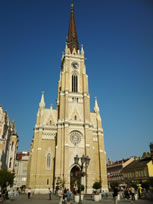
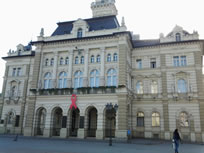
Yesterday morning I met up with other conference participants and after a bit of a wander around the city, we had lunch then went to the opening ceremony a reception. In the after we had a little guided tour of Novi Sad seeing some interesting buildings, including the Catholic or Orthodox Cathedrals, and the fortress. There are some rather attractive buildings here, wide, pedestrianised café-lined streets, some nice parks and generally a relaxed kind of atmosphere.
In the evening we all went to a restaurant about 4 or 5km from the city centre for dinner. I walked there with a few others, and the rest went by bus or taxi. We had a nice dinner with lots of polyglot chat, then some people started dancing, and others carried on chatting.
Today there were lectures and talks on a variety of topics including sound symbolism, the magic of metaphors, language coaching, and acting and humour in a foreign language.
So far I’ve had conversations in about 10 languages and spoken bits and pieces of maybe 10 others. In some cases this was only a few words (all I know), in others it was a bit more. There are even two guys here who are learning Scottish Gaelic, one of whom also speaks a bit of Manx, and another who is learning Irish.
Found poetry
I went to a poetry recital last night featuring Nia Davies, a Welsh/English poet who lives in Wales, and Hu Dong, a Chinese poet who lives in England. It was part of the North Wales International Poetry Festival. Nia’s poems were all in English, and Hu Dong’s were in Sichuanese, with English and Welsh translations.
Nia read a series of interesting poems based on really long words in various languages, or at least on their English definitions. She was inspired to write the first of these after discovering the Turkish word Çekoslavakyalılaştıramadıklarımızdansınız? (Are you one we couldn’t Czechoslavakianize?) while learning Turkish. She then looked for similarly long words in other languages, and wrote poems about some of them.
While listening to the long word-based poems I was trying to think up with a suitably long word to describe such activity. I came up with sesquipedalogology, which combines sesquipedalian ([of a word] polysyllabic; long; characterized by long words; long-winded), and logology (originally the science of word studies, but now the field of recreational linguistics, particularly word games).
Another interesting word that came up was metrophobia, the fear of poetry, which was the theme of one of the poems.
The English translations of long words in other languages can be quite poetic – a kind of found poetry. In fact you can take definitions from any monolingual dictionary and find poetry in them. Here are few from my English dicitonary:
elevenses, pl. n. Brit. informal
a light snack
usually tea or coffee
taken in mid-morning
elflock, n.
a lock of hair
fancifully regarded as having been
tangled by the elves
If you have a monolingual dictionary to hand, why not open it at random and see if you can find any interesting words and definitions.
Can’t do it for toffee
There’s an interesting idiom in British English that means that you are bad at doing something – you can’t do it for toffee. Apparently a US equivalent is can’t do something for beans.
The equivalent of this phrase in French is il n’est pas fichu de faire qch and in Welsh it’s nid yw’n medru gwneud rhywbeth am ffortiwn.
Are the similar idioms in other varieties of English, and in other languages?
Les mots de la semaine
| français | English | Cymraeg |
|---|---|---|
| le caramel | toffee | cyflaith; taffi; toffi |
| il n’est pas fichu de faire qch | he can’t do sth for toffee | nid yw’n medru gwneud rhywbeth am ffortiwn |
| la pomme d’amour | toffee apple | afal taffi |
| bêcheur | toffee-nosed | ffroenuchel; trwynsur |
| la cigogne | stork | storc; ciconia |
| de suite; d’affilié | on the trot; in a row | yn olynol; ar ôl ei gilydd |
| l’ankylostome | hookworm | llynghyren fachog; bachlyngyr |
| le ver | worm; maggot | pryf |
| (en)levé | upbeat (music) | curiad i fyny |
Da mad math
In Welsh and Cornish the usual word for good is da [daː], while in the other Celtic languages words for good are: Breton – mat [maːt˺], Irish – maith [mˠa(ɪ)(h)], Manx – mie [maɪ], and Scottish Gaelic – math [ma]. I’ve wondered for a while whether there were cognates in Welsh and Cornish for these words.
Last week I found that there are: mad in Welsh and mas in Cornish. The Welsh word, which means good, seemly, lucky, appears in the phrase: a wnêl mad, mad a ddyly (one good turn deserves another), but isn’t otherwise used, as far as I can discover. The Cornish word doesn’t appear in the Cornish dictionaries I’ve checked so I think it is probably not used any more.
These words all come from the Proto-Celtic *matis (measure), possibly from the Indo-European mē (measure, consider) [source], which is also the root of the Irish word meas (judgement, opinion, respect) [source], and possibly of the Welsh meddwl (to think), and the English mete (measure).
Maeldy
I came across an interesting word in my Welsh dictionary – maeldy [ˈmaːɨldɨ̬ / ˈmaildɪ] – which is an old word for shop. The normal Welsh word for shop is siop, which sounds like shop. I had wondered if there was a another word for shop other than the one borrowed from English, now I know.
Maeldy comes from mael (gain, profit) and tŷ (house). Other old words for shop are maelfa, which combines mael and ma (place, spot, plain), and masnachdy – masnach = trade, commerce.
Related words include:
– maeler = trader [masnachwr]
– maelera; maeliera; maelio = to trade; to profit [masnachu]
– maeleriaeth = trade; commerce [masnach]
– maelged = tribute; tax [rhodd; treth]
– maeliant = gain [lles; elw]
– maelier = merchant [marsiandïwr]
– maelwr = shop-keeper; trader [siopwr; masnachwr]
These are all archaic and I don’t think they’re used any more. The words currently used in their places are shown in [brackets].
Language matters
| français | English | Cymraeg |
|---|---|---|
| se débrouiller | to manage (get by) | dod trwyddi; ymdaro; dod i ben; ymdopi |
| gérer | to manage (a business) | rheoli; llywio |
| l’émeute (f) | riot | terfysg |
| le service | good turn | cymwynas; tro da |
| un service rendu en appelle un autre | one good turn deserves another | a wnêl mad, mad a ddyly |
| la donation, le don | donation | rhodd; anrheg |
All mouth and no trousers
The idiom all mouth and no trousers came up last night at the French conversation group. We were actually looking for a French equivalent of all fur coat and no knickers and couldn’t find one, but did find an equivalent of all mouth and no trousers, which has a somewhat similar meaning.
According to the Oxford Dictionaries, to be all mouth and no trousers is to “tend to talk boastfully without any intention of acting on one’s words, while all fur coat and no knickers means to “have an impressive or sophisticated appearance which belies the fact that there is nothing to substantiate it” [source].
According to Wiktionary all mouth and no trousers comes from northern England, was originally all mouth and trousers, and refers to someone who is “superficial, engaging in empty, boastful talk, but not of real substance.” Apparently a US equivalent is all hat and no cattle, and there are many other idioms with the same meaning:
- all bark and no bite
- all bluff and bluster
- all crown, no filling
- all foam, no beer
- all hammer, no nail
- all icing, no cake
- all shot, no powder
- all sizzle and no steak
- all talk
- all talk and no action
- all wax and no wick
- all show, no go
An equivalent in Welsh is pen punt a chynffon dima (“pound head and halfpenny tail”). Are there similar idioms in other languages?
Les mots de la semaine
| français | English | Cymraeg |
|---|---|---|
| bouffer | to scoff (food) | llowcio; claddu |
| se moquer de qn/qch | to scoff at sb/sth | gwawdio / cael hwl am ben rhywbeth/rhywun |
| mouchard | grass (informer) | prep(iwr); clepgi |
| cafteur | snitch | llechgi; llechiad; snechgi |
| malchanceux | unlucky (person) | anffodus; anlwcus |
| malheureux | unlucky (defeat, conicidence, choice) | anffodus |
| de malchance | unlucky (day, moment) | anffodus |
| porter malheur | to be unlucky | bod yn anlwcus / anffafriol |
| se distinguer | to excel | rhagori |
| chou frisé | kale | bresych deiliog; cêl |
| les bettes (fpl); les blettes (fpl) |
chard | ysgallddeilen; gorfetysen |
| aliment bourratif | stodge | stwnsh; sgrwtsh |
| bourratif; lourd | stodgy (food) | sgrwtshlyd; stwnshlyd; toeslyd |
| indigeste | stodgy (book) | trymaidd; trwm; diflas |
| barbant | stodgy (person) | diflas |
| tir à l’arc | archery | saethyddiaeth; saethu â bwa |
| la cible | target | saethnod; nod |
| il a que da la guele | he’s all mouth and no trousers | pen punt a chynffon dima |