Purple Fleas

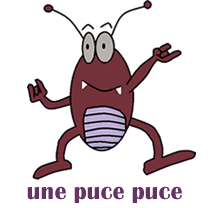
une puce puce (a purple flea)

What do the words purple and flea have in common?

Well in French, there is one word – puce [pys] – that means both purple and flea. It also means (micro)chip or bullet point.

Here are a few expressions featuring puce:

  • marché aux puces = flea market
  • ma puce = my love, sweetie, honey, dear, sweetheart
  • puce électronique = microchip
  • puce d’ordinateur = computer chip
  • carte à puce = smart card
  • puce mémoire = memory card
  • puce d’eau = water flea
  • puce de sable/mer = sand flea
  • liste à puce = bulleted list
  • pucer = to chip, tag
  • aller faire téter les puces = to go to sleep
  • donner la botte aux puces = to go to bed
  • avoir la puce à l’oreille = to be vigiliant
  • mettre la puce à l’oreille = to suspect, worry

If you were so inclined, you could say: Ma puce, une puce puce puce une puce puce avec une puce puce, or “Sweetie, a puce flea is tagging a puce flea with a puce tag”, but that would be rather silly.

Puce comes from the Old French pu(l)ce (flea), from the Latin pūlicem, from pūlex (flea), from the Proto-Indo-Euopean plúsis (flea). This is also the root of the English word flea, via the Proto-Germanic *flauhaz.

The colour puce is a dark redish-brown or a brownish-purple. It was first used to refer to this colour in about the 17th century in French, and possibly a lot earlier, and in the 18th century in English. It refers to the colour of bloodstains on flea-ridden bedding which would appear as a result of the fleas biting people and leaving their droppings or being squashed.

Puce was apparently a favourite colour of Marie Antoinette, and became fashionable in 19th century Paris.

There are a couple of other words that sound simliar to puce: pouce (thumb, inch) and pousse (growth, shoot). Both are pronounced [pus] though, so there should be no confusion.

Sources: Reverso, Wiktionary, Wikipedia

Longitudinal Cohorts

50 years ago this week a longitudinal cohort study known as the 1970 British Cohort Study or BCS70 started. The aim was to follow the lives of as many as possible of the 17,287 people born in England, Wales and Scotland during that week (5-11 April). Similar studies were started before then, and have been started since.

BCS70 has collected information on health, physical, educational and social development, and economic circumstances, and so on. It has become a vital source of evidence on key policy areas such as social mobility, education, training and employment, and economic insecurity [source].

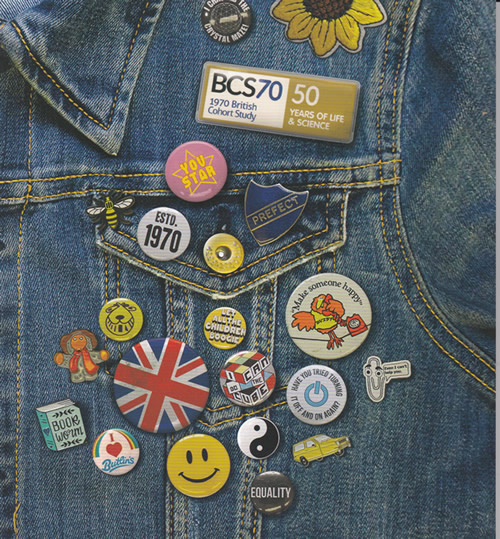
1970 British Cohort Study (BCS70) illustration

More information about BCS70:
https://cls.ucl.ac.uk/cls-studies/1970-british-cohort-study/
https://academic.oup.com/ije/article/35/4/836/686544
https://www.youtube.com/user/CLScohort/videos

See some of the participants in BCS70:

Why am I telling you this?

Well, I am one of those 17,287 people, and today is my 50th birthday.

Previously I knew only one other person who shared a birthday with me, and one with a birthday the day before. Recently the people at BCS70 set up a Facebook group for participants in the survery, and I found there are quite a few people with the same birthday as me.

It’s interesting to get to know them, and to share memories and stories. For example, it snowed on the day I was born, and quite a few other people in the group have said that there was snow on their birthdays as well. Today, by contrast, it started as a warm, sunny day, and is starting to cloud over as I write this.

Another interesting thing I’ve noticed in the group is that people are using their day of birth to refer to themselves. Today, for example, we 9ers are all wishing each other a happy birthday, yesterday it was the 8ers, and tomorrow will be the 10ers.

On this day in 1970 Paul McCartney apparently accounced the official break-up of the Beatles [source]. Other sources say it happened on 10th April. I had nothing to do with it.

The word cohort in this context means “A demographic grouping of people, especially those in a defined age group, or having a common characteristic” [source].

It comes from the Old French cohorte (cohort, a division of the Roman legion), from the Latin cohors (court; farmyard or enclosure; retinue; circle, crowd; tenth part of a legion; ship’s crew; bodyguard; military unit of 500 men), from co- (with) and hortus (garden) [source]

The word longitudinal in this context means “sampling data over time rather than merely once” [source]

It comes from the Latin longitūdō (length, longitude), from longus (far, long) and -tūdō (-ness: suffix for forming nouns) [source]

Sponge Mushrooms

In Swedish, I learned this week, there are two words for mushroom: svamp [svamp] (fungus, mushroom, toadstool, sponge) and champinjon [ɧampɪnˈjuːn] (mushroom) [source].

Svamp comes from the Old Swedish svamper (fungus, mushroom), from Old Norse svampr / svǫppr (sponge, mushroom, ball), from the Proto-Germanic *swammaz / swambaz (sponge, mushroom, fungus, swamp), which is also the root of the English word swamp [source].

The Old English word swamm (mushroom, fungus, sponge), and the Middle English swam (swamp, muddy pool, bog, marsh; fungus, mushroom), come from the same root as well [source].

Mushroom was borrowed from the Anglo-Norman musherum / moscheron (mushroom), from the Old French moisseron (mushroom), possibly from the Old French mosse / moise (moss), from the Frankish *mosa (moss) [source]

Champinjon was borrowed from the French champignon (mushroom, fungus, accelerator), from the Vulgar Latin *campāniolus (grows in the field), from the Late Latin campāneus (pertaining to fields), from Latin campānia (level country), which is also the root of the words campaign and champagne.

Apparently champinjon is used to refer to mushrooms used as food, and was borrowed into Swedish in 1690 [source], while svamp refers to mushrooms and fungi in general.

Svamp

Slimy Islands

For various reasons, I thought I would investigate a few disease-related words to find out where they come from.

Let’s start with virus, which comes from the Latin vīrus (poison, slime, venom), from the Proto-Italic *weisos, from Proto-Indo-European *wisós (fluidity, slime, poison). Virus used to mean venom as well, apparently [source].

Disease comes from the Anglo-Norman desese / disaise, from the Old French desaise (disease, deformity, melancholy), from des- (apart, reversal, removal) and aise (ease – lack of anxiety) [source].

In Middle English words for disease included adle, which comes from the Old English ādl (disease, sickness); and co(a)the, from the Old English coþu (disease). The latter continued to be used in some English dialects as coath (sickness, disease, pestilence) [source]

Pandemic comes from the Ancient Greek πάνδημος (pándēmos – of/belonging to all the people, public) and -ic (of/pertaining to) [source].

Epidemic comes from the French épidémique (epidemic), from the Latin epidemia (epidemic), from Ancient Greek ἐπιδήμιος (epidḗmios), from ἐπί (epí – upon) and δῆμος (dêmos – people) [source].

Isolation comes from the French isolation, from isolé (isolated, placed on an island) [source].

Hope you’re okay and coping with self-isolation, or whatever restrictions are in force / suggested where you are.

Forest Picnics

An interesting Danish word I learnt this week is skovtur, which means a picnic or outing, according to bab.la, or a “picnic (social gathering), not necessarily in a forest”, according to Wiktionary.

Grundlovs skovtur 2012

Wiktionary mentions a forest because this word is a portmanteau of skov (forest, woods), and tur (turn, trip, journey, walk, move, tour, stroll, outing). So it could be poetically translated at “forest trip/outing”. This gives me the idea that picnics in Denmark often take place in forests, or at least did in the past. Is this true? Er det sandt?

The word skov comes from the Old Norse skógr (wood, forest), from the Proto-Germanic *skōgaz (forest, wood), which is also the root of the word scaw / skaw (promontry) in some English dialects. The name of England’s highest mountain, Scafell Pike (formerly Scawfell), includes it, for example.

The word tur comes from the French tour (to go, turn), from the Old French tor (tower), from the Latin turris, turrem (tower), from the Ancient Greek τύρρις (túrrhis – tower), possibly from the Proto-Indo-European *tauro (mountain, hill, tall structure).

The word picnic is also used in Danish. It comes, via English, from the French pique-nique, from piquer (to pick) and nique (small thing) [source].

Do other languages have interesting words for picnics?

Outlaws and Brigands

Here are a few words that might be relevant today, if you happen to be in the UK:

Election – the choice of a leader or representative by popular vote, comes from the Anglo-Norman eleccioun, from the Latin ēlectiō (choice, option), from ēligō (I pluck out, I choose).

Vote – a formalized choice on matters of administration or other democratic activities, comes from the Latin vōtum (prayer, votive offering, wish, longing), from voveō (to vow, promise solemnity, dedicate, wish), from Proto-Indo-European *h₁wegʷʰ- (to promise, vow, praise).

Ballot – originally, a small ball placed in a container to cast a vote; now, a piece of paper or card used for this purpose, or some other means used to signify a vote. It comes from Italian ballotta (ballot, shot, ball, boiled chestnut), a diminutive of balla (bale, bundle).

Poll – a collection of votes, from the Middle English pol(le) (scalp, pate), probably from the Middle Dutch pol / pōle / polle (top, summit; head), from Proto-Germanic *pullaz (round object, head, top), from Proto-Indo-European *bolno-, *bōwl- (orb, round object, bubble), from *bew- (to blow, swell). The meaning of a “collection of votes” was first recorded in 1625, and came from the notion of counting heads.

Labour – comes from the Middle English labouren, from Old French laborer (to work, labour), from Latin laborare (to labor, strive, exert oneself, suffer), from labor (labor, toil, work, exertion).

Liberal – comes from Old French liberal (appropriate for a free person, generous, giving), from the Latin līberālis (befitting a freeman), from līber (free).

Conservative – comes from the Middle French conservatif (conservative), from Latin cōnservō (to preserve, conserve), from con- (with) and servō (to save, rescue, preserve, retain, watch).

Tory – comes from the Middle Irish tóraidhe, (outlaw, robber or brigand), from tóir (pursuit) [More details].

Source: Wiktionary.

Random Flowing Slumps

One of the random Swedish words I learnt recently that I rather like is slumpmässig, which means random, arbitary or haphazard, and isn’t just en slumpmässig radda bokstäver (a random jumble of letters).

Some other examples of how it’s used include:

  • Jag skall nämna några saker i slumpmässig ordningsföljd
    I would like to list a few issues in no particular order
  • Denna utveckling är inte slumpmässig
    This has not happened by chance

Related words include:

  • slump = accident, chance, coincidence, happenstance, hazard
  • slumpa = to randomize
  • slumpartad = casual, coincidental, fortuitous, serendipitous
  • slumpartat möte = chance encounter
  • slumpmässigt = random, haphazardly

Source: bab.la dictionary

The English word slump is possibly related to the Danish and Norwegian word slumpe (to happen on by chance), which comes from the Middle Low German slumpen, and may be onomatopoeic in origin [source].

Incidentally, the English word random comes from the Middle English randoun / raundon (force, magnitude, haste, intensity), from the Old French randon, from randir (to run, gallop), from the Frankish *rant / *rand (run), from the Proto-Germanic *randijō, from *rinnaną (to run), from the Proto-Indo-European *(H)r ̊-nw- (to flow, move, run) [source].

Which is all a bit random, is it not?

Knives and Cutlasses

Canif

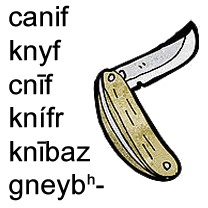
Yesterday I discovered that the French word for penknife is canif [ka.nif], which was borrowed from the Middle English knif / knyf [kniːf] (knife, dagger) [source]. The English word knife comes from the same root.

Knif comes from the Old English cnīf [kniːf] (knife), which was possibly borrowed or influenced by the Old Norse knífr (knife), which comes from the Proto-Germanic *knībaz [ˈkniː.βɑz] (pincers, shears, knife), from the Proto-Indo-European *gneybʰ- (to pinch, nip), from *gen- (to pinch, squeeze, bend, press) [source].

Cnīf was first used in writing in the 11th century. Before then, seax [sæɑ̯ks] was the word for a knife or dagger, which is related to the word Saxon [source].

The French word for knife is couteau [ku.to], which comes from the Old French coutel, from the Latin cultellus (small knife, dagger), a diminutive of culter [ˈkul.ter] (knife, razor) [source], which is also the root of words for knife in Romance languages, the English words cutlass and cutlery, and the Welsh word cyllell [ˈkəɬɛɬ].

Buoys & Oxen

What is the connection between buoys and oxen?

Buoy

Well, the word buoy comes from the Middle Dutch boeye (float, buoy), from the Old French buie (fetter, chain), probably from Frankish *baukan (sign, signal), the root of the English word beacon, or from the Latin boia (a (leather) collar, band, fetter), from the Ancient Greek βόεος (bóeos – of ox-hide), from βοῦς (boûs – ox), from the Proto-Indo-European *gʷow- (cow) [source].

Traditional Ox & cart

How do you pronounce buoy, by the way?

I pronounce it [ˈbɔɪ], as in boy, but I understand that some pronounce it [ˈbuːiː] or [ˈbui], like bwee.

Trolling Carols

One of the songs we started to learn last night at Bangor Community Choir is a version of the Christmas carol Deck the Halls (With Boughs of Holly). It contains the line “Troll the ancient Yule-tide carol”, which got me thinking that maybe the word troll had a different meaning when this carol was written.

The melody of Deck the Halls comes from a 16th century Welsh tune, Nos Galan (New Year’s Eve). The English words were written by Thomas Oliphant, and were first published in 1862 in Welsh Melodies (Volume 2) by John Thomas. The line in question was “Troul the ancient Christmas carol” in the original version.

According to the Merriam-Webster dictionary, troll can mean:

  1. a dwarf or giant in Scandinavian folklore inhabiting caves or hills
  2. to antagonize (others) online by deliberately posting inflammatory, irrelevant, or offensive comments or other disruptive content
  3. to cause to move round and round
  4. to sing the parts of (something, such as a round or catch) in succession; to sing loudly; to celebrate in song
  5. to fish by trailing a lure or baited hook from a moving boat

According to Wiktionary, other meanings of troll include:

  • an ugly person
  • optical ejections from the top of the electrically active core regions of thunderstorms that are red in color that seem to occur after tendrils of vigorous sprites extend downward toward the cloud tops.
  • to saunter
  • to trundle, to roll from side to side
  • to draw someone or something out, to entice, to lure as if with trailing bait.

I think troll in the carol most likely refers to singing, rather any of the other definitions.

The noun troll comes from the Old Norse trǫll (witch, mage, conjurer), from the Proto-Germanic *truzlą (a supernatural being, demon, fiend, giant, monster), which is also the root of the English word droll (oddly humorous, whimsical), and the French drôle (funny, amusing, strange, wierd, bizarre), as well as words for troll in Germanic languages.

Trolling

The verb troll comes from the Middle English troll (to go about, stroll, roll from side to side), from the Old French troller (to quest, to wander), from the Proto-Germanic *truzlōną (to lumber).

Source: Wiktionary

To me a troll is a mythical beast that appears in folklore and stories like The Hobbit, and in Terry Practchett’s Discworld series, or an internet troll.

What do you think of when you hear or read the word troll?